


How Ancient Lava Became Fertile Soil and What It Teaches Gardeners | Dr. Mani's Magic
How Ancient Lava Became Fertile Soil (And What It Teaches Us About Growing Anything)
Picture a black rock field. Nothing moves. Nothing grows. The air smells like sulfur and heat. The ground is hard as pavement and just as dead. A volcano erupted here. It left behind a grey-black wasteland of cooled lava stretching for miles in every direction.
Now fast-forward a thousand years. Stand in that same spot. Close your eyes and breathe in. You smell something different now. Rich. Earthy. Alive. Open your eyes and you see green everywhere. Tall trees. Dense ferns. Flowers. Fruit. Birds calling from the canopy above. The soil beneath your feet is dark and soft and full of life. You reach down and grab a handful. It crumbles in your fingers like chocolate cake. This is some of the most productive farmland on earth. And it all started from that same dead black rock.
How does that happen? How does something so destructive, so completely sterile, turn into something so alive? The answer to that question is one of the most important things you can learn as a gardener. Because the same invisible forces that turned ancient lava into living soil are the exact same forces that decide whether your plants thrive or slowly die. We have grown over 250,000 trees at our South Texas nursery, and this story explains everything we have learned about why some gardens explode with life and others just quietly fail. Stick with us. This is going to change the way you see your soil forever.

Organic Fertilizer | Crab, Kelp & Amino Acids
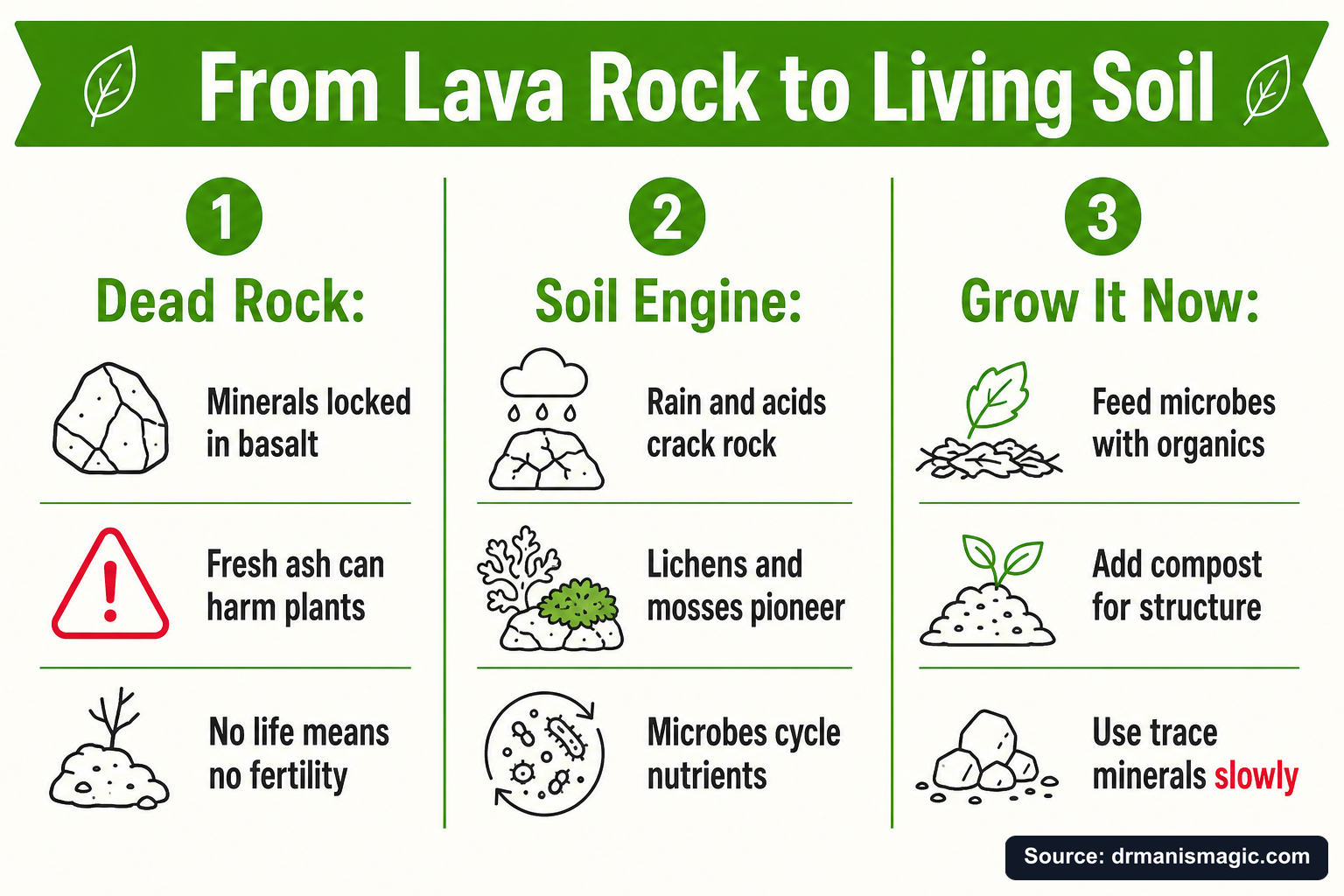
Key Takeaways
- Fresh lava and volcanic ash are not instant fertilizer. They can actually harm plants. It takes thousands of years of weathering, biology, and organic matter to turn rock into rich soil.
- The real secret of volcanic soil fertility is not just minerals. It is microbes plus minerals plus organic matter all working together as one living system.
- Salt-based synthetic fertilizers destroy the same living system that makes volcanic soil so productive.
- Organic fertilizer does not just avoid harming microbes. It actually feeds them first, and they convert it into plant nutrition over time like a natural slow-release system.
- Volcanic ash in fertilizer provides trace minerals like silica that strengthen plant cell walls and build drought resistance.
- The Three Plant Pillars mirror what nature spent thousands of years building in volcanic soil: structure, biology, and slow clean nutrition.
- You can build the same living-soil magic in your containers, raised beds, lawn, and garden today without waiting a thousand years.
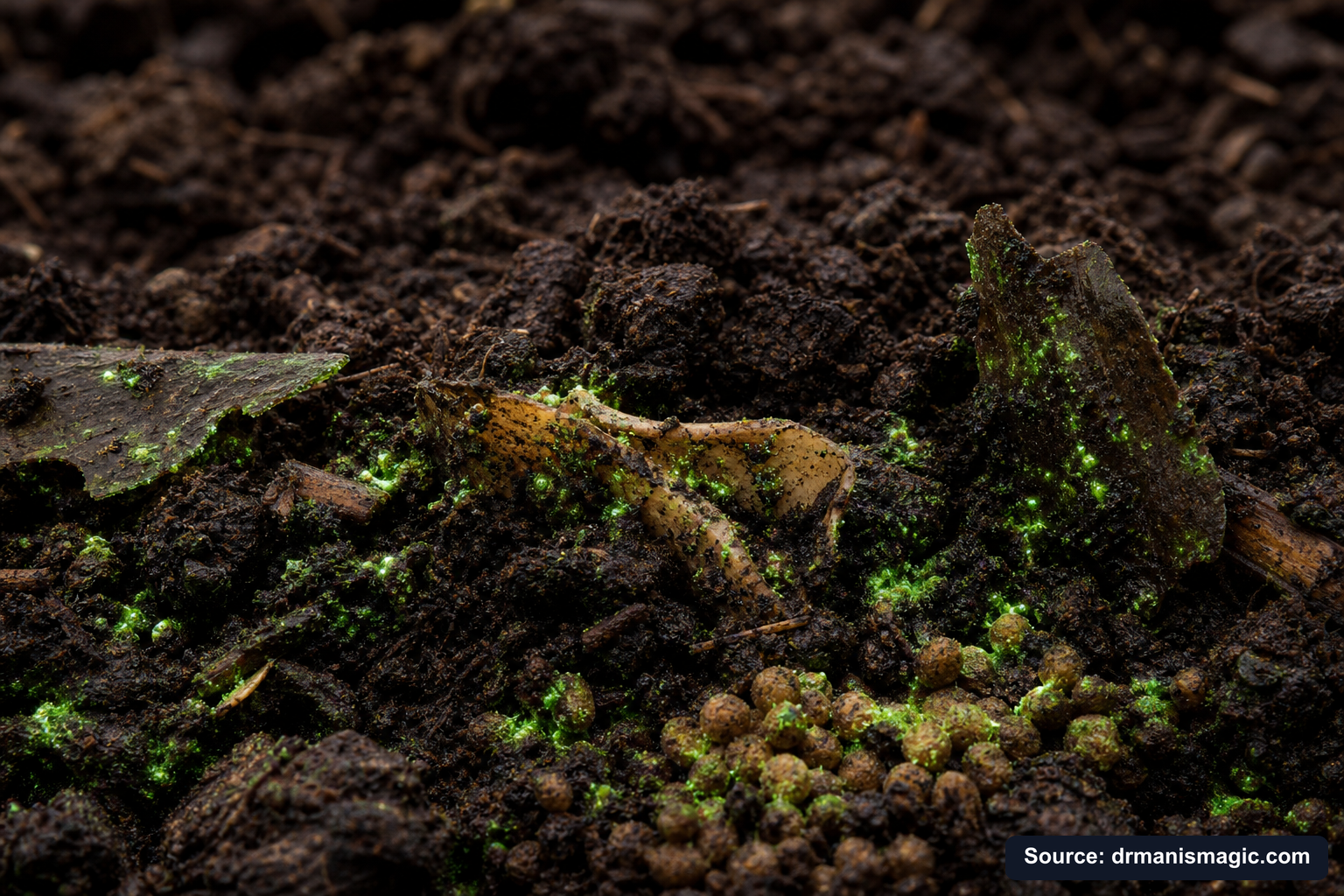
What Actually Happens When Lava Cools and Hardens?
Quick Answer: When lava cools, it becomes solid volcanic rock like basalt. This rock is full of locked-in minerals, but nothing can use them yet. The rock must crack, weather, and eventually host living microbes before those minerals become available to plants. This process takes hundreds to thousands of years.
Lava pours out of the earth at temperatures around 2,000 degrees Fahrenheit. When it hits air or water, it cools fast. The outer surface hardens first while the inside is still moving. This creates cracks and pockets and a rough, glassy texture. That texture matters. It gives the next stage of the process somewhere to start.
The rock that forms is called basalt. Basalt is loaded with minerals. Iron. Magnesium. Calcium. Potassium. Phosphorus. Dozens of trace elements that plants need to grow. But they are locked inside the rock. Locked so tight that no root on earth can reach them. The rock looks rich. But in this form, it is completely useless to any living thing.
Rain hits the rock. Temperatures swing from hot days to cold nights. The rock expands and contracts. Tiny cracks form. Water seeps in. Freezes. Expands. The cracks get bigger. This is called physical weathering, and it is the very first step in the long journey from dead rock to living soil.
Then something even more powerful begins. Water is slightly acidic. Carbon dioxide in the air dissolves into rainwater and makes a weak acid called carbonic acid. This acid slowly dissolves the minerals right out of the rock surface. Iron. Calcium. Silica. They start to release. This is called chemical weathering, and according to researchers at the University of Hawaii, it is one of the primary reasons Hawaiian volcanic soils become so productive over time. The weathering turns the glassy volcanic minerals into a new class of clay-like particles that can hold nutrients and water like a sponge.
But even at this stage, the soil cannot grow much. The minerals are there. But they are still not alive. Something is still missing. And that missing piece is what most gardening advice completely skips over.
Who Are the First Living Things to Colonize Bare Lava?
Quick Answer: The first colonizers of bare lava are not plants. They are lichens, mosses, and bacteria. These tiny pioneers break rock down further, trap windblown dust, and begin the first layer of organic matter. Without these pioneers, nothing else can follow.
A lichen lands on the rock. A lichen is not one organism. It is actually a partnership between a fungus and an algae living together. The algae captures sunlight and makes food. The fungus wraps around the rock and releases acids that dissolve minerals. Together they etch tiny pits into the rock surface and begin pulling nutrients out of solid stone. They are the original miners of the mineral world.
When the lichen dies, it leaves behind a thin layer of organic debris. Almost nothing. But it is a start. Windblown dust settles into the cracks. Tiny bacteria arrive. These bacteria begin the nitrogen cycle. They pull nitrogen gas right out of the air and convert it into forms that can feed plants. This is called nitrogen fixation, and it is the reason a lava field can eventually grow a forest without anyone ever adding fertilizer from a bag.
Mosses come next. They grow in the shallow cracks, hold moisture, and add more organic matter when they die. Each generation of pioneers makes the surface a little more hospitable for the next generation. This is called ecological succession, and it is biology's version of paying it forward.
The key thing to understand here is this. The minerals in the rock were always there. But they could not feed anything until living organisms arrived to unlock them. Minerals alone do not make fertile soil. Minerals plus biology plus organic matter makes fertile soil. This is not a small distinction. This is the whole game.
Why Do Microbes Matter More Than Minerals in Volcanic Soil?
Quick Answer: Microbes are the engine that converts raw minerals and dead organic matter into nutrition plants can actually absorb. Without microbes, even the most mineral-rich volcanic soil cannot feed a plant properly. Microbes cycle nitrogen, dissolve phosphorus, and build the sticky soil structure that holds everything together.
Here is what most people get wrong about volcanic soil. They hear "volcanic minerals" and think that is the secret. Pour some lava dust on your garden and watch it explode. But that is not how it works. Not even close.
The secret is the community of microbes that builds up over time inside that weathered volcanic material. Billions of bacteria. Miles of fungal threads called mycorrhizae weaving through the soil. Each one doing a specific job. Together they form a living network that is more complex than any fertilizer program a chemical company has ever designed.
Here is how it works in plain language. Bacteria eat dead organic matter. As they eat it, they break it down into simpler molecules. Amino acids. Nitrates. Phosphates. Forms that plant roots can actually absorb. When those bacteria die, they release everything they were holding directly into the soil around the roots. The plant picks it up. This is a slow, steady, continuous process. It mirrors exactly the way plants have been fed for hundreds of millions of years.
Fungi do something different but equally important. Certain fungi called mycorrhizal fungi grow directly into plant roots and extend far out into the surrounding soil. They bring back water and minerals from distances the roots could never reach on their own. In exchange, the plant feeds the fungi sugars. It is a partnership. Both sides win.
According to Oregon State University Extension, healthy soil can contain over one billion bacteria in a single teaspoon. That living community is what makes volcanic soil so powerful. Not just the minerals. The living system that processes those minerals and delivers them to plant roots in a usable form.
Now here is where this connects directly to your garden. When you pour a salt-based synthetic fertilizer into your soil, you are doing something that feels helpful but is actually destructive. Salt draws water out of microbial cells by osmosis. It kills them. The same microbes that took thousands of years to build up in volcanic soil can be wiped out by a single heavy application of synthetic fertilizer. You get a short burst of green. Then over months and years, your soil gets quieter and quieter. The life drains out. And your plants get weaker and harder to manage. This is the cycle that big chemical companies profit from and never want you to understand.
Why Is Volcanic Soil Fertile But Sometimes Phosphorus-Limited?
Quick Answer: Volcanic soils form unique minerals called allophane and imogolite that hold onto phosphorus so tightly that plants cannot always access it. This means volcanic soil can look rich but still leave plants phosphorus-deficient. Microbes and organic acids help unlock that bound phosphorus over time.
This is one of the most surprising things about volcanic soil, and almost nobody talks about it. When volcanic ash weathers, it forms a special class of minerals that scientists call short-range-order minerals. Names like allophane and imogolite. These minerals are remarkable. They create incredibly light, porous, sponge-like soil with amazing water-holding capacity. They are a big reason why volcanic soils drain well and hold moisture at the same time.
But these same minerals have a problem. They grab phosphorus and hold it in a grip so tight that plant roots cannot pull it free. The phosphorus is technically there in the soil. But it might as well be locked in a vault. This is called phosphorus fixation, and it is a real challenge in volcanic soils around the world, from Hawaii to Indonesia to Central America.
The solution that nature found to this problem? Microbes. Certain bacteria and fungi produce organic acids that break the grip those minerals have on phosphorus. They solubilize it. Free it up. Make it available. Without living biology in the soil, even a mineral-rich volcanic field can starve plants of one of their most essential nutrients.
This is exactly why the Three Plant Pillars framework we developed at US Citrus Nursery is not just about adding minerals or just about adding fertilizer. It is about building the whole system. Minerals need biology. Biology needs organic matter. Organic matter feeds biology. When all three are present and working together, you recreate what nature built in ancient volcanic soil. And your plants feel the difference.
What Does Fresh Volcanic Ash Actually Do to Plants?
Quick Answer: Fresh volcanic ash can harm plants. It buries leaves, blocks sunlight, alters soil pH, and can increase sodium and sulfur to damaging levels. Fresh ash is not instant fertilizer. It must weather for a very long time before it helps. Aged volcanic minerals in a formulated product are a completely different story.
This is one of the biggest myths in gardening. People hear "volcanic" and think nature's superfood. But fresh volcanic ash falling from an active eruption is not fertilizer. It is a hazard.
Fresh ash is fine and heavy. It coats leaves and blocks photosynthesis. It can smother seedlings. It often contains high levels of sulfur compounds that acidify the soil rapidly. It can carry sodium that builds up like a salt dose. It can lower phosphorus availability even further by adding more of those mineral fixers we just talked about. Farmers near active volcanoes know this firsthand. A fresh eruption can devastate crops for a season or more.
But give that same ash thousands of years of rain and weathering and microbial activity, and something beautiful happens. The harmful compounds wash away. The minerals unlock. The structure becomes porous and rich. The ancient weathered volcanic soil that results is a completely different material from the raw ash that created it.
When you see volcanic ash listed as an ingredient in a quality fertilizer product, you are not getting raw fresh ash. You are getting a processed volcanic mineral source that has been selected specifically for its trace mineral content. Silica. Iron. Calcium. Dozens of micronutrients that build stronger cell walls and increase drought and pest resistance. That is the form of volcanic material that actually helps your plants. Aged, processed, and paired with biology and organic nutrition. Not raw fresh ash scooped up from a recent eruption.
How Does Organic Matter Build Up and Why Does It Change Everything?
Quick Answer: Organic matter builds up layer by layer as plants and microbes die and decompose. It feeds soil biology, improves drainage while holding moisture, and creates the sticky "glue" that binds soil particles into a rich crumbly structure. Without it, even mineral-rich soil stays poor and lifeless.
Every generation of pioneer organisms on that old lava field left something behind when it died. A thin film of carbon. Some nitrogen. A bit of structure. And the next generation built on top of that. And the next. Over hundreds and thousands of years, these layers of dead biology built up into what soil scientists call humus. Rich, dark, spongy organic matter that smells like rain and earth and life.
Humus does several things that nothing else can replicate. It feeds soil microbes with carbon, which is their energy source. It holds water like a sponge while still allowing drainage. It binds to minerals and keeps them from washing away in rain. And it produces a sticky substance that glues soil particles together into crumbs called aggregates. Those crumbs create the pore spaces that roots need to breathe. Yes, roots breathe. They need oxygen. Without those pore spaces, roots suffocate, and root rot follows.
This is the reason we push back hard against sawdust-based potting mixes at Dr. Mani's Magic. Fresh wood bark and pine fines look like organic matter. They are organic matter, technically. But they break down fast. As they decompose inside a pot, they collapse into a dense, airless sludge. The pore spaces disappear. Roots stop getting oxygen. And the decomposition process actually steals nitrogen from the soil to fuel itself, leaving your plant with less nutrition than it started with. That is not a feature. That is a flaw that gets sold to you as premium potting mix every year.
The mineral-based soil in our Super Soil does not decompose. It is built on silica-rich sandy loam from the Rio Grande Valley. It keeps its structure permanently. It does not collapse. It does not steal nitrogen. It keeps those pore spaces open so roots can breathe for years and years. That is what ancient volcanic soil does after thousands of years of development. We built the same permanent structure into a bag you can use today.
You Never Had a Brown Thumb.
You were handed the wrong tools. This free guide hands you the right ones.
You watered it. You fed it. It died anyway.
It was never you. It was the dirt, the salt food, and the bad advice.
This guide shows you what really went wrong, and how to fix it for good.
- Why your plants really died, and why it was never your fault
- The salt hiding in your plant food that quietly burns the roots
- The hidden killer in almost every bag of store soil
- The tiny helpers that grow a whole forest for free
- The rescue trick that brings a half dead plant back to life

Why Do Salt-Based Fertilizers Undo What Nature Spent Thousands of Years Building?
Quick Answer: Salt-based synthetic fertilizers dissolve into the soil and raise the salt concentration around roots and microbes. This causes osmotic stress, which pulls water out of living cells. Roots and microbes dehydrate and die. The living system that makes soil fertile collapses, and the plant becomes dependent on the next dose of synthetic fertilizer to survive.
Imagine you spent a thousand years building a beautiful living city. Millions of residents. Complex systems of trade and communication. Everyone feeding everyone else. The whole thing humming along without any outside input needed.
Then someone dumps a truckload of salt on it. The residents start to die. The trade routes collapse. The city goes quiet. And then the person who dumped the salt says, "You need to buy more of our product to keep your plants alive." That is the synthetic fertilizer business model in one paragraph.
Salt-based fertilizers work by osmosis. When the salt concentration outside a cell is higher than inside the cell, water moves out of the cell to equalize the pressure. Scientists call this osmotic stress. It is the same reason you feel thirsty after eating salty food. For microbes and fine root hairs, osmotic stress is not just uncomfortable. It is lethal. They dehydrate and die. And once your soil biology collapses, the nutrients that were being cycled naturally stop cycling. Your plants go from being fed by a living system to depending entirely on whatever you pour on them next.
The other thing synthetic salt fertilizers do is create a false sense of progress. You apply them. Your plants turn green fast. You feel like it worked. But what actually happened is you gave the plant a quick jolt of immediately available nitrogen and the plant responded. Meanwhile, underground, the salt was doing damage. Root tips burning. Microbes dying. Soil structure degrading. Three months later, your plant looks worse than before. So you apply more. And the cycle continues. This is what Dr. Mani calls the addiction cycle, and it is exactly what the big chemical companies want.
See also: Why Most Fertilizers Are Actually Salt in Disguise
See also: The Hidden Reason Synthetic Fertilizers Cause Root Rot
How Does Organic Fertilizer Actually Feed Plants Through Soil Biology?
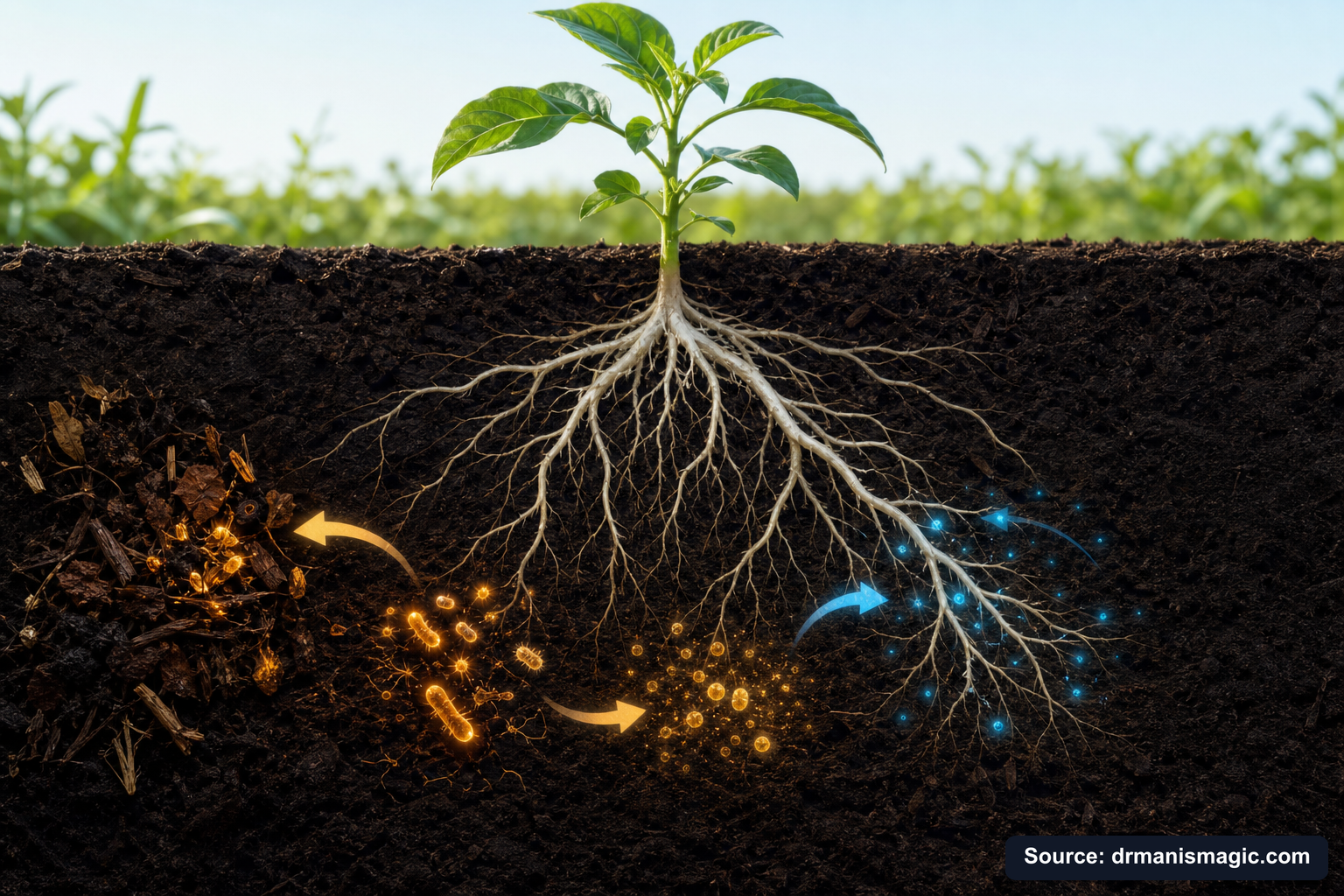
Quick Answer: Organic fertilizer feeds the microbes first. The microbes digest it and convert it into plant-usable forms. When those microbes die, they release that nutrition directly into the root zone. This creates a natural slow-release feeding system that mirrors exactly how plants have been nourished in living soils for millions of years.
Here is the mechanism that most fertilizer companies will never explain to you, because understanding it makes their products look like what they are.
When you apply an organic granular fertilizer made from crab shells, kelp, and amino acids, it does not dissolve into the soil and rush straight to the roots the way a synthetic salt fertilizer does. Something much more interesting happens first.
The microbes in your soil smell it. And they eat it. Bacteria and fungi break down the organic material into simpler molecules. They pull the nitrogen from the amino acids and the chitin in the crab shells. They extract the minerals from the kelp. They incorporate all of this nutrition into their own bodies. The microbes grow and multiply.
Now here is the magic part. When those microbes die, and they do die as part of the natural life cycle of the soil, they release everything they were holding directly into the soil water around the roots. Nitrates. Phosphates. Amino acid fragments. Calcium. Trace minerals. All in small, steady doses. Right where the roots are waiting. The plant absorbs exactly what it needs when it needs it.
This is the natural slow-release system that has been running in living soils since before humans existed. It is not a marketing claim. It is biology. And it is precisely why ancient volcanic soils that have had thousands of years to build up their microbial communities can grow tropical forests without anyone ever adding fertilizer from a bag.
The other beautiful thing about this system is that the plant has some control over how much it takes. Organic nitrogen from amino acids enters the root in molecular forms the plant can regulate. It is not the firehose of soluble nitrogen that salt fertilizers deliver. It is a gentle, controlled drip. No burn. No spike. No crash. Just steady, consistent nutrition that builds long-term health instead of creating short-term dependency.
What Does Chitin From Crab Shells Do for Soil and Roots?
Quick Answer: Chitin is the structural material in crab shells. When it breaks down in soil, it feeds a specific group of bacteria that also happen to destroy the chitin-based cell walls of fungal pathogens and pest eggs. This means crab shell fertilizer feeds your plants and activates a natural disease defense system at the same time.
Crab shells are not in our fertilizer just for the nitrogen and calcium, though both are excellent reasons. The real gift of crab shell is a molecule called chitin. Chitin is the same tough material that makes up the shells of crustaceans and the cell walls of many harmful soil fungi and the eggs of soil-dwelling pest insects.
When you add crab shell chitin to your soil, something clever happens. A group of soil bacteria called chitinase-producing bacteria notice the chitin and start multiplying rapidly. Their job is to break chitin down. They are very good at it. And they are not selective. Once they are abundant and active in your soil, they also start attacking the chitin in harmful fungal cell walls and pest egg casings.
This means you are not just feeding your plants. You are also activating a natural immune response in your soil. The same way volcanic soil that has had thousands of years to develop a rich microbial community resists disease and pests far better than sterile or salt-damaged soil.
This is why crab shell is one of the core ingredients in our Crab, Kelp & Amino Acids fertilizer. It is doing three jobs at once. Feeding the plant with nitrogen and calcium. Feeding the soil biology with chitin. And defending the root zone against pathogens. One ingredient, three benefits. That is efficiency that no synthetic fertilizer can match.
What Does Cold-Processed Kelp Actually Do That Regular Fertilizer Cannot?
Quick Answer: Kelp is not plant food in the traditional sense. It is a biostimulant. It contains natural plant hormones called auxins and cytokinins that tell your plant's cells to divide and grow. It also delivers dozens of trace minerals and complex carbohydrates that feed soil microbes. Kelp works at the cellular level in ways that synthetic nutrients simply cannot replicate.
Here is something most people do not know. Kelp does not primarily work by providing nitrogen, phosphorus, and potassium. Its NPK numbers are low. If you judged kelp by NPK alone, you would throw it out. But that would be a serious mistake.
Kelp works at a completely different level. It contains natural plant hormones. Auxins that tell plant cells to elongate and roots to grow. Cytokinins that signal cell division and push out new growth. These are the same hormones that healthy plants produce internally, but adding them externally from a high-quality kelp source gives your plant an extra signal boost, especially under stress.
Kelp also contains complex carbohydrates called alginic acid and mannitol. These are food for soil microbes. They help microbes multiply and stay active even when other organic matter is scarce. In this way, kelp acts as a microbial fertilizer as much as a plant fertilizer.
Cold-processed kelp is important because heat destroys the hormones and many of the complex carbohydrates. If kelp is processed at high temperatures, you lose the most valuable parts. Cold processing preserves them. This is why the processing method matters, not just the ingredient name on the label.
The trace minerals in kelp are also worth noting. Ocean water contains virtually every mineral on the periodic table in dissolved form. Kelp absorbs and concentrates them. When you apply cold-processed kelp to your soil, you are delivering a broad-spectrum trace mineral supplement that no single mined mineral source can replicate. This is the kind of mineral diversity that ancient volcanic soils develop over thousands of years of weathering. Kelp delivers a version of it in weeks.
Synthetic Fast-Release vs. Slow-Release vs. Organic Fertilizer: What Is the Real Difference?
Quick Answer: Synthetic fast-release fertilizers are salt-based and damage roots and microbes. Coated slow-release synthetics are better but still use plastic shells that leave microplastics in your soil. Organic fertilizers work through biology, feed microbes first, and create a self-sustaining feeding system with no salt damage and no plastic residue.
| Feature | Synthetic Fast-Release | Coated Slow-Release Synthetic | Organic (Crab, Kelp, Amino Acids) |
|---|---|---|---|
| Salt content | Very high | Moderate | Negligible |
| Microbial impact | Kills beneficial microbes via osmotic stress | Reduces microbial activity over time | Feeds and multiplies microbes |
| How it releases nutrients | Immediately soluble, all at once | Temperature-controlled through plastic coating | Microbially mediated, steady and slow |
| Root burn risk | High | Low to moderate | Very low |
| Soil residue | Salt accumulation | Microplastic shell fragments | Organic matter that improves soil |
| PFAS / biosludge risk | Some products contain biosludge fillers | Some products contain biosludge fillers | Zero PFAS, Zero biosludge in clean-formulated products |
| Long-term soil health | Degrades over time | Neutral to slight degradation | Builds over time like volcanic soil development |
| Best for | Instant visual response only | Situations requiring precise control | All plants, all settings, long-term health |
One more thing worth saying clearly. Some fertilizers, both synthetic and some labeled "organic," use biosludge as a filler. Biosludge is treated municipal waste. Human sewage. And it can carry PFAS, the so-called forever chemicals that accumulate in soil, water, and your body and never break down. You deserve to know what is in your fertilizer. Our Crab, Kelp & Amino Acids contains zero PFAS and zero biosludge. Zero synthetic salts. Just clean organic inputs that work with nature instead of against it.
How to Diagnose: Salt Damage vs. Overwatering vs. True Root Rot
Quick Answer: Salt damage looks like crispy brown leaf edges on otherwise green plants. Overwatering looks like wilting despite wet soil. True root rot causes mushy dark roots, foul smell, and collapse even after watering. Knowing which one you have is the first step to saving your plant.
| Symptom | Salt Damage (Osmotic Stress) | Overwatering | True Root Rot (Pythium / Phytophthora) |
|---|---|---|---|
| Leaf appearance | Brown crispy edges, otherwise green | Yellowing, wilting, soft leaves | Yellowing, wilting, eventual collapse |
| Soil feel | May look normal or crusty on surface | Consistently wet or waterlogged | Wet and often foul-smelling |
| Root appearance | Brown root tips, otherwise normal | White but waterlogged, soft | Dark brown to black, mushy, fall apart |
| Smell | None | Faint musty odor | Strong foul, sewage-like odor |
| Primary cause | Salt-based fertilizer or accumulated mineral salts | Too frequent watering, poor drainage | Pythium or Phytophthora pathogens in anaerobic soil |
| Recovery approach | Flush soil with clean water, switch to organic fertilizer | Let soil dry, improve drainage | Remove affected roots, repot in mineral-based soil, add live microbes |
If your plant has true root rot caused by Pythium or Phytophthora, here is a simple recovery checklist to follow:
- Remove the plant from its container and gently shake off the old soil.
- Rinse the roots with clean water and cut away any dark, mushy, or foul-smelling roots with clean scissors.
- Let the roots air dry for 30 to 60 minutes in a shaded spot.
- Repot in a mineral-based, fast-draining soil that will not compact and suffocate roots again.
- Apply live microbials to the root zone to reintroduce beneficial biology that competes against pathogens.
- Hold off on fertilizing for two weeks, then begin a gentle organic fertilizer program.
- Water only when the top inch of soil is dry, not on a fixed schedule.
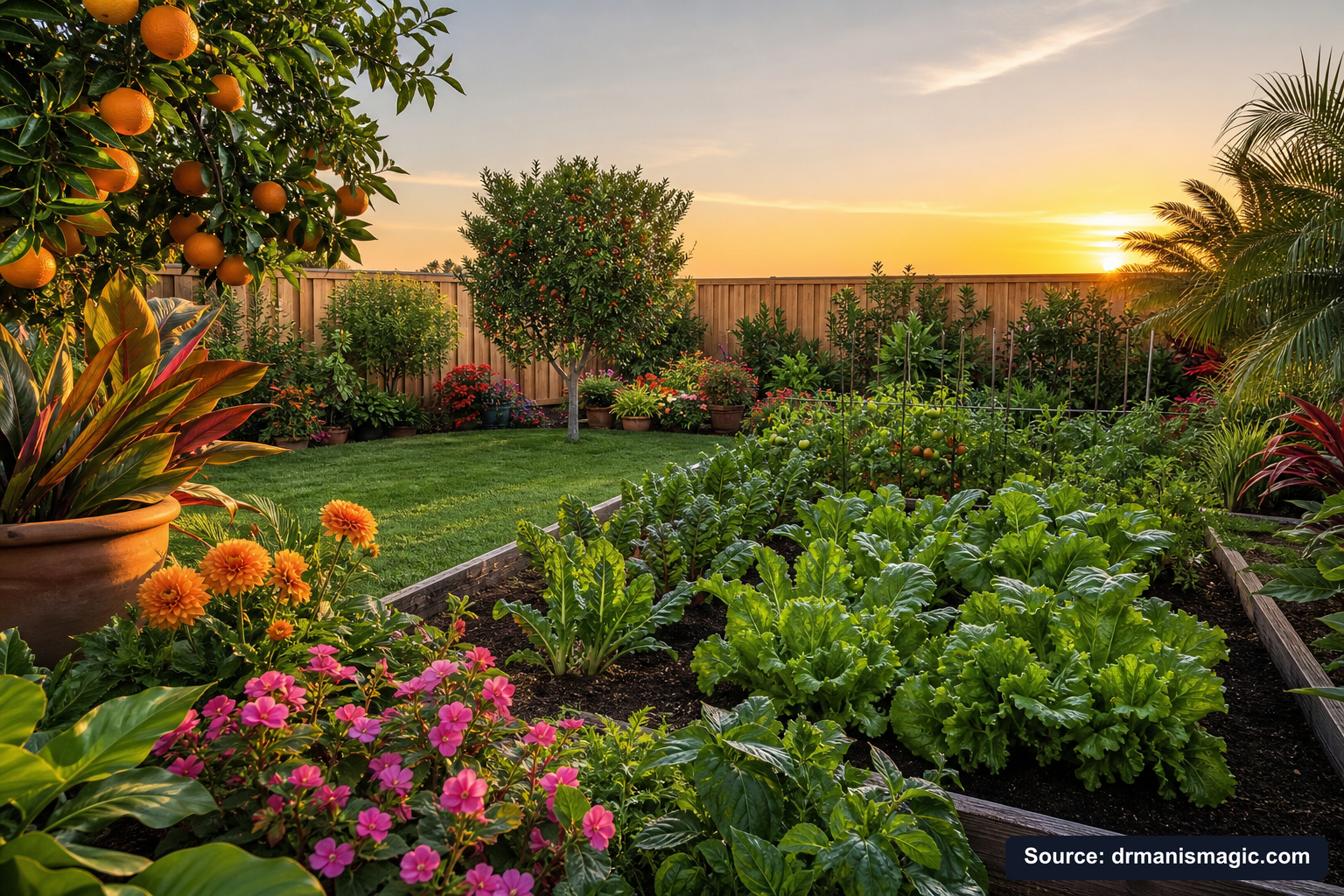
What Are the Lessons From Volcanic Soil for Your Lawn, Garden, and Containers Today?
Quick Answer: The lessons are simple. Build permanent soil structure that does not collapse. Add living microbes that cycle nutrients naturally. Feed with clean organic inputs that work through biology instead of against it. These three steps mirror what nature spent thousands of years doing in volcanic soil, and you can apply them to any plant in any setting starting today.
Here is the thing that gets us excited about the volcanic soil story. You do not have to wait a thousand years. You do not need to live near a volcano. The same principles that turned black rock into paradise soil can be applied right now to your containers, your raised beds, your backyard lawn, and your indoor houseplants.
Nature figured out the formula a long time ago. Start with permanent mineral structure that drains well and holds its shape. Build in living biology that cycles nutrients and fights disease. Layer in slow, clean organic nutrition that feeds the biology and lets the biology feed the plant. Time does the rest.
At US Citrus Nursery, we tested this formula on over 250,000 citrus trees in South Texas. We watched what happened when we used salt-based fertilizers. We watched what happened when we used sawdust-based potting mixes. We watched trees stall. We watched roots rot. We watched years of effort drain away. And then we built the Three Plant Pillars framework to solve every one of those problems at the root cause level.
The Three Plant Pillars are not complicated. Mineral-based soil that stays open and drains and breathes. Live microbials that rebuild the underground ecosystem. Organic fertilizer that feeds the biology first and lets the biology feed your plant. That is it. That is the whole system. That is what volcanic soil took thousands of years to build. We put it in three products you can use today.
We know what it feels like to pour money and hope into a plant and watch it slowly fail. We know the frustration of doing everything right by the old rules and still losing. And we know that time is the one thing you cannot buy back. Every month that passes with a plant in the wrong soil, fed with the wrong inputs, is a month you cannot recover. The best time to start doing this right was years ago. The second best time is today.
If you want to see the Three Plant Pillars in action and learn exactly how to apply them to your specific plants, our Free Plant Care Field Guide walks you through the whole system step by step in plain language. No jargon. No upsell. Just the same principles that turned ancient lava into the most productive soil on earth, applied to the plants growing in your home and backyard right now.
Start there. Your plants will tell you the difference within weeks.
Frequently Asked Questions
You just learned how dead lava rock turns into the richest soil on earth. Now you have questions. Good. These are the exact questions that will help you understand why your garden is either thriving or struggling right now. The answers connect directly to what Dr. Mani discovered after growing over 250,000 trees in South Texas.
Does lava actually create fertile soil?
Yes, but not right away. Fresh lava is completely sterile. It takes hundreds to thousands of years of weathering, microbe activity, and organic matter building up before lava rock becomes rich, productive soil. The minerals are locked inside the rock at first. Microbes are the key that unlocks them. This is exactly why Pillar Two of the Three Plant Pillars focuses on living microbes. Without them, even mineral-rich soil stays locked and useless to your plants.
What is the soil formed from lava called?
Soil formed from weathered lava is often called black soil or Regur soil. It comes from cooled basaltic lava rock that slowly breaks down over time. It is packed with iron, magnesium, potassium, and calcium. The problem is that most gardeners are working with dead, compacted potting mix that has none of these minerals. Dr. Mani's Super Soil uses mineral-rich sandy loam from the Rio Grande Valley to give your plants that same kind of solid mineral foundation without waiting a thousand years.
What is the most fertile soil on earth and why?
Chernozem, also called black soil, is considered the most fertile natural soil on earth. It is loaded with organic matter, phosphorus, and moisture-holding power. Volcanic soils called Andisols run a close second. What makes both of them so powerful is the same thing: minerals plus microbes plus organic matter all working together. That is the exact formula behind the Three Plant Pillars. Dr. Mani spent 35 years figuring out how to recreate that living system in a bag and a bottle.
Can burning lava turn into rich, fertile soil?
It absolutely can, and it does all over the world. Places like Indonesia, Hawaii, and parts of Italy sit on volcanic rock and produce some of the most abundant food crops on the planet. But the lava itself does not do it alone. Microbes move in first. Then organic matter builds up. Then the minerals unlock. That three-part process mirrors the Three Plant Pillars exactly. Mineral structure, living microbes, and organic nutrition working together. That is the whole system in a nutshell.
Why are volcanic soils so productive for growing food?
Volcanic soils are productive because they have deep mineral content, excellent drainage and aeration, and a thriving microbial population. Roots can breathe and push deep. Nutrients are available in forms plants can actually use. This is why Dr. Mani built Super Soil around mineral-based sandy loam instead of the pine bark and sawdust junk most potting mixes use. Sawdust rots and compacts. Minerals do not. Your roots get the same open, aerated, mineral-rich environment that volcanic farmland naturally provides.
Why is it illegal to take lava rocks from Hawaii?
Taking lava rocks from Hawaii is illegal because those rocks are part of a living, protected ecosystem. They host rare native microbes, protect coastlines from erosion, and hold deep cultural significance in Native Hawaiian tradition. Removing them disrupts the very biological system that makes Hawaiian soil so alive. This ties directly to what Dr. Mani teaches. Every rock, every grain of soil, every microbe is part of a connected living system. Damage one part and the whole thing suffers. Protect the biology and everything thrives.
How long does it take for lava to become good growing soil?
In nature, it takes hundreds to thousands of years for lava to become truly fertile soil. You do not have that kind of time. Nobody does. The number one thing people tell Dr. Mani is that they want to see fruit on their own tree while they still can. That is why the Three Plant Pillars exist. You get the mineral foundation from Super Soil, the living microbes from Plant Super Boost, and the slow-release organic nutrition from the Crab, Kelp, and Amino Acids fertilizer. You skip the thousand-year wait and start seeing results within weeks.
About the Author
Ron Skaria, MD
Ron Skaria, MD, is the co-founder of Dr. Mani's Magic and the son of Dr. Mani. He trained as a medical doctor at Baylor College of Medicine, did his residency at UT Health Science Center - San Antonio and fellowship training at Texas Tech University. He now works full time on the family farm at US Citrus and US Citrus Nursery in Hargill, Texas, building Dr. Mani's Magic alongside his dad. He wrote the Brown Thumb Field Guide to put his father's 48 years of plant science into plain words any gardener can use. His belief is simple. You never had a brown thumb. You just never had the right help.


