


How Ancient Farmers Grew Food Without Chemicals | Dr. Mani's Magic
How Ancient Farmers Grew Food Without Chemicals (And the Invisible Secret Beneath Their Feet)
Picture a farmer in ancient Egypt. No tractor. No fertilizer bag. No bottle of synthetic pesticide. Just the dark, rich silt the Nile River left behind every flood season. He presses seeds into that black earth, and months later he is harvesting wheat that feeds an empire.
How did he do it? No chemistry degree. No Miracle-Gro. No trips to the hardware store. Just a handful of practices passed down through generations. Practices that, without him knowing it, were feeding trillions of invisible creatures living in his soil. Creatures so small you could fit ten thousand of them on the period at the end of this sentence. Creatures that were doing all the real work of feeding his crops.
Here is what blows most people away: those ancient farmers were not doing anything mystical. They were managing a living underground ecosystem. They just did not have a microscope to see it. Modern soil science has finally caught up. And once you understand what those farmers accidentally got right, you will never look at a bag of chemical fertilizer the same way again. More importantly, you will know exactly how to bring that same invisible power to your backyard, your containers, your lawn, and your garden today.

Plant Super Boost
Key Takeaways
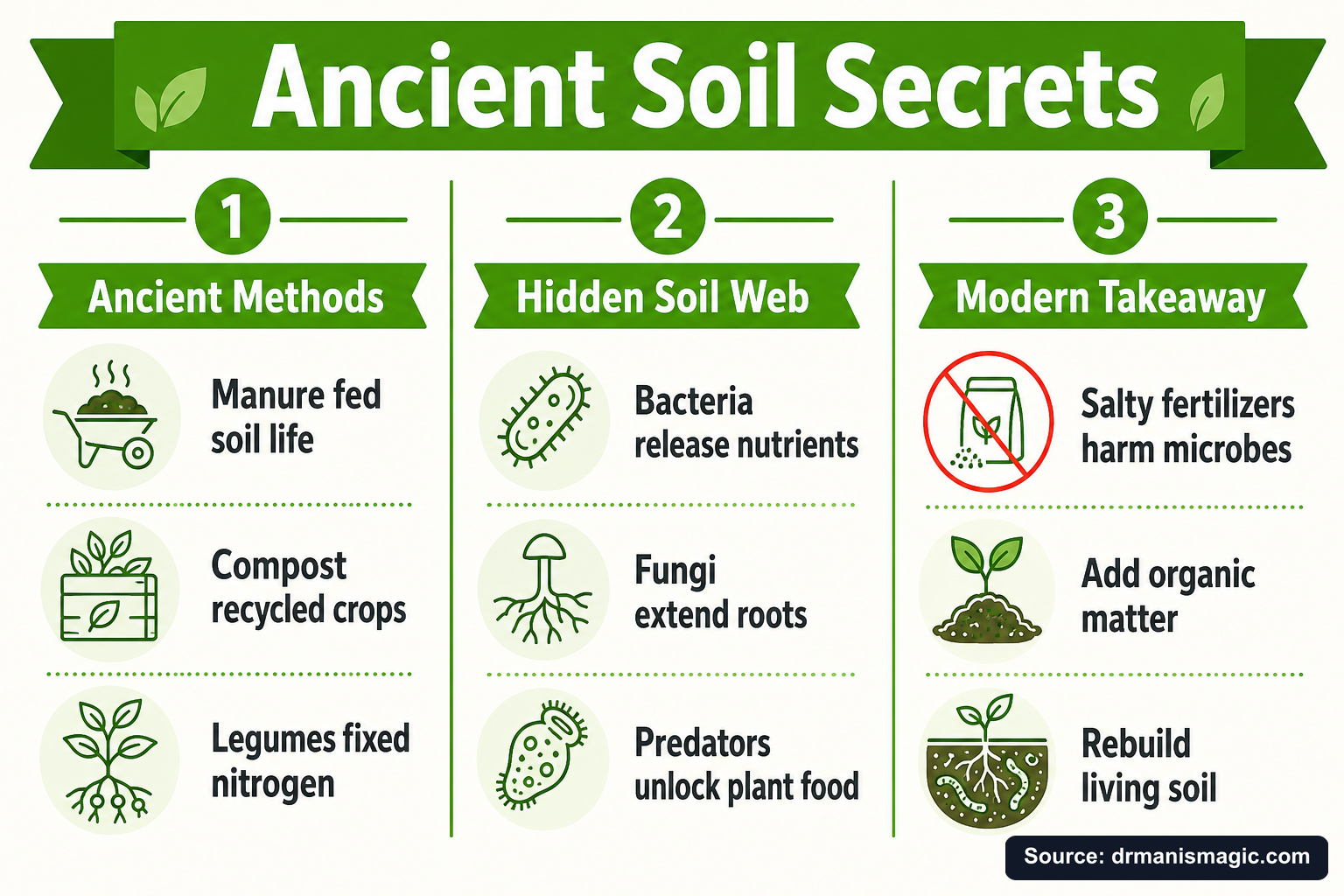
- Ancient farmers fed the soil food web without knowing it existed, using manure, compost, legumes, fallow cycles, and flood silt.
- The real engine behind chemical-free fertility is a living underground ecosystem of bacteria, fungi, protozoa, and nematodes that convert organic matter into plant food.
- Mycorrhizal fungi act as a second root system, extending a plant's reach for water and nutrients far beyond what roots alone can access.
- Salt-based synthetic fertilizers kill beneficial microbes, destroy soil structure, and set up a cycle of dependency that worsens over time.
- Many so-called "probiotic" soil products use dead or dying microbes that cannot survive shipping or storage.
- Rebuilding living soil after chemical damage is possible, but it takes the right biology, the right organic matter, and the right conditions working together.
- The Three Plant Pillars framework from Dr. Mani's Magic recreates what ancient farmers had naturally: mineral structure, live biology, and organic nutrition.
How Did Ancient Farmers Fertilize Crops Without Synthetic Chemicals?
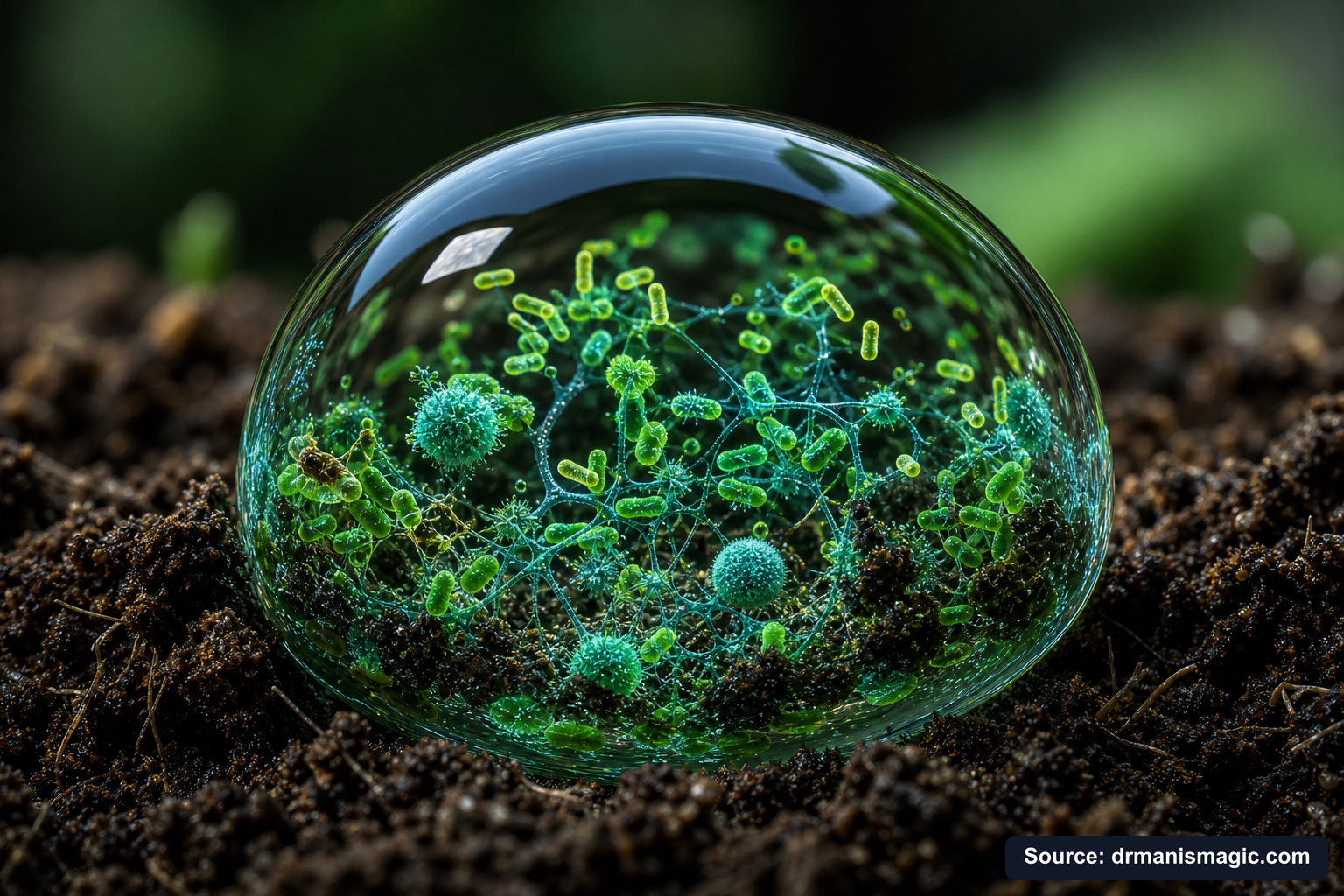
Quick Answer: Ancient farmers fertilized crops by recycling organic matter back into the soil through manure, compost, crop residues, legumes, and flood silt. These practices unknowingly fed billions of soil microbes, which broke down organic matter and released nutrients that plants could absorb. No chemistry was needed because biology handled everything.
They did it by keeping the cycle going.
Think about a forest. Nobody fertilizes a forest. Nobody sprays pesticides. Nobody aerates the soil with a machine. Yet forests grow enormous trees, fight off disease, and produce food for every creature that lives in them. The reason is the soil beneath the forest floor is teeming with life. Every fallen leaf, every dead branch, every animal dropping gets broken down by microbes and recycled back into nutrients that feed the next generation of trees.
Ancient farmers, whether they lived in Egypt, Mesopotamia, China, or the Americas, figured out how to mimic this cycle. They just did not know the science behind it.
Here are the main tools they used:
Manure and Animal Integration
Farmers grazed animals on fields after harvest. Animal dung returned organic matter and nutrients to the soil. More importantly, it fed the bacteria and fungi living in the ground. Those microbes then broke the manure down into forms plants could actually use. The animals were not just food. They were part of the fertility system.
Compost and Crop Residues
Leftover stalks, roots, and plant debris were turned back into the soil. This gave soil microbes food to eat. As microbes ate and multiplied, they released nitrogen, phosphorus, and dozens of other nutrients directly into the root zone. The soil became richer every year, not poorer.
Legumes and Nitrogen Fixation
Farmers in ancient Rome, China, and the Middle East rotated beans and peas into their fields. They did not know why it worked. We do now. Legumes host special bacteria called rhizobia in nodules on their roots. Those bacteria pull nitrogen from the air and convert it into a form plants can eat. Free fertilizer from thin air, powered entirely by living biology.
Fallow Periods
Letting a field rest gave the soil food web time to rebuild. Microbes multiplied. Fungal networks spread. Organic matter decomposed into nutrients. The Bible references the sabbath year for land, letting the earth recover every seven years. It was not just spiritual wisdom. It was sound soil science, thousands of years ahead of its time.
Flood Silt and Sediment Irrigation
The Nile flood was not just water. It deposited a fresh layer of mineral-rich, microbe-loaded sediment every year. Egyptian farmers did not need to add fertility. The river delivered it, complete with the living organisms to make it work. When the Aswan Dam stopped the floods in the 20th century, Egyptian farmers had to switch to chemical fertilizers almost overnight. The ancient system had been working perfectly for five thousand years.
Seaweed, Ash, and Mineral Amendments
Coastal farmers in Europe and the Americas used seaweed as a soil amendment for centuries. Inland farmers used wood ash. Both added trace minerals and fed soil biology. Neither required a chemical plant to produce.
What Is the Soil Food Web and Why Did Ancient Farmers Depend on It?
Quick Answer: The soil food web is the community of living organisms in healthy soil, including bacteria, fungi, protozoa, nematodes, earthworms, and more. Each organism eats another, and that chain of predator and prey releases nutrients directly at the root zone. Ancient farmers unknowingly kept this web alive through organic practices, which is why their soil stayed fertile without synthetic inputs.
The soil food web is the invisible workforce that made every ancient farm function.
According to the USDA Natural Resources Conservation Service Soil Biology Primer, healthy soil is not an inert material. It is a complex, living ecosystem with billions of organisms interacting every second. Understanding that ecosystem is the key to understanding how any plant grows without chemicals.
Here is how the food web works, step by step:
Step 1: Roots Feed the Bacteria and Fungi
Living plant roots constantly release sugars, proteins, and carbohydrates into the surrounding soil. This is called the rhizosphere, the zone around the roots. Plants do this on purpose. They are feeding bacteria and fungi to attract them close. In return, those microbes go to work for the plant.
Step 2: Bacteria and Fungi Break Down Organic Matter
When a leaf falls or an animal drops waste, bacteria and fungi begin decomposing it. They break complex organic compounds into simpler forms. Nitrogen, phosphorus, potassium, calcium, and dozens of trace minerals all get unlocked in this process. This is the engine of all natural fertility.
Step 3: Protozoa and Nematodes Graze the Microbes
Here is the part almost nobody talks about. Tiny single-celled organisms called protozoa eat the bacteria and fungi. Beneficial nematodes do the same. When they eat a microbe, they release the nutrients stored inside it directly into the soil water near the roots. This is called nutrient mineralization. The plant can absorb those nutrients immediately. Protozoa and beneficial nematodes are essentially the delivery drivers of the soil food web. Without them, nutrients stay locked up inside microbial cells.
Step 4: Mycorrhizal Fungi Extend the Root System
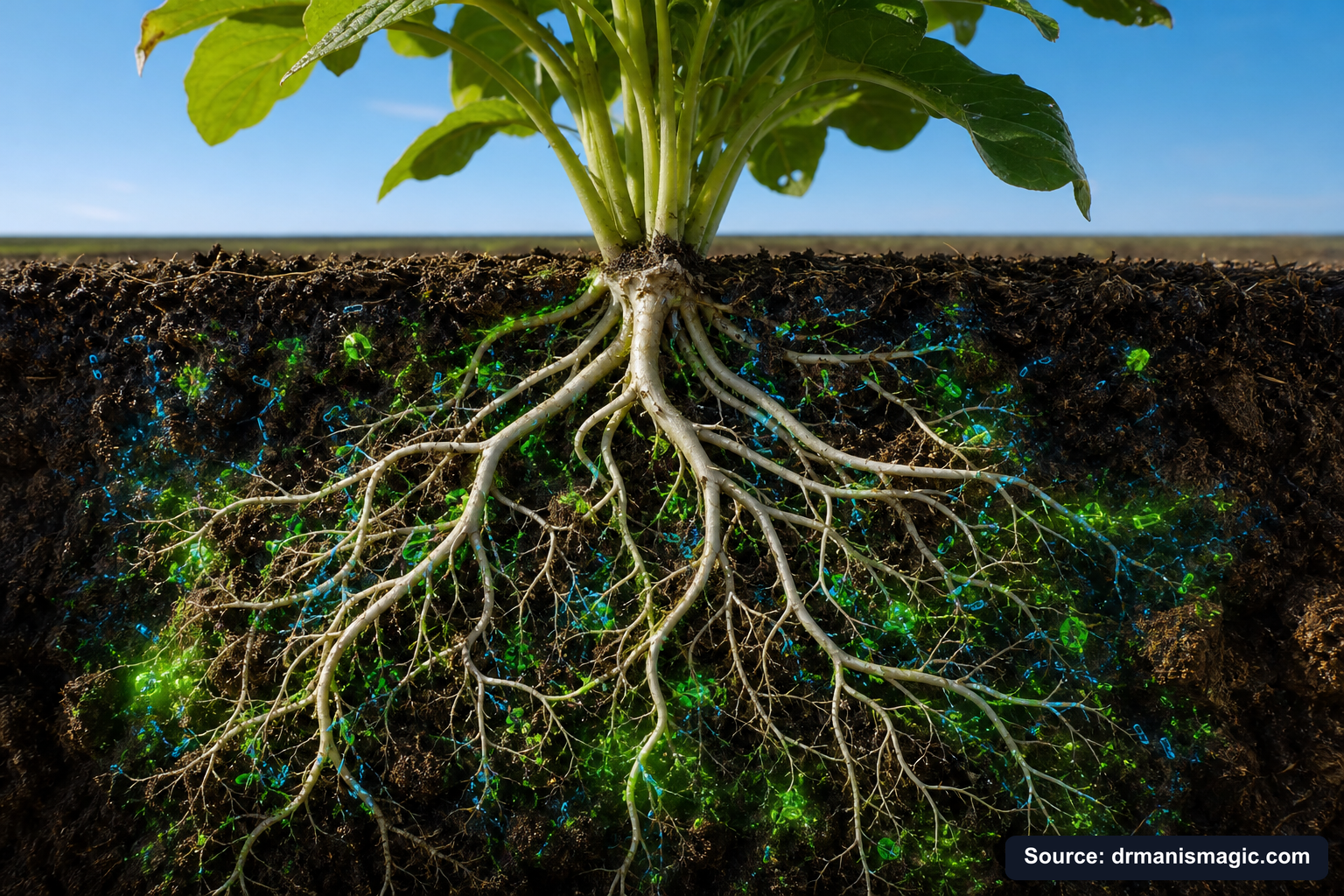
Mycorrhizal fungi are a special class of fungi that form a direct partnership with plant roots. They grow thread-like structures called hyphae that extend far beyond the reach of the roots themselves, sometimes hundreds of times farther. These fungal threads access water and phosphorus in pockets of soil the roots could never reach. In exchange, the plant feeds the fungi sugars. According to University of Minnesota Extension, mycorrhizal fungi can significantly improve a plant's ability to access phosphorus and water, and may help suppress some soil-borne diseases.
Ever pulled a weed out of a crack in the sidewalk and seen fuzzy white threads clinging to the roots? That is mycorrhizae. That is why weeds grow so aggressively with no fertilizer, no watering, and no care. They have a living fungal network doing the work.
Step 5: Earthworms and Larger Organisms Create Structure
Earthworms shred organic matter and mix it deeper into the soil. Their tunnels create channels for air and water. Their castings are some of the most nutrient-dense material in any ecosystem. Ancient farmers who kept organic matter in their fields automatically kept earthworm populations thriving.
| Organism | What It Eats | What It Does for the Plant | Destroyed By |
|---|---|---|---|
| Bacteria | Root sugars, organic matter | Decomposes residues, fixes nitrogen, suppresses pathogens | Synthetic fertilizer salts, herbicides, pesticides |
| Fungi | Root sugars, organic matter | Decomposes tough materials, creates soil structure via glomalin | Fungicides, synthetic fertilizers, bare tillage |
| Mycorrhizal Fungi | Root sugars from the plant | Extends root reach, delivers phosphorus and water, disease resistance | Fungicides, high phosphorus salts, bare soil, brassica crops |
| Protozoa | Bacteria and fungi | Releases nutrients from microbial cells directly at root zone | Pesticides, herbicides, soil sterilization |
| Beneficial Nematodes | Bacteria, fungi, and pest insects | Mineralizes nutrients, suppresses harmful pest nematodes and larvae | Pesticides, fungicides, synthetic inputs |
| Earthworms | Organic matter, microbes | Shreds residues, creates drainage channels, enriches soil with castings | Pesticides, tillage, compaction, chemical inputs |
How Did Ancient Farmers Control Pests Without Pesticides?
Quick Answer: Ancient farmers controlled pests through biodiversity, beneficial predator populations, healthy plants, and soil biology. Healthy plants grown in living soil produce natural defenses. Diverse farming systems kept pest populations from exploding. Beneficial insects, birds, and soil organisms kept harmful populations in check. The key was balance, not elimination.
A healthy plant grown in living soil is not an easy target.
When the soil food web is intact, plants receive balanced nutrition slowly and consistently. They build thick cell walls. They produce natural compounds that deter insects and resist disease. Unhealthy plants grown in depleted soil are soft, overfed with nitrogen salts, and wide open to attack.
Ancient farmers also practiced what we now call biodiversity. They mixed crops. They kept hedgerows and wild edges around their fields. Those wild areas harbored predatory insects, birds, frogs, and spiders that ate the pests. The system regulated itself because nothing was sterilized.
When you remove that diversity and replace it with one crop, sterile soil, and synthetic inputs, you create a pest buffet. Every chemical company selling you pesticides profits more when your soil biology is dead and your plants are weak. That is not a coincidence.
What Did Ancient Farmers Use Before Synthetic Fertilizer? The Real Lesson Modern Gardeners Keep Missing
Quick Answer: Before synthetic fertilizer, ancient farmers used manure, green manures from legumes, compost, crop rotation, fallow periods, flood silt, seaweed, wood ash, and animal integration. Every one of these practices worked by feeding soil microbes, which in turn fed the plants. The nutrients never came directly from the farmer. They came from living biology in the soil.
This is the part that most gardening content gets completely wrong.
They say ancient farmers used compost and manure as fertilizer. That is technically true, but it misses the whole point. Manure does not directly feed plants. Raw compost does not directly feed plants. They feed the microbes. The microbes feed the plants. Remove the microbes from the equation and you can dump all the compost you want on your soil and very little will happen.
This is why synthetic fertilizers seem to work at first. They bypass the microbial step entirely and push nutrients directly into the root zone in soluble salt form. The plant responds fast. But here is what they do not tell you.
Synthetic fertilizers are salt-based. High salt concentrations in soil water kill the beneficial bacteria and fungi that ancient farmers unknowingly depended on. The soil slowly goes sterile. The plant becomes completely dependent on the next application. You are no longer growing a plant in a living ecosystem. You are growing a plant in a chemistry experiment, and you have to keep adding chemicals forever or the whole thing collapses.
See also: Why Most Fertilizers Are Actually Salt in Disguise
At our nursery in South Texas, after growing and testing over 250,000 citrus trees, we watched this cycle happen over and over again with growers who came to us frustrated. Big results for a month or two. Then stalling. Then yellowing leaves. Then disease. Then they bought more products and started the cycle over. Meanwhile, trees grown in living soil with proper biology just kept getting stronger, year after year.
You Never Had a Brown Thumb.
You were handed the wrong tools. This free guide hands you the right ones.
You watered it. You fed it. It died anyway.
It was never you. It was the dirt, the salt food, and the bad advice.
This guide shows you what really went wrong, and how to fix it for good.
- Why your plants really died, and why it was never your fault
- The salt hiding in your plant food that quietly burns the roots
- The hidden killer in almost every bag of store soil
- The tiny helpers that grow a whole forest for free
- The rescue trick that brings a half dead plant back to life

What Happened When Ancient Farmers Got It Wrong? The Mesopotamia Salt Warning
Quick Answer: Ancient Mesopotamia, the birthplace of agriculture, collapsed partly due to soil salinization. Irrigation water left mineral salts behind with each watering cycle. Over centuries, salt levels rose until crops could no longer grow. Cities that once fed empires became desert. It is the oldest recorded example of what happens when water and salt management are ignored.
Ancient farmers were not always successful. Some of the most dramatic agricultural failures in human history came from getting one thing wrong: salt.
Mesopotamia, the land between the Tigris and Euphrates rivers in what is now Iraq, was once called the Fertile Crescent. It supported some of the earliest and largest cities on earth. Farmers there irrigated their crops in a dry climate. Every time water evaporated from the soil surface, it left behind tiny amounts of dissolved minerals and salts. Over hundreds of years, those salts built up. By 2000 BCE, ancient records show farmers switching from wheat to barley because wheat could no longer tolerate the salt levels. A few centuries later, even barley struggled. Cities that had thrived for millennia were abandoned.
This is not just a history lesson. It is a warning that applies directly to every gardener using synthetic fertilizer today.
Salt-based fertilizers leave behind salts with every application. Container soils are especially vulnerable because there is nowhere for those salts to drain. The same cycle that destroyed Mesopotamian agriculture plays out in a pot on your porch over months and years. First the microbes die. Then the roots get stressed. Then the plant stalls. Then it slowly declines. Most gardeners blame themselves and think they have a brown thumb. They do not. The deck was stacked against them before they started.
See also: The Long-Term Damage Caused by Salt Accumulation in Soil
Live Microbes vs. Dead Microbes: Why Most Soil Products on Store Shelves Do Almost Nothing
Quick Answer: Most commercial microbial products contain dead or dormant organisms that cannot survive shipping, shelf storage, or the journey into soil. Dried powder microbes rarely reactivate. Compost-tea products often go anaerobic in the bottle and smell like sewage by the time they reach you. Living, stabilized microbes in liquid form that show measurable activity at the moment of application are what actually move the needle for plant health.
Walk into any garden center and you will find dozens of products with words like "probiotics," "beneficial bacteria," "mycorrhizae," and "soil biology" on the label. Most of them will not do much of anything for your plants. Here is why.
There are three ways microbial products are typically made, and two of them have serious problems.
The Dried Powder Problem
Most commercial microbial products are manufactured in large factories where specific bacterial or fungal species are grown in giant vats, then dried into a powder. The idea is that the spores will reactivate when you add water. We have tested dozens of these products at our nursery. The results were consistently disappointing. Dried spores that have been sitting in a warehouse and on a store shelf simply do not have the vitality to establish themselves in soil, especially soil that already has competing organisms.
The Stinky Bottle Problem
The second approach is compost tea style products, made by extracting microbes from compost or earthworm castings into a liquid. When fresh, these can be genuinely powerful. The problem is they go anaerobic, meaning the microbes run out of oxygen and begin dying, within about 24 hours unless they are actively aerated. By the time a product like this has been packaged, shipped, and sat on a shelf, the microbes are dead or dying. The telltale sign is the smell. If a microbial product smells like sewage or makes a hissing sound when you open it, the biology inside is dead and fermenting. You are paying for a smelly liquid with some residual organic compounds, not a living product.
The Lactobacillus Problem
Some products use lactobacillus, the same bacteria found in yogurt. It is easy to grow and stays alive. But lactobacillus is so aggressive it can crowd out the beneficial microbes your soil actually needs. It belongs in your gut, not your garden.
The solution is a product where the microbes are harvested from natural compost, stabilized using an all-natural process that keeps them alive without oxygen, and delivered to your roots with measurable biological activity. If you put a drop of a truly live microbial product under a microscope, you should be able to see movement. That is the standard we hold our Plant Super Boost to, and we have lab analyses to back it up.
| Product Type | Microbe Viability | Spectrum of Organisms | Odor | Real-World Results |
|---|---|---|---|---|
| Dried / powdered lab microbes | Very low | Narrow (1-5 species) | Minimal | Little to no measurable benefit |
| Dried powder rehydrated in liquid | Very low | Narrow | Minimal | Same as above |
| Compost tea, fresh under 24 hours | Moderate (aerated) | Broad but variable | Earthy | Good when truly fresh; requires effort |
| Compost tea, old over 24 hours | Low (anaerobic) | Partial | Strong sewage smell | Not recommended; biology largely dead |
| Lactobacillus-based products | High | Very narrow | Sour | Can crowd out beneficial microbes |
| Plant Super Boost (stabilized, full-spectrum) | High | 2,000+ bacteria species, 400-500 fungi including mycorrhizae, protozoa, nematodes | Earthy, not offensive | Proven across 250,000+ trees at US Citrus Nursery |
Plant Super Boost contains Zero Synthetic Salts, Zero Biosludge, and Zero PFAS. It smells like healthy earth because it is not rotting. It is alive. And it comes with a 30-day money-back guarantee because we know it works.
Why Do Roots Need Live Microbes? The Ancient Partnership Modern Agriculture Broke
Quick Answer: Plant roots and soil microbes evolved together over hundreds of millions of years in a partnership where plants feed microbes sugars through root exudates, and microbes supply plants with nutrients, disease protection, and water access in return. Modern synthetic inputs interrupt this partnership. Without live microbes, plants are nutritionally dependent on whatever chemicals you add, vulnerable to disease, and unable to access the natural nutrient reserves locked in soil minerals and organic matter.
Plants and soil microbes have been partners for approximately 400 million years.
Long before humans started farming, plants were working with fungi and bacteria to survive in nutrient-poor soils. The relationship is written into the DNA of almost every plant on earth. When you grow a plant in sterile potting mix with no microbial life and feed it only synthetic salts, you are asking it to survive without the biological support system it evolved to depend on. It is like asking someone to run a marathon on one leg. They might hobble forward for a while, but they will never reach their potential, and the first real stress will knock them down.
This is why plants grown in living soil with healthy microbiology are so much more resilient. They do not need you to supply every nutrient. The biology does it. They do not need you to spray fungicides. The beneficial organisms crowd out the pathogens. They do not need you to add water every single day. The mycorrhizal network extends their reach to moisture reserves you did not even know existed.
According to the USDA Natural Resources Conservation Service, soil health is defined by the capacity of soil to function as a living ecosystem. Not as a growth medium. Not as a delivery system for chemicals. As a living ecosystem. That distinction is everything.
Ancient farmers intuitively preserved that ecosystem. Modern chemical agriculture has spent seventy years dismantling it. The good news is you can rebuild it. And it does not take long when you give the biology what it needs.
Can You Rebuild Soil After Chemicals? How to Restore the Ancient Underground Ecosystem
Quick Answer: Yes, you can rebuild living soil biology after chemical damage, but it requires removing the inputs that kill microbes, adding organic matter for them to feed on, reintroducing live biology with a full-spectrum inoculant, and giving the system repeated applications and time. Container soils and heavily chemically treated garden beds take longer to recover, but most soils show measurable improvement within 30 to 90 days of proper care.
The most common question we hear at our nursery in South Texas is some version of this: "I have been doing everything right, spending good money on products, and my plants still struggle. What am I missing?"
The answer is almost always the same. The biology is gone. Years of synthetic inputs, fungicides, herbicides, or simply sterile potting mix with no living organisms have left the soil dead. And dead soil cannot do what soil is supposed to do.
Here is the practical recovery checklist we walk people through. It is built on the same principles ancient farmers used, translated into modern steps you can take this week.
- Stop the inputs that kill microbes. That means stepping back from synthetic salt-based fertilizers, broad-spectrum fungicides, and systemic pesticides. These are the first things that need to go. You cannot rebuild biology while continuing to destroy it.
- Test your soil or growing medium for salt buildup. In containers, flush the pot thoroughly with clean water to leach out accumulated salts. In garden beds, a basic EC test will show you whether salt levels are dangerously high for microbial life.
- Add real organic matter. Compost, worm castings, and organic mulch give soil microbes the food source they need to multiply. A two to three inch layer of quality compost worked into the top few inches of soil is a strong start. In containers, mixing organic matter into the growing medium helps establish a microbial habitat.
- Inoculate with full-spectrum live microbes. This is the step most gardeners skip or get wrong. Adding a live microbial product with a broad spectrum of bacteria, fungi, protozoa, and beneficial nematodes jump-starts the food web. Apply monthly, especially in the first several months of recovery. The biology needs to establish itself against competing pathogens.
- Feed the microbes and the plant with organic fertilizer. Organic slow-release fertilizers made from natural sources like crab, kelp, and amino acids feed both the plant and the soil organisms without the salt damage that synthetic inputs cause. They work with the biology instead of against it.
- Keep living roots in the ground. Living roots constantly feed soil microbes through exudates. Bare soil between plants or after harvest starves the food web. Cover crops, mulch, and keeping plants in the ground year-round help maintain the biological activity that ancient farmers relied on naturally.
- Be patient and consistent. A soil that has been chemically managed for years will not recover in a week. But most soils show real signs of improvement within 30 to 90 days. Leaves get greener. Roots look healthier. New growth accelerates. The process compounds over time, just like it did on ancient farms that got better every year instead of worse.
The Three Plant Pillars framework from Dr. Mani's Magic is built exactly around these steps. Mineral-based soil that drains properly and does not decompose into root-choking sludge. Live microbials that stay alive through shipping and deliver a full spectrum of organisms to your root zone. Organic fertilizer that feeds both the plant and the biology without salt damage. When all three work together, the results compound fast.
See also: The Hidden Reason Synthetic Fertilizers Cause Root Rot
What Can You Do Right Now? Bringing Ancient Wisdom Into Your Garden Today
Here is the beautiful, hopeful truth in all of this.
Those ancient Egyptian farmers did not have a biology degree. They did not have a microscope. They did not know what a mycorrhizal fungus was. They just worked with the natural systems that were already there. They kept organic matter cycling. They kept living roots in the ground. They let animals graze and drop manure. They rested their land. And the invisible world beneath their feet rewarded them with fertility that lasted thousands of years.
You have something those ancient farmers did not have. You have the science. You know why it works. You know what bacteria and fungi and protozoa and mycorrhizae actually do underground. You know why salt-based fertilizers break the system. You know what to look for in a microbial product and why most of them fail. That knowledge puts you miles ahead.
And you have something else ancient farmers did not have. You do not have to build your own compost pile, brew your own compost tea, source your own manure, or hope that the Nile floods on schedule this year.
After thirty years of growing and testing plants at our South Texas nursery, after watching over 250,000 citrus trees, hundreds of houseplants, tropical trees, and garden beds respond to living soil biology, Dr. Mani and his team built a system that puts all three pillars into practice simply and effectively. Mineral soil that gives roots room to breathe. Live microbes that are genuinely alive when they reach your plants. Organic nutrition that feeds the biology instead of burning it.
One of the most common things people tell us is that they want to see fruit on a tree they planted with their own hands. Not in twenty years. Not someday. In their lifetime, soon enough to enjoy it, to share it, to feel the deep satisfaction of having grown something real. That desire is not small. It connects to something ancient in all of us. We were made to tend living things. We were designed to cultivate. The frustration of watching plants struggle and die, of spending time and money and getting nothing back, is a real loss. Not just of money. Of time. And time is the one thing none of us can buy back.
The ancient farmers did not have better luck than you. They just had the right system. And now, so can you.
If you are ready to stop guessing and start growing the way nature intended, explore the Free Plant Care Field Guide from Dr. Mani's Magic, built on the same Three Plant Pillars that ancient farmers used without knowing it, now backed by decades of modern soil science and tested across a quarter million trees in South Texas.
Frequently Asked Questions
People are waking up to the truth about chemicals in their gardens and on their food. These are the questions we hear most often from gardeners who are ready to stop guessing and start growing the right way. The answers below are grounded in over 30 years of real-world testing on more than 250,000 trees at US Citrus Nursery in South Texas.
Is it really possible to grow healthy food without pesticides or synthetic chemicals?
Yes, and ancient farmers proved it for thousands of years. The real secret is healthy soil packed with living microbes. When your soil is alive with bacteria, fungi, and mycorrhizae, your plants build strong natural defenses on their own. At Dr. Mani's Magic, we call this the Second Plant Pillar. Healthy plants grown in living soil simply do not invite pests and disease the way stressed, chemically dependent plants do.
How did ancient farmers keep bugs out of their gardens without sprays?
They built soil so rich and alive that their plants grew strong enough to resist most pests naturally. They also used companion planting, crop rotation, and natural barriers. The core idea is the same one Dr. Mani proved on over 250,000 citrus trees: a plant rooted in mineral-rich soil, fed by live microbes, and nourished with organic fertilizer is a tough plant. Tough plants do not roll out the welcome mat for bugs.
What do organic farmers use instead of pesticides?
Smart organic growers focus on prevention first. They build living soil, rotate crops, and attract beneficial insects. When they do need to spray, they use natural options like neem oil or beneficial bacteria. Dr. Mani's approach goes even deeper. His Three Plant Pillars, which are mineral-based soil, live microbials, and organic fertilizer, build plant immunity from the roots up so you rarely need to spray anything at all.
What foods carry the most pesticide residue?
Thin-skinned fruits and leafy greens tend to hold the most residue. Strawberries, spinach, apples, grapes, peaches, and cherries are common examples. That is exactly why growing your own food matters so much. When you use Dr. Mani's Magic products, you know every input that touched your soil. No hidden chemicals. No mystery residues. Just clean, organic nutrition your whole family can eat with confidence.
What happens to soil when farmers stop using synthetic fertilizers?
At first, yields may dip while the soil recovers. That is because synthetic, salt-based fertilizers have been wiping out beneficial microbes for decades. Once you stop the chemical inputs and reintroduce live biology, the soil begins to heal. Dr. Mani saw this firsthand in his own nursery. When he added Plant Super Boost, his living microbial formula, the trees responded fast. The soil came back to life and the plants followed.
How can a home gardener stop using pesticides and still protect plants?
Start with the foundation. Most pest problems are a symptom of weak, depleted soil, not bad luck. When you fix the soil with the Three Plant Pillars, which are mineral structure, live microbes, and organic fertilizer, your plants stop being easy targets. Dr. Mani's Magic Super Soil, Plant Super Boost, and Crab Kelp and Amino Acids fertilizer work together to create exactly that kind of strong foundation for any plant in any garden.
Why do so many gardeners fail even when they try to go chemical-free?
Because they pull the chemicals out but never put the biology back in. Going organic without living microbes is like removing a crutch without healing the leg. The soil stays dead. Plants stay weak. That is the gap Dr. Mani spent 35 years solving. His Plant Super Boost delivers live, stabilized bacteria, fungi, and mycorrhizae that actually survive shipping and go to work the moment you water them in. That is what makes the difference.
About the Author
Dr. Mani Skaria, PhD
Dr. Mani Skaria, PhD, is a plant pathologist and the scientific founder of Dr. Mani's Magic. He earned his doctorate at Purdue University and spent 48 years studying how plants, soil, and living microbes work together, including his years as Professor Emeritus at Texas A&M and as a member of the USDA NAREEE Advisory Board. He invented micro-budding, a method for growing healthier, stronger trees, and has grown more than 250,000 trees on the family farm in Hargill, Texas - US Citrus Nursery. His life's work takes real lab science and practical experience and turns it into simple, safe, organic plant care anyone can use at home.


