


How Amino Acids Support Plant Stress Tolerance | Dr. Mani's Magic
How Amino Acids Help Plants Handle Stress: What's Really Happening Inside Your Roots
Picture this. It's July. The sun is hammering your backyard like a blowtorch. You walk outside and look at the tree you planted three months ago. The leaves are curling. The tips are brown. The whole thing looks like it's slowly giving up.
You watered it yesterday. You fed it last week. You did everything the bag said to do. So why is your plant suffering? Here's the thing nobody told you: the problem isn't what's happening above the soil. It's what's happening beneath it. Your roots are under attack. Not from bugs. Not from disease. From stress. Invisible, chemical stress that is draining your plant from the inside out — like a slow leak in a tire you can't see.
This is where amino acids come in. Not as a miracle cure. Not as a replacement for fixing real problems. But as one of nature's most powerful tools for helping a plant survive, recover, and come back stronger. After growing over 250,000 trees at our nursery in South Texas, we learned exactly when amino acids matter — and when they don't. This article gives you the full honest picture.

Organic Fertilizer | Crab, Kelp & Amino Acids
Key Takeaways
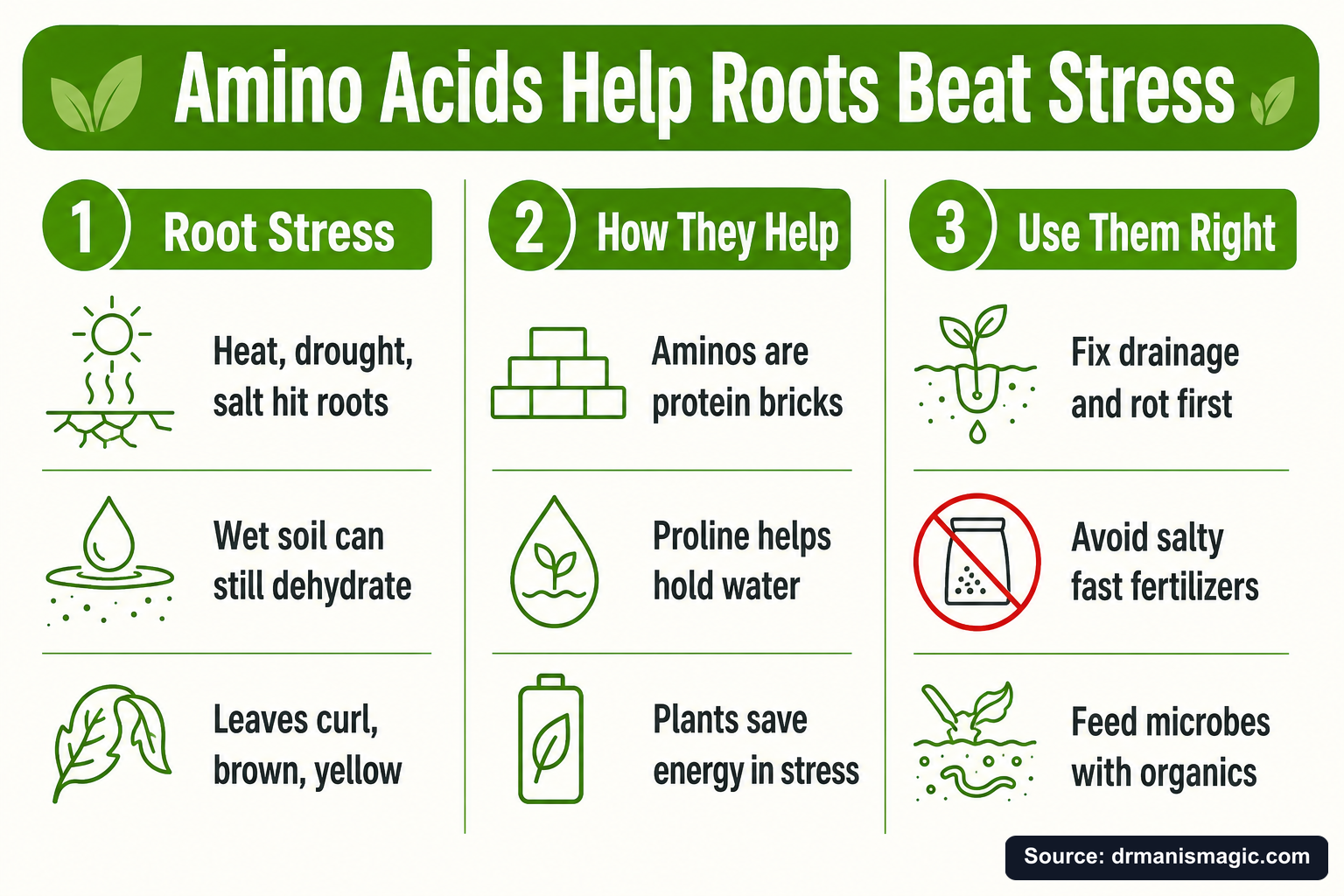
- Amino acids are the building blocks of proteins inside every plant cell — they help plants survive heat, drought, salt damage, transplant shock, and cold injury.
- They do not replace fertilizer, fix poor drainage, or reverse severe root rot on their own. Fixing the root cause always comes first.
- Plants can absorb some amino acids directly through roots and leaves, bypassing the usual nitrogen cycle — this makes them especially valuable during stress.
- Salt-based synthetic fertilizers kill soil microbes, create osmotic stress, and can trigger the very same symptoms they claim to fix.
- Organic slow-release inputs like crab meal, kelp, and amino acids feed microbes first, then the plant — mimicking how nature actually works.
- The Three Plant Pillars — mineral soil, live microbes, and organic fertilizer — form the foundation that makes amino acid inputs most effective.
- All plants benefit: lawns, houseplants, fruit trees, ornamentals, vegetables, and gardens.
What Are Amino Acids and Why Do Plants Need Them?
Quick Answer: Amino acids are the building blocks of proteins. Plants use them to build every living structure inside their cells — from enzymes that run chemical reactions to chlorophyll that captures sunlight. Without enough amino acids, growth slows, stress tolerance collapses, and the plant becomes fragile.
Think of amino acids like Lego bricks. Every protein your plant makes — and it makes thousands — is built from chains of these bricks snapped together in a specific order.
Normally, your plant builds its own amino acids. It takes nitrogen from the soil, combines it with carbon from photosynthesis, and assembles the building blocks it needs. That process works great when conditions are perfect.
But here's the problem. When a plant is stressed — by heat, drought, salt, or transplanting — that whole process breaks down. The plant can't make amino acids fast enough. It starts cannibalizing itself, pulling nutrients from older leaves to keep newer growth alive. That's why you see those brown tips and yellowing leaves. The plant is robbing Peter to pay Paul.
When you supply amino acids from the outside — through a clean organic input like feather meal or plant-based sources — the plant doesn't have to do that hard work. It gets the bricks delivered, pre-made, ready to use. This frees up energy for surviving the stress instead of manufacturing building materials under pressure.
As reviewed in peer-reviewed biostimulant research, protein hydrolysates and free L-amino acids improve plant tolerance to drought, heat, salinity, and nutrient stress through multiple pathways — including osmotic adjustment, antioxidant activity, and improved nutrient-use efficiency. This isn't marketing. It's documented plant biology.
What Is Osmotic Stress and Why Does It Make Plants Act Like They're Dying of Thirst?
Quick Answer: Osmotic stress happens when the concentration of salts or dissolved materials outside a root cell is higher than inside it. Water moves out of the root to try to balance things out — leaving the plant dehydrated even when the soil is wet. This is called physiological drought, and it's one of the most misunderstood plant killers.
Here's a picture that will make this stick. Imagine you're floating in the ocean drinking saltwater. You're surrounded by water. But you're getting more dehydrated by the minute. That's osmosis working against you.
Your plant's roots work the same way. Water moves from areas of lower concentration to higher concentration. When salt levels in the soil are high — from synthetic fertilizers, deicing salt on roads, or accumulated irrigation buildup — water literally gets pulled OUT of the root cells. The plant wilts. Leaves curl. Growth stops. The whole thing looks like it needs water, even though the soil is moist.
The University of Minnesota Extension explains this clearly: salts from deicers and concentrated fertilizers cause root dehydration, foliage burn, compaction, reduced infiltration, and dieback in lawns, trees, shrubs, and ornamentals. This is not a rare edge case. It happens in backyards across America every single day.
This is why salt-based synthetic fertilizers are such a trap. They promise fast green-up. They deliver a short burst. But underneath the surface, they are raising the salt index in your soil, stressing your roots, and killing the microbes that keep your plant healthy long-term.
See also: The Osmotic Shock Your Plants Feel From Synthetic Nutrients
Amino acids help here in a specific way. Certain amino acids — especially proline — act as osmoprotectants. They accumulate inside root and leaf cells, raising the internal concentration to match the outside pressure. This keeps water inside the cell where it belongs. The plant stays hydrated. It keeps functioning. It survives what would otherwise shut it down.
How Do Salt-Based Fertilizers Create the Stress That Amino Acids Have to Fix?
Quick Answer: Most synthetic fertilizers are made from salt compounds. When those salts concentrate in the soil, they pull water away from roots, kill beneficial microbes, and create a cycle of dependency. The plant looks fed but the soil is getting sicker with every application.
Let's be honest about something. We're not saying synthetic fertilizers are evil. We're saying the way they work creates real problems that most people don't know about.
Here's how it works. Synthetic fertilizers dissolve fast. Nitrogen, phosphorus, and potassium flood the root zone all at once. The plant gets a surge of nutrients. Leaves green up. Looks great.
But those nutrients are bound to salt molecules. And salt is indiscriminate. It doesn't just feed the plant. It also raises the osmotic pressure in the soil, as described above. It burns fine root hairs — the tiny, delicate structures that actually absorb water and nutrients. And it kills the bacteria and fungi in your soil that were doing the slow, steady work of feeding your plant naturally.
Now you've got a plant that's dependent on your next application because the natural nutrient cycle is broken. You've also got a root system that's more vulnerable to Pythium and Phytophthora — the water mold pathogens that cause root rot — because stressed roots with damaged cell walls are easy targets.
We've seen this pattern in thousands of trees at our South Texas nursery. A grower comes to us with a "sick" tree. It's getting fertilized regularly. It looks worse every month. We ask what fertilizer they're using. Nine times out of ten, it's a salt-based product applied too heavily or too often.
See also: How Salt-Based Feeding Quietly Destroys Root Systems
The fix is not to add more fertilizer. The fix is to stop the salt damage, rebuild the microbe population, and then support recovery with clean organic inputs — including amino acids.
| Feature | Synthetic Fast-Release | Synthetic Slow-Release | Organic (Crab, Kelp, Amino Acids) |
|---|---|---|---|
| Salt Index | High — immediate root stress risk | Medium — plastic-coated pellets release salts over time | Very low — protein-bound, not salt-based |
| Microbial Impact | Kills beneficial bacteria and fungi | Less immediate damage, but still disrupts biology | Feeds microbes — they thrive on organic nitrogen |
| Root Safety | Burns fine root hairs at high concentrations | Moderate risk near pellets | Gentle — roots self-regulate absorption |
| Speed of Results | Fast visible green-up (1-2 weeks) | Moderate (weeks) | Steady (2-6 weeks, then sustained) |
| PFAS / Biosludge Risk | Some products use biosludge fillers with PFAS | Plastic coating leaches into soil | Zero PFAS, Zero Biosludge when sourced clean |
| Long-Term Soil Health | Degrades over months and years | Neutral to negative | Builds soil biology with every application |
| Stress Tolerance Support | None — can worsen osmotic stress | Minimal | High — amino acids, kelp hormones, chitin immunity |
How Do Amino Acids Actually Feed a Plant? (The Microbe Chain Explained)
Quick Answer: Amino acids in organic fertilizers feed your soil microbes first. The microbes break them down and release nitrogen in a plant-ready form. When those microbes die, they release even more nutrition directly into the root zone. It's a built-in, slow-release feeding system that mirrors how nature has always worked.
This is the part that most people miss. And it's the most important thing we can teach you.
When you apply an organic fertilizer — one that contains protein-based amino acids — here's what actually happens underground.
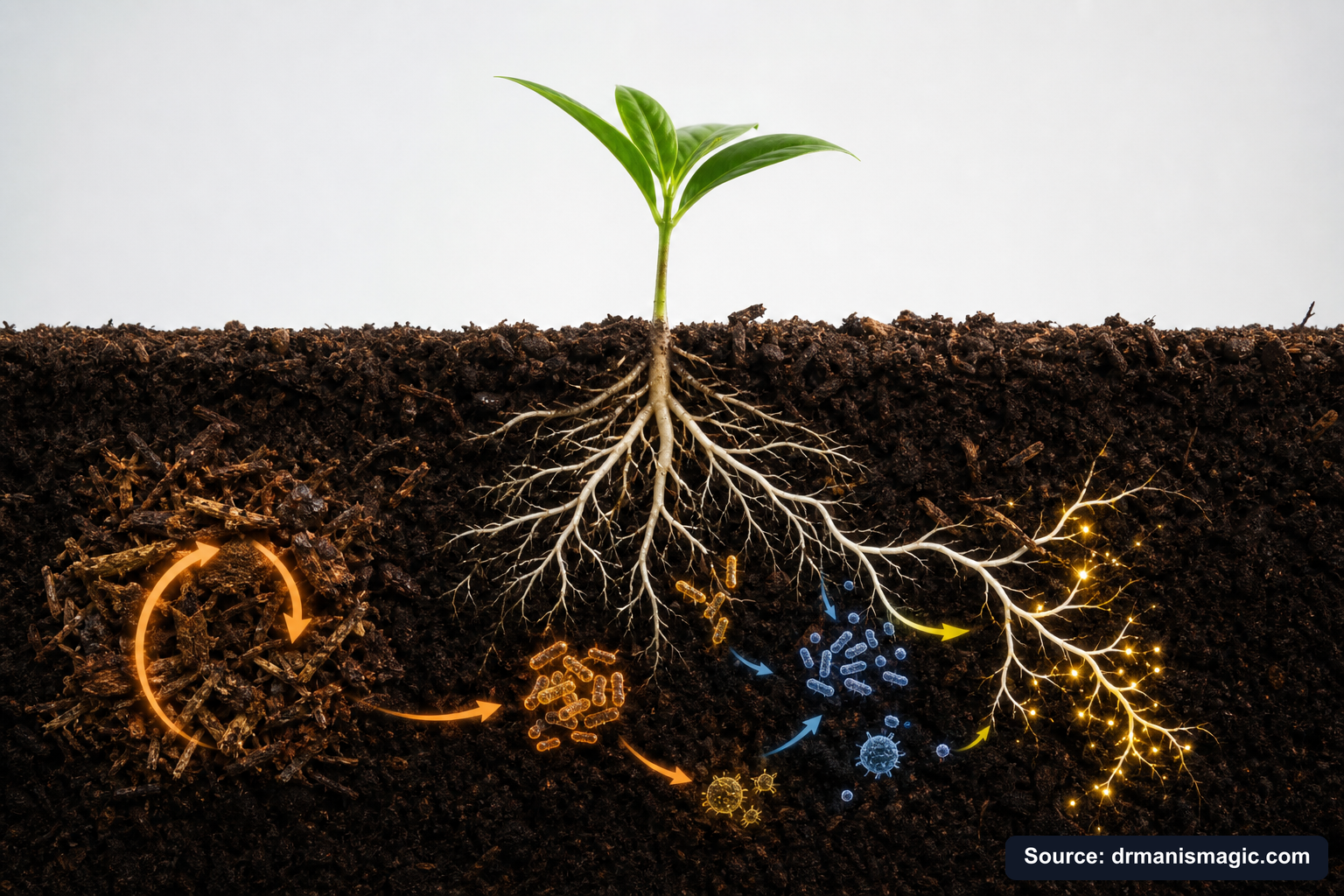
Step one: The amino acids land in the soil. Bacteria and fungi recognize them as food. They eat them. In the process, they break the amino nitrogen loose into ammonium, which then converts to nitrate — the form plants love most. This is called mineralization.
Step two: The plant absorbs that nitrate through its roots. But here's the bonus. Some amino acids — especially smaller ones like glycine and glutamine — can actually be absorbed directly by plant roots without going through the microbial conversion step at all. Penn State Extension and University of Minnesota soil biology resources both confirm that plants have transport systems for direct amino acid uptake, especially useful when microbial activity is slow during cold or drought stress.
Step three: When those microbes eventually die — as all living things do — their bodies decompose. And what are microbe bodies made of? Nutrients. Nitrogen. Phosphorus. Trace minerals. All of it releases directly into the root zone in the most plant-available form possible.
So you apply the fertilizer once. The microbes eat it and feed the plant. Then the microbes die and feed the plant again. It's a double-release system built right into the biology. No timer. No plastic coating. No guessing. Just nature running the way it always has.
This is the core of The Three Plant Pillars — the framework Dr. Mani Skaria developed over 40 years of research and proven across 250,000 trees in South Texas. Mineral soil. Live microbes. Organic fertilizer. All three working together like a machine.
What Does Chitin From Crab Shells Actually Do for a Stressed Plant?
Quick Answer: Chitin is a natural compound found in crab shells. When it breaks down in soil, it triggers the plant's immune system — the same response that fights off fungal pathogens. It also feeds beneficial microbes and delivers calcium, which strengthens cell walls and makes the plant physically tougher.
Here's something that will surprise you. Crab shells are not just a nitrogen source. They're a biological signal.
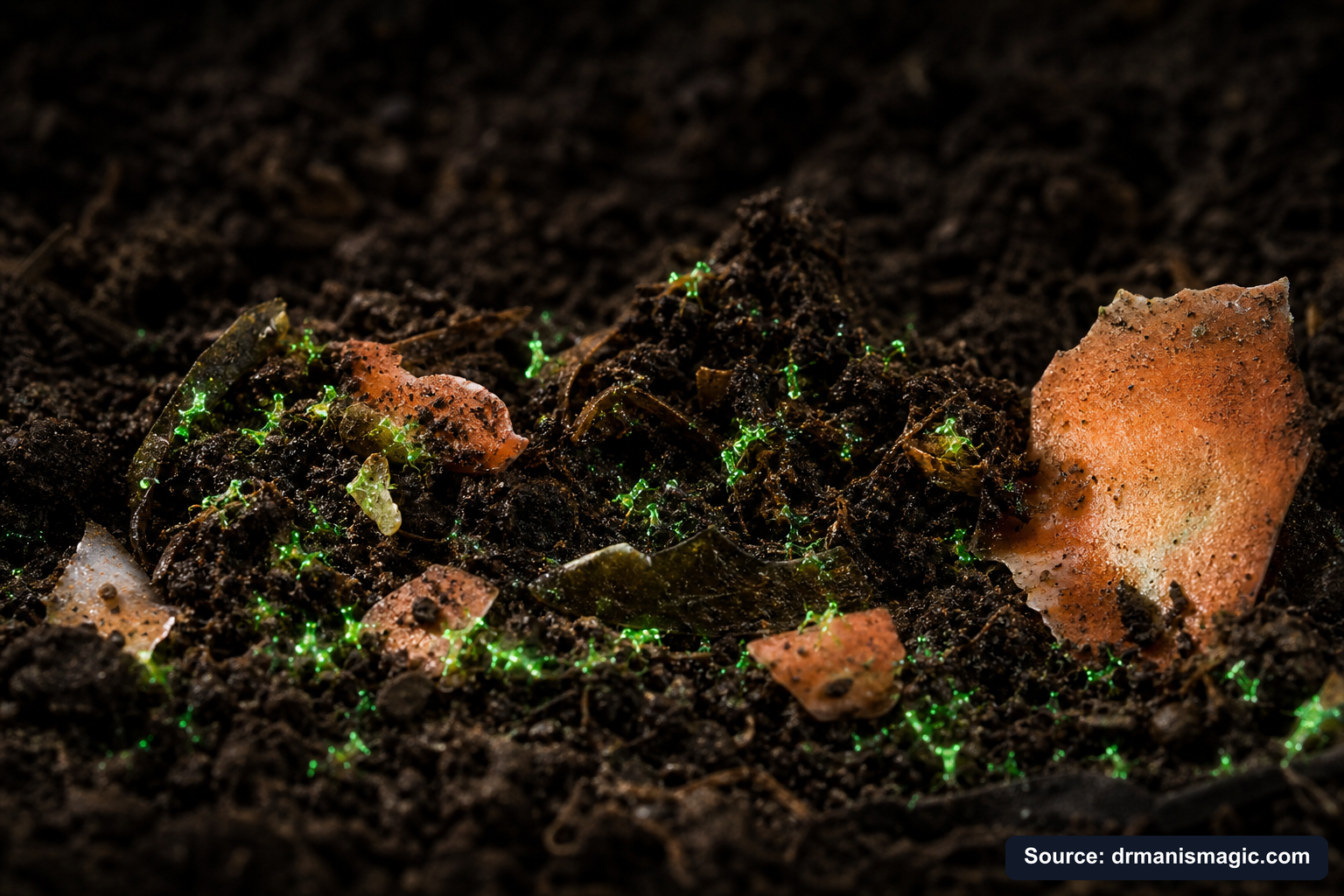
When chitin — the hard structural material in crab shells — enters the soil, something fascinating happens. Beneficial bacteria called chitinase-producing microbes break it down. And as they do, they release compounds that the plant's roots recognize as a warning signal. "Fungal invader detected." The plant responds by ramping up its own natural defenses — thickening cell walls, producing antifungal compounds, and boosting immune enzyme activity.
This matters enormously for stressed plants. When a plant is under heat stress, drought stress, or salt stress, its immune system is already running on low power. Chitin helps reboot those defenses without any synthetic chemicals. The plant gets tougher from the inside out.
Chitin also feeds the microbial community in your soil — specifically the beneficial fungi and bacteria that compete with harmful pathogens like Pythium and Phytophthora. A soil rich in chitin-fed microbes is a soil where root rot organisms struggle to gain a foothold.
Plus, crab shells contain calcium — a lot of it. Calcium is the backbone of every cell wall in your plant. Strong cell walls mean the plant can hold water better, resist physical damage, and transport nutrients more efficiently. For stressed plants, that structural strength is the difference between recovery and collapse.
What Does Kelp Do That Regular Fertilizer Cannot?
Quick Answer: Kelp contains natural plant hormones called auxins and cytokinins that regulate root growth, cell division, and stress response. It also provides trace minerals and carbohydrates that feed soil microbes. These are things no synthetic fertilizer delivers — and they matter most exactly when a plant is under pressure.
Cold-processed kelp is not just a nutrient delivery system. It's a hormone delivery system.
Auxins are hormones that tell roots to grow. More root growth means more surface area for water and nutrient absorption — exactly what a plant needs when stress is limiting its resources. Cytokinins are hormones that regulate cell division and delay aging in leaves. They literally slow down the process of leaves yellowing and dropping during stress.
During a heat wave, a drought, or after transplanting, these hormonal signals are suppressed. The plant goes into survival mode. Growth stops. Leaves age fast. Root development slows. Kelp helps flip those signals back toward growth and recovery.
Kelp also brings a dense array of trace minerals — iodine, selenium, vanadium, and dozens of others — that most soils lack but plants use in tiny amounts for enzyme function. Think of them as the small screws that hold a big machine together. You don't need much. But without them, things loosen and fall apart.
And the carbohydrates in kelp? Those are food for your soil microbes. More microbe food means more microbial activity. More microbial activity means more nutrient release, better disease suppression, and a more resilient root zone. Everything connects.
You Never Had a Brown Thumb.
You were handed the wrong tools. This free guide hands you the right ones.
You watered it. You fed it. It died anyway.
It was never you. It was the dirt, the salt food, and the bad advice.
This guide shows you what really went wrong, and how to fix it for good.
- Why your plants really died, and why it was never your fault
- The salt hiding in your plant food that quietly burns the roots
- The hidden killer in almost every bag of store soil
- The tiny helpers that grow a whole forest for free
- The rescue trick that brings a half dead plant back to life

Can Amino Acids Help After Fertilizer Burn, Salt Damage, or Overwatering?
Quick Answer: Yes — amino acids can support recovery after fertilizer burn, road salt exposure, and mild overwatering stress. But they cannot fix the underlying cause. You must correct the salt source, improve drainage, or address root rot first. Amino acids speed up recovery once the stressor is controlled.
Let's talk about the three situations we hear about most from plant owners.
Fertilizer burn. You applied too much. Leaves are scorched. Tips are brown. The soil has a high salt load. First, flush the soil with clean water to dilute the salts. Then stop the synthetic fertilizer entirely. Now amino acid inputs can help — they support protein repair in damaged cells, they feed the recovering microbial community, and they deliver gentle nitrogen without adding more salt stress.
Road salt or deicing salt damage. This is a slow killer for trees and shrubs near driveways, sidewalks, and roads. Salt accumulates in the root zone over winter. Come spring, the plant looks drought-stressed even though there's plenty of moisture. Correcting this requires leaching — running large amounts of water through the soil to dilute and flush the sodium. Improving drainage helps too. Once the salt load drops, amino acid inputs support osmotic recovery and help the plant rebuild its protein structures.
Overwatering and root damage. Here's where we have to be completely honest with you. If your plant has active Pythium or Phytophthora root rot — real fungal infection, not just waterlogged soil — amino acids alone cannot fix it. You must improve drainage first. You may need to let the root zone dry out. You need live beneficial microbes, like those in Plant Super Boost, to outcompete the pathogens. Then, once the roots are recovering, amino acid inputs support new root growth and cellular repair.
| Symptom | Salt Damage / Osmotic Stress | Overwatering (Waterlogged Roots) | True Root Rot (Pythium / Phytophthora) |
|---|---|---|---|
| Leaf appearance | Brown tips, scorch edges, curling inward | Yellowing all over, soft wilting | Sudden collapse, dark wilted leaves |
| Soil condition | Dry crust or white salt deposits on surface | Wet, compacted, smells sour | Wet with foul odor; roots mushy and dark |
| Root color when pulled | White to tan, possibly dry and brittle | White to light brown, soft | Brown-black, mushy, falls apart |
| Response to watering | Does not improve — may worsen | Worsens with more water | Does not respond; continues to decline |
| Primary fix | Flush soil, remove salt source | Improve drainage, reduce watering frequency | Improve drainage, add beneficial microbes, allow drying |
| Role of amino acids | High value in recovery phase | Moderate value after drainage correction | Supportive only after pathogen is controlled |
When Should You Use Amino Acids? (A Practical Timing Guide)
Quick Answer: Amino acids are most valuable during and after stress events — transplanting, heat waves, drought, cold snaps, salt exposure, root pruning, and flowering. They also help during mild nutrient stress and as regular maintenance to keep plants resilient before stress hits.
Timing matters. Amino acids are not an all-season emergency spray. They are a targeted support tool. Here are the moments when they deliver the most value.
- Transplanting. Moving a plant tears roots. Torn roots cannot absorb water and nutrients efficiently. Amino acids applied at transplant time reduce shock, support new root growth, and give the plant building materials without demanding heavy metabolic work to produce them.
- Heat waves. When temperatures spike, photosynthesis slows and protein damage accelerates. Amino acid inputs give the plant ready-made materials for cellular repair without requiring the energy that heat has already stolen.
- Drought recovery. Once you restore proper watering, amino acids help the plant rebuild osmotic balance and resume growth. Proline — a specific amino acid — helps cells rehydrate and stabilize.
- After salt exposure. Whether from fertilizer overload or road deicers, amino acids support the cellular recovery process once the salt source is removed or diluted.
- Flowering and fruit set. This is a metabolically expensive phase. Amino acids support protein synthesis for developing fruit tissue and pollen — reducing fruit drop and improving size and flavor.
- After cold or wind injury. Freeze damage and windburn tear cell membranes. Amino acids support the repair and regrowth phase in spring.
- Repotting and root pruning. Any time roots are disturbed, amino acid support reduces recovery time and improves establishment success.
Are Amino Acids a Fertilizer? What's the Difference?
Quick Answer: Amino acids are not a complete fertilizer by themselves. They provide organic nitrogen and stress-support compounds, but they do not supply a full balanced NPK ratio. They work best as part of a complete organic fertilizer that also includes phosphorus, potassium, calcium, trace minerals, and biostimulants.
This is one of the most common questions we get. And the honest answer is: amino acids are one part of a complete nutrition system — not the whole thing.
Here's how to think about it. Nitrogen is essential for growth. Amino acids are an organic, plant-friendly form of nitrogen. But your plant also needs phosphorus for roots and flowering, potassium for stress tolerance and fruit quality, calcium for cell walls, magnesium for chlorophyll, and a dozen trace minerals for enzyme function.
Amino acids alone won't cover all of that. But here's what they do cover that synthetic nitrogen sources cannot: they provide the nitrogen in a form that the plant can absorb directly, in a form that microbes can metabolize slowly, and in a form that does not spike the salt index in your soil.
The reason Crab, Kelp & Amino Acids works so well is that it pairs amino acid nitrogen with all the other pieces — crab shell calcium and chitin, kelp hormones and trace minerals, volcanic ash for silica and micronutrients — in one clean, slow-release granular formula. You get amino acid benefits without sacrificing complete nutrition. Zero PFAS. Zero biosludge. Zero synthetic salts. Just clean inputs that work with your soil biology instead of against it.
See also: Why Most Fertilizers Are Actually Salt in Disguise
What's the Full Stress Chain That Amino Acids Support?
Quick Answer: Plant stress is not one event — it's a chain reaction. Salt or drought triggers osmotic stress. Osmotic stress causes root dehydration. Dehydrated roots absorb fewer nutrients. Weakened plants become targets for Pythium and Phytophthora. Amino acids interrupt multiple links in this chain, but only work fully when the soil biology is intact.
Most people think of plant stress as a single problem. "My plant is too hot." Or "my plant needs water." But stress is a cascade. One thing leads to another. And understanding the full chain helps you see exactly where amino acids fit in.
The chain looks like this:
Salt accumulation or drought → osmotic stress (water leaves root cells) → physiological drought (plant is thirsty even in moist soil) → reduced photosynthesis → lower sugar production → less food for soil microbes → fewer microbes → less nutrient mineralization → nutrient stress → weakened immune response → roots become vulnerable to Pythium and Phytophthora → root rot → plant collapse.
Amino acids interrupt this chain at multiple points. Osmoprotectant amino acids like proline keep water inside cells during the osmotic stress phase. Amino acids that feed microbes help sustain the microbial population during stress. Direct amino acid uptake through roots bypasses the need for active mineralization when microbial activity is suppressed. And amino acid-derived proteins repair damaged enzyme systems that control antioxidant defense and immune response.
But here's what we want to be crystal clear about. Amino acids cannot fix compacted soil that suffocates roots. They cannot fix active Phytophthora when water is still pooling. They cannot neutralize severe salt accumulation without physical leaching. They cannot correct pH that's locking up nutrients. The soil foundation has to be right first. That is the entire point of the Three Plant Pillars.
See also: The Hidden Reason Synthetic Fertilizers Cause Root Rot
What About PFAS and Biosludge in Fertilizers? Are Amino Acid Products Safe?
Quick Answer: Some organic fertilizers use biosludge — treated municipal waste — as filler. Biosludge can contain PFAS "forever chemicals" that accumulate in soil and in the food you grow. Clean amino acid fertilizers sourced from crab meal, feather meal, and kelp carry none of these risks.
This one makes people uncomfortable. But it's important.
Not all organic fertilizers are clean. Some companies use biosludge — treated municipal sewage waste — as a cheap filler. It's technically "organic" because it comes from living sources. But it can carry PFAS compounds — "forever chemicals" that don't break down, accumulate in soil, and end up in food crops.
We want you to be able to walk barefoot on your lawn. Let your kids dig in the garden. Eat the tomatoes you grew. Pick the fruit off your tree and bite right into it. That only works if what you put in the soil is actually clean.
That's why Dr. Mani's Magic contains zero biosludge, zero PFAS, and zero synthetic salt fillers. The amino acids in our formula come from feather meal, tankage, and crab meal — all traceable, American-sourced agricultural inputs. Every ingredient has a known origin. Nothing hidden. Nothing borrowed from a sewage treatment plant.
And because everything in our line is made in the USA — sourced from American farms and fisheries — you also sidestep the supply chain risks, tariff problems, and quality control issues that come with imported fertilizers. In an era where potash comes from Russia and phosphorus from Morocco, that stability matters.
A Recovery Checklist: What to Do When Your Plant Is Under Stress
Quick Answer: Before adding any input, diagnose the stress type. Correct the root cause first, then support recovery with biology-friendly inputs. Amino acids work best in step four and five — after the damage source is removed.
When a plant looks sick, the instinct is to add something. More fertilizer. More water. A spray. A drench. But adding inputs to an already-stressed root system without fixing the cause first often makes things worse.
Here is the sequence that actually works:
- Identify the stress type. Is the soil too wet? Too dry? Are there salt deposits? Is it near a road that gets deiced? Was it recently fertilized heavily? Use the diagnostic table above to narrow it down.
- Remove or reduce the stressor. Stop the synthetic fertilizer. Improve drainage. Flush accumulated salts with clean water. Move a container plant out of direct midday sun. This step is non-negotiable.
- Check your soil structure. Is it compacted? Is it a decomposing bark mix that's gone anaerobic? Roots need oxygen to recover. If the soil structure is the problem, repotting into a mineral-based, well-draining mix makes everything else work better. See also: Why Most Potting Mix Collapses Within 6-12 Months.
- Rebuild the microbial community. Apply a quality liquid microbial inoculant — bacteria, fungi, and mycorrhizae — to recolonize the root zone. This is Pillar Two of the Three Plant Pillars, and it's the engine that makes organic nutrition work.
- Apply clean amino acid and organic nutrition. Once drainage is improved, salts are flushed, and the microbial community is reactivated, apply a slow-release organic fertilizer that includes amino acids. This feeds the microbes and supplies the plant with gentle, stress-supportive nitrogen.
- Be patient. Recovery is not instant. Roots need weeks to regrow. Leaves that were burned won't turn green again — but new growth will come in healthy. Give it 30-45 days before judging results.
- Maintain the system. The goal is a living soil that keeps working between applications. With the Three Plant Pillars in place, your plant becomes resilient enough that the next stress event barely registers.
Does This Apply to Lawns, Houseplants, and Vegetables Too — Or Just Trees?
Quick Answer: Every plant on earth uses amino acids for the same biological functions. Lawns, houseplants, vegetables, flowers, hedges, and fruit trees all benefit from amino acid support during stress. The mechanisms are the same. The timing adjusts slightly by plant type.
We developed the Three Plant Pillars at US Citrus Nursery because citrus is brutally unforgiving. If your inputs are wrong, you find out fast. Salt stress in a Meyer lemon shows up as leaf curl and tip burn within days. Root rot in a potted Valencia orange moves from fine to dead in a matter of weeks. Citrus kept us honest.
But the biology we learned applies to every plant alive. A lawn under heat stress is losing cellular water the same way a citrus tree does. A houseplant sitting in soggy bark mix is suffering the same oxygen starvation as a containerized mango. A vegetable garden hit by a neighbor's synthetic fertilizer runoff faces the same osmotic shock as a row of ornamental shrubs near a salted road.
Amino acids work in all of these situations because the protein chemistry of plant cells is universal. Proline accumulates in drought-stressed grass blades just like it does in drought-stressed lemon leaves. Glutamate helps nitrogen assimilation in a tomato plant just like it does in a citrus tree. The plant doesn't know what genus it is. It just knows it needs building materials to survive.
After growing over 250,000 citrus trees and testing these inputs on our houseplants, tropical trees, vegetable plots, and ornamental gardens in South Texas, we can tell you with confidence: the Three Plant Pillars are not a citrus-specific trick. They are a first-principles approach to how plants actually grow. The Free Plant Care Field Guide walks you through applying these principles to your specific plants — whether that's a container lemon tree, a backyard garden bed, or a struggling patch of lawn.

The Honest Truth About What Amino Acids Can and Cannot Do
Quick Answer: Amino acids are a legitimate, research-backed stress support tool. They are not magic. They cannot override poor soil structure, active root disease, severe salt accumulation, or incorrect pH. They are most powerful as part of a complete biology-friendly system — not as a standalone rescue product.
We want to be the voice that's honest with you. Because there is a lot of noise in the gardening world right now about biostimulants. And some of it is hype.
Amino acids will not save a plant that is sitting in saturated, compacted, oxygen-depleted soil. They will not kill Phytophthora that is actively destroying your root system. They will not neutralize years of salt accumulation from aggressive synthetic fertilization without leaching and drainage correction. No input can do those things. Not ours. Not anyone's.
What amino acids can do — when the foundation is right — is remarkable. They help plants tolerate stress before it becomes crisis. They accelerate recovery after the crisis is corrected. They supply nitrogen in a form that doesn't punish the microbes doing the real work. They deliver hormonal signals, cellular building blocks, and osmotic protection that synthetic fertilizers simply do not contain.
The growers who get the best results are not the ones who spray amino acids on a dying plant and hope. They are the ones who build the right foundation first — mineral soil, live microbes, clean organic nutrition — and then use amino acid inputs as the fine-tuning layer that takes a healthy system to a resilient one.
That's the system Dr. Mani Skaria spent 40 years building. It's what we use on every tree at our nursery. And it's available to you right now, without the decades of trial and error it took us to figure it out.
The number one thing people tell us when they reach out is that they want to see their tree bear fruit while they still have the time to enjoy it. They don't want to spend years doing it wrong, starting over, losing plants, and wondering if their thumb will ever turn green. Time is the one thing you cannot get back. Money comes and goes. But the seasons your garden spent struggling under salt-based fertilizers and dead soil — those seasons are gone.
You deserve a system that works with nature instead of against it. One that's clean, simple, and backed by real science from a real nursery with a real track record. If you're ready to build that foundation, start with Crab, Kelp & Amino Acids — our clean, slow-release organic fertilizer that brings amino acid stress support, chitin immunity, kelp hormones, and trace minerals together in one straightforward formula. No biosludge. No PFAS. No synthetic salts. Just clean inputs your whole plant system can actually use — backed by a 30-day money-back guarantee.
Frequently Asked Questions
You just read about what amino acids do inside a stressed plant. Now come the real questions. The ones gardeners ask after losing a tree, watching leaves curl in July, or wondering if there is a better way. These answers are grounded in over 30 years of growing more than 250,000 trees in South Texas.
How do amino acids help plants handle stress?
When a plant is stressed by heat, drought, or transplant shock, it cannot build proteins fast enough on its own. Amino acids are the building blocks of those proteins. When you supply them directly through a clean organic input, the plant skips the hard manufacturing work. It gets the building blocks ready to use. That frees up energy to survive the stress instead of fight it. The result is faster recovery, stronger roots, and leaves that stop curling.
Do plants absorb amino acids through their roots?
Yes. Plants can absorb certain free amino acids directly through their roots and even their leaves. This bypasses the normal nitrogen cycle completely. That is a big deal during stress, because the normal cycle slows down or stops when conditions get tough. Getting amino acids from a source like crab meal, kelp, and amino acids fertilizer means your plant gets what it needs even when the soil is struggling. We have seen this work on over 250,000 trees at our South Texas nursery.
Can amino acids replace regular fertilizer?
No. Amino acids are one piece of the puzzle, not the whole picture. At Dr. Mani's Magic, we teach the Three Plant Pillars. You need mineral-based soil for drainage and root breathing. You need live microbes to unlock nutrients and fight disease. And you need organic fertilizer, including amino acids, to feed the plant slowly and cleanly. All three work together. Skip one pillar and the whole system gets weaker. Amino acids shine brightest when the foundation is already solid.
How do you know if your plant needs more amino acid support?
Watch for these signs. Brown leaf tips. Yellowing older leaves while new growth looks pale. Slow recovery after a hot week or a transplant. These happen because a stressed plant starts pulling nutrients from its older parts to keep newer growth alive. It is robbing itself. That is your signal. Adding a clean amino acid source through organic fertilizer can stop that cycle and help your plant rebuild from the roots up instead of breaking itself down.
Why are synthetic fertilizers bad for stress tolerance?
Synthetic fertilizers are salt-based. Salt pulls water away from roots through osmosis. That creates osmotic stress, the same kind of invisible pressure that makes leaves curl and tips turn brown. Worse, those salts kill the beneficial microbes in your soil. No microbes means no nutrient unlocking, no disease protection, and no living ecosystem under your plant. You end up treating symptoms while making the root cause worse. That is why we built our entire fertilizer around crab meal, kelp, and amino acids instead.
Do amino acids help with heat stress in summer?
Yes, and summer is exactly when they matter most. High heat shuts down the enzyme systems plants use to build proteins on their own. When you supply amino acids through an organic slow-release fertilizer, the plant does not have to run those enzyme systems at full power. It gets what it needs delivered. We grow citrus in South Texas where summer is brutal. The trees that had the full Three Pillar system, including organic amino acid fertilizer, handled the heat far better than anything fed with synthetic salt-based products.
Will amino acids work for all types of plants, not just trees?
Absolutely. Every living plant cell uses amino acids to build proteins. It does not matter if you are growing a lemon tree in a container, tomatoes in a raised bed, grass in your backyard, or a fiddle leaf fig on your windowsill. The biology is the same. We tested our system on over 250,000 citrus trees first because that is our specialty. But the Three Plant Pillars, including organic amino acid fertilizer, work for lawns, flowers, vegetables, houseplants, and orchards alike.
About the Author
Ron Skaria, MD
Ron Skaria, MD, is the co-founder of Dr. Mani's Magic and the son of Dr. Mani. He trained as a medical doctor at Baylor College of Medicine, did his residency at UT Health Science Center - San Antonio and fellowship training at Texas Tech University. He now works full time on the family farm at US Citrus and US Citrus Nursery in Hargill, Texas, building Dr. Mani's Magic alongside his dad. He wrote the Brown Thumb Field Guide to put his father's 48 years of plant science into plain words any gardener can use. His belief is simple. You never had a brown thumb. You just never had the right help.


