


How Amino Acids Reduce Fertilizer Stress in Your Plants | Dr. Mani's Magic
How Amino Acids Reduce Fertilizer Stress (And Why Your Roots Have Been Quietly Crying for Help)
You walk out to your garden on a Saturday morning. Coffee in hand. The air smells like cut grass and possibility. You gave your plants a good feeding last week. You followed the directions on the bag. You did everything right.
But something looks wrong. The tips of the leaves are brown and crispy. The edges look scorched, like someone held a lighter too close. The soil has a crusty white film on top. Your tomatoes are wilting even though you just watered. Your citrus tree looks pale and defeated. And somewhere in the back of your mind, a familiar voice whispers: Maybe I just don't have a green thumb.
Stop right there. It is not your fault. What you are looking at is fertilizer stress. And the culprit is not you. It is the salt. Almost every popular fertilizer on the market is built on soluble salts. Those salts are literally pulling water away from your roots. Your plant is sitting in a full pot of soil and dying of thirst. The good news? Once you understand what is really happening underground, the fix becomes surprisingly simple. And that is exactly what this article is about.
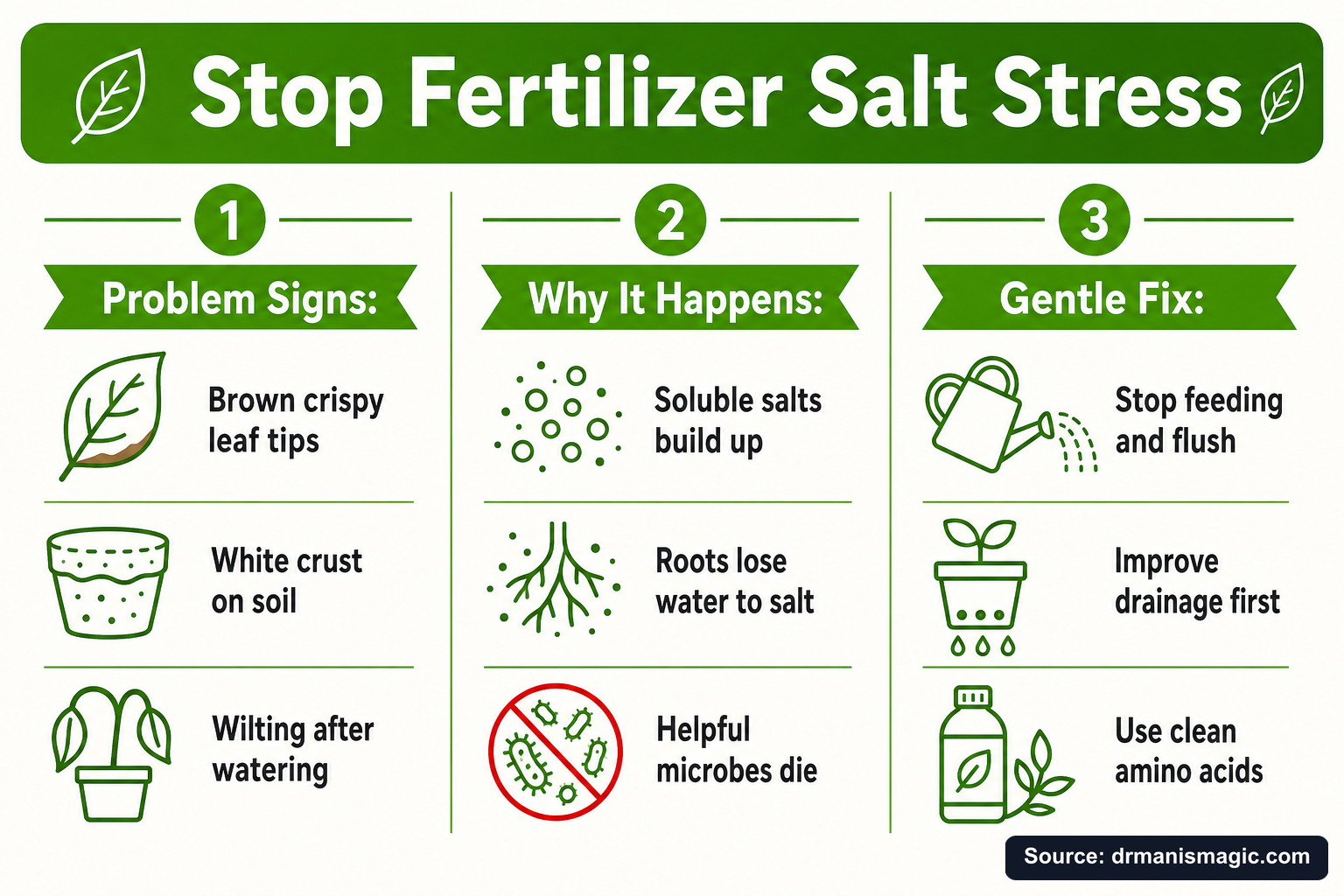
Key Takeaways
- Most fertilizer damage is caused by soluble salts, not the nutrients themselves. Salts create osmotic stress that dehydrates roots even when the soil is wet.
- Amino acids are a low-salt, plant-ready form of organic nitrogen that feeds your plants gently and supports the beneficial microbes in your soil instead of killing them.
- Soil microbes supply roughly 75% of plant-available nitrogen naturally. Feeding those microbes with organic inputs like amino acids keeps that biological engine running.
- Chitin from crab shells, kelp hormones, and volcanic trace minerals work together with amino acids to reduce stress, strengthen roots, and help plants recover faster.
- Biosludge and PFAS "forever chemicals" are hidden in many organic fertilizers. Clean sourcing matters as much as the nutrient label.
- After fertilizer stress, there is a simple recovery sequence: stop feeding, flush salts, fix drainage, and then reintroduce gentle organic nitrogen.
- The Three Plant Pillars framework, developed at US Citrus Nursery across 250,000+ trees, shows that mineral soil, live microbes, and organic fertilizer work as a system, not as separate products.
What Is Fertilizer Stress and Why Does It Happen to Good Gardeners?
Quick Answer: Fertilizer stress happens when soluble salts in synthetic fertilizers build up in the root zone. Those salts pull water away from roots through osmotic pressure, causing dehydration, tissue damage, leaf scorch, and wilting even when the soil feels moist. It is a salt problem, not a watering problem.
Here is the thing most fertilizer bags never tell you.
The word "fertilizer" sounds helpful. Nurturing, even. But most conventional fertilizers are made from soluble mineral salts. Ammonium nitrate. Potassium chloride. Monoammonium phosphate. These are salts. They dissolve fast in water, which is why they create that dramatic "instant green-up" that looks so satisfying in the first week.
But here is the science that no big box store ever explains at the checkout counter.
When you pile salts into the root zone, you change the osmotic pressure of the soil water. Osmotic pressure is just a fancy way of saying: water moves from where there is less salt to where there is more salt. If the soil around your roots is saltier than the inside of the root cells, water moves out of the roots and into the soil. Your plant loses water even while sitting in wet soil. University of Maryland Extension describes this as physiological drought. Your plant looks like it needs water. But watering more makes the salt problem worse, not better.
Penn State Extension and CSU Extension both document this salt accumulation cycle in container plants especially, where salts have nowhere to go. They concentrate. They form that white crust you see on the top of the soil or on the pot's edge. They burn tender root tips. They scorch leaf margins. They make seedlings collapse.
This is fertilizer stress. And it is the number one hidden cause of struggling plants across lawns, gardens, containers, and orchards all over the United States.
See also: How Fertilizer Salts Block Water Instead of Helping Plants
Why Do Soluble Salts Kill the Microbes Your Roots Depend On?
Quick Answer: Beneficial soil bacteria and fungi are living organisms. High salt concentrations in the root zone dehydrate and kill them the same way they stress plant roots. When microbes die, the biological nutrient cycle breaks down. Plants lose their natural feeding system and become fully dependent on whatever you pour from a bag.
This is the part of the story that the big chemical companies really do not want you to think about.
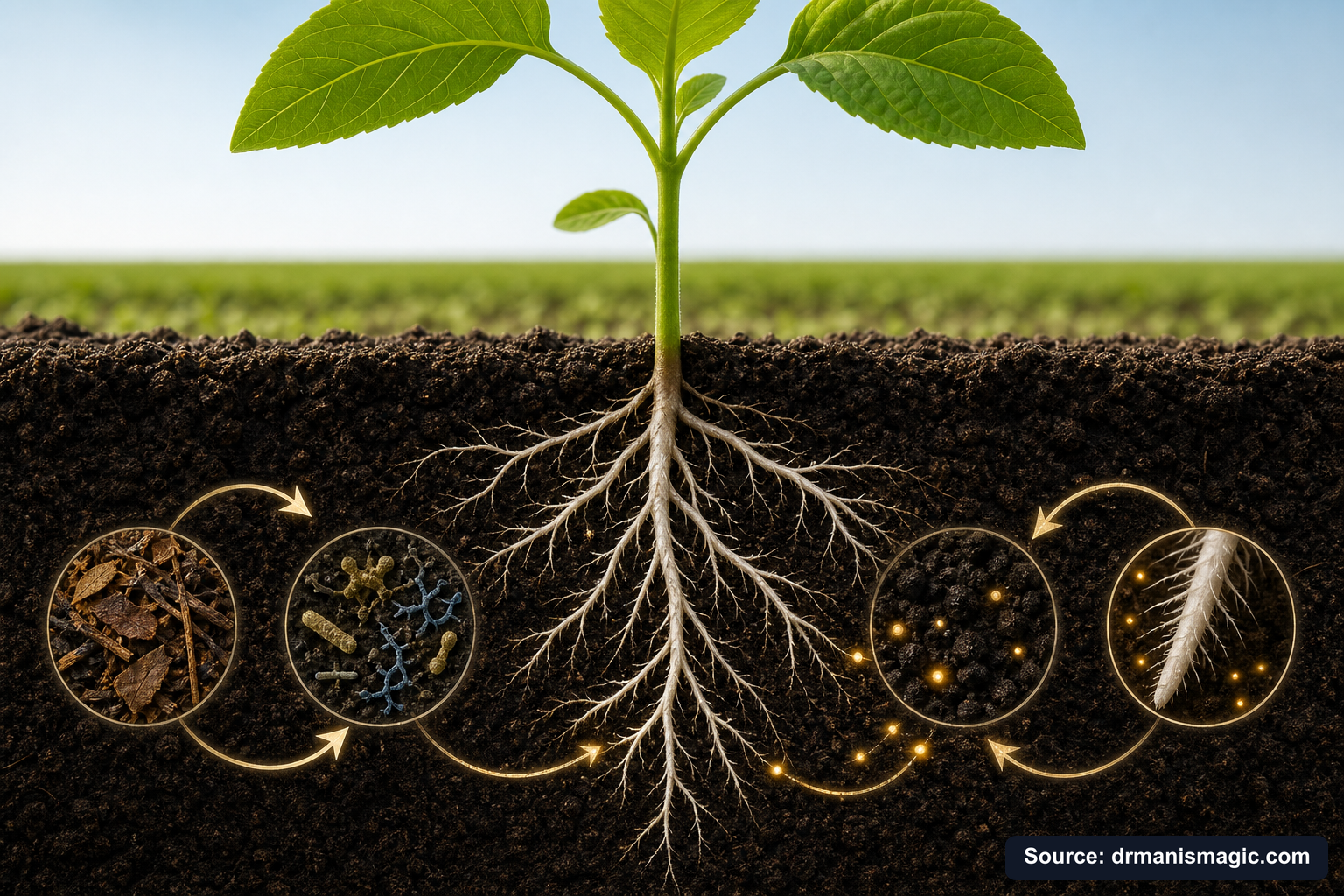
Your soil is not just dirt. It is a living city. University of Minnesota Extension research shows that soil biological processes supply approximately 75% of plant-available nitrogen and 65% of available phosphorus. Penn State identifies soil microbes as the primary force cycling carbon, nitrogen, sulfur, and phosphorus through the root zone.
These microbes, bacteria, fungi, and mycorrhizal networks, are your plant's silent business partners. They break down organic matter. They unlock bound nutrients. They protect roots from disease-causing organisms like Pythium and Phytophthora. They build soil structure so water and oxygen can move freely.
Salt kills them.
Every time you apply a high-salt synthetic fertilizer, you are not just feeding your plant. You are also poisoning the biological ecosystem that your plant depends on for long-term survival. The plant gets a fast hit of nutrients. Then the microbes die. Then the nutrient cycle slows. Then you need more fertilizer. Then more salt. Then more dead microbes. It is a cycle designed to keep you buying, not growing.
Dr. Mani Skaria, a Professor Emeritus of Plant Pathology and founder of the Clean Citrus Program in Texas, spent 40 years watching this pattern repeat itself in citrus orchards across the state. He saw beautiful trees slowly weaken over seasons of synthetic feeding. Not because growers were careless. Because they had been handed the wrong tool and told it was the only one that worked.
See also: The Hidden Reason Synthetic Fertilizers Cause Root Rot
How Do Amino Acids Reduce Fertilizer Stress in Your Plants?
Quick Answer: Amino acids reduce fertilizer stress by delivering nitrogen in a low-salt, plant-compatible form. They act as organic nitrogen sources, osmolytes that help cells manage water balance under stress, chelators that improve micronutrient transport, and food for beneficial soil microbes. They work with the biology of your soil instead of burning through it.
So what exactly are amino acids, and why do they matter?
Amino acids are the building blocks of protein. Every living thing, plants, animals, microbes, is built from chains of amino acids. When you apply amino acids to the root zone, several things happen at once.
First, the plant can absorb certain amino acids directly through the roots. That means nitrogen reaches the plant without the plant having to wait for a microbe to break down a salt compound. No osmotic pressure spike. No burning. Just a gentle, ready-to-use form of nitrogen that the plant recognizes and welcomes.
Second, the microbes in your soil absolutely love amino acids. They feast on them. And here is the part that most gardening content skips entirely.
When microbes eat organic fertilizer like amino acids, they convert it into plant-available nutrients. Then, when those microbes die naturally, they release all of that stored nutrition directly into the root zone. It is a slow, steady drip. A natural time-release system that mirrors exactly what happens in a healthy forest or prairie. No plastic-coated pellet. No salt spike. Just biology doing what it evolved to do over millions of years.
This is the mechanism behind the Three Plant Pillars: mineral soil for drainage and oxygen, live microbes to run the nutrient cycle, and organic fertilizer that feeds the microbes first and the plant second. When all three work together, the root zone becomes self-sustaining.
Third, amino acids can act as osmolytes. Under salt stress or drought, plants accumulate small organic molecules to balance water pressure inside their cells. Certain amino acids, like proline, serve this exact function. They help the plant hold onto water when the root zone is hostile. Research published in peer-reviewed journals on protein hydrolysates confirms this stress-buffering role.
Fourth, amino acids chelate micronutrients. Chelation is just a word for "holding onto." When amino acids wrap around iron, zinc, or manganese molecules, they keep those nutrients in a form the plant can actually absorb. High-pH soils and salt-heavy soils often lock up micronutrients. Amino acid chelation is one of the most effective natural tools for unlocking them.
What Is the Salt Index and Why Should Every Gardener Know It?
Quick Answer: The salt index measures how much a fertilizer raises the salt concentration in the soil compared to sodium nitrate. High-salt-index fertilizers, common in fast-release synthetic products, create the greatest osmotic stress risk. Organic fertilizers like amino acid-based inputs have very low salt indexes, making them far gentler on roots and soil life.
Picture a spectrum. On one end, you have pure sodium chloride, table salt. It has a salt index of 100. It would destroy your garden instantly. On the other end, you have compost or aged organic matter. Salt index near zero. Completely safe for the most delicate seedling root.
Most synthetic fertilizers sit much closer to the salt end of that spectrum than the bag label lets on. Potassium chloride, one of the most commonly used potassium sources in lawn fertilizer, has a salt index of 116. Higher than table salt. Ammonium nitrate is at 105. These numbers come from university agronomy research and are well-documented in soil science curricula.
Organic nitrogen sources, including feather meal, crab meal, and amino acid hydrolysates, have salt indexes that are a fraction of their synthetic counterparts. That is not a marketing claim. That is chemistry. When you shift from high-salt-index inputs to low-salt organic nitrogen, you reduce osmotic stress in the root zone. Roots stop losing water. Microbes stop dying. The soil ecosystem starts recovering.
This is not a minor difference. For container plants especially, where salts accumulate with nowhere to drain, the difference between a high-salt and low-salt feeding program can be the difference between a thriving tree and a dead one.
What Does Chitin From Crab Shells Actually Do for Your Plants?
Quick Answer: Chitin is a natural compound in crab shells that acts as a biological signal in the root zone. It stimulates beneficial soil microbes, particularly those that suppress disease-causing organisms like Pythium and Phytophthora. It also strengthens cell walls, encourages woody growth, and helps plants resist pest and disease pressure naturally.
This one surprises most gardeners.
You might look at crab shell meal and think it is just a calcium source. And yes, it does provide calcium and magnesium, two nutrients that most fertilizers under-deliver. Calcium is the structural backbone of woody plant tissue. A large proportion of the hard, strong parts of any tree or shrub are calcium-based cell walls.
But chitin, the structural material that makes up the crab's shell, does something much more interesting underground.
When chitin enters the soil, it signals a specific group of beneficial bacteria and fungi to wake up and multiply. These organisms, called chitinase-producing microbes, break down the chitin for food. And as a side effect of eating chitin, they also attack and destroy the cell walls of root-infecting pathogens. Organisms like Pythium and Phytophthora, which cause the root rot that kills so many houseplants, container trees, and garden vegetables, have chitin in their cell walls too. The microbes activated by crab chitin treat these pathogens as food.
It is biological warfare, carried out quietly underground, triggered by your fertilizer choice.
This is why after growing over 250,000 trees at US Citrus Nursery in South Texas, Dr. Mani and his team built crab meal into the core of their organic fertilizer formulation. Not as a filler. As a functional ingredient with a documented biological mechanism.
What Does Kelp Actually Do Beyond Just Adding Nutrients?
Quick Answer: Cold-processed kelp delivers natural plant hormones called auxins and cytokinins, along with carbohydrates, trace minerals, and biostimulant compounds. These hormones regulate root growth, stress response, and cell division. Kelp helps plants recover from transplant shock and drought stress faster, and it feeds the microbes that run your soil's nutrient cycle.
Kelp is one of the most misunderstood inputs in gardening.
Most people think of it as a trace mineral supplement. And it does deliver trace minerals, dozens of them, in forms the plant can actually use. But the real power of cold-processed kelp is in its hormones.
Auxins are plant hormones that regulate root development. When your plant is stressed, whether from transplanting, salt damage, drought, or cold, auxin signaling is disrupted. Roots stop growing. The plant goes into survival mode. Cold-processed kelp contains naturally occurring auxins and cytokinins that help restore that hormonal balance. Roots resume growing. Stress response hormones calm down. The plant starts recovering instead of stalling.
Cytokinins specifically regulate cell division. They tell the plant to produce new root tips, new leaves, new growth points. When you apply kelp to a stressed plant, you are essentially sending a biological message: it is safe to grow again.
Kelp also carries complex carbohydrates that beneficial soil microbes use as food. Every application of kelp is simultaneously a hormone therapy for the plant and a meal for the microbial community in the root zone. These two effects compound over time. More microbes means more nutrient cycling. Better hormone balance means more root growth. More root growth means better water and nutrient uptake. The whole system accelerates.
The key word in all of this is "cold-processed." Heat destroys hormones. Many kelp products are heat-dried, which preserves the mineral content but eliminates most of the biostimulant activity. Cold-processed kelp retains the full spectrum of active compounds.
You Never Had a Brown Thumb.
You were handed the wrong tools. This free guide hands you the right ones.
You watered it. You fed it. It died anyway.
It was never you. It was the dirt, the salt food, and the bad advice.
This guide shows you what really went wrong, and how to fix it for good.
- Why your plants really died, and why it was never your fault
- The salt hiding in your plant food that quietly burns the roots
- The hidden killer in almost every bag of store soil
- The tiny helpers that grow a whole forest for free
- The rescue trick that brings a half dead plant back to life

Fertilizer Type Comparison: What Is Really in That Bag?
Not all fertilizers work the same way. Here is a direct comparison of the three main types so you can see exactly what you are choosing between.
| Feature | Synthetic Fast-Release | Synthetic Slow-Release (Coated) | Organic: Crab, Kelp & Amino Acids |
|---|---|---|---|
| Salt Index | Very High (often 100+) | Medium (plastic coating delays release, but salt is still inside) | Very Low (protein-based, not salt-based) |
| Effect on Soil Microbes | Kills beneficial bacteria and fungi | Still harmful to microbes; plastic shell residue in soil | Feeds and multiplies microbes |
| Root Burn Risk | High, especially in containers | Moderate (risk if coating breaks down too fast) | Very Low (plant self-regulates absorption) |
| Nutrient Release Speed | Immediate spike, then crash | Weeks to months depending on temperature | Gradual, microbe-mediated, mirrors nature |
| PFAS / Biosludge Risk | Possible (some use biosludge fillers) | Possible | Zero PFAS, Zero Biosludge (when sourced clean) |
| Biostimulant Activity | None | None | Yes: chitin, kelp hormones, amino acid chelators |
| Long-Term Soil Health | Degrades over time | Degrades over time; microplastic residue | Builds soil biology and structure |
The plastic-coated "slow-release" synthetic is worth a special mention. It sounds like a smarter choice. And in some ways it is, because it reduces the immediate salt spike. But the plastic coating itself is a problem. Those tiny shells accumulate in your soil. They do not break down. And the nutrient inside is still a salt compound. You are just delaying the problem, not solving it.
What Does Fertilizer Burn Actually Look Like, and How Is It Different From Root Rot or Drought?
Quick Answer: Fertilizer salt burn causes crispy brown leaf tips and edges, white soil crust, and wilting in moist soil. Root rot causes soft, brown, mushy roots with a foul smell. True drought causes uniform wilting and dry soil. Each has a different cause and a different fix. Misdiagnosing them leads to the wrong treatment and more damage.
This is where most gardeners go wrong. They see a struggling plant. They assume it needs more water, or more fertilizer, or both. They give it both. And the plant gets worse.
Here is a diagnostic table to help you tell these conditions apart before you take action.
| Symptom | Salt / Fertilizer Burn | Overwatering / Root Rot | True Drought | Nutrient Deficiency |
|---|---|---|---|---|
| Leaf appearance | Brown crispy tips and edges, margins scorched | Yellow leaves, soft wilting, lower leaves drop first | Wilting, dull color, leaves curl inward | Yellowing between veins, pale older or newer leaves depending on nutrient |
| Soil surface | White or yellowish crusty buildup | Consistently wet, may smell sour or musty | Dry, pulling away from pot edges | Normal appearance |
| Root appearance | Brown tips, dry, brittle | Soft, brown, mushy, foul odor (Pythium, Phytophthora) | Dry, shrunken, white or tan | Normal or slightly underdeveloped |
| Wilting pattern | Wilting despite moist soil | Wilting despite wet soil | Wilting in dry soil | Rarely wilts; mostly color and growth issues |
| Immediate action | Stop feeding. Flush with clean water. Improve drainage. | Stop watering. Improve drainage. Check roots. Consider Plant Super Boost microbials after recovery. | Water deeply and consistently. | Apply complete organic fertilizer. Check soil pH. |
| Are amino acids appropriate right now? | After flushing, yes. Gentle dilute application. | Only after drainage is fixed and roots show white tips. | Yes. Amino acid osmolytes help water management. | Yes. Amino acids plus full-spectrum organic fertilizer. |
Notice that fertilizer burn and root rot can look nearly identical from above the soil line. Both cause wilting in wet soil. The difference shows up at the roots. Salt burn roots are dry and brittle at the tips. Root rot roots are mushy and brown all the way through, with a distinctive sour or swampy smell. That smell is Pythium or Phytophthora at work, the same pathogens that chitin-activated microbes defend against.
If you want to go deeper on why soil structure is the foundation that prevents both problems before they start, see also: Why Most Fertilizers Are Actually Salt in Disguise
Can Amino Acids Fix Fertilizer Burn After It Has Already Happened?
Quick Answer: Amino acids alone cannot reverse existing tissue damage. Burnt leaf tips stay burnt. But they can support root recovery and reduce ongoing stress by reintroducing low-salt nitrogen and supporting microbial regrowth in the root zone. Recovery requires stopping the salt source first, then restoring biology, then gently reintroducing nutrition.
Let's be honest about what amino acids can and cannot do.
They are not a miracle cure. They cannot bring back dead root tissue. They cannot un-scorch a leaf margin. They cannot fix a drainage problem or repair compacted soil.
But they can help the plant start over. Here is a simple recovery sequence, proven through thousands of stressed plants at US Citrus Nursery.
- Stop all fertilizing immediately. Do not add any more inputs until the root zone has stabilized. More feeding right now is the last thing a stressed root system needs.
- Flush the root zone with clean water. For containers, water slowly and deeply until water runs freely from the drainage holes. Do this two or three times over a few days. You are physically pushing accumulated salts down and out. Do not do this if drainage is poor. That makes waterlogging worse.
- Fix drainage and aeration first. If your soil is compacted, oxygen-depleted, or sitting in a saucer of water, no amount of amino acids will help. Roots need oxygen to recover. See also: The Osmotic Shock Your Plants Feel From Synthetic Nutrients
- Remove visible fertilizer crust from the soil surface. That white buildup is concentrated salt. Scrape it off gently and discard it before the next watering.
- Wait for signs of life. New white root tips. New leaf buds. Any indication the plant is mobilizing energy. This may take one to three weeks.
- Reintroduce beneficial microbes. A liquid microbial drench helps repopulate the root zone with the bacteria and fungi the salt killed. This restarts the biological nutrient cycle.
- Apply dilute organic amino acid fertilizer. Start at half the recommended rate. You are not trying to push growth. You are restoring a gentle, low-salt nutrient baseline that the recovering microbes can work with.
This sequence works for houseplants, container trees, garden beds, and lawns. The biology is the same regardless of what you are growing.
What About PFAS and Biosludge? Why Does Fertilizer Sourcing Actually Matter?
Quick Answer: Some fertilizers, both synthetic and organic, use biosludge (treated municipal waste) as a filler. Biosludge is a documented source of PFAS "forever chemicals" that accumulate in soil, plants, and eventually in your body. Clean organic fertilizers sourced from crab meal, kelp, and amino acids from food-grade protein sources carry none of this risk.
This one makes people uncomfortable. But it needs to be said.
When you pick up a bag of organic fertilizer at a big box store, you might assume "organic" means clean. Safe. Something you could use in your vegetable garden without worry. But the word "organic" in fertilizer labeling means carbon-containing, not chemical-free or sludge-free.
A significant number of commercial fertilizers, including some labeled organic, use biosolids as a nitrogen or phosphorus source. Biosolids is the industry's polite word for treated municipal wastewater sludge. Human waste, industrial runoff, pharmaceutical residues, all processed and dried and bagged and sold as garden amendment.
The problem is PFAS. Per- and polyfluoroalkyl substances. They are called forever chemicals because they do not break down. They accumulate in soil. They absorb into plant tissue. They enter the food chain. They have been linked to serious health concerns by multiple government health agencies.
If you are barefoot on your lawn, letting your kids play in the garden, or eating vegetables from your own backyard, the source of your fertilizer's nitrogen matters enormously.
Dr. Mani's Magic Crab, Kelp & Amino Acids contains zero biosludge, zero PFAS, and zero synthetic salts. The nitrogen comes from crab meal and amino acid protein hydrolysates. The potassium and trace minerals come from kelp and volcanic ash. Every ingredient is sourced and manufactured in the United States. The only exception in the entire Dr. Mani's Magic line is coco coir in the Super Soil, which is a tropical product by nature.
That is not a small thing. In a world of supply chain shortcuts and imported inputs, knowing exactly what is in your soil, and what is not, is real peace of mind.
Amino Acids vs. Kelp vs. Humic Acid: What Is the Difference?
Quick Answer: Amino acids provide low-salt organic nitrogen and act as osmolytes and chelators. Kelp delivers plant hormones, carbohydrates, and trace minerals that regulate growth and stress response. Humic acids improve soil structure, cation exchange capacity, and nutrient retention. They are not competitors. They are complementary tools that work better together than alone.
This question comes up constantly in gardening communities, and the confusion is understandable. All three are marketed as "natural" alternatives to synthetic fertilizers. All three claim to improve plant health. How are they different?
Think of it this way. If your plant were a person training for a race:
Amino acids would be the protein. The raw building material. The thing that gets absorbed and used directly for muscle and repair.
Kelp would be the hormones and vitamins. The signals that tell the body when to grow, when to recover, when to adapt to stress.
Humic acid would be the gut lining. The thing that makes nutrient absorption more efficient and creates a better internal environment for everything else to work.
None of these replaces a complete fertilizer program. None of them replaces balanced macronutrients. But when you combine them with a mineral soil foundation and a living microbial community, you get a root zone that functions the way nature designed it. Resilient. Self-sustaining. Capable of bouncing back from stress without a rescue dose of salts.
This is why the Three Plant Pillars doctrine developed by Dr. Mani Skaria is built around systems thinking, not single-product thinking. Mineral soil gives roots oxygen and drainage. Live microbes run the nutrient cycle. Organic fertilizer with amino acids, chitin, and kelp feeds the whole system gently and completely.
For a deeper look at how the soil structure side of this equation works, see the Super Soil page and the free care guide at Dr. Mani's Magic Plant Care Field Guide.
Why Does Time Matter More Than Money When It Comes to Fertilizer Choices?
Quick Answer: Cheap high-salt fertilizers can create short-term green-up but cause long-term microbial death and root decline. Over months and years, that decline stalls growth and eventually reverses it. The plants never reach their potential. The real cost is not the money spent on replacement fertilizer. It is the years lost watching a plant struggle instead of flourish.
Here is something Dr. Mani hears more than almost anything else.
People want to see fruit on the tree they planted. Not someday. In their lifetime. While they are healthy enough to pick it and taste it and share it at the table they built. That is not a small wish. That is one of the most deeply human things a person can want.
And the salt-based fertilizer cycle quietly steals that from them.
In the first season, the synthetic fertilizer works. The plant looks green. There is growth. You feel good about your purchase. In the second season, the microbes are thinning. The roots are a little more brittle. Growth is a little slower. You add more fertilizer. In the third season, the plant looks tired. You start troubleshooting. You buy different products. Nothing sticks. Four years in, you have spent real money and even more real time, and you are further from fruit than you were the day you started.
You cannot get those years back. You can always earn more money. You cannot earn more spring planting seasons.
The biology-forward approach is not slower. It is actually faster over any timeline longer than six weeks, because it does not destroy the living infrastructure your plant needs to reach maturity. When the soil biology is intact, when the roots can breathe, when the nutrient cycle is running on its own, plants grow the way they were designed to grow. Steadily. Resiliently. Producing fruit and flowers and lush growth on a schedule that rewards patience with abundance.
The best time to switch to a salt-free, biology-forward feeding program was the day you bought your first plant. The second best time is today.
Your Plants Are Waiting for This
You now know something that most gardeners, and most fertilizer labels, will never tell you.
Fertilizer stress is a salt problem. Salts pull water from roots, kill the microbes that run your soil's nutrient cycle, and lock your plant into a slow, invisible decline that looks like your failure but is actually a design feature of the products you were sold.
Amino acids break that cycle. They deliver nitrogen in a low-salt, plant-compatible form. They feed the microbes instead of burning them. They act as osmolytes under stress, chelators for locked minerals, and biological signals that help roots recover. Pair them with chitin from crab shells and cold-processed kelp hormones, and you have a root zone that fights disease, manages stress, and feeds itself the way nature intended.
This is not complicated. It is actually simpler than what most gardeners are currently doing with a shelf full of incompatible products and a dead plant every six months.
The Three Plant Pillars give you the foundation: mineral soil that drains and breathes, live microbes that run the nutrient engine, and organic fertilizer that works with biology instead of against it. Get those three things right, and gardening stops being a guessing game and starts feeling like the joyful, sensory, life-giving practice it was always supposed to be.
If you want to see exactly what that looks like in practice, built and tested across 250,000 citrus trees in South Texas, and made available for every plant you own, from your backyard lawn to your kitchen windowsill, the Free Plant Care Field Guide is the place to start. No pressure. No hard sell. Just the clearest, most honest explanation of what your roots actually need, written by the people who grow for a living.
Frequently Asked Questions
Fertilizer stress is one of the most common reasons good gardeners watch their plants slowly fall apart. These questions come up again and again from real plant owners who are doing their best but getting burned by bad information. The answers below are grounded in what Dr. Mani learned growing over 250,000 trees at US Citrus Nursery in South Texas.
Can amino acid fertilizer actually help a plant that is already stressed?
Yes, and it works fast. Amino acids are already broken down into a form plants can absorb directly. That means your plant does not have to work hard to use them. They are low in salt, so they do not make osmotic stress worse like synthetic fertilizers do. At Dr. Mani's Magic, crab, kelp, and amino acids work together to feed your plant gently while keeping the beneficial microbes in your soil alive and thriving.
Why do synthetic fertilizers burn roots even when you follow the directions?
Because they are made from soluble salts. Those salts pull water out of your roots through osmotic pressure. Your plant sits in wet soil and still dehydrates. This is not a user error. It is a design flaw baked into most popular fertilizers since the 1950s. Dr. Mani calls this the big lie. Salt-based fertilizers give you a quick green-up and then quietly destroy the living soil around your roots.
Can you mix amino acid fertilizer with other NPK products?
You can, but here is the problem. Most NPK fertilizers are salt-based. Mixing them with amino acids does not cancel out the salt damage. The amino acids may help your plant absorb nutrients a little better, but you are still feeding salts into your root zone. The cleaner move is to switch to a fully organic system like Dr. Mani's Three Plant Pillars, where your soil, microbes, and fertilizer all work together instead of fighting each other.
How do you apply amino acids to plants the right way?
You can water them in at the root zone or spray them on the leaves. Root application works best when you want to feed the soil microbes and strengthen the root system. Foliar application works well for a fast boost when a plant looks pale or stressed. Dr. Mani's Crab, Kelp, and Amino Acids fertilizer is designed to be mixed with water and applied directly to the soil, where it feeds both the plant and the living biology underneath.
Can amino acids be mixed with fungicide?
Technically yes, but it is not the best strategy. Fungicides are designed to kill living organisms. Amino acids are designed to feed living organisms, especially the beneficial fungi and bacteria in your soil. Mixing them works against the goal. Dr. Mani's approach is to build such a strong microbial ecosystem with Plant Super Boost that disease pressure drops naturally. A healthy soil community is your best defense against fungal problems in the first place.
What amino acid helps plants handle stress better?
Proline is one of the most important amino acids for plant stress tolerance. It helps plants manage heat, drought, and salt pressure. Glutamic acid plays a role in nitrogen metabolism. Glycine supports chlorophyll production. Dr. Mani's Crab, Kelp, and Amino Acids fertilizer delivers a full spectrum of these plant-ready amino acids sourced from clean, USA-based ingredients. No biosludge. No hidden chemicals. Just what your plant actually needs to bounce back.
How long does it take to recover a plant from fertilizer stress?
Most plants show improvement within two to four weeks once you stop the salt cycle. The recovery sequence is simple. Stop feeding with synthetics. Flush the soil with clean water to push salts out. Fix your drainage so water moves freely. Then reintroduce gentle organic nitrogen through amino acids. Add live microbes with Plant Super Boost to rebuild the soil biology. Dr. Mani has watched this process turn struggling trees into thriving ones across more than 250,000 citrus trees in South Texas.
About the Author
Dr. Mani Skaria, PhD
Dr. Mani Skaria, PhD, is a plant pathologist and the scientific founder of Dr. Mani's Magic. He earned his doctorate at Purdue University and spent 48 years studying how plants, soil, and living microbes work together, including his years as Professor Emeritus at Texas A&M and as a member of the USDA NAREEE Advisory Board. He invented micro-budding, a method for growing healthier, stronger trees, and has grown more than 250,000 trees on the family farm in Hargill, Texas - US Citrus Nursery. His life's work takes real lab science and practical experience and turns it into simple, safe, organic plant care anyone can use at home.


