


Hidden Risks of Waste-Derived Fertilizers: PFAS, Biosolids, and Salt Burn | Dr. Mani's Magic
The Hidden Risk of Waste-Derived Fertilizers: What the Bag Never Tells You About PFAS, Biosludge, and Salt Burn
You're standing in the garden center. The bag looks great. It says "organic." It says "natural." It says "recycled nutrients" and "slow-release" right there in big green letters. Maybe it even says "Class A" or "Exceptional Quality." You drop it in the cart. You feel good about the choice.
Then you get home. You spread it across your lawn. You sprinkle it under your fruit trees and around your vegetable beds. You water it in and wait. A few weeks pass. Maybe the grass greens up a little. Maybe it doesn't. But either way, something you cannot see is happening underground. Your soil microbes — the invisible army that makes every plant thrive — may be getting hammered. And in some cases, depending on where that fertilizer came from, something far worse than salt could be building up in your soil. Something that does not break down. Ever.
That is the hidden risk of waste-derived fertilizers. Not that they are always bad. But that the bag almost never tells you the full story. At our South Texas nursery, after growing over 250,000 trees and testing inputs for more than 30 years, we learned the hard way that what goes into the soil matters just as much as what comes out of it. This guide is going to show you exactly what to look for, what to avoid, and how to protect the living soil under your feet.

Organic Fertilizer | Crab, Kelp & Amino Acids
Key Takeaways
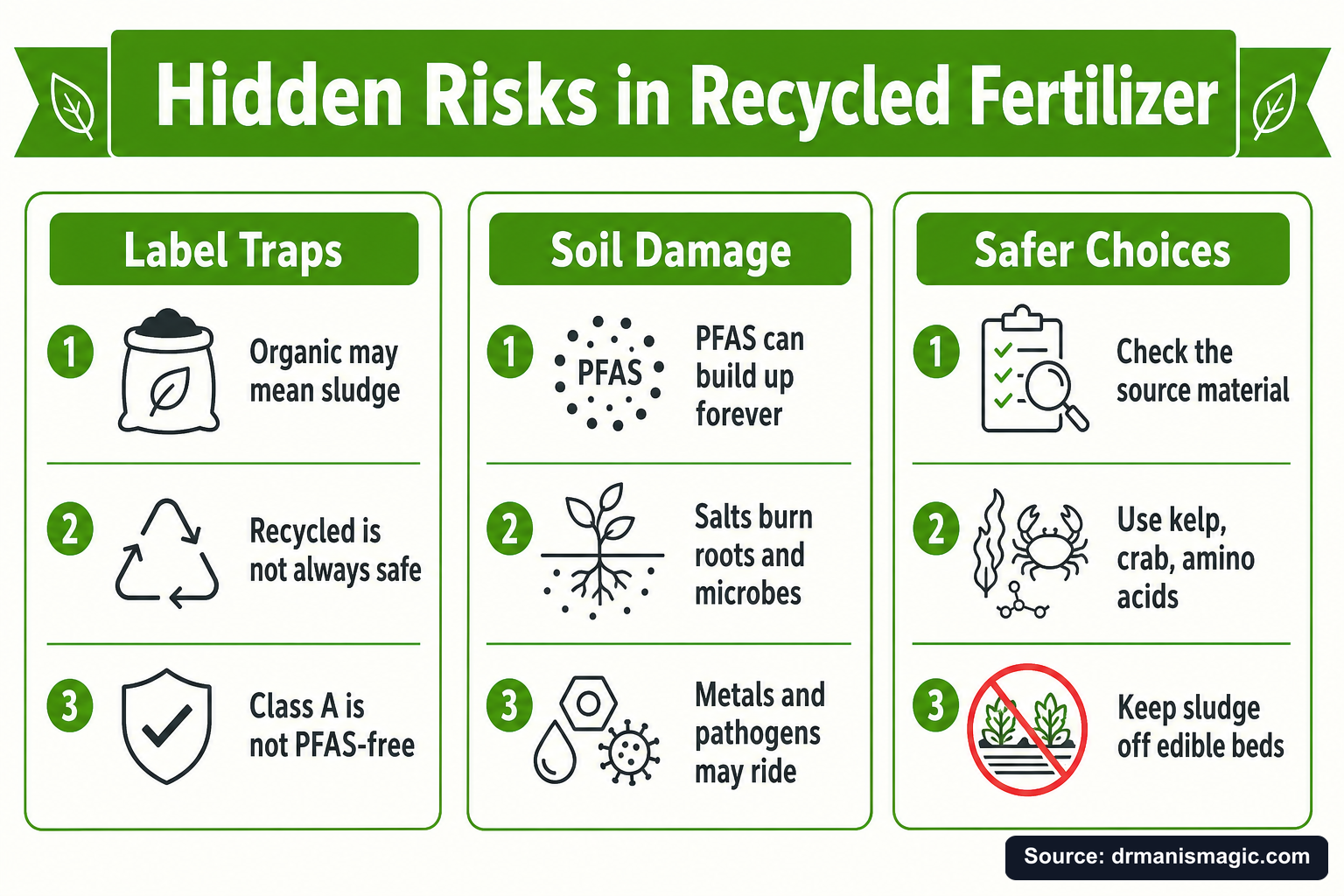
- Waste-derived fertilizers are not automatically safe just because they are labeled "organic," "natural," or "recycled."
- Municipal biosolids (sewage sludge) can carry PFAS "forever chemicals," heavy metals, and pathogens — especially risky in edible gardens.
- Salt-based inputs — synthetic or organic — can burn roots, kill soil microbes, and trigger a slow plant death that looks like overwatering.
- The real risk is the source material: clean plant- or marine-based inputs like crab shell, kelp, and amino acids are far safer than municipal waste streams.
- Soil microbes are the engine that converts organic matter into plant food. Anything that kills them costs you time, growth, and money you cannot get back.
- Clean, biology-friendly nutrition — the kind that feeds microbes first and plants second — is the foundation of Dr. Mani's Magic's Three Plant Pillars system.
- You can learn to read a fertilizer label and rank inputs by risk. This guide shows you how.
What Are Waste-Derived Fertilizers and Why Should You Care?
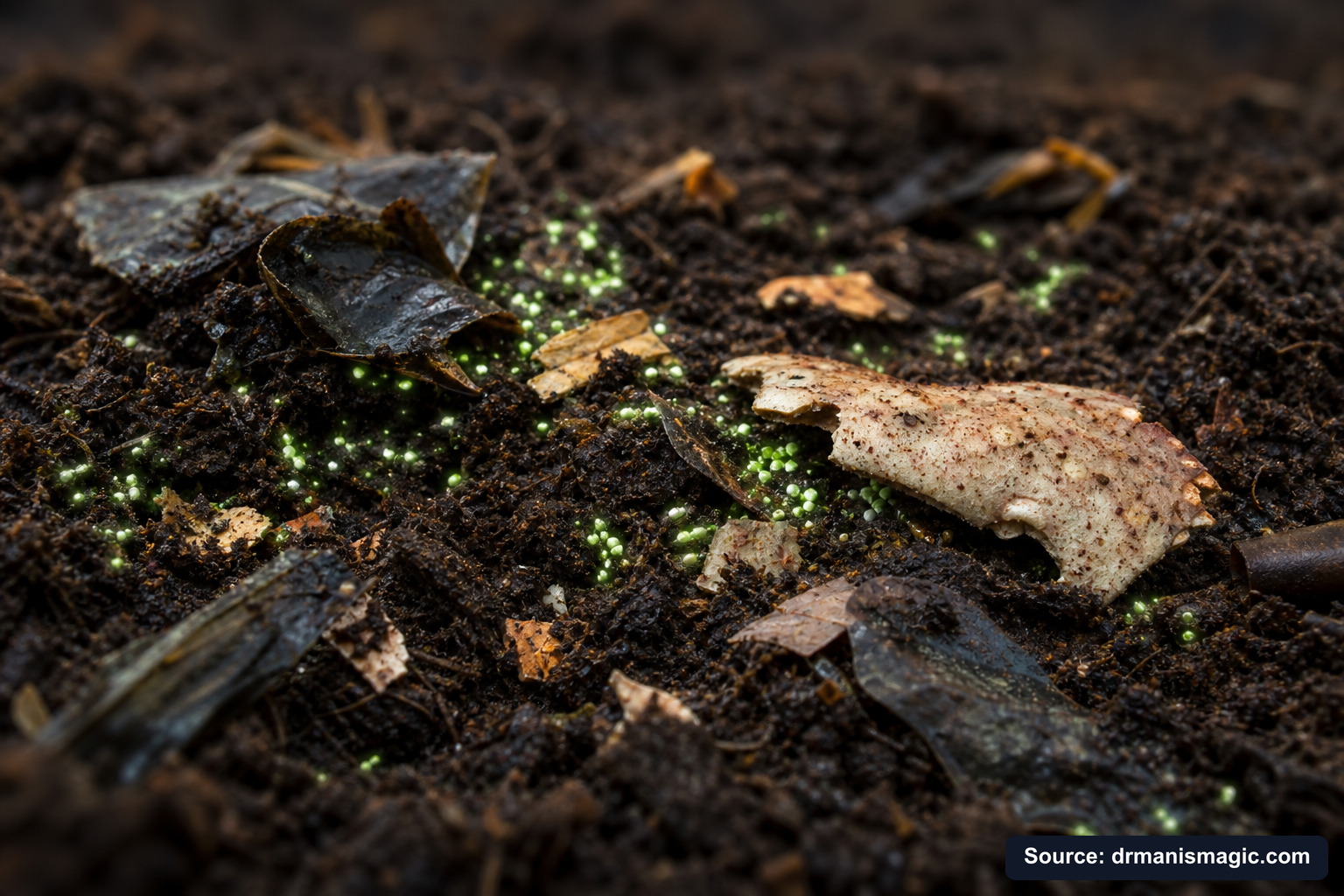
Quick Answer: Waste-derived fertilizers are made from recycled organic materials like sewage sludge, manure, food scraps, and industrial byproducts. They can be helpful or harmful depending on what is actually in them. The word "organic" or "recycled" on the label does not mean the product is free of salt, PFAS, heavy metals, or pathogens.
Waste-derived fertilizer is any fertilizer made from recycled biological material. That sounds like a good thing. And sometimes it is. Compost from clean yard waste or food scraps can be wonderful for soil. But the category is enormous. It includes materials ranging from carefully composted wood chips all the way to treated municipal sewage sludge — and everything in between.
Here is the part that surprises most gardeners. The word "organic" on a fertilizer bag does not tell you what the source material is. It just means the nutrients come from carbon-based compounds rather than synthetic chemistry. A product made from treated human waste can legally carry the word "organic." So can one made from clean kelp or crab shells. The word alone tells you almost nothing about safety.
The gap between those two products is enormous. And your lawn, your fruit trees, your vegetable beds, and the soil microbes living under all of it feel that difference. That is why source material matters so much. That is the whole story.
| Fertilizer Source | Nutrient Release Speed | Salt Risk | PFAS Risk | Pathogen Risk | Heavy Metal Risk | Best Use |
|---|---|---|---|---|---|---|
| Municipal Biosolids (Sewage Sludge) | Medium | Medium | HIGH | Medium (Class A) to High (Class B) | Medium to High | Non-edible ornamental land only, with caution |
| Manure Compost | Medium-Slow | Medium | Low | Low (if hot-composted) | Low | Garden beds, lawns, trees |
| Yard-Waste Compost | Slow | Very Low | Very Low | Very Low | Very Low | All uses including edible gardens |
| Food-Waste Compost | Slow | Low | Low | Low (if properly processed) | Low | Most garden uses |
| Feather Meal / Amino Acids | Slow | Very Low | Very Low | Very Low | Very Low | All uses — excellent for trees and gardens |
| Crab Shell / Chitin | Slow | Very Low | Very Low | Very Low | Very Low | All uses — excellent for pest resistance |
| Kelp Extract | Slow | Very Low | Very Low | Very Low | Very Low | All uses — excellent biostimulant |
| Synthetic Salt-Based Fertilizer | Very Fast | VERY HIGH | Low | None | Low | Short-term green-up only — damages microbes and roots |
What Exactly Are Biosolids and Why Do They Concern Scientists?
Quick Answer: Biosolids are the solid material left over after treating municipal wastewater — essentially processed sewage sludge. They can contain PFAS "forever chemicals," heavy metals, and drug residues depending on what entered the wastewater system. "Class A" means pathogens have been reduced, but it does not mean the product is PFAS-free.
Biosolids start in the sewer system. Every city collects wastewater from homes, hospitals, factories, and streets. That water gets treated at a wastewater plant. What is left over — the solid material — is called biosolids, or more plainly, sewage sludge. It gets dried, processed, sometimes pelletized, and sold or given away as fertilizer.
Now, there is real nitrogen and phosphorus in there. Plants can use it. That is the benefit side of the story. And for decades, using biosolids on agricultural land seemed like a smart recycling solution. The EPA created a rating system. "Class A" means pathogens like E. coli and Salmonella have been reduced to safe levels. "Class B" means they have not been fully eliminated. You will see terms like "Exceptional Quality" on retail bags, which sounds reassuring.
But here is what the rating system was never designed to catch. PFAS.
PFAS stands for per- and polyfluoroalkyl substances. These are man-made chemicals used in non-stick cookware, food packaging, firefighting foam, waterproof clothing, and hundreds of industrial products. They enter the wastewater system constantly. And because they do not break down — ever — they concentrate in biosolids. The EPA's own research has found PFAS in biosolids samples across the country. According to Penn State Extension, there is growing concern about PFAS accumulation in agricultural soils where biosolids have been repeatedly applied over many years.
Class A does not mean PFAS-free. Exceptional Quality does not mean PFAS-free. Those ratings were designed for pathogen control. They say nothing about forever chemicals. That is the gap. That is what the bag does not tell you.
For lawns and non-edible ornamentals, the risk calculus is different than for vegetable gardens and fruit trees where you eat what grows. If you are growing food — especially root vegetables or low-growing crops — biosolid-based fertilizers deserve real caution. Not panic. Just clear-eyed caution and better options.
How Does Salt in Fertilizer Actually Kill Your Plants?
Quick Answer: Salt in fertilizer pulls water away from plant roots through a process called osmotic stress. The roots try to drink but the water moves the wrong direction, out of the root and into the salty soil. The plant wilts, the root tips burn, and the soil microbes that protect your plants start dying. It looks like drought, but watering more makes it worse.
Picture a pickle. A cucumber goes into brine and shrivels up. That is salt pulling water out. The same physics happens in your soil when fertilizer salt concentration gets too high. University of Maryland Extension describes this as osmotic stress — the technical term for what happens when dissolved salts in the soil water exceed the concentration inside the root cells. Water moves toward higher salt concentration. So instead of flowing into the roots, it flows out.
Your plant is surrounded by water and still dying of thirst. That is physiological drought. And it is one of the most misdiagnosed problems in home gardening.
The symptoms look just like underwatering. Wilting. Brown leaf tips. Leaf scorch on the margins. Plants that droop even when the soil is moist. Most people see this and water more. Watering more into salty soil makes the problem worse, not better. The salt is already there. More water just spreads it deeper into the root zone.
Now here is the part that really matters for your long-term garden health. Salt does not just stress the plant. It kills the microbes. The bacteria and fungi living in your soil — the ones that unlock nutrients, fight off Pythium and Phytophthora root rot, and build the structure of healthy soil — they are extraordinarily sensitive to salt. Iowa State Extension research confirms that high-salt fertilizers disrupt the microbial communities that are essential to soil function. When the microbes die, the soil stops working. Nutrients lock up. Roots have no protection. Disease moves in.
You can get your money back. You cannot get your time back. Every season you spend fighting a salt-damaged root zone is a season your trees are not producing, your lawn is not lush, and your garden is not giving you what you planted it for.
See also: How Salt-Based Feeding Quietly Destroys Root Systems
| Symptom | Salt Damage | True Overwatering | Root Rot (Pythium / Phytophthora) |
|---|---|---|---|
| Leaf wilting | Yes — even in moist soil | Yes — soil stays wet | Yes — soil often wet or was wet |
| Brown leaf tips or margins | Yes — classic symptom | Possible but less common | Possible in advanced stages |
| Soil condition | Can be dry or moist | Wet, soggy | Often has poor drainage |
| Root appearance | Burned root tips, brown edges | Pale, soft, mushy | Dark brown or black, rotten smell |
| Watering more helps? | No — makes it worse | No — makes it much worse | No — makes it much worse |
| Recovery approach | Flush soil, switch to low-salt input | Let dry out, improve drainage | Improve drainage, add beneficial microbes |
| Microbial involvement | Salt kills microbes, disease follows | Microbes struggle without oxygen | Pathogenic microbes overwhelm beneficial ones |
Why Do Soil Microbes Matter More Than Any Fertilizer You Can Buy?
Quick Answer: Soil microbes are the living engine that converts organic matter into plant food. Without them, nutrients lock up, roots have no defense against disease, and your soil becomes dead chemistry. With them, plants get a steady, natural trickle of nutrition that no bottle of synthetic fertilizer can replicate.
Here is something most gardening advice skips right over. Plants do not actually eat fertilizer. Not directly. They eat what microbes make from fertilizer.
Think of it this way. You can pour a pile of raw grain on the table in front of someone, but they cannot eat grain kernels whole and get much from it. It has to be processed first. Ground into flour, cooked, transformed. Microbes do that same transformation for your plant roots. They eat organic matter. They break it down. They convert it into simple mineral forms — nitrogen as ammonium and nitrate, phosphorus as soluble phosphate — that plant roots can actually drink in.
Wisconsin Extension describes this process as mineralization — the microbial conversion of organic nitrogen into plant-available forms. It happens at a pace that matches how plants naturally feed. A little at a time. Steady. Reliable. Not a flood, not a drought. Just a consistent trickle that keeps roots healthy and growth strong.
And when those microbes die? They release everything they stored. Every bit of nutrition they were holding gets dumped right into the root zone for the plant to use. It is a living, self-renewing time-release system that nature designed over millions of years.
Salt kills that system. Not slowly. Fast. High-salt fertilizers — whether synthetic or from certain waste-derived sources — wipe out the microbial community the way bleach wipes out bacteria on a countertop. What is left is chemically dead soil. Nutrients do not move. Roots do not have allies. Pythium and Phytophthora — the root rot pathogens — love dead soil because there is nothing to fight them off.
Dr. Mani Skaria, founder of US Citrus Nursery and a Professor Emeritus of Plant Pathology with over 40 years of research at the Texas A&M Citrus Center, spent decades watching this play out in real trees. The pattern was always the same. Salt goes in. Microbes die. Roots weaken. Disease follows. The tree struggles for a season or two, then collapses. And the gardener never knew why because the bag said "fertilizer" and fertilizer is supposed to help.
That is the conspiracy Dr. Mani talks about. Not a dramatic one. Just a quiet, profitable one. Companies that sell salt-based products benefit when your plants keep struggling. Every new bag you buy is revenue for them. Every dead tree is a new tree sale. The system works perfectly — for them.
What Is the Difference Between Biosolid-Based Organic Fertilizer and Clean Organic Fertilizer?
Quick Answer: The difference is the source. Biosolid-based fertilizers come from treated municipal sewage and can carry PFAS, heavy metals, and pharmaceutical residues. Clean organic fertilizers — like those made from crab shell, kelp, feather meal, and amino acids — come from tightly controlled food and marine sources with none of those contamination risks.
This is the question most gardeners never think to ask. They see "organic fertilizer" and assume all organic fertilizers are roughly equal. They are not.
Some organic fertilizers use biosludge — processed municipal waste — as a filler or primary nitrogen source. It is cheap. It is abundant. And it carries everything that went down the drain of every home, hospital, factory, and business connected to that municipal sewer system. Pharmaceuticals. Industrial chemicals. PFAS compounds that were used in manufacturing, packaging, and firefighting foam. These do not all get removed in the treatment process. What does not break down concentrates in the solids.
The bag may say "organic." It may say "slow-release." It may not mention biosolids at all, because labeling requirements are not always clear. Utah State Extension notes that consumers rarely have access to feedstock documentation when buying bagged retail fertilizers, which makes it genuinely difficult to know what you are putting in your garden.
Clean organic fertilizers use entirely different source materials. Crab shell is a byproduct of the seafood industry — a controlled food stream. Kelp is harvested from ocean water. Feather meal comes from poultry processing. Amino acids are derived from carefully sourced animal proteins. These materials go through tight supply chains where contamination is minimal and traceable.
The difference is not abstract. If you are growing food, the difference between those two categories is the difference between building healthy soil and slowly introducing compounds that do not break down into the ground where your vegetables grow and your children play.
At Dr. Mani's Magic, our Crab, Kelp & Amino Acids fertilizer contains zero biosludge, zero PFAS, and zero synthetic salts. That is not a marketing claim. It is a design principle. We built it for our own 250,000-tree nursery, and we would not put anything in our soil that we would not want in yours.
You Never Had a Brown Thumb.
You were handed the wrong tools. This free guide hands you the right ones.
You watered it. You fed it. It died anyway.
It was never you. It was the dirt, the salt food, and the bad advice.
This guide shows you what really went wrong, and how to fix it for good.
- Why your plants really died, and why it was never your fault
- The salt hiding in your plant food that quietly burns the roots
- The hidden killer in almost every bag of store soil
- The tiny helpers that grow a whole forest for free
- The rescue trick that brings a half dead plant back to life

What Does Chitin from Crab Shell Actually Do for Your Soil?
Quick Answer: Chitin is a natural compound found in crab shells that triggers a defense response in plant roots. When soil microbes break chitin down, the process activates the plant's immune system against fungal pathogens and soil pests. It also feeds beneficial microbes, strengthens cell walls, and adds calcium and magnesium to the soil.
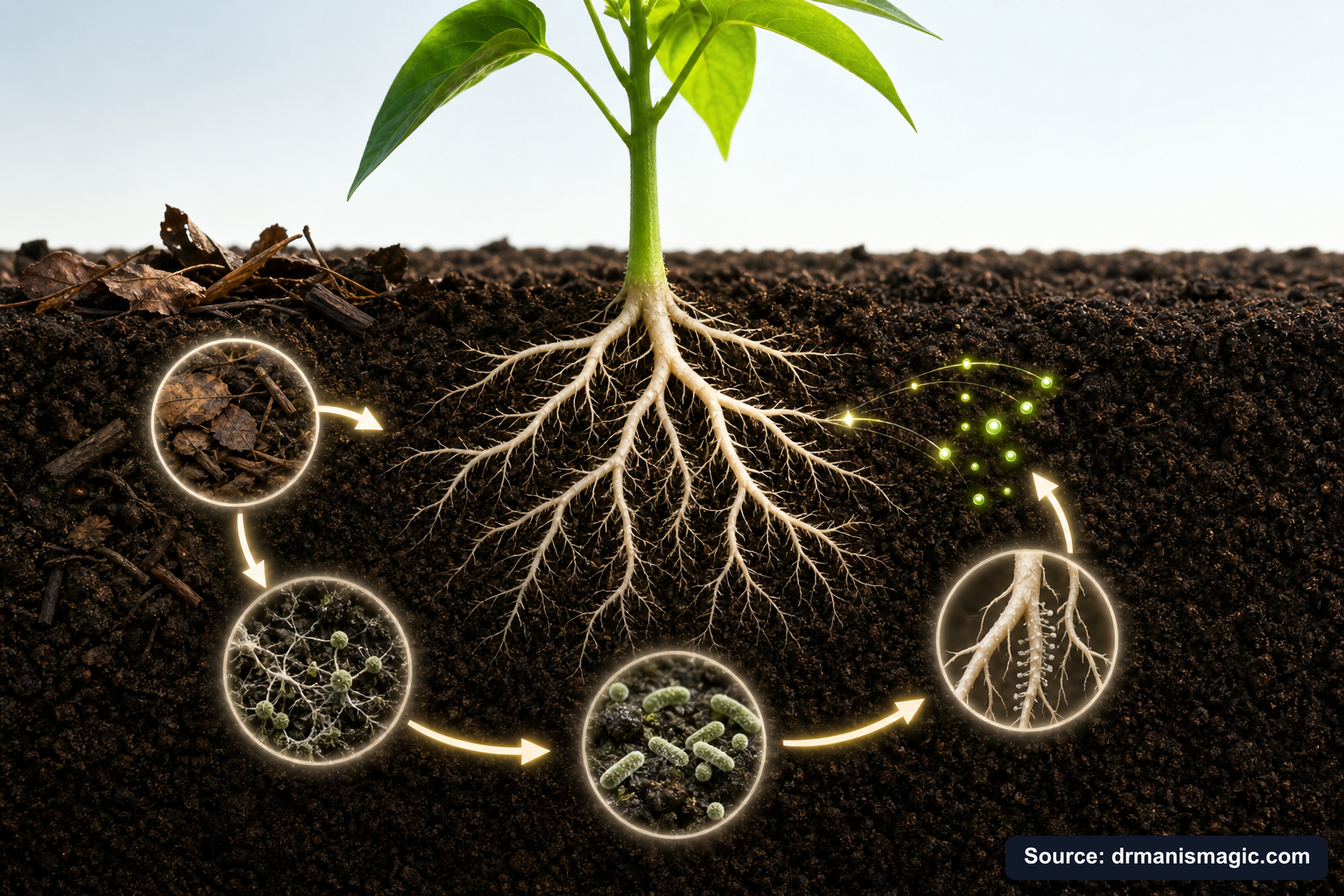
Chitin is one of the most underrated inputs in all of organic gardening. It is the same compound that makes up the shells of crustaceans and the cell walls of fungi. And when you add it to your soil, something remarkable happens.
Soil microbes recognize chitin as food and start breaking it down. That process releases compounds that signal plant roots to activate their natural defense systems. The plant's immune response kicks on. It starts producing enzymes that suppress fungal pathogens — including some of the same ones that cause root rot. Meanwhile, the breakdown of chitin directly feeds populations of beneficial bacteria that protect the root zone.
Crab shell is also rich in calcium — the mineral that builds the woody structural mass of plants — and magnesium, which sits at the center of every chlorophyll molecule. Without magnesium, photosynthesis slows. Without calcium, cell walls weaken and fruit quality drops. Crab shell delivers both in a slow, steady form that does not burn roots or spike soil salt levels.
Think of chitin as both food and medicine for your soil. It feeds the right microbes. It arms your plants. It builds the woody structure that makes trees strong enough to hold heavy fruit. And it does all of this while releasing nutrients so gently that there is almost no risk of over-application.
Why Is Kelp Called a Biostimulant and What Does That Mean for Your Plants?
Quick Answer: Kelp contains natural plant hormones called auxins and cytokinins that trigger root growth, cell division, and stress recovery. It also carries dozens of trace minerals, carbohydrates that feed microbes, and compounds that help plants tolerate drought, cold, and disease. These effects go beyond simple nutrition — kelp activates biological processes that fertilizer salts cannot touch.
Kelp is not just a nutrient source. It is a biological signal. That is what makes it a biostimulant rather than just a fertilizer ingredient.
Cold-processed kelp — extracted at low temperatures to preserve the active compounds — contains auxins, which are plant hormones that drive root elongation and branching. More roots mean more surface area for water and nutrient uptake. More roots mean better drought tolerance and faster establishment after transplanting. Kelp also contains cytokinins, which promote cell division and slow the aging of leaves. Plants that receive kelp regularly tend to hold their leaves longer, recover from stress faster, and push new growth more vigorously.
Beyond the hormones, kelp carries a broad spectrum of trace minerals from ocean water — elements that are often depleted in modern soils but essential for enzyme function, immune response, and fruit quality. And the natural carbohydrates in kelp feed beneficial soil microbes directly, acting as a prebiotic for your root zone.
None of these effects come from a salt-based synthetic fertilizer. You cannot synthesize auxins cheaply and put them in a bag of ammonium nitrate. The complexity is what makes kelp irreplaceable as a garden input. It works at a biological level that chemistry alone cannot reach.
What Are Amino Acid Fertilizers and Why Do Plants Prefer Them?
Quick Answer: Amino acids are the building blocks of protein. When used as a nitrogen source in fertilizer, they provide nitrogen in a form plants can absorb directly through their roots without waiting for microbial conversion. They also feed soil microbes, support enzyme function inside the plant, and carry no salt load that could burn roots or damage the soil food web.
Most nitrogen sources in conventional fertilizers are salt-based — ammonium nitrate, urea, ammonium sulfate. These release nitrogen fast, flood the root zone, and carry a high salt index that stresses roots and microbes simultaneously. They work the same way a sugar rush works in a child. Fast energy spike, crash, and damage over time.
Amino acid nitrogen works differently. Plants have root transport proteins specifically designed to absorb certain amino acids directly. That means the plant can skip the microbial conversion step entirely for a portion of its nitrogen needs, absorbing usable nitrogen the moment it encounters it. At the same time, amino acids also feed soil microbes, which convert them at their own pace and release additional nitrogen over weeks.
The result is a dual feeding system. Fast enough to see results. Slow enough to last. And gentle enough that the salt index stays low, the microbes stay alive, and the root zone stays healthy.
Amino acid fertilizers derived from feather meal and similar clean animal protein sources carry no PFAS risk, no biosludge contamination, and no synthetic salt load. They work with your soil biology, not against it. That is why they are a cornerstone of the Three Plant Pillars approach that Dr. Mani developed and tested across more than 250,000 trees at US Citrus Nursery in South Texas.
See also: Why Most Fertilizers Are Actually Salt in Disguise
How Do You Read a Fertilizer Label to Spot Hidden Risks?
Quick Answer: Look for the words "biosolids," "sewage sludge," "municipal waste," "derived from wastewater solids," "Class A," or "Exceptional Quality" — these signal a municipal waste origin and possible PFAS risk. Also check the salt index if listed. If the label does not disclose feedstock sources, that absence is itself a warning sign.
Most fertilizer bags are designed to sell the product, not inform you about it. The front of the bag has photographs of lush gardens and bold nutrient numbers. The ingredient list is on the back in the smallest legal type size. And even then, the language is often vague enough to obscure the actual source.
Here is a practical checklist for reading any fertilizer label before you buy.
- Find the ingredient or derived-from list. It will say things like "derived from feather meal, crab meal, kelp meal" — those are clean sources. Or it will say "derived from biosolids, municipal waste, or sewage sludge" — those carry PFAS risk.
- Look for "Class A" or "Exceptional Quality." These are EPA designations for pathogen reduction in biosolids. They do not indicate PFAS testing or safety.
- Check for a salt index or soluble salts percentage. Higher numbers mean higher burn risk. Organic inputs made from crab, kelp, and amino acids typically have very low salt indexes.
- Look for third-party certification. OMRI listing (Organic Materials Review Institute) means an independent body reviewed the ingredients. It is not a guarantee of PFAS safety, but it does mean the product met organic standards.
- Ask the manufacturer directly. If a company cannot or will not tell you whether their product contains biosolids or has been tested for PFAS, that is your answer.
- Prioritize clean source transparency. Companies that use crab shell, kelp, and amino acids from food-grade sources can usually name exactly where those ingredients come from. That transparency is a trust signal.
Synthetic vs. Slow-Release vs. Clean Organic: Which One Actually Builds Healthy Soil?
Quick Answer: Synthetic fast-release fertilizers deliver a salt-heavy nutrient flood that burns microbes and roots. Slow-release synthetics are better but still salt-based and often coated in plastic. Clean organic fertilizers — from sources like crab, kelp, and amino acids — feed microbes first, release nutrients steadily over time, and build long-term soil health that no salt-based product can match.
This is the core comparison every gardener deserves to understand before they spend another dollar on fertilizer.
| Feature | Synthetic Fast-Release | Slow-Release Synthetic (Coated) | Clean Organic (Crab / Kelp / Amino Acids) |
|---|---|---|---|
| Nutrient release speed | Immediate flood | Timed, weeks to months | Steady, microbe-mediated trickle |
| Salt content | Very High | Medium to High | Very Low |
| Effect on microbes | Kills beneficial microbes | Reduces microbial populations | Feeds and supports microbes |
| Root burn risk | High — osmotic stress, physiological drought | Low to Medium | Very Low |
| PFAS / biosludge risk | Low (but some contain fillers) | Low to Medium | Zero (clean source material) |
| Plastic residue in soil | No | Yes — polymer coating fragments remain | No |
| Long-term soil health | Declines over time | Neutral to slight decline | Improves continuously |
| Biostimulant activity | None | None | Yes — hormones, chitin, kelp compounds |
| Safe for edible gardens | With caution | With caution | Yes |
| Safe for children and pets around soil | No — chemical exposure risk | Moderate concern | Yes |
The slow-release synthetic category deserves a special mention here. It sounds like the responsible middle ground. And compared to fast-release salt fertilizers, it is less immediately destructive. But most slow-release synthetics are still salt-based nutrients encased in a polymer coating — a thin plastic shell that meters out the salts over time. That plastic breaks into microplastic fragments that stay in your soil. Indefinitely. And the nutrients inside are still salts. They are just delivered more slowly.
The clean organic approach is fundamentally different. It is not slower chemistry. It is biology. The microbes eat the organic matter, convert it, and release it. When those microbes die, they add to the nutrient pool. The whole system self-renews. It is the way soil has always worked before anyone invented a fertilizer bag.
See also: The Hidden Reason Synthetic Fertilizers Cause Root Rot
What Should You Do If Your Soil Has Already Been Exposed to High-Salt or Waste-Derived Inputs?
Quick Answer: Recovery is possible. The steps are to flush excess salts, stop adding the damaging input, reintroduce beneficial microbes, switch to a clean low-salt organic fertilizer, and give the soil biology time to rebuild. Most root zones can recover within one to three months when the right inputs are applied consistently.
You cannot undo years of salt damage overnight. But you can absolutely reverse it. Here is the recovery path we have seen work across thousands of trees and gardens at our South Texas nursery.
- Stop the damaging input immediately. Whatever you have been using that is salt-heavy or biosludge-based, stop. Every additional application makes the recovery harder and longer.
- Flush the root zone. Water deeply and slowly — more than you normally would — for two to three waterings. This dilutes and pushes accumulated salts down below the active root zone. Do not do this if drainage is already poor, as it will make conditions worse. Fix drainage first.
- Check and improve soil structure. Compacted, poorly draining soil holds salts and keeps them in contact with roots. A mineral-based soil structure with good aeration allows salts to flush and gives roots room to recover. See our Super Soil for how we address this at the foundation level.
- Reintroduce beneficial microbes. The microbes that protect roots and cycle nutrients have been depleted. Adding live bacteria, fungi, and mycorrhizae gets the biological engine running again. Use a liquid microbial drench — like our Plant Super Boost — applied to the root zone monthly.
- Switch to a clean, low-salt organic fertilizer. Begin feeding with a product that has no biosludge, no synthetic salts, and a very low salt index. Give the microbes something clean to work with.
- Be patient and consistent. Root zone recovery is biological. It takes weeks, not days. One month in you should see new growth. Two to three months in the plant should be noticeably more vigorous. Keep the inputs consistent and let the biology do its work.
One more thing. If you suspect PFAS contamination from repeated biosolid applications in a vegetable garden or fruit tree bed, the recovery picture is more complicated. PFAS do not flush out the way salts do. In that situation, the most practical approach for edible plantings is to switch to raised beds with clean imported soil and clean inputs going forward. The existing ground can continue to be used for ornamentals where food safety is not a concern.
How Do the Three Plant Pillars Protect You From All of These Hidden Risks?
Quick Answer: The Three Plant Pillars — mineral-based soil, live microbes, and clean organic fertilizer — work together to create a root environment that naturally resists salt damage, disease, and nutrient lockup. When all three are in place, your plants have a foundation that no waste-derived input or synthetic fertilizer can match for long-term health and productivity.
Dr. Mani Skaria developed the Three Plant Pillars framework after decades of watching what happened when any one of these elements was missing. He did not develop it as a marketing concept. He developed it because he needed to keep 250,000 trees alive and productive in the challenging conditions of South Texas — alkaline soil, high heat, variable rainfall, and a market that kept pushing salt-based products as the easy answer.
The first pillar is mineral-based soil. Not potting mix made from decomposing pine bark. Real mineral soil — sandy loam with stable structure — that does not compact, does not steal oxygen from roots as it breaks down, and does not create the waterlogged conditions where Pythium and Phytophthora thrive. Permanent structure means permanent drainage. Permanent drainage means roots can breathe. Roots that breathe are roots that fight off disease.
The second pillar is live microbes. Bacteria, fungi, and mycorrhizae that colonize the root zone and become the biological immune system of your plant. They unlock bound nutrients. They crowd out pathogens. They build the microscopic channels in soil that move water and air. Without this pillar, the third pillar cannot work properly because there is nothing to convert organic fertilizer into plant food.
The third pillar is clean organic fertilizer. Not biosludge. Not salt-based synthetics. Inputs with known, clean source material — crab shell for chitin, calcium, and magnesium; cold-processed kelp for hormones, trace minerals, and microbial food; amino acids for gentle, direct nitrogen that both feeds the plant and nourishes the microbes.
When all three are working together, the root zone becomes nearly self-sustaining. Microbes feed on the organic fertilizer. They convert it into plant food. They protect the roots. The roots grow into good mineral soil with proper drainage. The plant gets steady nutrition, strong immunity, and the structural support to hold fruit, survive stress, and reward you season after season.
That is what gardening is supposed to feel like. Not chasing problems. Not buying another bag hoping this one fixes what the last one caused. Just watching things grow the way they are supposed to grow.
You can get money back. You cannot get time back. The number one thing people tell Dr. Mani they want is to see their trees bearing fruit while they still have the energy to enjoy them. Every season spent fighting salt damage, root rot, or contaminated soil inputs is a season that goal moves further away. The foundation matters. Build it right from the beginning, and everything else gets easier.
For a deeper look at how soil structure protects your root zone from all of these risks, visit our Free Plant Care Field Guide — it walks you through the complete system in plain language with no guesswork.
The Bottom Line: What to Put in Your Soil and What to Leave on the Shelf
The hidden risk of waste-derived fertilizers is not that recycling is bad. Recycling organic matter back into the soil is one of the oldest and most natural things in the world. The risk is in the source. Municipal biosolids concentrate everything that went through the sewer system — including PFAS compounds that do not break down and heavy metals that accumulate over time. "Class A" and "Exceptional Quality" ratings address pathogen levels, not forever chemicals. The label terms "organic," "natural," "recycled," and "slow-release" can all appear on a bag that contains biosludge.
Salt — whether from synthetic fertilizers or certain waste-derived products — kills the soil microbes that make your entire garden work. Without those microbes, nutrients lock up, roots become defenseless against Pythium and Phytophthora, and the soil slowly dies. The plant follows.
Clean inputs from known sources — crab shell, cold-processed kelp, amino acids from food-grade proteins — carry none of those risks. They feed the microbes first. The microbes convert them into plant food. The whole system runs at the natural pace plants prefer, with a steady trickle of nutrition that builds soil health instead of depleting it.
That is the system Dr. Mani built. That is the system we have tested on over 250,000 trees. And that is the system that is available to you — whether you are growing citrus in a container, managing an ornamental garden, running a lawn, or tending houseplants in an apartment.
If you want to see what clean, biology-first nutrition looks like in practice, take a look at what we put into Crab, Kelp & Amino Acids. Zero biosludge. Zero PFAS. Zero synthetic salts. A complete nutrient profile with real biostimulants — designed for every plant you grow, backed by decades of hands-on nursery science, and guaranteed to work within 30 days or we refund every penny. No whining. No excuses. Just results.
Frequently Asked Questions
If you are worried about what is really in your fertilizer bag, you are asking the right questions. After 30 years and 250,000 trees grown in South Texas, Dr. Mani has seen firsthand how the wrong inputs quietly destroy soil, roots, and years of hard work. These are the questions gardeners ask most, and you deserve straight answers.
What exactly is a waste-derived fertilizer?
A waste-derived fertilizer is made from recycled biological material. That can mean clean yard compost or it can mean treated municipal sewage sludge. Both can legally carry the word "organic" on the label. The word tells you nothing about what is actually inside. Source material is everything. Clean inputs like crab shell, kelp, and amino acids are completely different from processed human or industrial waste, even if the bag looks the same at the store.
Does the USA use human waste as fertilizer on farms and lawns?
Yes. In the USA, treated human waste used in agriculture is officially called biosolids. It goes through processing to reduce pathogens, and the EPA classifies the cleanest grade as Class A. But processing does not remove PFAS forever chemicals or all heavy metals. Some biosolid-based fertilizers are sold directly to homeowners and spread on lawns and vegetable gardens without most people ever knowing what they are actually applying to their soil.
What are PFAS and why do they matter for my garden?
PFAS are man-made chemicals sometimes called forever chemicals because they do not break down in soil or in your body. They can show up in biosolid-based fertilizers because they pass through wastewater treatment plants unchanged. Once in your soil, they can move into plant tissue and groundwater. This is one of the biggest hidden risks of using fertilizers sourced from municipal waste streams, especially in vegetable beds and fruit tree areas where you eat what you grow.
What are the big three fertilizer nutrients and why does their source matter?
The big three are nitrogen, phosphorus, and potassium, shown as NPK on every bag. Nitrogen drives leafy green growth. Phosphorus builds roots and fruit. Potassium strengthens the whole plant against stress and disease. Those three numbers tell you how much of each nutrient is present, but they tell you nothing about where it came from. Salt-based synthetic sources burn your soil microbes. Clean organic sources like crab shell, kelp, and amino acids feed your microbes first and let them feed your plants naturally, which is exactly what Pillar Three of Dr. Mani's system is built on.
Can salt in fertilizer really kill my plants slowly?
Yes, and it is one of the most common reasons plants stall and decline after a few months of looking fine. Synthetic fertilizers are salt-based. Salt pulls water away from roots and scorches the beneficial bacteria and fungi living in your soil. Without those microbes, your plant loses its ability to absorb nutrients no matter how much fertilizer you add. Dr. Mani saw this cycle repeat across thousands of trees. More fertilizer, worse results. Breaking that cycle is exactly what the Three Plant Pillars are designed to do.
Do countries like Japan and China still use human waste to grow food?
Historically yes, and in some rural areas it still happens today. Japan used human waste as a primary crop fertilizer for centuries. China did the same and still processes and composts human waste for agricultural use in some regions, though modern practices have reduced raw application significantly. These traditions show that recycled nutrients can work, but the safety of the output depends entirely on how the waste is processed and what contaminants it carried to begin with. That is the same issue facing biosolid fertilizers sold in the USA today.
What fertilizer does Dr. Mani's Magic use and why is it safer?
Dr. Mani's Magic uses a crab, kelp, and amino acid organic fertilizer. There is no municipal waste, no biosolids, no synthetic salt, and no plastic-coated slow-release pellets leaching toxins into your soil. Crab shell brings natural chitin that feeds beneficial fungi. Kelp delivers trace minerals and natural growth stimulants. Amino acids give plants bioavailable nitrogen without burning roots or wiping out soil life. It does not smell bad either, which is a real problem with fish emulsion and other common organic options. Every ingredient is sourced from clean, known inputs and made in the USA.
About the Author
Ron Skaria, MD
Ron Skaria, MD, is the co-founder of Dr. Mani's Magic and the son of Dr. Mani. He trained as a medical doctor and now works full time on the family farm in Hargill, Texas, building Dr. Mani's Magic alongside his dad. He wrote the Brown Thumb Field Guide to put his father's 48 years of plant science into plain words any gardener can use. His belief is simple. You never had a brown thumb. You just never had the right help.


