


Food-Grade vs. Waste-Based Organics: What Your Fertilizer Label Hides | Dr. Mani's Magic
The Difference Between Food-Grade and Waste-Based Organics (And Why It Changes Everything You Grow)
Picture this. You're standing in the garden center, bag of fertilizer in your hands. The label says "organic." You feel good about it. You feel responsible. You picture your tomatoes plumping up. Your lemon tree finally setting fruit. Your lawn going that deep, almost embarrassing shade of green.
You get home. You apply it. Weeks pass. Maybe things look okay for a while. Then the leaves start to yellow. A little at first. Then more. You water more. You add more fertilizer. Nothing makes sense. Sound familiar? Here is what nobody told you: the word "organic" on a fertilizer bag can mean almost anything. It can mean cold-pressed kelp and crab shells carefully selected for soil biology. Or it can mean treated municipal sewage sludge. Yes, you read that right. Human waste. Processed and bagged and sitting right next to the tomato cages at your local garden center. And the label is allowed to call it organic.
This is not a scare story. This is the real difference between food-grade and waste-based organics, and once you understand it, you will never look at a fertilizer bag the same way again. After growing more than 250,000 trees at our South Texas nursery, we have seen what clean inputs do versus what waste-stream inputs do. The difference is not subtle. It shows up in your roots, your soil, your fruit, and eventually your family's safety. Let's walk through it together.

Plant Super Boost
Key Takeaways
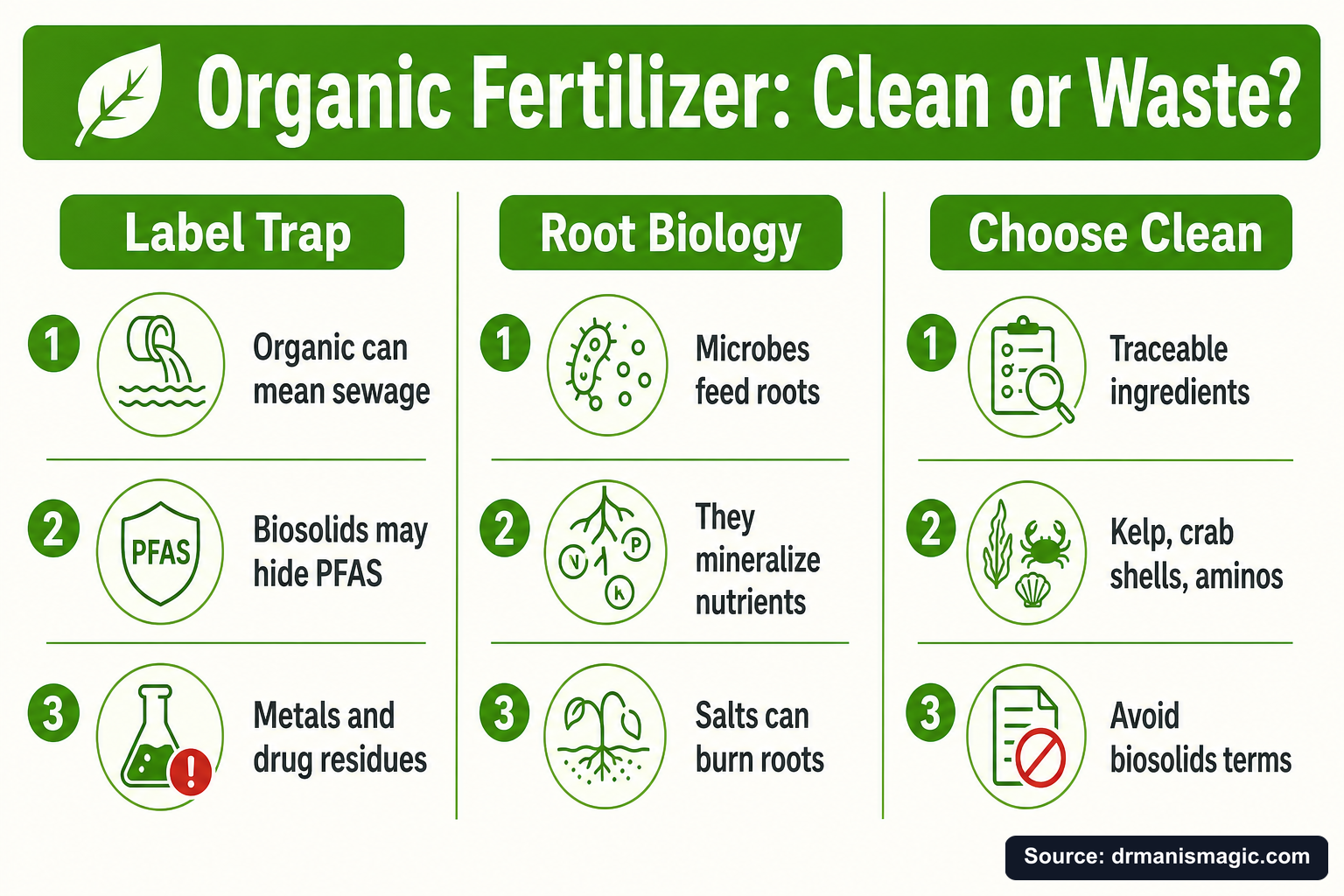
- The word "organic" on a fertilizer label does not guarantee clean, safe, or plant-friendly ingredients.
- Waste-based organic fertilizers can contain biosolids (treated sewage sludge), which may carry PFAS "forever chemicals," heavy metals, and pharmaceutical residues.
- Food-grade or known-input organics use traceable, clean ingredients like crab shells, kelp, and amino acids that feed your soil biology, not just your plants.
- Organic nutrients work through microbial mineralization: microbes eat the material first, then convert it into a form plant roots can absorb. This creates a natural slow-release effect.
- Salt-based synthetic fertilizers and high-salinity composts damage roots, kill beneficial microbes, and can trigger root rot conditions linked to Pythium and Phytophthora.
- You can identify biosolids on a label by looking for terms like "biosolids," "sewage sludge," "activated sewage sludge," "municipal waste," "Class A biosolids," or "EQ biosolids."
- The Three Plant Pillars framework (mineral soil, live microbes, organic fertilizer) only works when the fertilizer input is clean, biology-friendly, and free of synthetic salts and waste-stream residuals.
What Is the Difference Between Food-Grade and Waste-Based Organics?
Quick Answer: Food-grade or known-input organics come from clean, traceable sources like crab shells, kelp, and amino acids. Waste-based organics come from municipal sewage treatment, animal rendering waste streams, or other industrial by-products. Both can be called "organic," but their safety profiles, soil biology effects, and contaminant risks are very different.
The distinction is not about the USDA organic label or even about being plant-derived versus animal-derived. The real question is this: where did this material come from, and what came along with it?
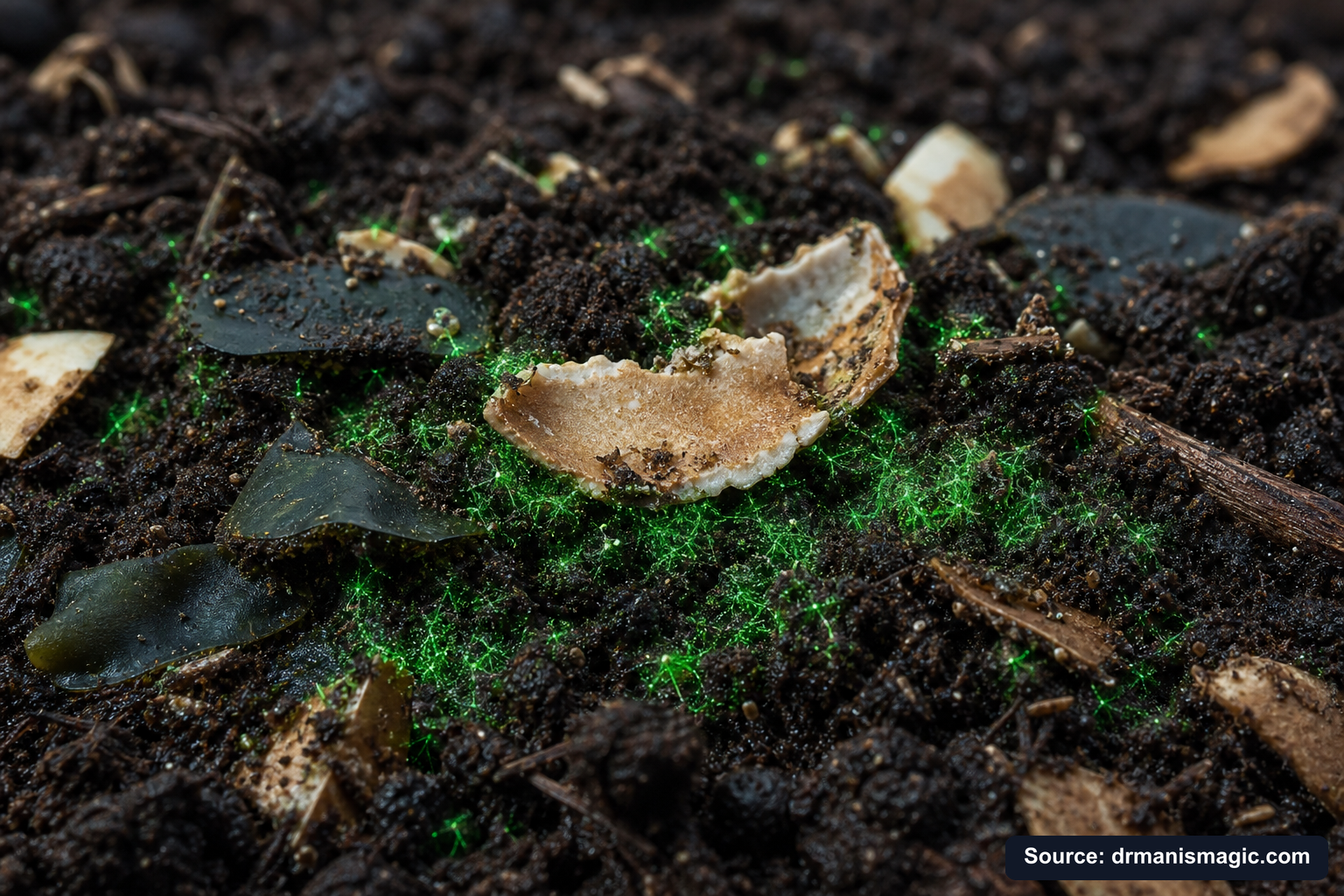
Food-grade organics, sometimes called known-input organics, are made from ingredients with a clear, traceable origin. Think of it like cooking. You know what went into the pot. Crab shells from the seafood industry. Kelp harvested from cold ocean water. Feather meal or amino acids from food processing. These materials carry the nutrients plants need, plus biostimulants and natural compounds that support the living ecosystem in your soil.
Waste-based organics are different. They start at the end of a different process entirely. Municipal wastewater treatment plants take everything that goes down the drain in a city. Industrial chemicals. Pharmaceuticals. Heavy metals. Personal care products. What is left after treatment is called biosolids or sewage sludge. When it passes certain pathogen-reduction standards, it can be sold as fertilizer. It is technically "organic" in the regulatory sense. But the input stream is anything but clean.
The Environmental Protection Agency has classified two grades: Class B biosolids, which still contain detectable pathogens and are mostly restricted to farm fields, and Class A or Exceptional Quality (EQ) biosolids, which have lower pathogen levels and can be sold directly to homeowners. Neither class is tested for PFAS "forever chemicals." Neither class is tested for the full spectrum of pharmaceuticals. And both are legally allowed to carry the word "organic."
That is the gap nobody explains at the garden center.
Why Does the Source Material Matter So Much for Your Roots?
Quick Answer: Plant roots do not just absorb fertilizer. They live inside a web of living microbes that process, convert, and deliver nutrients. Waste-stream inputs can carry salts, heavy metals, and PFAS that damage that microbial web and create the exact conditions that lead to root rot, osmotic stress, and physiological drought.
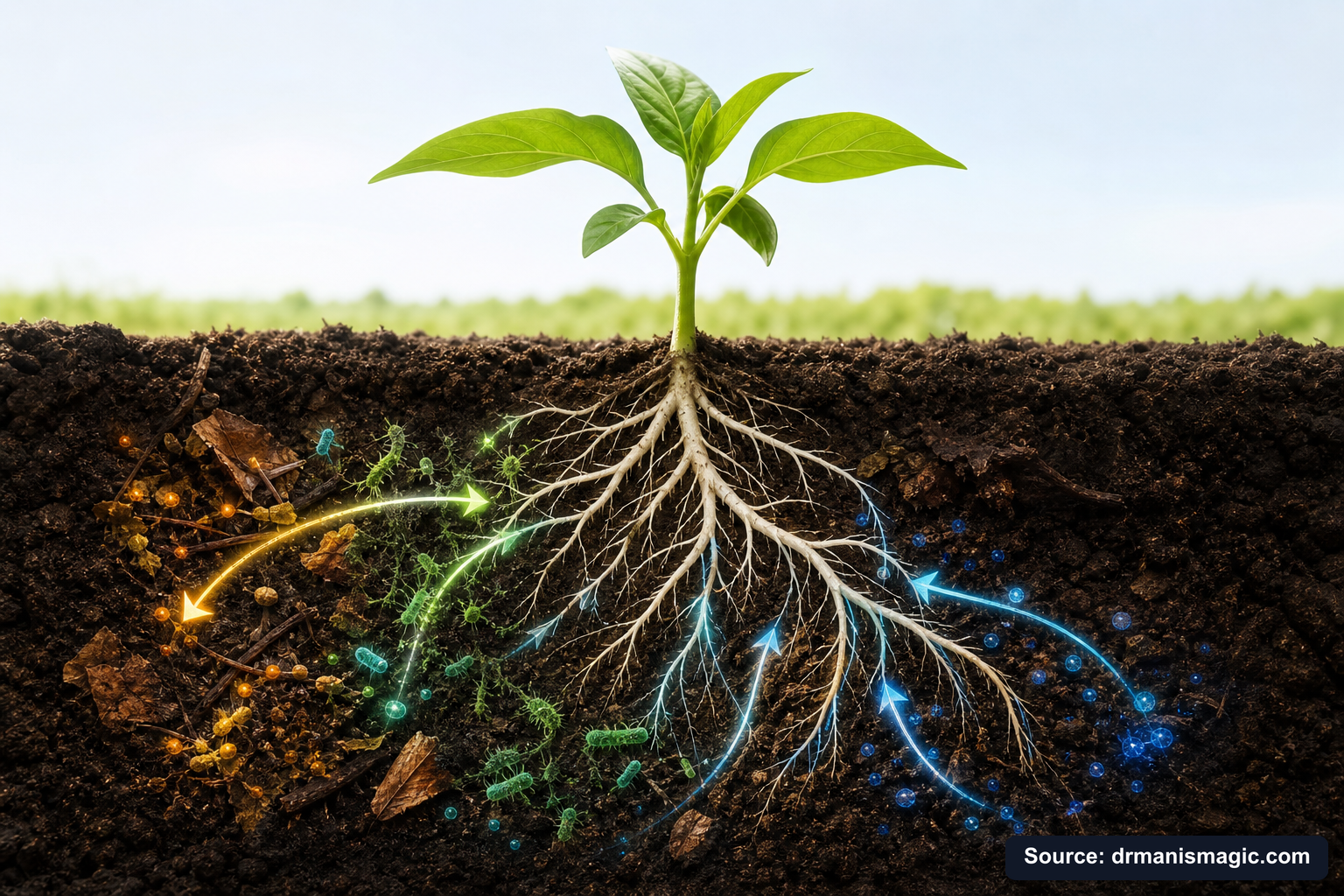
Your roots are not just pipes that suck up water and nutrients. They are living partnerships. Trillions of bacteria and fungi live in and around your root zone. They break down organic materials and convert them into forms your plant can actually use. University of Minnesota Extension describes this process as microbial mineralization: organic nitrogen, phosphorus, and sulfur compounds are converted by soil microbes into simple mineral forms the plant can absorb.
Here is the part most gardeners never hear: organic fertilizer does not feed your plant directly. It feeds the microbes first. The microbes eat the organic material. They convert it. They multiply. And when those microbes die, they release all of that stored nutrition directly into the root zone in a form the plant can grab easily. This is nature's slow-release system. It keeps working long after you put down the fertilizer. Long after you have moved on to other things in the garden. The soil is still feeding your plant.
Now imagine pouring a waste-stream input into that system. Biosolids can carry elevated salt levels. Washington State University Extension notes that high-salinity composts and amendments can increase a plant's susceptibility to root rot organisms like Phytophthora and Pythium. Here is why. When salt concentrations around the root zone get too high, the plant cannot pull water in. Water actually moves out of the root, toward the saltier zone outside. This is called osmotic stress, and it mimics drought even when the soil is wet. Roots shrink. They weaken. And weakened roots in wet soil are exactly what Pythium and Phytophthora are waiting for.
This is not a hypothetical risk. This is a documented mechanism. It is the same reason synthetic salt-based fertilizers cause root rot. The input stream matters because it determines what gets into your root zone alongside the nutrients you wanted.
See also: The Hidden Reason Synthetic Fertilizers Cause Root Rot
How Do You Spot Biosolids on a Fertilizer Label?
Quick Answer: Biosolids are often hidden behind technical or marketing language on fertilizer labels. Look for terms like "biosolids," "sewage sludge," "activated sewage sludge," "municipal waste," "wastewater residuals," "Class A biosolids," "EQ biosolids," or "recycled nutrients." If a label does not name its nitrogen sources explicitly, that is a warning sign worth investigating.
This is where label reading becomes a real skill. The fertilizer industry is allowed to use softer language, and many companies take full advantage of that. Here is a plain-English decoder for the terms you might see.
| Label Term | What It Actually Means | Risk Level for Home Gardens |
|---|---|---|
| Biosolids | Treated municipal sewage sludge | High — PFAS and heavy metal risk; not tested for all contaminants |
| Sewage sludge | Same as biosolids; older regulatory term | High |
| Activated sewage sludge | Biosolids processed with additional aeration | High |
| Municipal waste / municipal residuals | Broad term covering sewage and related treatment by-products | High |
| Wastewater residuals | Another term for biosolids or sludge | High |
| Class A biosolids / EQ biosolids | Pathogen-reduced sludge cleared for retail sale | Moderate to high — still not PFAS tested |
| Recycled nutrients / recycled organics | May include biosolids; check further | Moderate — requires deeper investigation |
| Crab meal / kelp meal / feather meal / amino acids | Known-input, food-grade organic materials with traceable sources | Low — clean input stream, supports soil biology |
The rule is simple. If you cannot trace the nitrogen source to a specific, nameable ingredient, ask questions. A company with clean inputs is proud to name them. Crab shells. Kelp. Feather meal. Amino acids from protein hydrolysis. Those names tell a story. "Recycled organics" tells you nothing.
Our Crab, Kelp & Amino Acids fertilizer names every major input on the label because we have nothing to hide. Zero biosludge. Zero PFAS. Zero synthetic salts. That transparency is part of the product.
What Are PFAS, and Can They Really Get Into My Garden Through Fertilizer?
Quick Answer: PFAS are man-made chemicals called "forever chemicals" because they do not break down in the environment or in the human body. Research from Maine and other states has confirmed that crops grown in biosolids-amended soil can take up PFAS into their tissue. Edible gardens, fruit trees, citrus, and root vegetables are at particular risk of plant uptake.
PFAS stands for per- and polyfluoroalkyl substances. These are industrial chemicals used in nonstick coatings, firefighting foam, food packaging, and hundreds of other products. They end up in wastewater. They concentrate in biosolids. And they do not disappear when the sludge is treated. They just go along for the ride into the bag and into your soil.
The state of Maine made national news when it discovered dairy farms that had used biosolids for years had PFAS contamination in the milk, the soil, and the groundwater. The farms were shut down. This is not an edge case. It is a documented example of what happens when waste-stream inputs accumulate over time in agricultural soil.
For home gardeners, the risk is real and worth taking seriously, especially in edible gardens, vegetable beds, herb gardens, fruit trees, berry patches, and any space where children or pets play in the soil. The EPA has not established a safe level of PFAS in agricultural soils. Testing for PFAS in fertilizer products is not currently required by federal law. That means the only way to protect yourself is to choose inputs with known, clean, traceable sources.
This is one reason we care so deeply about the Three Plant Pillars approach. Pillar Three is not just about slow-release nutrition. It is about clean nutrition. Nutrition that feeds your soil biology rather than poisoning it with industrial residues. You can learn more about the full system at our Three Plant Pillars page.
Food-Grade Organics vs. Waste-Based Organics: A Complete Side-by-Side Comparison
Quick Answer: The clearest way to see the difference is in the source material, safety profile, and soil biology impact. Known-input food-grade organics support the microbial web, carry no PFAS risk, and release nutrients gradually. Waste-based organics come with a variable, often unknown contaminant load and can disrupt the root zone biology they are supposed to help.
| Category | Food-Grade / Known-Input Organics | Waste-Based Organics (Biosolids) |
|---|---|---|
| Source material | Crab shells, kelp, feather meal, amino acids, plant-derived materials | Municipal sewage treatment by-products |
| Nutrient release | Slow, microbe-mediated, steady trickle over weeks and months | Variable; depends on pathogen treatment and material composition |
| Salt risk | Very low; plant can regulate absorption pace | Moderate to high; elevated electrical conductivity common |
| PFAS risk | Negligible with clean, named inputs | Real and documented; no federal testing required |
| Heavy metal risk | Very low with traceable sourcing | Regulated but not eliminated; copper, lead, zinc, cadmium possible |
| Pharmaceutical residues | None with food-grade inputs | Possible; not fully regulated or tested |
| Microbial impact | Feeds and supports beneficial soil bacteria and fungi | May suppress or shift soil microbial communities |
| Burn potential | Almost none; plant regulates uptake pace | Moderate; high-salt batches can cause root damage |
| Odor | Mild, earthy; does not go anaerobic | Can be strong, especially in heat or enclosed spaces |
| Best use cases | Edible gardens, fruit trees, citrus, lawns, houseplants, ornamentals, children's areas, pet areas | Non-edible land, highway revegetation, commercial turf away from edibles |
| Transparency | Named ingredients; traceable sourcing | Often generic label language; source hard to verify |
Why Do Microbes Need Organic Inputs to Do Their Job?
Quick Answer: Soil microbes are the engine that converts organic matter into plant-available nutrients. They need carbon-rich, biologically recognizable inputs as their food source. Clean organic materials like crab shells, kelp, and amino acids are recognizable to soil biology. Waste-stream residuals with high salt or chemical loads can suppress or kill the very microbes plants depend on.
Think of your soil as a living city. Billions of residents. Bacteria, fungi, protozoa, nematodes. They all have jobs. They break things down. They move nutrients. They build structure. They protect roots from disease organisms. This city runs on organic carbon. It runs on proteins and carbohydrates from decomposing organic matter. That is the food that keeps the city going.
When you apply a clean organic fertilizer, you are delivering groceries to that city. The microbes eat the crab chitin. They eat the kelp carbohydrates. They eat the amino acids. They grow. They multiply. And as they work, they convert all of those complex organic molecules into simple mineral forms, ammonium, nitrate, phosphate, potassium, that plant roots can pull in directly. Oregon State University Extension explains this process clearly: nutrient availability from organic sources depends almost entirely on the rate and quality of microbial activity in the soil.
Here is the part that should change how you think about fertilizer timing. When you apply a clean organic amendment, it does not all become available to your plant at once. Some of it gets used right away. Some of it gets incorporated into microbial bodies. When those microbes die, the nutrients inside them are released right into the root zone again. It is a slow, self-regulating, self-repeating cycle. Nature's version of a time-release capsule.
Synthetic salt-based fertilizers short-circuit this entire system. They dump concentrated, immediately soluble nutrients into the soil. That salt spike kills beneficial microbes. It creates a brief green-up. And then the system collapses. The microbes are gone. The soil biology is weakened. The plant becomes dependent on the next synthetic hit just to stay alive. We have watched this cycle play out on thousands of trees over thirty years. It is not a theory. It is a pattern.
See also: How Salt-Based Feeding Quietly Destroys Root Systems
You Never Had a Brown Thumb.
You were handed the wrong tools. This free guide hands you the right ones.
You watered it. You fed it. It died anyway.
It was never you. It was the dirt, the salt food, and the bad advice.
This guide shows you what really went wrong, and how to fix it for good.
- Why your plants really died, and why it was never your fault
- The salt hiding in your plant food that quietly burns the roots
- The hidden killer in almost every bag of store soil
- The tiny helpers that grow a whole forest for free
- The rescue trick that brings a half dead plant back to life

What Does Chitin From Crab Shells Actually Do for Your Plants?
Quick Answer: Chitin is a structural fiber found in crab shells that does several remarkable things in soil. It activates a plant's natural defense system, feeds specific beneficial bacteria that suppress disease-causing organisms, provides slow-release calcium and nitrogen, and helps build stronger cell walls in roots and shoots.
This is one of the most underappreciated ingredients in organic horticulture. Chitin is the tough, fibrous material that makes up the shell of crustaceans. When it breaks down in soil, several things happen at once.
First, chitin feeds a specific group of bacteria called chitinase-producing bacteria. These bacteria thrive when chitin is present and, as a side effect of eating the chitin, they also break down the cell walls of fungal pathogens like Fusarium and Rhizoctonia. They are, in a sense, your plant's personal security team. You feed them with chitin, and they keep the disease organisms at bay.
Second, chitin triggers the plant's own immune response. Plants have receptor proteins that detect chitin as a signal of potential fungal or insect attack. When those receptors fire, the plant ramps up its own internal defenses. This is called induced systemic resistance. You are essentially giving your plant a heads-up, and it responds by toughening up from the inside.
Third, crab shells are rich in calcium, which is critical for cell wall structure, root tip development, and fruit firmness. Calcium deficiency is one of the most common hidden causes of fruit cracking, blossom drop, and poor fruit set in citrus and other fruiting trees.
This is why we chose crab meal as a cornerstone ingredient. Not because it sounds interesting. Because it does multiple jobs at once, all of them aligned with what a plant actually needs.
What Does Kelp Do That Regular Fertilizer Cannot?
Quick Answer: Kelp is not primarily a nutrient source. It is a biostimulant, meaning it contains natural plant hormones, growth regulators, complex carbohydrates, and trace minerals that help plants respond to stress, root more deeply, and produce more flowers and fruit. These compounds work with your soil biology in ways that synthetic fertilizers simply cannot replicate.
Kelp has been used in coastal farming for centuries. Farmers would haul it from the beach and lay it across their fields. They did not know why it worked. They just knew that fields with kelp grew better than fields without it.
Now we know why. Kelp is loaded with naturally occurring plant hormones called auxins and cytokinins. Auxins drive root elongation and branching. Cytokinins promote cell division and delay leaf aging. When you apply cold-processed kelp to your soil, you are adding a cascade of biological signals that tell your plant to grow more roots, hold its leaves longer, and set more fruit.
Kelp also contains complex polysaccharides, long-chain carbohydrates that are excellent food for soil microbes. These carbohydrates help microbes build the sticky biological glue that holds soil particles together into aggregates. Better aggregates mean better drainage. Better drainage means more oxygen in the root zone. More oxygen means healthier roots and far less risk of the anaerobic conditions that Phytophthora and Pythium love.
And kelp carries a broad spectrum of trace minerals from cold ocean water. Iodine. Selenium. Dozens of elements that land-based soils are often depleted of. These trace elements fill in the gaps that a standard NPK fertilizer never addresses.
The key word above is "cold-processed." Heat destroys the delicate hormone compounds in kelp. Low-temperature processing preserves them. This is a sourcing and manufacturing detail that matters enormously and that most fertilizer companies never disclose.
How Do Amino Acids Feed Plants and Microbes at the Same Time?
Quick Answer: Amino acids are the building blocks of protein. When applied to soil, they serve as a direct, highly bioavailable nitrogen source for plants and as a premium food source for soil microbes. Unlike synthetic nitrogen forms, amino acid nitrogen does not require extensive microbial conversion and carries no salt load, making it one of the gentlest and most effective nitrogen forms available.
Nitrogen is the nutrient plants need most. It builds chlorophyll, which is what makes leaves green and powers photosynthesis. It builds amino acids inside the plant, which build proteins, which build everything from enzymes to cell walls.
The problem with most nitrogen fertilizers is the form they come in. Synthetic nitrogen sources like urea and ammonium nitrate are salt-based. They are immediately soluble. They hit the root zone fast, hard, and in high concentration. That salt spike is what causes osmotic stress, the condition where water is pulled out of root cells instead of into them. This is called physiological drought. The plant is sitting in moist soil and dying of thirst at the same time. Colorado State University Extension documents this mechanism clearly, noting that soluble salt injury mimics drought symptoms even under adequate irrigation.
Amino acid nitrogen is completely different. It arrives in a form the plant can recognize and use directly through specific amino acid transporters in the root membrane. No conversion required. No salt spike. The plant takes what it needs at its own pace. And the amino acids that do not get absorbed directly become food for soil bacteria, which then continue the mineralization cycle we described earlier.
This is what we mean when we say organic fertilizer works with your soil biology instead of against it. The nitrogen does not just appear. It flows through a living system. And that living system, once established, keeps working between applications. It keeps releasing. It keeps feeding. It keeps protecting.
What About Volcanic Ash? Why Does That Belong in a Fertilizer?
Quick Answer: Volcanic ash is a rich natural source of silica and trace minerals that strengthen plant cell walls, improve drought resistance, and support the overall resilience of roots and shoots. Silica is not classified as an essential nutrient, but research consistently shows it improves plant health outcomes across dozens of crop types, including citrus, vegetables, and ornamentals.
Plants in volcanic regions have always been notoriously tough. Farmers in these regions noticed it long before anyone understood why. Volcanic soils are rich in silica, iron, and a wide range of micronutrients that most agricultural soils are slowly depleted of by continuous cropping and synthetic fertilization.
Silica makes plant cell walls harder. Literally. It deposits in the cell walls and creates a physical barrier that makes it harder for fungal pathogens to penetrate and harder for sap-sucking insects to get through. Plants with adequate silica show measurably better resistance to both biotic stress (disease and pests) and abiotic stress (drought, heat, cold).
Volcanic ash also carries a complex mineral profile that changes depending on its origin. Iron, manganese, zinc, copper, boron, molybdenum. The micronutrients that most synthetic fertilizers completely ignore. These are the nutrients that activate enzymes, regulate hormone production, and fine-tune dozens of internal plant processes. When even one of these is deficient, the plant's overall performance drops, even if nitrogen, phosphorus, and potassium are abundant. This is the Law of the Minimum in action.
Adding volcanic ash to a fertilizer blend is not a marketing gimmick. It is a way to fill in the trace mineral gaps that would otherwise require separate products, additional purchases, and a lot more label reading on your part.
Salt Damage vs. Overwatering vs. True Root Rot: How to Tell the Difference
Quick Answer: Salt damage, overwatering, and root rot share similar symptoms but have different root causes and different solutions. Misdiagnosing one as another is one of the most common and costly gardening mistakes. This table helps you read what your plant is actually telling you.
| Symptom or Sign | Salt Damage / Osmotic Stress | Overwatering / Oxygen Stress | True Root Rot (Pythium / Phytophthora) |
|---|---|---|---|
| Leaf wilting | Yes, even in moist soil | Yes, soft and limp | Yes, progressive and worsening |
| Leaf edge browning (scorch) | Classic symptom; tips and margins brown first | Sometimes; yellowing more common | Yellowing and drop; browning later |
| Soil condition | May be moist or dry; salt crust visible sometimes | Consistently wet; poor drainage | Often wet; anaerobic; may smell sour |
| Root appearance | Brown tips; fine root death; no slime | Brown, waterlogged; may be soft | Dark, mushy, slimy; easily pulled apart |
| Soil smell | No unusual odor | Musty; stale | Sour or sulfur-like; clearly anaerobic |
| Recovery if input is fixed | Good if caught early; flush soil and switch inputs | Good if drainage improved promptly | Partial at best; biological intervention needed |
| Primary cause | High salt-index fertilizer, waste-based compost, over-application | Poor drainage, compacted soil, over-irrigation | Pythium, Phytophthora, Fusarium in oxygen-depleted root zone |
| Best fix | Stop salt inputs, flush soil, switch to organic low-salt fertilizer | Improve drainage, reduce watering, improve soil structure | Remove affected roots, introduce beneficial microbes, improve drainage |
UC IPM and the University of Wisconsin Extension both note that root rot pathogens like Pythium and Phytophthora are opportunists. They do not cause healthy roots to rot. They colonize roots that are already weakened by salt stress, oxygen deprivation, or physical damage. This is why fixing the root zone environment matters more than applying a fungicide. Fix the conditions, and the plant can often recover on its own.
See also: Why Most Fertilizers Are Actually Salt in Disguise
If Your Roots Have Been Damaged by Salt or Poor Inputs, Here Is How to Begin Recovery
Quick Answer: Salt and waste-based input damage is reversible if caught early. The recovery process focuses on flushing accumulated salts, restoring beneficial microbial life, switching to clean inputs, and improving root zone oxygen. Follow these steps in order.
- Stop the damage first. Stop applying whatever synthetic or unknown-input fertilizer you have been using. Do not add more until the root zone has had time to recover.
- Flush the soil. Water deeply and slowly two or three times over a week. This moves accumulated salts down through the root zone and out through drainage. This works in containers and in ground.
- Check your drainage. If water pools or the soil stays wet for more than a day after watering, the drainage is part of the problem. Compacted or organics-heavy soil that has broken down may need to be addressed. See our Super Soil page for the permanent mineral-based solution to this problem.
- Reintroduce beneficial microbes. Live bacteria, fungi, and mycorrhizae are the fastest way to rebuild root zone biology after salt damage. Apply a microbial drench like Plant Super Boost to jump-start the living ecosystem your roots depend on.
- Switch to a clean, slow-release organic fertilizer. Choose one with named, traceable ingredients. No biosludge. No synthetic salts. No mystery fillers. A clean amino acid and kelp-based blend feeds the microbes and the plant simultaneously without any salt risk.
- Be patient and observe. Recovery takes weeks, not days. Watch for new leaf growth, improved color, and firmer stems. Those are the signs the root zone is coming back to life.
- Maintain the system. Once the Three Plant Pillars are in place, consistent monthly inputs keep the biology active and the plant feeding steadily. You are not chasing problems anymore. You are preventing them.
Is Slow Release Really Better, or Is That Just Marketing?
Quick Answer: Slow release is not a marketing phrase when it describes microbial mineralization. It is the actual pace at which nature delivers nutrients to plant roots. Fast-release synthetic fertilizers force an artificial pace that overwhelms the root zone and bypasses the biological system entirely. Slow, biology-mediated release is what plants evolved to expect.
Walk into any forest. Nobody is fertilizing those trees. Nobody is applying anything. Yet they grow. They thrive. They produce. They live for centuries in some cases. How?
The answer is in the soil. Leaves fall. Animals die. Organic matter accumulates. Microbes break it all down. Nutrients are released gradually. Roots absorb what they need when they need it. The system is self-sustaining because it is slow. Because it is steady. Because it matches the pace of root uptake.
When you dump a fast-release synthetic fertilizer on that system, you are not feeding your plant the way a forest feeds its trees. You are flooding the root zone with a concentrated salt solution that the plant cannot regulate and the soil cannot buffer. The short-term result looks impressive. Green leaves. Fast growth. You feel like you did something. But underneath, the microbial community is dying. The salt index is climbing. And the plant is becoming dependent on the next dose just to maintain what it has.
This is why, after thirty years of growing at our South Texas nursery, we reached the same conclusion the forest already knew. Slow is not a compromise. Slow is correct. Slow is what roots were built for. The microbe-mediated release of nutrients from clean organic inputs is not a workaround. It is the original design.
For a deeper look at how soil structure plays into this, explore our Free Plant Care Field Guide, where we walk through all three pillars in plain language with real examples from our nursery.
The Three Plant Pillars and Why Clean Inputs Are Not Optional
Quick Answer: The Three Plant Pillars, mineral-based soil, live microbes, and clean organic fertilizer, only work as a system when all three inputs are aligned. Introducing waste-based or salt-heavy fertilizer into a system with living microbes is like putting diesel in a gasoline engine. The whole system breaks down.
Dr. Mani Skaria spent decades at the Texas A&M Citrus Center studying what made citrus trees thrive and what made them fail. He tested products from around the world. He watched synthetic fertilizers produce quick results and long-term devastation. He watched cheap potting soils collapse and suffocate roots within months. And he watched clean, biology-friendly inputs produce trees that just kept getting better and better year after year.
The Three Plant Pillars came from that long observation. Mineral-based soil that does not decompose, does not compact, and does not steal oxygen from roots. Live microbes that build the soil ecosystem, protect roots, and convert organic matter into plant-available nutrition. And clean organic fertilizer that feeds the microbes first, then feeds the plant, in a slow, self-regulating cycle that mirrors what nature does in every healthy forest, prairie, and garden on earth.
The fertilizer pillar only works as intended when the input is clean. When you introduce biosolids, high-salt amendments, or synthetic fertilizers into a system built on living soil biology, you are undermining the second pillar in order to satisfy the third. The microbes die. The cycle breaks. The plant loses its protection. And you are back to chasing problems with more products.
This is why the provenance of your fertilizer is not a minor detail. It is foundational. The difference between food-grade and waste-based organics is the difference between feeding a living system and slowly poisoning it.
The Bottom Line: Your Plants Deserve Clean Inputs
You started gardening because you wanted something beautiful. Something alive. Maybe you wanted fruit on a branch you planted yourself. Maybe you wanted vegetables you grew from seed. Maybe you just wanted a lawn your kids could run on barefoot without you worrying about what chemicals they were touching.
Those are not small wants. They are deeply human ones. And they deserve inputs that are honest about what they contain.
The difference between food-grade and waste-based organics is not complicated once you know what to look for. Named ingredients versus mystery language. Traceable sources versus municipal waste streams. Biology-friendly inputs versus salt-and-contaminant loads that undermine the very system they claim to support.
You cannot get back the seasons you lost to bad inputs. You cannot reclaim the years a tree spent struggling in soil poisoned by salts and unknown residuals. But you can start building the right foundation right now. Clean soil. Living microbes. And a fertilizer that feeds the system the way nature intended.
If you are ready to see what clean inputs actually do for your plants, lawns, gardens, and trees, explore the full Three Plant Pillars system and see what over 10,000 growers have already discovered at our South Texas nursery.
Frequently Asked Questions
Most gardeners never think twice about what is actually inside their fertilizer bag. But the wrong inputs can quietly wreck your soil, harm your family, and waste months of your time. These questions cut straight to what you need to know before you feed your plants one more time.
What is the real difference between food-grade and waste-based organic fertilizers?
Food-grade organics come from clean, traceable sources like crab shells, kelp, and amino acids. You know exactly what went in. Waste-based organics often start at a sewage treatment plant or industrial rendering facility. Both bags can legally say "organic." But one feeds your soil biology. The other can carry heavy metals, PFAS forever chemicals, and pharmaceutical residues straight into the ground where your food grows. At Dr. Mani's Magic, we only use food-grade inputs. Period.
Can organic fertilizer actually damage my plants?
Yes, and it happens more than people realize. Waste-based organics can carry high salt loads, contaminants, and residues that kill the beneficial microbes living in your soil. Once those microbes are gone, your roots lose their support system. Nutrients lock up. Plants yellow. Growth stalls. We tested this across more than 250,000 trees at our South Texas nursery. Clean inputs produced strong, healthy roots. Contaminated inputs caused exactly the kind of slow decline that makes gardeners think they have a brown thumb.
How do I know if my fertilizer contains biosolids or sewage sludge?
Read the ingredient list carefully. Look for words like "biosolids," "sewage sludge," "activated sewage sludge," "municipal waste," "Class A biosolids," or "EQ biosolids." Those terms mean the fertilizer was made from treated human waste. If the label is vague or just says "organic matter" without listing a source, that is a red flag. A trustworthy fertilizer tells you exactly what is inside. Our Crab, Kelp, and Amino Acids fertilizer lists every ingredient clearly because we have nothing to hide.
Why does the source of organic fertilizer matter for soil microbes?
Your soil is alive. Billions of bacteria and fungi live there, and they are the engine that turns organic matter into food your plant roots can actually absorb. This is called microbial mineralization. Clean food-grade organics feed those microbes and keep them thriving. Waste-based inputs, especially ones with high salinity or chemical residues, can wipe out that living ecosystem fast. Without healthy microbes, the second pillar of our Three Plant Pillars system collapses, and your plants suffer no matter how much you water or feed them.
Is all organic fertilizer slow-release?
Not exactly. True slow-release happens when soil microbes break down organic material over time and convert it into nutrients plant roots can use. That natural process is gentle, steady, and safe. But some waste-based products release nutrients in unpredictable bursts, or they carry salts that act more like synthetic fertilizers than true organics. Our Crab, Kelp, and Amino Acids fertilizer works through real microbial activity. That means steady feeding, no burning, and long-term soil health that builds on itself season after season.
What makes crab shells and kelp better than other organic fertilizer sources?
Crab shells bring nitrogen, phosphorus, and chitin, which is a natural compound that helps suppress harmful soil pathogens. Kelp delivers trace minerals and natural biostimulants that boost root development and stress resistance. Amino acids feed soil biology directly and help plants absorb nutrients faster. Together, these three ingredients work in harmony with live microbes and mineral-based soil, which is exactly what the Three Plant Pillars framework requires. There is no mystery ingredient, no waste stream, and no chemical residue. Just clean, powerful nutrition your plants can feel.
Will switching to food-grade organic fertilizer fix my struggling plants quickly?
Most people see noticeable improvement within 30 days when they combine clean organic fertilizer with live microbes and the right mineral-based soil. That is the Three Plant Pillars system working together. But here is the honest truth: every week you spend using the wrong inputs is time you cannot get back. Your tree cannot grow fruit it missed. Your lawn cannot recover the seasons it spent starving. The best time to make the switch was last year. The second best time is right now, today, before another growing season slips away.
About the Author
Dr. Mani Skaria, PhD
Dr. Mani Skaria, PhD, is a plant pathologist and the scientific founder of Dr. Mani's Magic. He spent 48 years studying how plants, soil, and living microbes work together, including his years as Professor Emeritus at Texas A&M and as a member of the USDA NAREEE Advisory Board. He invented micro-budding, a method for growing healthier, stronger trees, and has grown more than 250,000 trees on the family farm in Hargill, Texas - US Citrus Nursery. His life's work takes real lab science and turns it into simple, safe, organic plant care anyone can use at home.


