


Feeding Plants vs. Feeding Life: Why Soil Biology Beats N-P-K | Dr. Mani's Magic
The Difference Between Feeding Plants and Feeding Life: Why Soil Biology Matters More Than N-P-K Alone
Picture yourself standing in your backyard on a Saturday morning. Coffee in hand. You're looking at a tree you planted six months ago. You've watered it. You've fertilized it. The bag of fertilizer promised "fast green-up" and a "season-long boost." But the leaves are pale. Maybe a little yellow at the edges. One branch looks almost gray.
You've done everything the bag told you to do. So why does your tree look like it's barely hanging on?
Here's what nobody told you. That bag of fertilizer? It didn't feed your plant. Not really. It fed a number. It delivered a chemical jolt — a short burst of nitrogen ions dissolved in salty water — and your plant's roots had to absorb it or suffer. Some of those roots are already burned. The microbes that were supposed to protect and nourish your tree? Many of them are dead. And the living soil that should be working quietly underneath your plant, cycling nutrients and building resilience day after day? It's been quietly falling apart. That's the difference between feeding a plant and feeding life. One is a short-term chemical event. The other is an ecosystem strategy. And once you understand the difference, everything about the way you grow plants will change.

Plant Super Boost
Key Takeaways
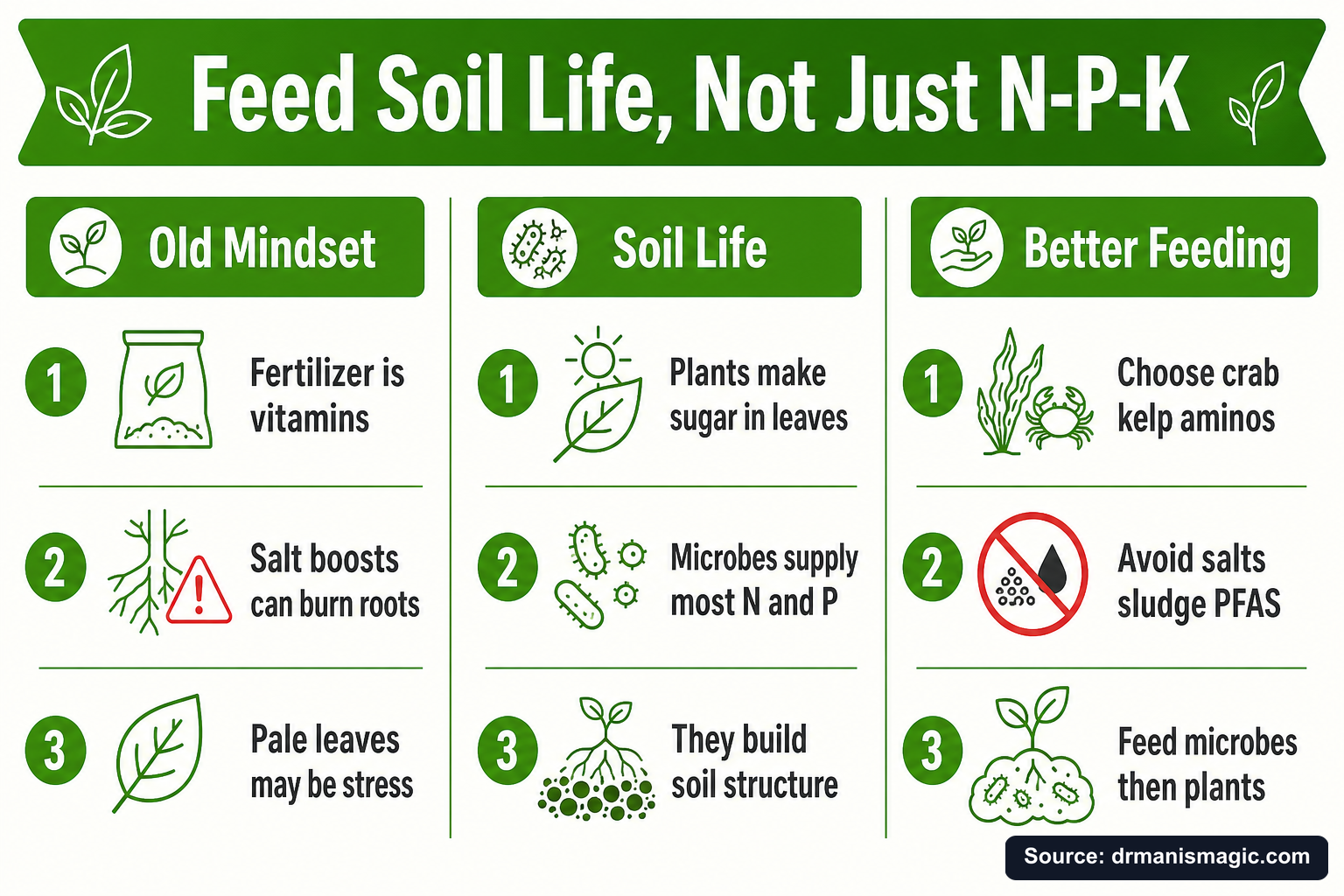
- Fertilizer is not plant food. True plant food is sunlight, water, and carbon dioxide. Fertilizer is more like vitamins — essential, but only useful when the whole system is working.
- Salt-based synthetic fertilizers deliver quick nutrient ions but damage roots through osmotic stress, kill beneficial soil microbes, and create a cycle of dependency.
- University research shows soil microbes supply roughly 75% of plant-available nitrogen and 65% of available phosphorus. No microbes means no natural nutrient cycling.
- Organic fertilizers like crab, kelp, and amino acids feed the microbes first. The microbes convert those nutrients into plant-ready forms, then release them slowly as they live and die — a built-in time-release system.
- The Three Plant Pillars — mineral-based soil, live microbes, and organic fertilizer — form the foundation proven across 250,000+ trees at US Citrus Nursery in South Texas.
- Plants that look hungry after fertilizing may actually be suffering from salt damage, osmotic stress, root rot, pH lockout, or compaction — not a lack of nutrients.
- Clean inputs matter: biosludge, PFAS "forever chemicals," and synthetic salt residues are real risks in conventional fertilizers. Zero PFAS, zero biosludge, zero synthetic salts is the standard that protects your family, your soil, and your plants.
What Does "Feeding a Plant" Actually Mean?
Quick Answer: Feeding a plant in the traditional sense means delivering nitrogen, phosphorus, and potassium through soluble salt-based fertilizer. But plants make their own food through photosynthesis. Fertilizer provides vitamins and minerals, not fuel. The real question is whether those minerals arrive through a chemistry experiment or through a living soil ecosystem.
Most people think fertilizer is plant food. Walk down any garden center aisle and you'll see the word "plant food" on almost every bag. It sounds simple. Pour this on your plant. Watch it grow. Done.
But here's the truth that took Dr. Mani Skaria — Professor Emeritus of Plant Pathology, founder of Texas's Clean Citrus Program, and the scientist behind Dr. Mani's Magic — decades of research to fully appreciate. Plants make their own food. Right now, every leaf on every healthy plant in the world is running a solar-powered sugar factory. Sunlight hits the leaf. Carbon dioxide comes in from the air. Water moves up from the roots. Out comes glucose — the real fuel that drives growth, flowering, and fruiting. That process is called photosynthesis, and no fertilizer on earth replaces it.
So what does fertilizer actually do? Think of it like vitamins for a human. You don't eat vitamin C for energy. You eat it because your body can't build collagen, fight infections, or absorb iron without it. Fertilizer works the same way. Nitrogen helps build chlorophyll and amino acids. Phosphorus drives energy transfer and root development. Potassium regulates water movement and fruit quality. Without these, the plant's internal machinery breaks down. But they aren't the fuel. They're the support crew.
The question that changes everything is this: how do those minerals get to the root? Do they arrive as a harsh salt solution dumped into the soil? Or do they arrive the way nature intended — slowly, steadily, converted by billions of living microbes into exactly the form the plant needs, exactly when it needs it?
That is the difference between feeding a plant and feeding life.
Why Do Soil Microbes Matter More Than the Fertilizer Bag Says?
Quick Answer: Soil microbes are the workforce that converts organic matter, atmospheric nitrogen, and bound minerals into plant-available nutrients. According to University of Minnesota Extension, biological processes supply roughly 75% of plant-available nitrogen and 65% of available phosphorus in healthy soil. Without microbes, plants can't access most of what's naturally in the ground.
Imagine hiring a hundred thousand tiny workers and then poisoning half of them every time you tried to feed your plant. That's essentially what happens when you pour salt-based synthetic fertilizer into living soil.
Here's what those workers actually do. According to University of Minnesota Extension, soil organisms drive nutrient cycling, water retention, disease suppression, and soil structure. They recycle nitrogen, phosphorus, sulfur, and carbon from organic residues. They protect roots from pathogens like Pythium and Phytophthora — two of the most common causes of root rot in home gardens. They build the physical structure of soil so water drains correctly and roots can breathe.
And they do something even more remarkable. Certain bacteria in the root zone — called nitrogen-fixing bacteria — pull nitrogen directly from the air (which is 78% nitrogen) and convert it into a form the plant can use. Lightning does this too, which is why your lawn always looks greener after a thunderstorm. That smell of rain? That's nature fertilizing your yard for free.
When you pour salt-based fertilizer into the soil, you disrupt this entire system. The salt raises the osmotic pressure around the root zone. Water is pulled out of microbial cells and root tip cells in a process called osmotic stress — sometimes called physiological drought. The microbes that survived the salt shock are now weakened. The ones that couldn't survive are gone. The nitrogen-fixing bacteria stop working. The fungi that were connecting your plant's roots to nutrients twenty feet away shrivel up. And your plant, which looked green for two weeks after you fertilized, starts to decline again. So you add more fertilizer. The cycle continues.
As Penn State Extension explains, salt-based soluble fertilizers can deliver immediately available ions, but soil microbes are the workforce that recycles carbon, nitrogen, sulfur, and phosphorus from organic matter over time. One is a short-term chemical event. The other is a long-term ecosystem strategy.
After growing more than 250,000 citrus trees at US Citrus Nursery in South Texas, Dr. Mani's team saw this pattern over and over again. Trees fertilized with salt-based products would green up fast, then stall, then decline. Trees grown with the full Three Plant Pillars — mineral-based soil, live microbes, and organic fertilizer — kept growing stronger month after month, year after year. The difference wasn't the nutrients. It was the life in the soil.
How Does Salt-Based Fertilizer Damage Roots and Microbes?
Quick Answer: Salt-based fertilizers raise the salt concentration in the soil solution. When salt levels get too high, water is pulled out of root cells and microbial cells through osmosis — a process called physiological drought or osmotic stress. Root tips burn, fine roots die, and beneficial microbes are killed, leaving the plant vulnerable to root rot, disease, and nutrient lockout.
This is the part most fertilizer companies don't want you to think about too hard.
Salt doesn't just sit in the soil doing nothing. Every salt molecule pulls water toward itself. When you pour a high-salt fertilizer into the root zone, you're essentially creating a little drought right at the tips of your plant's roots. The fine root hairs — the tiny, hairlike structures that actually absorb water and nutrients — are bathed in a solution that is saltier than the water inside them. Water moves from where it's less salty to where it's more salty. So instead of water moving into the root, water moves out. The root tip desiccates. It burns. It dies.
University extensions across the country — including Utah State, Colorado State, University of Maryland, Michigan State, Iowa State, Purdue, and Wisconsin — consistently describe this soluble-salt injury as drought-like stress, leaf scorch, marginal burn, restricted root growth, inhibited germination, and yield loss. It shows up in lawns. It shows up in ornamentals. It shows up in vegetable gardens, containers, fruit trees, and shrubs. It is one of the most widespread and most misdiagnosed problems in home gardening.
And here's the part that makes it worse. Once those fine roots are damaged, the door opens for Pythium and Phytophthora — two water mold pathogens that cause classic root rot. Healthy roots with intact cell walls can resist these pathogens. Burned, osmotically stressed roots cannot. What started as fertilizer burn ends as root rot. And the homeowner adds more fertilizer because the plant looks pale and hungry. The root damage gets worse. The plant spirals.
See also: The Hidden Reason Synthetic Fertilizers Cause Root Rot
The salt doesn't just hurt roots. It kills microbes. And as we just covered, those microbes are the engine of your soil's nutrient-cycling system. Kill the microbes, and the plant loses its natural support system. It becomes entirely dependent on the next dose of synthetic fertilizer to survive. That's not gardening. That's addiction.
Why Does Your Plant Look Hungry Even After You Fertilized?
Quick Answer: Plants can look pale, yellow, or weak after fertilizing because of salt damage, pH lockout, compacted soil, oxygen deprivation, dead roots, or poor microbial cycling — not a lack of nutrients. Adding more fertilizer to a salt-damaged, compacted, or oxygen-starved root zone makes the problem worse, not better.
This is the question that drives gardeners crazy. You fertilized. The bag said it would work. The leaves are still yellow. So you add more.
Stop. Here's a diagnostic framework to think through before you reach for the bag again.
| What You See | Likely Cause | What's Actually Happening | What Helps |
|---|---|---|---|
| Yellow leaves after fertilizing | Salt damage / osmotic stress | Root tips burned; nutrient uptake blocked | Flush soil with water; switch to organic slow-release |
| Yellow leaves with green veins (new growth) | Iron chlorosis / pH lockout | High pH locks iron; plant can't absorb it even if it's present | Organic matter, microbes, pH correction |
| Yellow leaves (older leaves first) | Nitrogen deficiency | Mobile nitrogen moved from old to new leaves | Organic nitrogen source with microbial activation |
| Brown leaf edges / tip burn | Fertilizer burn / salt index damage | Salt concentration too high in root zone | Flush, reduce fertilizer, add microbes |
| Wilting even with wet soil | Root rot (Pythium / Phytophthora) | Damaged roots can't move water; pathogen attack | Improve drainage, add beneficial fungi and bacteria |
| Stunted growth despite feeding | Compaction / oxygen stress | Roots can't breathe; organic potting mix collapsed | Mineral-based soil, aeration, microbial inoculant |
| Wilting in dry conditions | Drought stress | Insufficient water; salt may be worsening it | Deep, consistent watering; mulch; check salt levels |
The most important takeaway from this table: most of these problems look like hunger but are not hunger. Adding more fertilizer to a plant suffering from salt damage, root rot, or compaction is like giving a sick person more vitamins when they actually need surgery. The root cause — not the symptom — has to be fixed first.
See also: How Salt-Based Feeding Quietly Destroys Root Systems
What Is the Real Difference Between Synthetic Fertilizer and Organic Fertilizer?
Quick Answer: Synthetic fertilizers are salt-based and deliver nutrients immediately as ions, but damage roots and microbes through osmotic stress and salt index buildup. Organic fertilizers feed microbes first, which then convert nutrients into plant-ready forms slowly and steadily — mimicking the natural nutrient cycle without the root damage, microbial destruction, or salt accumulation.
Let's break this down in plain terms.
Synthetic fertilizer is made from salts. Ammonium nitrate. Ammonium sulfate. Potassium chloride. These are soluble salts that dissolve in water and flood the root zone with ions. The plant can absorb them quickly — which is why you see fast green-up. But that speed comes with a cost. High salt index. Osmotic stress. Microbial death. Root burn. And once you stop applying, the green-up stops too, because there's nothing left in the soil doing any work.
Organic fertilizer works completely differently. And this is the part that most gardening content never explains clearly enough.
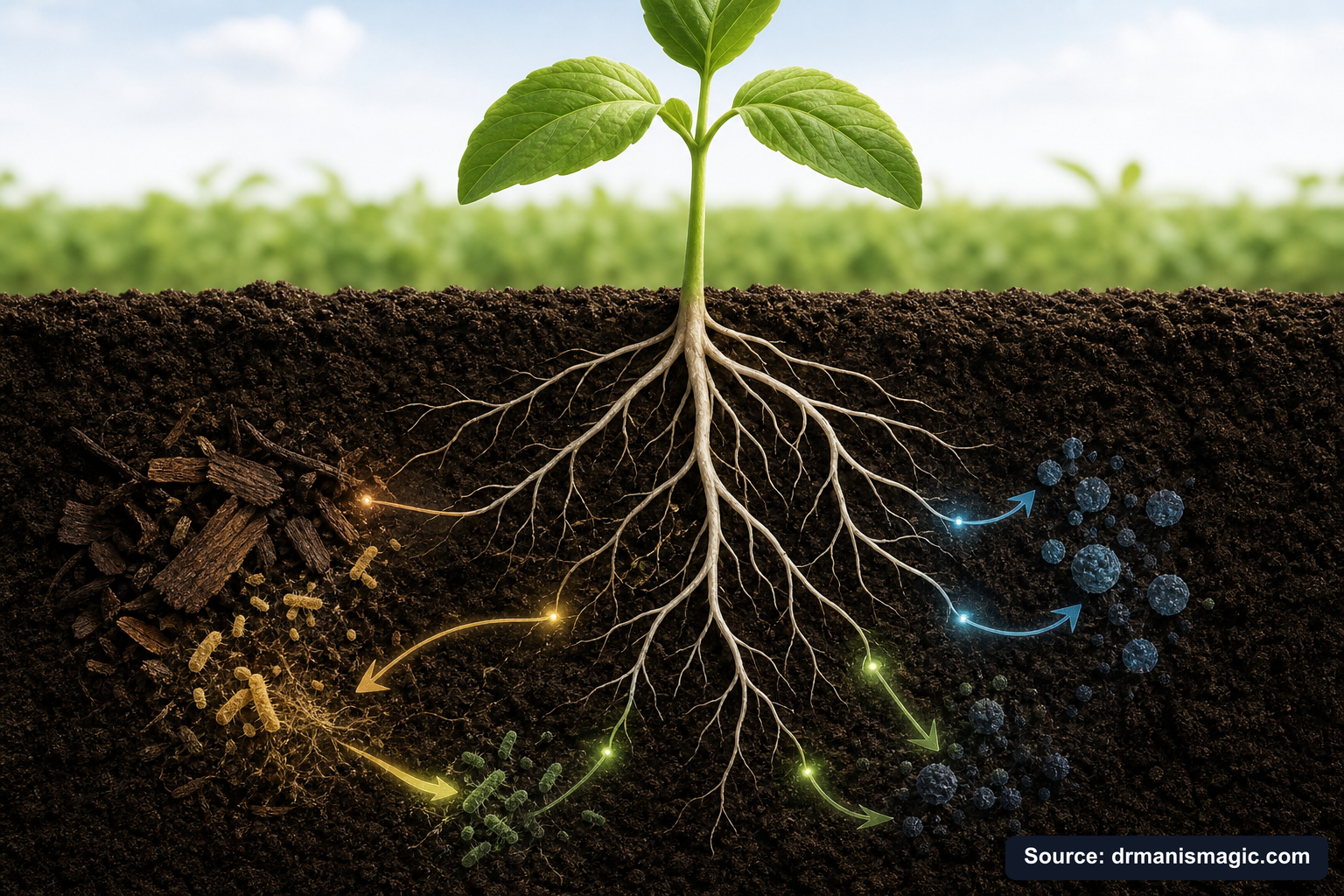
When you apply an organic fertilizer — something made from crab shells, kelp, amino acids, and volcanic ash — you are not feeding the plant directly. You are feeding the microbes. The bacteria and fungi in the soil eat the organic material. They break it down. They convert it into nitrogen, phosphorus, potassium, and trace minerals in exactly the forms the plant's roots can absorb. Then, as those microbes live their short lives and die, they release all of that stored nutrition directly into the root zone. It's a slow, steady trickle. A built-in time-release system that keeps working long after you applied it. No spikes. No crashes. No burns.
This is not a new idea. It is exactly how forests, prairies, and wild fruit trees have fed themselves for millions of years. No one showed up to spray a citrus grove in the Amazon with synthetic ammonium nitrate. The trees fed themselves through living soil. Dr. Mani spent 40 years studying exactly how that system works — and how to replicate it in your backyard.
| Feature | Synthetic Fast-Release | Coated Slow-Release (Synthetic) | Organic (Crab, Kelp, Amino Acids) |
|---|---|---|---|
| How nutrients are delivered | Immediate ion flood | Timed ion release from plastic coatings | Microbial conversion, then slow release |
| Salt content / salt index | Very high | Moderate to high | Very low |
| Effect on soil microbes | Kills many beneficial microbes | Still salt-based; damages microbes over time | Feeds and supports microbes |
| Root burn risk | High (osmotic stress) | Moderate | Very low |
| Soil residues | Salt buildup over time | Plastic microplastic fragments in soil | None — breaks down naturally |
| PFAS / biosludge risk | Possible if biosludge fillers used | Possible | Zero PFAS, zero biosludge (when clean-sourced) |
| Long-term soil health | Degrades over time | Neutral to negative | Builds soil health continuously |
| Works with microbes? | No — competes and destroys | No — still salt-based | Yes — synergistic partnership |
Notice the row about PFAS and biosludge. This is a growing concern that most fertilizer marketing completely ignores. Some fertilizers — both synthetic and organic — use treated municipal waste (biosludge) as a filler. Biosludge contains PFAS, the so-called "forever chemicals" that don't break down in soil or in the human body. If you're growing vegetables, herbs, or fruit in your backyard and applying biosludge-contaminated fertilizer, those PFAS compounds can end up in your food and in your groundwater. For anyone with children, pets, or a vegetable garden, this is not a small concern.
Dr. Mani's Magic Crab, Kelp & Amino Acids contains zero PFAS, zero biosludge, and zero synthetic salts. That's not a marketing claim. It's a commitment to the kind of gardening that's safe for your family.
You Never Had a Brown Thumb.
You were handed the wrong tools. This free guide hands you the right ones.
You watered it. You fed it. It died anyway.
It was never you. It was the dirt, the salt food, and the bad advice.
This guide shows you what really went wrong, and how to fix it for good.
- Why your plants really died, and why it was never your fault
- The salt hiding in your plant food that quietly burns the roots
- The hidden killer in almost every bag of store soil
- The tiny helpers that grow a whole forest for free
- The rescue trick that brings a half dead plant back to life

What Makes Crab, Kelp, and Amino Acids So Effective for Soil Life?
Quick Answer: Crab shells provide chitin that activates natural disease resistance and feeds beneficial microbes. Cold-processed kelp delivers natural plant hormones, trace minerals, and carbohydrates that support root growth and stress tolerance. Amino acids supply nitrogen in a form microbes and plants can use immediately without salt damage. Together, they feed the living soil system the way nature intended.
Let's walk through each ingredient and why it matters. Not in a chemistry-textbook way. In a "here's what's actually happening in your soil right now" way.
Crab Shells and Chitin: The Immune System Activator
Crab shells are rich in a compound called chitin. Chitin is the same material that forms the outer shell of insects and crustaceans. When chitin gets into the soil, something interesting happens. The beneficial microbes in the soil recognize it and go to work breaking it down. In the process, they produce enzymes called chitinases. Those same enzymes attack the outer shells of fungal pathogens and harmful nematodes in the root zone. Essentially, your plant's soil starts producing its own natural pesticide — triggered by the chitin in the crab shells — without you spraying anything.
Crab shells also deliver calcium and magnesium. Calcium is critical for cell wall strength and woody growth. A large proportion of the woody mass of your tree is calcium. Without it, cell walls are weak and the plant is more vulnerable to pests, cracking, and disease. Magnesium sits at the center of every chlorophyll molecule in every leaf on your plant. No magnesium, no photosynthesis. It's that direct.
Cold-Processed Kelp: The Hormone and Mineral Powerhouse
Kelp is one of the fastest-growing organisms on earth. It does that by producing natural compounds that accelerate cell division, root elongation, and stress response. The key ones are auxins (plant hormones that drive root tip growth), cytokinins (hormones that trigger cell division and leaf development), and natural carbohydrates that feed soil microbes directly.
Cold-processing matters here. Heat destroys many of these hormones and biostimulants. Cold-processed kelp preserves them so they actually work when they reach your plant's root zone. Plus, kelp carries a full spectrum of trace minerals from the ocean — iodine, selenium, boron, molybdenum, manganese, and more — in concentrations that are almost impossible to replicate with synthetic mineral additions alone.
Amino Acids: Nitrogen the Way Nature Delivers It
Here's something most gardeners don't know. Plants can absorb nitrogen in three forms: nitrate, ammonium, and amino acids. Synthetic fertilizers almost always deliver nitrogen as nitrate or ammonium — which is why the salt content is so high. Amino acid nitrogen is different. It arrives already partially processed. The plant doesn't have to do as much work to use it. The microbes love it. And it doesn't carry the osmotic baggage of salt-based nitrogen sources.
Amino acids are also the literal building blocks of proteins. Every enzyme your plant uses to grow, fight disease, and produce fruit is made of amino acids. Delivering them directly through fertilizer gives the plant a shortcut — less energy spent building proteins from scratch, more energy available for growth and fruiting.
Volcanic Ash: The Trace Mineral Foundation
Volcanic ash is a natural source of silica and a wide spectrum of micronutrients. Silica strengthens cell walls, increases drought resistance, and helps plants withstand physical stress. It's the reason grasses and grains are tough enough to survive wind, foot traffic, and temperature swings. Adding volcanic ash-derived minerals to your soil gives plants a resilience foundation that synthetic fertilizers simply cannot provide.
All of these ingredients work together in Crab, Kelp & Amino Acids — a slow-release granular fertilizer that feeds the living soil system the way nature designed it, without salt, without biosludge, and without PFAS.
What Are the Three Plant Pillars and Why Do All Three Have to Work Together?
Quick Answer: The Three Plant Pillars — mineral-based soil, live microbes, and organic fertilizer — form the complete root-zone environment that plants need to thrive. Each pillar supports the others. Remove any one of them, and the whole system breaks down. Together, they replicate the conditions of healthy natural soil and make plants nearly bulletproof.
After 30 years of growing in South Texas — and after testing everything on 250,000+ citrus trees — Dr. Mani's team identified three things that every plant needs, regardless of whether it's a lemon tree in a pot, a rose bush in a garden bed, a lawn, or a houseplant on a windowsill.
Pillar 1: Mineral-Based Soil — The Foundation That Lets Roots Breathe
Most potting mixes are made from pine bark, wood chips, and other organic material. That sounds natural. But here's the problem. Organic material decomposes. As it breaks down, it compacts. The spaces that used to hold air and allow water to drain slowly fill with mush. Roots that need oxygen to function are now sitting in a wet, airless, suffocating environment. Root rot follows. Almost every case of root rot in a container plant starts here.
Mineral-based soil doesn't decompose. It's built on sandy loam from the Rio Grande Valley — silica-rich sand that holds its structure permanently. Roots can push through it. Water drains through it properly. Oxygen reaches the root tips. This is not a temporary fix. It's a permanent home for your plant's roots. Learn more at Super Soil.
Pillar 2: Live Microbes — The Invisible Workforce
Bacteria, fungi, and mycorrhizae. These are the living organisms that connect your plant to the nutrients in the soil. Mycorrhizal fungi extend the effective root system of your plant by hundreds of times — reaching nutrients and water that roots alone could never find. Beneficial bacteria protect against Pythium, Phytophthora, and other root pathogens. Nitrogen-fixing bacteria pull nitrogen from the air and deliver it directly to the root zone.
Without live microbes, a plant is isolated. It can only access what's in the immediate soil around its roots. With a thriving microbial community, a plant is connected to everything. It becomes resilient in a way that no amount of synthetic fertilizer can replicate. Learn more about live microbial support at Plant Super Boost.
Pillar 3: Organic Fertilizer — The Fuel That Feeds the Whole System
Organic fertilizer completes the system. Not because it delivers nutrients directly to the plant — but because it feeds the microbes that do. Crab, kelp, amino acids, and volcanic minerals give the microbial community everything it needs to thrive, multiply, and continuously convert organic material into plant-available nutrition. The result is a slow, steady, self-regulating nutrient delivery system that mirrors nature. No spikes. No burns. No crashes.
Remove any one of these three pillars and the system weakens. Bad soil chokes roots regardless of how good your microbes and fertilizer are. No microbes means organic fertilizer breaks down slowly and unevenly. No organic fertilizer means microbes starve and the soil ecosystem collapses. The Three Plant Pillars work as a system because that's exactly how nature built them.
How Do You Know If Your Problem Is Salt Damage, Overwatering, or True Root Rot?
Quick Answer: Salt damage causes leaf tip burn and wilting even with moist soil, usually after fertilizing. Overwatering causes yellowing, soft stems, and soil that stays wet for days. True root rot — caused by Pythium or Phytophthora — produces slimy, dark, foul-smelling roots that break apart when touched. Each has a different root cause and a different fix.
This distinction matters because the treatment for each problem is different. Treating root rot like a nutrient deficiency makes it worse. Treating salt damage like overwatering wastes time and kills more roots. Here's how to tell them apart.
| Symptom | Salt Damage / Fertilizer Burn | Overwatering | True Root Rot (Pythium / Phytophthora) |
|---|---|---|---|
| Leaf appearance | Brown tips and edges; marginal scorch | Yellow, limp, pale overall | Yellow to brown; rapid wilting |
| Soil condition | May be dry or moist; white crust on surface | Constantly wet; poor drainage | Wet, poorly draining; organic matter collapsing |
| Root appearance | Brown, dry, crispy root tips | Pale, mushy, waterlogged roots | Dark, slimy, foul-smelling; breaks apart easily |
| When it appears | Shortly after fertilizing, especially with fast-release | After frequent watering or heavy rain | Progressively worsening; often after compaction or poor drainage |
| Primary cause | High salt index / osmotic stress | Oxygen deprivation in root zone | Pathogen attack on stressed or damaged roots |
| Does adding fertilizer help? | No — makes it worse | No — makes it worse | No — the root system can't absorb it |
Recovery Checklist: What to Do When Your Plant Is Struggling
- Stop fertilizing immediately. If salt damage or root rot is suspected, adding more fertilizer will cause more root damage. Give the root zone time to recover.
- Flush the soil with clean water. For container plants with salt buildup, water deeply three times in a row to push excess salts out of the drainage holes. Let it drain completely each time.
- Check your soil structure. Pull the plant from its pot if possible. If the root ball is dark, slimy, or smells sour, root rot is present. If the potting mix is compacted, gray, and dense, it's suffocating the roots.
- Repot into mineral-based, well-draining soil. Organic potting mixes that have been in use for more than a year are likely compacted and oxygen-depleted. Mineral-based soil gives roots a fresh, permanent foundation.
- Introduce live beneficial microbes. A microbial inoculant with bacteria, fungi, and mycorrhizae helps restore the soil ecosystem, suppress remaining pathogens, and reconnect roots to the nutrient cycle.
- Resume feeding with a low-salt organic fertilizer. Once the root zone is recovering, a slow-release organic fertilizer feeds the microbes and delivers gentle, steady nutrition without risking further osmotic stress.
- Be patient. Root recovery takes time. New white root tips are the signal that the system is working. Green leaves will follow.
Does "Feeding Life" Actually Work? What Does the Science Say?
Quick Answer: Yes. University research consistently confirms that healthy soil biology drives the majority of plant-available nutrient supply. Field evidence from 250,000+ trees grown at US Citrus Nursery in South Texas supports the same conclusion: plants grown with mineral soil, live microbes, and organic fertilizer outperform salt-fertilized plants in long-term health, disease resistance, and yield.
This isn't philosophy. It's documented biology.
University of Minnesota Extension research confirms that soil organisms are responsible for roughly 75% of plant-available nitrogen and 65% of available phosphorus in healthy soil. Those aren't small numbers. That means the majority of what your plant eats in a healthy ecosystem comes not from the bag you buy at the store, but from the invisible workforce living in the ground beneath your feet.
Penn State Extension's soil microbiome research draws the same contrast: soluble salt fertilizers deliver immediate ions, but soil microbes are the workforce that recycles carbon, nitrogen, sulfur, and phosphorus continuously from organic matter. One is a one-time event. The other is a perpetual, self-renewing system.
At US Citrus Nursery in South Texas, Dr. Mani Skaria and his team tested this system across 250,000+ trees over more than 30 years. The trees grown with the Three Plant Pillars — mineral-based soil, live microbes, and organic fertilizer — showed consistently better root development, stronger disease resistance, more consistent fruiting, and longer productive life than trees grown with conventional salt-based inputs. That's not a small test group. That's a career's worth of evidence.
And the same principles that work for citrus trees work for your lawn, your vegetable garden, your roses, your houseplants, and your orchard. The biology is the same. The pillars are the same. The results are the same.
See also: Why Most Fertilizers Are Actually Salt in Disguise
What Is the Real Cost of Doing It the Old Way?
Quick Answer: The real cost of salt-based fertilizing isn't just money on products that damage your soil. It's time. Months and years of slow decline, repeated purchases, and stunted plants add up to a window of growing time you can never get back. The goal is to see your trees and gardens flourish in your lifetime — and the old way quietly steals that possibility.
Here is something Dr. Mani hears more than almost anything else from the gardeners he talks to. They don't just want a healthy tree. They want to see fruit on that tree. They want to walk outside on a summer morning and pick something they grew. They want to hand something to their kids or their grandkids that came from their own backyard. They want to feel what it's like to actually tend a garden and have it respond.
That's not a small thing. That's one of the most human desires there is. We were made to tend things. To plant and harvest and nurture. That drive doesn't go away just because we live in suburbs and buy our food at grocery stores.
But here's what the old way costs. Not just money — though you will spend plenty on products that damage your soil and leave you starting over every season. The real cost is time. A plant that spends its first two years in salt-damaged soil with dead microbes and suffocating roots doesn't just look bad. It falls behind on a timeline you can't recover. A healthy plant in living soil, built on mineral-based structure with a thriving microbial community, can produce fruit in a fraction of the time. It can thrive for decades. It can become the tree in your yard that your family talks about.
The old way — synthetic salt fertilizers, organic potting mixes that collapse within a year, no microbial support — might look like it's working for a few weeks. Then it stalls. Then it goes backward. Not because you're bad at gardening. Because you were handed tools that work against nature instead of with it. That's not your fault. The system was designed that way.
The good news is that changing it doesn't require years of study or complicated chemistry. It requires three things. Living soil. Live microbes. Clean organic nutrition. And the time to start is right now, because you can never get back the time you've already spent doing it the hard way.
For a complete foundation — including guidance on soil, microbes, and fertilizing for any plant you're growing — the Free Plant Care Field Guide is a good place to begin. It's the same knowledge Dr. Mani's team uses with every tree that leaves the nursery. No jargon. No guesswork. Just the three things that actually work.
You've already spent time reading this. That means you're serious about growing something that lasts. The next step is simple: give your soil what it needs to come alive. Feed the life. The plants will follow.
Frequently Asked Questions
Most gardeners are doing everything they were told to do and still watching their plants struggle. These questions come up again and again because the old advice is broken. The answers below are grounded in over 30 years of real-world testing across 250,000 trees at US Citrus Nursery in South Texas.
Is feeding a plant the same as fertilizing?
Not really. Plants make their own food through photosynthesis using sunlight, water, and air. Fertilizer is more like a vitamin supplement. The problem is most fertilizers are salt-based chemicals that skip your soil biology entirely. Dr. Mani's Three Plant Pillars approach works differently. It feeds the living microbes in your soil first. Those microbes then unlock and deliver nutrients to your roots in a form plants actually crave. That is a living system, not a chemical shortcut.
Why do my plants still look pale and yellow after I fertilize them?
That yellow color is a warning sign, and it is almost never a simple nutrient shortage. Salt-based fertilizers burn roots, wipe out beneficial microbes, and lock up nutrients in the soil so roots cannot reach them. You fed the number on the bag, not the life in your soil. Without live microbes working underground, your plant cannot absorb what you are putting down. That is exactly why Pillar Two, living microbials like Plant Super Boost, changes everything.
Can I use plant food and fertilizer at the same time?
You can, but most store-bought plant food and fertilizer are the same salt-based chemistry with different labels. Stacking them doubles the salt load in your soil and can burn your roots fast. Worse, synthetic salts kill the beneficial bacteria and fungi your soil depends on. The smarter move is to build a living soil foundation with mineral-based Super Soil, live microbes, and a clean organic fertilizer like Dr. Mani's Crab, Kelp, and Amino Acids. That system feeds itself.
How often should I feed my potted plants?
With conventional synthetic fertilizers, you end up on a constant re-application cycle because those salts flush out fast and damage roots over time. With Dr. Mani's organic fertilizer approach, you feed less often because the microbes in your soil keep cycling nutrients around the clock. A slow-release organic feed every four to six weeks paired with a monthly dose of Plant Super Boost gives most potted plants everything they need without the burn or the guesswork.
What is the best natural fertilizer for any type of plant?
After 35 years of testing and over 250,000 trees, Dr. Mani landed on a blend of crab meal, kelp, and amino acids. It releases nutrients slowly, it does not burn roots, it smells like earth instead of sewage, and it feeds the microbial life in your soil rather than destroying it. It works for citrus trees, houseplants, vegetables, grass, and flowers. It has zero synthetic salts, zero PFAS, and zero biosludge. That is the clean standard your family and your soil deserve.
Which plants do not like synthetic fertilizer?
Honestly, none of them truly like it, even if they tolerate it short-term. Salt-based fertilizers stress root systems, deplete microbial life, and create a dependency cycle that weakens plants over time. Citrus trees, tropical houseplants, and fruiting trees are especially sensitive. Dr. Mani saw this firsthand in his South Texas nursery. The trees that thrived long-term were never the ones blasted with synthetic salts. They were the ones grown in living soil with organic inputs from the start.
Does the type of soil matter as much as the fertilizer?
Soil is actually Pillar One for a reason. Most potting mixes are made from pine bark and wood that break down into a root-choking sludge. Roots cannot breathe. Drainage fails. Disease moves in. Dr. Mani's Super Soil is built on mineral-based sandy loam from the Rio Grande Valley. It does not decompose. It drains perfectly. Roots expand freely. Without that foundation, even the best fertilizer in the world cannot save a plant that is slowly suffocating underground.
About the Author
Ron Skaria, MD
Ron Skaria, MD, is the co-founder of Dr. Mani's Magic and the son of Dr. Mani. He trained as a medical doctor at Baylor College of Medicine, did his residency at UT Health Science Center - San Antonio and fellowship training at Texas Tech University. He now works full time on the family farm at US Citrus and US Citrus Nursery in Hargill, Texas, building Dr. Mani's Magic alongside his dad. He wrote the Brown Thumb Field Guide to put his father's 48 years of plant science into plain words any gardener can use. His belief is simple. You never had a brown thumb. You just never had the right help.


