


The Fastest, Gentlest Way Plants Absorb Nutrition Without Burning Roots | Dr. Mani's Magic
The Fastest, Gentlest Way Plants Absorb Nutrition (Without Burning Roots or Killing the Microbes That Feed Them)
Picture this. You walk outside on a Saturday morning, coffee in hand, and look at your lawn. Or your potted lemon tree on the patio. Or those tomatoes you planted two months ago that still look... sad. You went to the store. You bought the fertilizer with the big cheerful logo. You followed the directions. And yet here you are, staring at yellow leaves, brown edges, or just nothing happening at all.
So you wonder. Did you use too much? Too little? Is the soil bad? Is it root rot? Is it your fault? You are not alone. Millions of people ask the same questions every single week. And here is the thing nobody told you: the fertilizer you bought was probably making things worse. Not because you did something wrong. But because that product was designed to look like it works fast, not to actually build a healthy plant. There is a big difference between those two things.
After 30 years of growing and testing over 250,000 trees at our South Texas nursery, we found a better way. A way that is fast AND gentle. A way that feeds the plant without burning the roots, without killing the microscopic life in the soil, and without loading up your backyard with salt. This article is going to show you exactly how it works. And once you see it, you will never look at a bag of fertilizer the same way again.

Organic Fertilizer | Crab, Kelp & Amino Acids
Key Takeaways
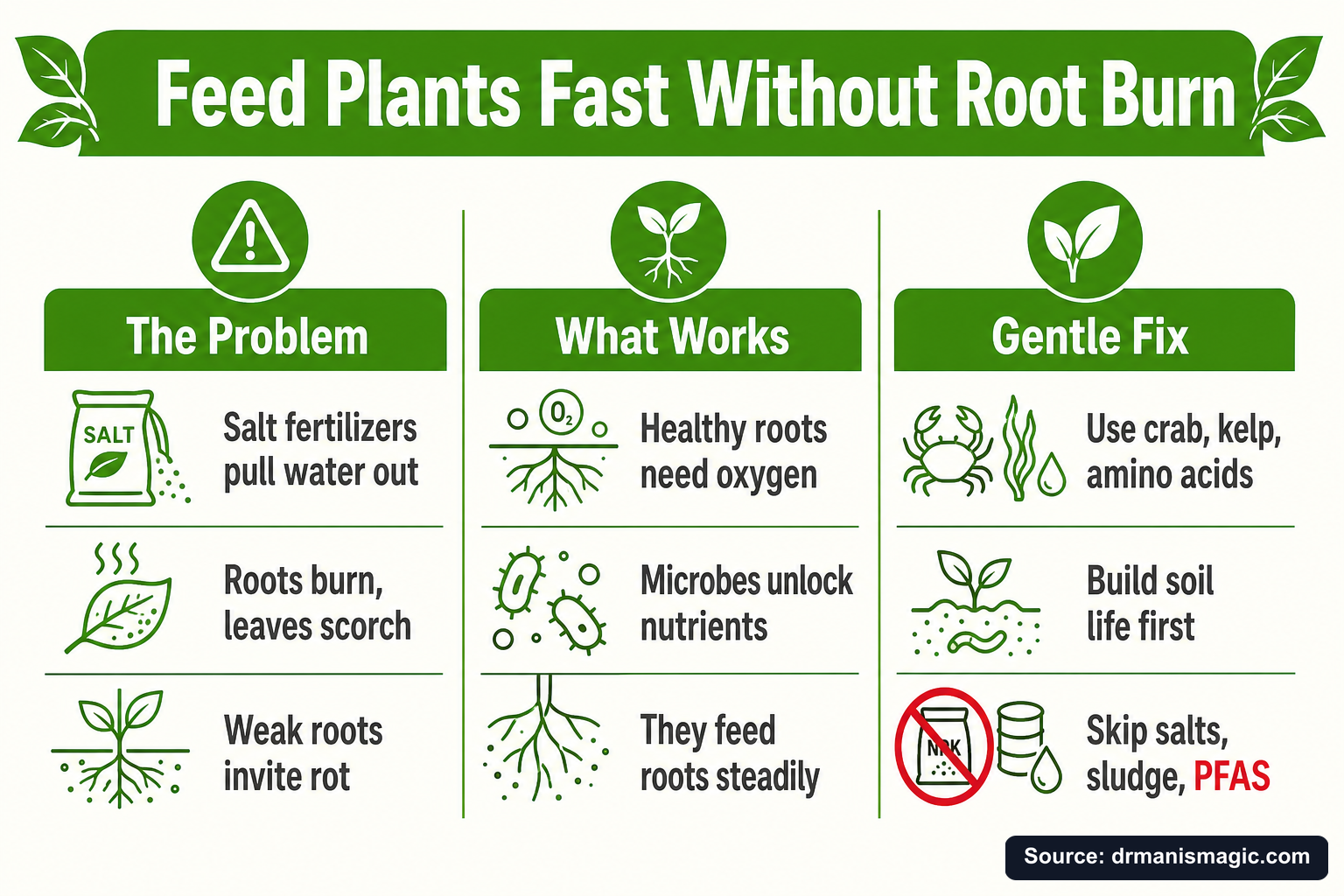
- The fastest plant nutrition is not the most soluble fertilizer. It is the nutrition that reaches healthy, oxygen-rich roots without injury.
- Most common fertilizers are salt-based. Salt draws water OUT of roots, causes osmotic stress, burns root tips, kills soil microbes, and invites root rot pathogens like Pythium and Phytophthora.
- Soil microbes are the real delivery system. They eat organic matter, break it down, and hand nutrients directly to plant roots in the exact form the plant can use.
- Organic fertilizers made from crab, kelp, and amino acids feed microbes first, then feed the plant slowly and gently, the way nature intended.
- Chitin from crab shells activates natural plant defenses. Kelp delivers growth hormones, trace minerals, and stress protection. Amino acids supply ready-to-use nitrogen without a salt spike.
- Before you add ANY fertilizer, make sure the roots can breathe. Compacted soil, waterlogging, and oxygen-starved roots will block nutrition no matter what you apply.
- Zero PFAS. Zero biosludge. Zero synthetic salts. That is the standard your plants and your family deserve.
Why Does "Fast Nutrition" Sometimes Hurt Plants Instead of Help Them?
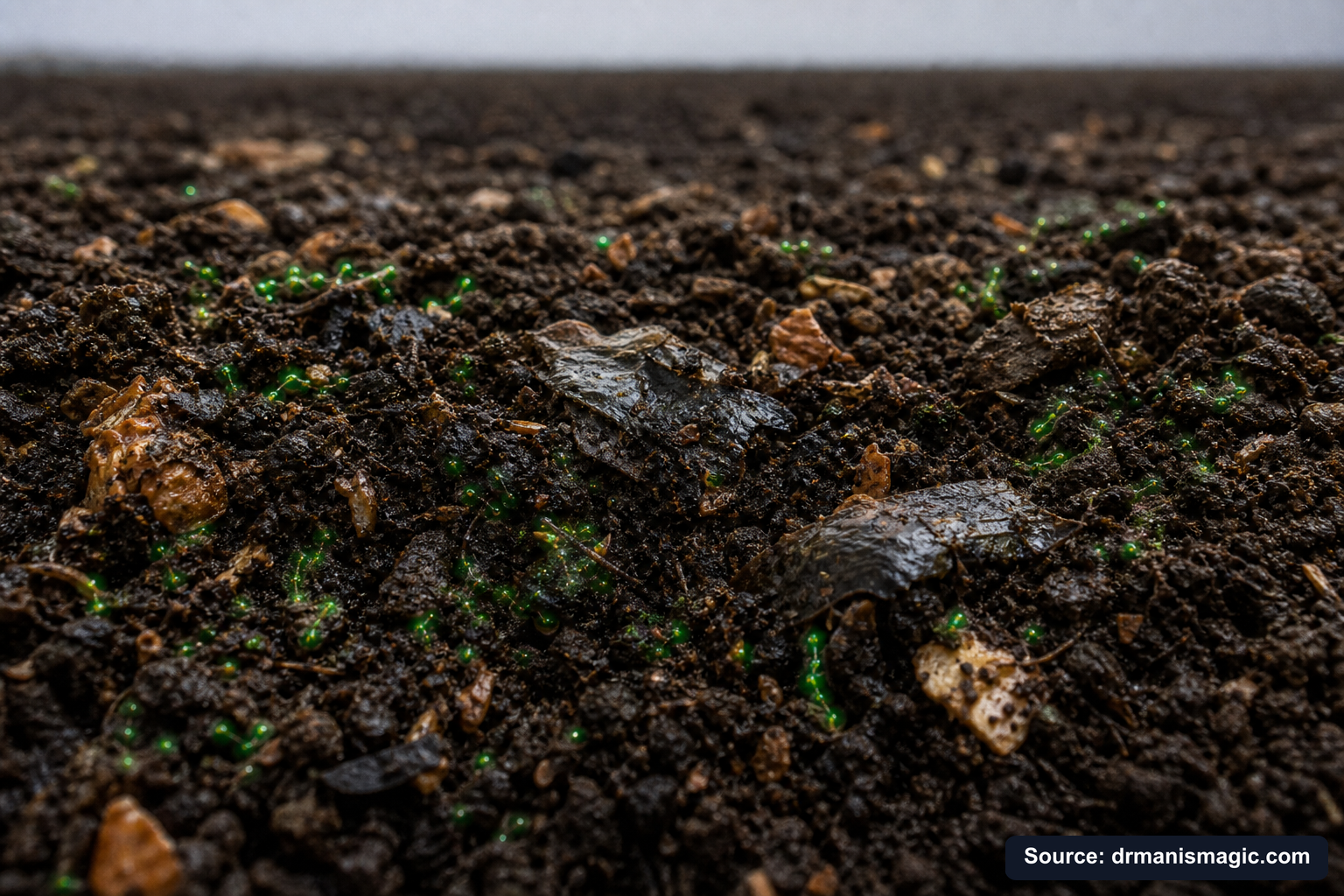
Quick Answer: Most fast-acting fertilizers are salt-based. When salt concentration around the roots is higher than inside the roots, water actually flows OUT of the plant instead of in. The plant wilts even when the soil is wet. Roots burn. Microbes die. And the plant gets weaker, not stronger, even though it might look green for a week or two.
Here is something that shocks most people when they first hear it.
That bag of blue crystals or bright liquid you pour on your plants? It is basically salt. Not table salt exactly, but the same principle. It is a salt-based compound that dissolves fast and sits in the soil water around your roots.
Now think about what happens when you eat way too much salty food. You get thirsty. Your body pulls water toward the salt to try to balance it out. The same thing happens to your plant roots.
When the salt concentration outside the root is higher than inside, water moves the wrong direction. Out of the root. Into the soil. Plant scientists call this osmotic stress. Your plant is sitting in wet soil and still dying of thirst. The leaves wilt. The root tips burn. The cell walls break down.
University extension researchers at Iowa State, Penn State, Texas A&M, and others have documented this exact problem. Penn State Extension notes that soluble salt injury from fertilizer leads to reduced water uptake, root damage, leaf-edge scorch, and restricted growth. And it gets worse.
When roots are damaged by salt, the door opens for root rot pathogens. Pythium and Phytophthora, the two most common root rot organisms, love weakened, salt-stressed roots. They move in fast. And once they do, no amount of fertilizer will save your plant.
See also: The Hidden Reason Synthetic Fertilizers Cause Root Rot
What Do Soil Microbes Actually Do for Plant Nutrition?
Quick Answer: Soil microbes eat organic matter and break it into tiny pieces the plant can absorb through its roots. They also fix nitrogen from the air, dissolve locked-up minerals, and protect roots from disease. Without microbes, plants are on their own in a very unfriendly world. With them, the soil becomes a self-feeding engine that works around the clock.
There is a world under your feet that most people never think about. One teaspoon of healthy garden soil contains more living organisms than there are people on Earth. Bacteria, fungi, mycorrhizae, nematodes, protozoa. A whole invisible ecosystem.
These tiny creatures are not just living in your soil. They are working for your plant. Every single day.
Here is how it works in plain language.
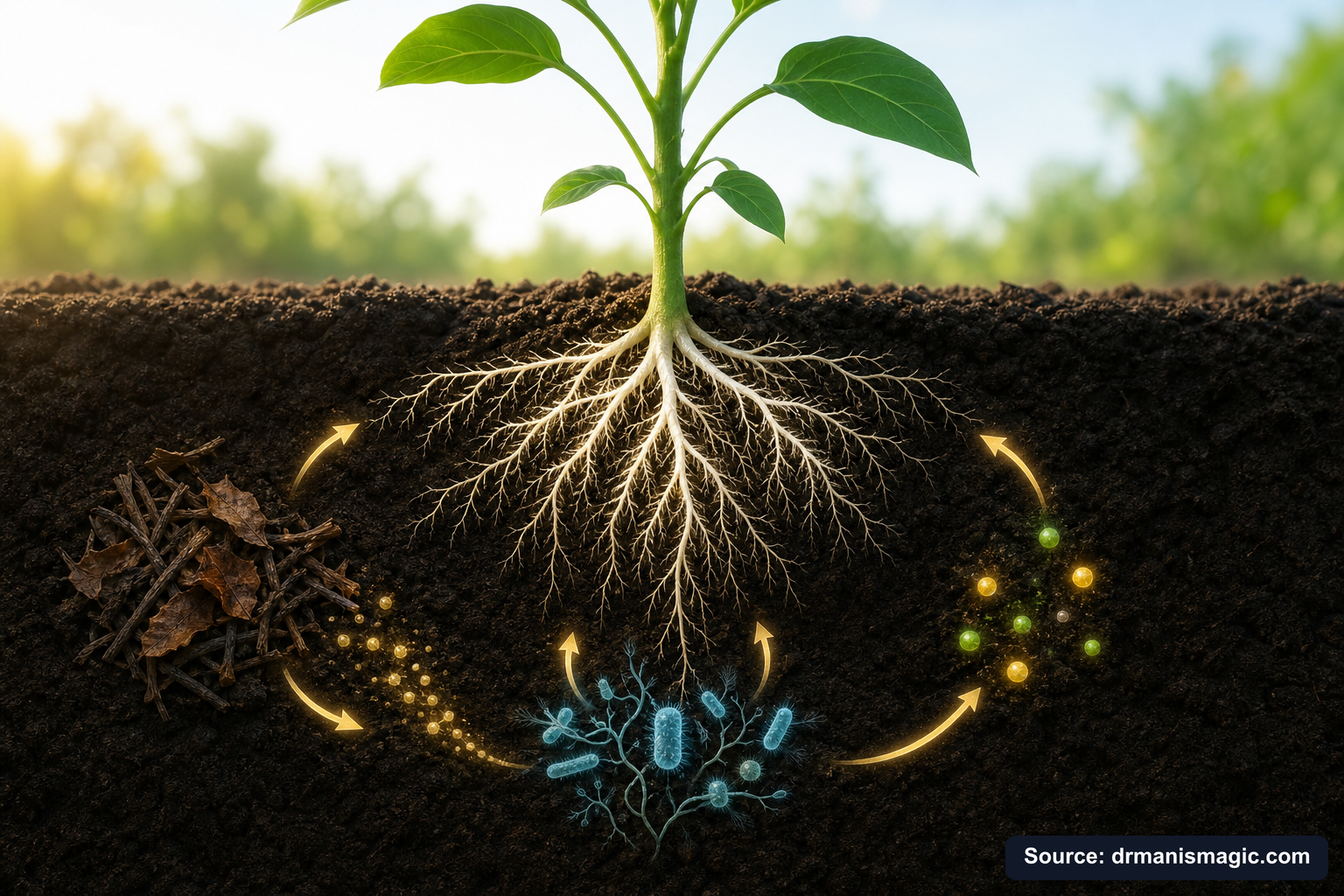
Organic matter, like a crab shell or a piece of kelp or a dead leaf, falls into the soil. Bacteria and fungi start eating it. As they digest it, they release nutrients. Nitrogen. Phosphorus. Calcium. Trace minerals. All in small, steady doses. All in forms the plant root can absorb directly.
Then, when those microbes die, they release everything they stored inside their own bodies. Right into the root zone. It is like a built-in time-release capsule. No plastic coating needed. No synthetic chemistry. Just life feeding life.
The University of Minnesota Extension states that soil organisms support nutrient cycling, water infiltration, disease suppression, and biodiversity, and that biological processes supply much of the plant-available nitrogen and phosphorus in healthy soil. That is not a small thing. That is the whole game.
When you pour a salt-based synthetic fertilizer on your soil, you do not just feed the plant. You kill the microbes. And when the microbes die, that whole self-feeding engine shuts down. Your plant becomes dependent on you. You have to keep buying and applying. That is not a coincidence. It is the business model.
At Dr. Mani's Magic, we call this the Three Plant Pillars. Mineral soil. Live microbes. Organic fertilizer. All three working together. Miss one and everything gets harder. Hit all three and your plants become almost impossible to kill.
What Makes Organic Fertilizer Faster AND Safer Than Synthetic Salts?
Quick Answer: Organic fertilizer feeds the microbes first. The microbes convert it into plant-ready nutrients on a steady schedule. When microbes die, they release stored nutrition directly into the root zone. This creates a natural slow-release system that keeps feeding long after you apply it. No salt spike. No root burn. No microbial massacre. Just steady, safe, consistent nutrition.
This is the part that changes everything.
Most people think organic fertilizer is just a slower version of synthetic fertilizer. Weaker. Less effective. Something you use if you care about the environment but do not really care about results.
That is completely backwards.
Organic fertilizer is not slow because it is weak. It is slow because it works through the soil food web. And that system, once it is running, feeds your plant more completely and more consistently than any salt-based product ever could.
Here is the sequence, step by step.
- You apply organic granules to the soil surface or mix them in lightly.
- Bacteria and fungi start breaking down the organic material. They eat it, digest it, and hold the nutrients inside their own cells.
- As they work, they release small amounts of plant-ready nitrogen, phosphorus, potassium, calcium, and trace minerals directly into the water around the roots.
- The plant roots pick up exactly what they need, when they need it. No flood. No starvation. No salt spike.
- When those microbes finish their life cycle and die, they release everything stored in their bodies into the root zone. A second wave of nutrition. All gentle. All ready to use.
That is not just safe. That is smarter than anything you can get from a bag of blue crystals.
And here is the bonus. Because the organic material feeds and supports microbes, your soil gets healthier every single application. The microbial population grows. The nutrient cycling improves. You need less input over time, not more. You are building something permanent.
Salt-based fertilizers do the opposite. Every application chips away at the microbial community. The soil gets more dependent. Less alive. More like a chemical substrate than a living ecosystem. You end up buying more every season just to get the same shrinking results.
See also: How Salt-Based Feeding Quietly Destroys Root Systems
Fertilizer Comparison: Which Type Is Fastest and Safest for Your Roots?
Quick Answer: Fast-release synthetic fertilizers show quick color but carry the highest salt damage risk. Slow-release synthetics lower burn risk but still use plastic coatings and can contain PFAS. Organic fertilizers with crab, kelp, and amino acids are gentle, build the soil food web, and deliver steady nutrition with zero salt injury risk when used as directed.
| Fertilizer Type | Speed of Visible Response | Salt Index / Burn Risk | Effect on Soil Microbes | Long-Term Soil Health | PFAS / Biosludge Risk |
|---|---|---|---|---|---|
| Synthetic Fast-Release (granule or liquid) | Days | Very High | Kills beneficial bacteria and fungi | Degrades over time | Possible (some contain biosludge) |
| Synthetic Slow-Release (plastic-coated prill) | Weeks | Moderate | Still salt-based, still harmful | Neutral to negative; plastic residue builds up | Possible; plastic shell stays in soil |
| Organic / Crab-Kelp-Amino (granular) | Weeks (with microbe surge) | Very Low | Feeds and multiplies microbes | Improves with every application | Zero when sourced clean (no biosludge, no PFAS) |
The visible response from organic fertilizer is a few weeks, not a few days. But here is what the chart cannot show you. That green you get from a salt spike is temporary. The plant looks good for two weeks and then crashes. The green you get from a living soil system keeps going. Month after month. Season after season. Because you built the engine, not just revved it once.
Why Does Crab Shell Chitin Make Plants Stronger From the Inside?
Quick Answer: Chitin is a natural compound found in crab shells. When it enters the soil, plants recognize it as a signal that something that eats them (like fungal pathogens or insects) is nearby. The plant activates its own immune system in response. Roots get stronger. Disease resistance goes up. And the chitin feeds beneficial microbes at the same time.
This one surprises almost everybody.
When you grind up crab shells and put them in the soil, the plant does something remarkable. It reads the chitin as a warning signal. Chitin is the same material found in the outer shells of insects and the cell walls of many harmful fungi. So when the plant detects it, it thinks something dangerous is close by. It activates its defenses.
Stronger cell walls. More robust immune responses. Increased resistance to pathogens. Not because you sprayed a chemical on it. Because you gave the plant information it could act on itself.
At the same time, chitin is a food source for the specific microbes that fight root rot. Chitin-eating bacteria multiply when chitin is present. And those same bacteria suppress Pythium and Phytophthora, the two main root rot killers. You get pest and disease protection as a side effect of feeding the soil.
Plus, crab shells are rich in calcium and magnesium. Calcium builds the woody structure of the plant. More calcium means stronger stems, thicker bark, better fruit firmness. A large portion of the dry weight of a woody plant is calcium. That is not a detail. That is structural.
You Never Had a Brown Thumb.
You were handed the wrong tools. This free guide hands you the right ones.
You watered it. You fed it. It died anyway.
It was never you. It was the dirt, the salt food, and the bad advice.
This guide shows you what really went wrong, and how to fix it for good.
- Why your plants really died, and why it was never your fault
- The salt hiding in your plant food that quietly burns the roots
- The hidden killer in almost every bag of store soil
- The tiny helpers that grow a whole forest for free
- The rescue trick that brings a half dead plant back to life

What Does Cold-Processed Kelp Do That Regular Fertilizer Cannot?
Quick Answer: Cold-processed kelp delivers natural plant growth hormones called auxins and cytokinins, plus a dense package of trace minerals, carbohydrates, and biostimulants. These hormones signal roots to grow deeper and faster, help the plant handle heat and drought stress, and activate cellular processes that raw NPK fertilizer cannot touch.
You have probably seen kelp meal listed on organic fertilizer bags and wondered if it actually does anything. It does. But most people do not understand how.
Kelp is not just a trace mineral source, though it is excellent at that. The real power is in the plant hormones it contains. Auxins and cytokinins are two of the most important growth-regulating compounds in all of plant biology. They tell root cells to divide and extend. They signal the plant to push new growth. They help the plant cope with temperature swings, drought, and disease stress.
The key word in cold-processed is COLD. Heat destroys those hormones. If kelp is processed at high temperatures, which most commercial products are, you get the minerals but lose the biological activity. Cold processing preserves the full spectrum of what makes kelp special. The hormones survive. The carbohydrates survive. The biostimulant activity stays intact.
For any plant, from a container lemon tree to a half-acre lawn to a window box of herbs, kelp is one of the most broadly effective biostimulants in nature. It works on roots. It works on leaves. It works in heat and in cold. And it works with microbes instead of against them.
How Do Amino Acids Feed Plants Faster Without the Salt Risk?
Quick Answer: Amino acids are the building blocks of protein. Plants can absorb certain amino acids directly through their roots, bypassing the normal nitrogen conversion process. This delivers usable nitrogen faster than most organic sources, without any salt spike. Amino acids also support microbes, fuel enzyme activity, and help the plant build new tissue efficiently.
Here is a little plant biology most people never learned in school.
Plants normally get nitrogen in two main forms. Nitrate, which travels through the soil water and enters through the root. And ammonium, which comes from microbial breakdown of organic matter. Both work, but both require the plant to do significant chemical work to convert them into usable proteins.
Amino acids skip most of that conversion work. They are already partially processed. The plant root can absorb certain amino acids directly and plug them straight into protein synthesis. That means faster growth response and less energy spent on chemistry. The plant uses that saved energy on root growth, flowering, and fruiting instead.
The amino acids in a quality organic fertilizer come from natural sources like feather meal and animal tankage. They are high in nitrogen and phosphorus. They do not spike the salt index. They do not shock the root. And when microbes encounter them, they thrive on them, which multiplies the microbial population and accelerates the whole nutrient cycling process.
This is the combination that makes amino acid nitrogen special. Fast enough to show results. Gentle enough to never burn. And beneficial to the soil food web at every step.
How Do You Know If Your Plant Is Starving or Suffocating?
Quick Answer: A starving plant shows specific leaf symptoms like pale yellowing in older leaves for nitrogen deficiency or interveinal yellowing for iron or magnesium issues. A suffocating plant shows wilting in wet soil, root slime, a sour or rotten smell from the pot, and brown mushy roots. Adding fertilizer to a suffocating plant makes things worse. Fix the oxygen first.
This is the most important diagnostic question in all of plant care. And most people get it wrong.
They see yellow leaves. They assume the plant needs food. They pour on fertilizer. And the plant gets worse. Sometimes it dies.
Why? Because yellow leaves can mean two completely different things. Nutrient deficiency or root suffocation. If it is deficiency, gentle nutrition helps. If it is suffocation or root rot, adding fertilizer adds salt stress to an already damaged root system. That combination is often fatal.
Here is a simple diagnostic table to help you figure out which problem you are actually looking at.
| Symptom | Salt Burn / Fertilizer Overload | Overwatering / Oxygen Starvation | True Root Rot (Pythium / Phytophthora) |
|---|---|---|---|
| Leaf color | Brown crispy edges, tips scorch first | Pale yellow all over, soft and limp | Yellow to brown, rapid decline |
| Soil condition | Often dry or crust on top; white salt residue visible | Wet, heavy, slow-draining | Wet, compacted, often smells sour |
| Root appearance | Brown tips, fine root damage visible | White but compressed; little new growth | Brown, black, slimy, mushy |
| Smell from pot or soil | No unusual smell | Earthy but stale; slightly sour | Strong sour, rotten, or sewage-like odor |
| Wilting pattern | Wilts, then recovers when watered (if salts not extreme) | Wilts in WET soil (classic sign) | Progressive wilt that does not recover |
| Recent history | Fertilizer applied recently, possibly too much | Watered too frequently or pot has no drainage | Combination of overwater plus salt damage or poor soil |
| Correct action | Flush soil with clean water. Stop all fertilizer. Improve drainage. | Stop watering. Improve aeration. Check soil structure. | Remove, inspect, trim dead roots. Repot into mineral-based soil. Add live microbes. |
This is why the first Pillar in our Three Plant Pillars framework is mineral-based soil. Soil that drains perfectly, does not compact, and keeps roots in oxygen-rich conditions at all times. You cannot feed a plant that cannot breathe. Fix the air first. Then feed.
See also: Why Most Fertilizers Are Actually Salt in Disguise
What Is the Root-Safe Feeding Framework? A Step-by-Step Recovery Plan
Quick Answer: Before you feed, make sure the roots can actually receive nutrition. Check drainage, oxygen, and root health first. Then apply live microbes to restore the soil food web. Then add a low-salt organic fertilizer in small, regular doses. Monitor the plant for response. This sequence prevents re-injury and builds long-term resilience for any plant, lawn, garden, or tree.
If your plant has been through the fertilizer-burn-and-crash cycle, here is how to bring it back. And how to prevent it from happening again.
- Stop all synthetic fertilizer immediately. Do not add more salt to an injured root system. Give the soil a chance to flush.
- Water deeply once to leach accumulated salts. Pour enough clean water through the pot or bed to carry salts below the root zone. Let it drain completely.
- Check your soil structure. If it is compacted, dense, or waterlogged, the roots cannot get oxygen. No amount of fertilizer will help until air can move through. Consider repotting into a mineral-based soil that does not compress or decompose. This is what our Super Soil was built for.
- Restore the microbial community. Apply a live microbial drench, liquid bacteria, fungi, and mycorrhizae, to reactivate the soil food web. This is the fastest way to restart the nutrient delivery engine. Our Plant Super Boost is the liquid microbial inoculant we use on every one of our 250,000 nursery trees.
- Apply organic fertilizer at a low dose once roots show recovery. When you see new leaf flush or root tip growth, begin a gentle organic feeding program. Small amounts more often beats large amounts once in a while.
- Monitor and adjust. Watch leaf color, new growth speed, and stem thickness. Healthy plants show vibrant green color, strong new shoots, and visible root health. If something looks off, consult a diagnostic guide before adding anything new.
- Build the habit, not the event. Healthy plants do not come from one heroic intervention. They come from a consistent system. Mineral soil. Live microbes. Gentle organic nutrition. Every time. For every plant you own.
Why Do Biosludge and PFAS in Fertilizer Matter to Your Family?
Quick Answer: Some fertilizers, both synthetic and organic, use "biosludge" as a filler. Biosludge is treated municipal wastewater waste. It can contain PFAS, also called forever chemicals, which do not break down in soil or in the human body. These chemicals have been linked to serious health concerns. Your fertilizer should list clean sources only. Zero biosludge. Zero PFAS. Full stop.
This is the part of the fertilizer conversation almost nobody talks about.
You buy a bag of organic fertilizer because you want something safe. Something natural. Something you do not have to worry about around your kids or your dog or your vegetable garden. And then you find out that some of those bags, even the ones labeled organic, are filled with treated sewage sludge. Municipal waste. Human waste, processed and dried and mixed into the product.
That waste can contain PFAS. Per- and polyfluoroalkyl substances. The chemicals nicknamed forever chemicals because they do not break down. They accumulate in soil. They move into groundwater. They get absorbed by plants. And they build up in the human body over time.
We do not use biosludge. We do not use PFAS-containing materials. Our Crab, Kelp & Amino Acids fertilizer is made from clean, traceable sources. Crab shells. Cold-processed kelp. Amino acids from feather meal and animal tankage. Volcanic ash. That is it. Nothing hidden. Nothing that ends up in your soil for the next 40 years.
What is it worth to walk barefoot on your grass without wondering what is in it? To let your kids play in the garden? To harvest vegetables from your own backyard and eat them without a second thought? That is not a small thing. That is real wealth.
What Is the Fastest, Gentlest Nutrition Pathway for Any Plant You Own?
Quick Answer: The fastest gentle pathway is oxygen-rich roots plus live microbes plus low-salt organic nutrition delivered in steady, small doses. This combination gets nutrients to the plant without burning roots, without killing the soil food web, and without the salt-driven crash that follows every synthetic fertilizer spike. It works on lawns, trees, gardens, containers, and houseplants.
Let us pull it all together.
Speed matters. Nobody wants to wait years to see results. But the fastest route is not the highest salt. It is the healthiest root system. A root that can breathe, that is surrounded by living microbes, that is not under osmotic stress, absorbs nutrition dramatically faster than a burned, compacted, microbe-depleted root.
Think of it like this. A clean, open highway moves traffic faster than a road full of accidents and construction. Your root zone is the highway. Salt fertilizers cause accidents. Live microbes and organic nutrition keep the road clear and moving.
This is the doctrine Dr. Mani Skaria, Professor Emeritus of Plant Pathology and founder of the Clean Citrus Program in Texas, built over 40 years of research and 30 years of nursery growing. It is not theory. We tested it on over 250,000 trees in South Texas heat, alkaline soil, and drought conditions. It works. On citrus. On grass. On roses. On tomatoes. On every houseplant you have ever tried to keep alive.
The three things that make it happen are the same three things every time.
Mineral-based soil that does not compress or steal oxygen from roots. Live bacteria, fungi, and mycorrhizae that run the nutrient delivery engine. And clean organic fertilizer with no salt, no biosludge, no PFAS, and no shortcuts.
That is the Three Plant Pillars. That is the system. And when all three are in place, the plant does not just survive. It thrives in a way that looks like something you cannot explain to your neighbors.
One more thing. Time is the resource you cannot get back. Money comes and goes. But the years you spent trying fertilizer after fertilizer, watching plants stall and struggle and eventually fail, those do not come back. The number one thing people tell Dr. Mani they want is to see fruit on a tree they planted with their own hands, in their own lifetime. That is not a small dream. That is one of the most human things there is. And the only way to make it happen is to build the right foundation from the start, not to keep hoping that the next bag of salt-based granules will somehow be different.
You can learn more about how all three Pillars work together in our Free Plant Care Field Guide, which walks you through the whole system in plain language with no guesswork.
And when you are ready to feed your plants the fastest, gentlest way nature ever invented, our Crab, Kelp & Amino Acids granular fertilizer is the clean, complete, microbe-friendly answer we have trusted on every tree we have ever grown. Zero PFAS. Zero biosludge. Zero synthetic salts. Backed by a 30-day money-back guarantee. Because we want you to see results, not just hope for them.
Frequently Asked Questions
Most gardeners are doing everything right on the surface but getting everything wrong underneath. These questions come up again and again because the fertilizer industry never told you the full story. Here is what 30 years of growing over 250,000 trees in South Texas taught us about how plants actually absorb nutrition.
What is the fastest and gentlest way for plants to absorb nutrition?
The fastest way is not the most soluble fertilizer. It is nutrition delivered to roots that can actually breathe. When your soil has the right mineral structure, live microbes break down organic nutrients and hand them directly to root cells in the exact form the plant uses. No salt spike. No root burn. No waiting for a damaged root system to recover. That is how Dr. Mani's Three Plant Pillars work together to get nutrients in fast and keep them flowing.
What helps plants absorb nutrients better?
Three things work together. First, the roots need oxygen. Compacted or waterlogged soil suffocates roots and blocks absorption completely. Second, live soil microbes unlock and deliver nutrients that roots cannot access alone. Third, the fertilizer itself has to be in a form the plant can actually use. Organic sources like crab, kelp, and amino acids give plants slow-release nitrogen, phosphorus, and potassium without the salt that synthetic fertilizers dump into the root zone. All three of these are exactly what the Three Plant Pillars address.
Does water help plants absorb nutrients?
Yes, but only when the soil is set up correctly. Water carries dissolved nutrients into the root zone. But if your soil is compacted or loaded with salt from synthetic fertilizers, water actually works against you. Salt in the soil pulls water out of roots instead of letting roots pull water in. That is called osmotic stress and it is why plants wilt even in wet soil. Mineral-based soil with proper drainage keeps water moving the right direction so roots can drink and feed the way nature intended.
How do I add nutrients to water for plants?
The cleanest method is to use a liquid organic fertilizer diluted in room-temperature water and applied at the root zone. Avoid anything salt-based or synthetic. Dr. Mani's Crab, Kelp, and Amino Acids fertilizer dissolves cleanly and feeds your soil microbes first, which then feed your plant. It does not smell bad, it does not burn roots, and it does not leave a toxic residue. Mix it according to directions and water it in slowly so it reaches the full root zone.
Is Epsom salt good for plants?
Only if your soil is actually deficient in magnesium, which a soil test would confirm. Most gardeners use it as a general fix and see little to no benefit. Worse, adding magnesium sulfate when it is not needed can block calcium uptake and throw your soil chemistry off balance. Instead of chasing single-mineral band-aids, focus on building a living soil with microbes and organic fertilizer. When the whole system is working, trace mineral deficiencies rarely show up in the first place.
Are coffee grounds and cinnamon good for plants?
They can help in small amounts. Coffee grounds add nitrogen and work well for acid-loving plants when composted first. Cinnamon has mild antifungal properties and can protect seedling roots from surface mold. But neither one replaces a real foundation. Piling coffee grounds on top of potted soil can harden and block water. These are minor helpers, not a system. The Three Plant Pillars give you a complete foundation so you are not piecing together folk remedies hoping something sticks.
Which plants do not like manure-based fertilizers?
Root vegetables like carrots and potatoes can fork and develop problems with heavy manure. Herbs like lavender and rosemary prefer lean, well-drained soil and struggle with rich, moisture-holding amendments. Heavy-fruiting plants like tomatoes and peppers can go all-leaf and no-fruit when nitrogen is too high. Fresh manure also carries burn risk and can harbor harmful bacteria. Dr. Mani's organic fertilizer uses crab, kelp, and amino acids instead. It feeds slowly, smells clean, and works safely for a wide range of plants without the guesswork.
About the Author
Dr. Mani Skaria, PhD
Dr. Mani Skaria, PhD, is a plant pathologist and the scientific founder of Dr. Mani's Magic. He earned his doctorate at Purdue University and spent 48 years studying how plants, soil, and living microbes work together, including his years as Professor Emeritus at Texas A&M and as a member of the USDA NAREEE Advisory Board. He invented micro-budding, a method for growing healthier, stronger trees, and has grown more than 250,000 trees on the family farm in Hargill, Texas - US Citrus Nursery. His life's work takes real lab science and practical experience and turns it into simple, safe, organic plant care anyone can use at home.


