


Farming Secrets That Predate Synthetic Fertilizers (And Still Work) | Dr. Mani's Magic
The Farming Secrets That Predate Synthetic Fertilizers (And Why They Still Work Better)
Close your eyes for a second. Picture a forest. No farmer. No fertilizer bag. No sprayer. No schedule. Just massive trees, dripping with fruit, roots diving deep, leaves the color of emeralds. Nobody waters them. Nobody feeds them. Nobody worries about them. And yet they thrive for hundreds of years without a single drop of synthetic help.
Now picture your backyard. Maybe a fruit tree that cost you real money, sitting in a pot or a patch of ground, leaves yellowing at the edges. You've tried the stuff from the big box store. You've Googled at midnight. You've maybe lost a plant or two and felt that quiet sting of failure. Here's the truth nobody told you: that forest and your struggling plant are not that different. The forest just has something your soil is missing. Something invisible. Something alive. And farmers figured this out thousands of years before a single bag of synthetic fertilizer ever existed.
What those ancient farmers stumbled onto was not a product. It was a system. A living, breathing, underground workforce of bacteria, fungi, and microscopic creatures that turn raw dirt into something almost magical. At our South Texas nursery, after growing over 250,000 trees and testing every input we could find, we learned that this ancient secret is still the most powerful force in gardening. And once you understand it, everything changes. This article is about that secret, how it works, and how you can put it back to work in your soil today.

Organic Fertilizer | Crab, Kelp & Amino Acids
Key Takeaways
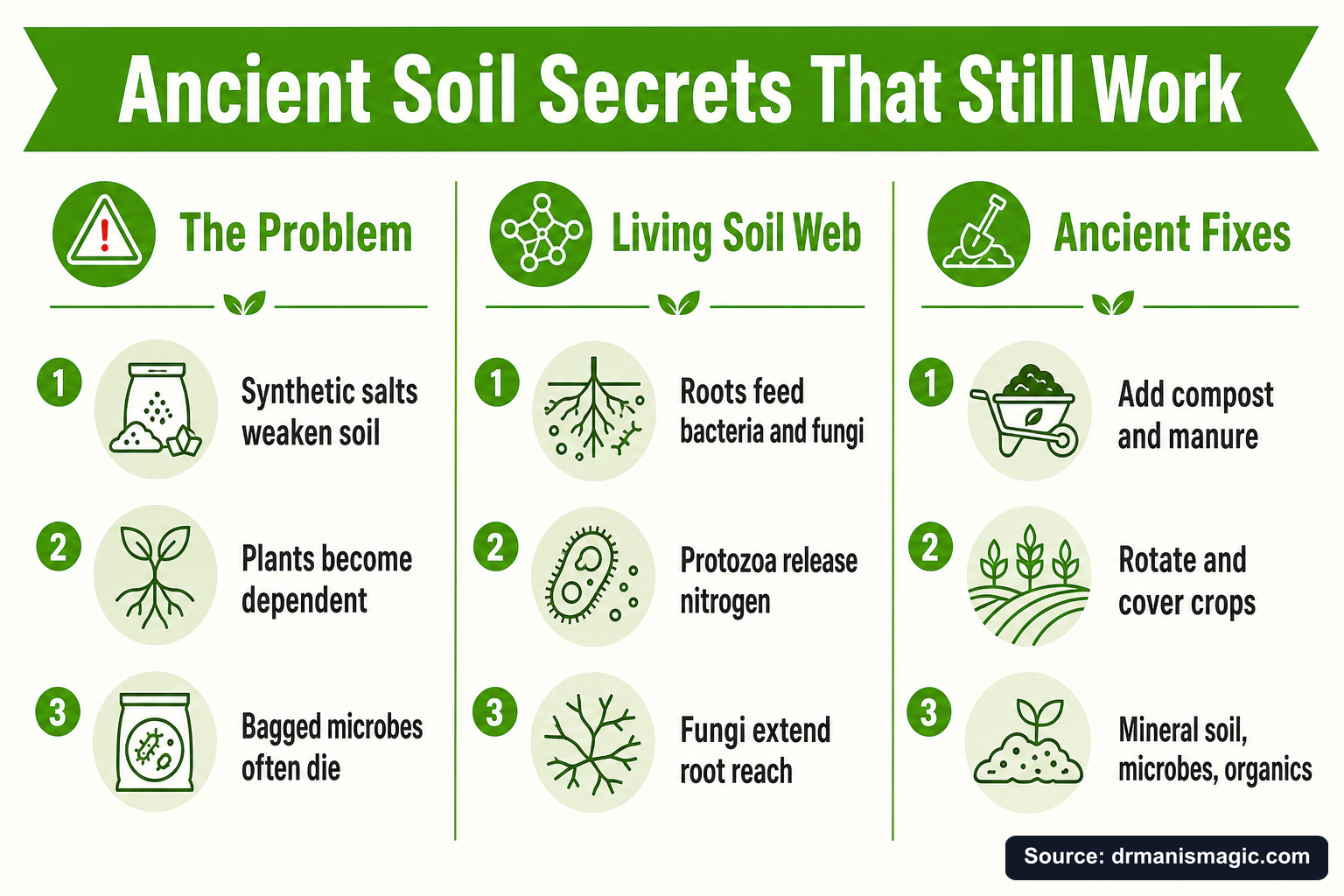
- Farmers fed crops for thousands of years without synthetic fertilizers by feeding the living organisms in their soil first.
- The real secret is the soil food web: a community of bacteria, fungi, protozoa, and nematodes that unlock nutrients, fight disease, and build soil structure.
- Ancient practices like composting, manure application, cover crops, and crop rotation all worked by fueling this underground workforce.
- Synthetic salt-based fertilizers and chemical inputs disrupt or destroy this living system, creating a cycle of dependency and decline.
- Most commercial microbial products are dried, dead, or dying by the time they reach your garden and deliver little real benefit.
- Rebuilding living soil biology takes time and consistent effort, but the payoff is a plant that practically takes care of itself.
- The Three Plant Pillars (mineral soil, live microbes, organic fertilizer) are the modern version of what ancient farmers knew instinctively.
What Did Farmers Actually Use Before Synthetic Fertilizers Existed?
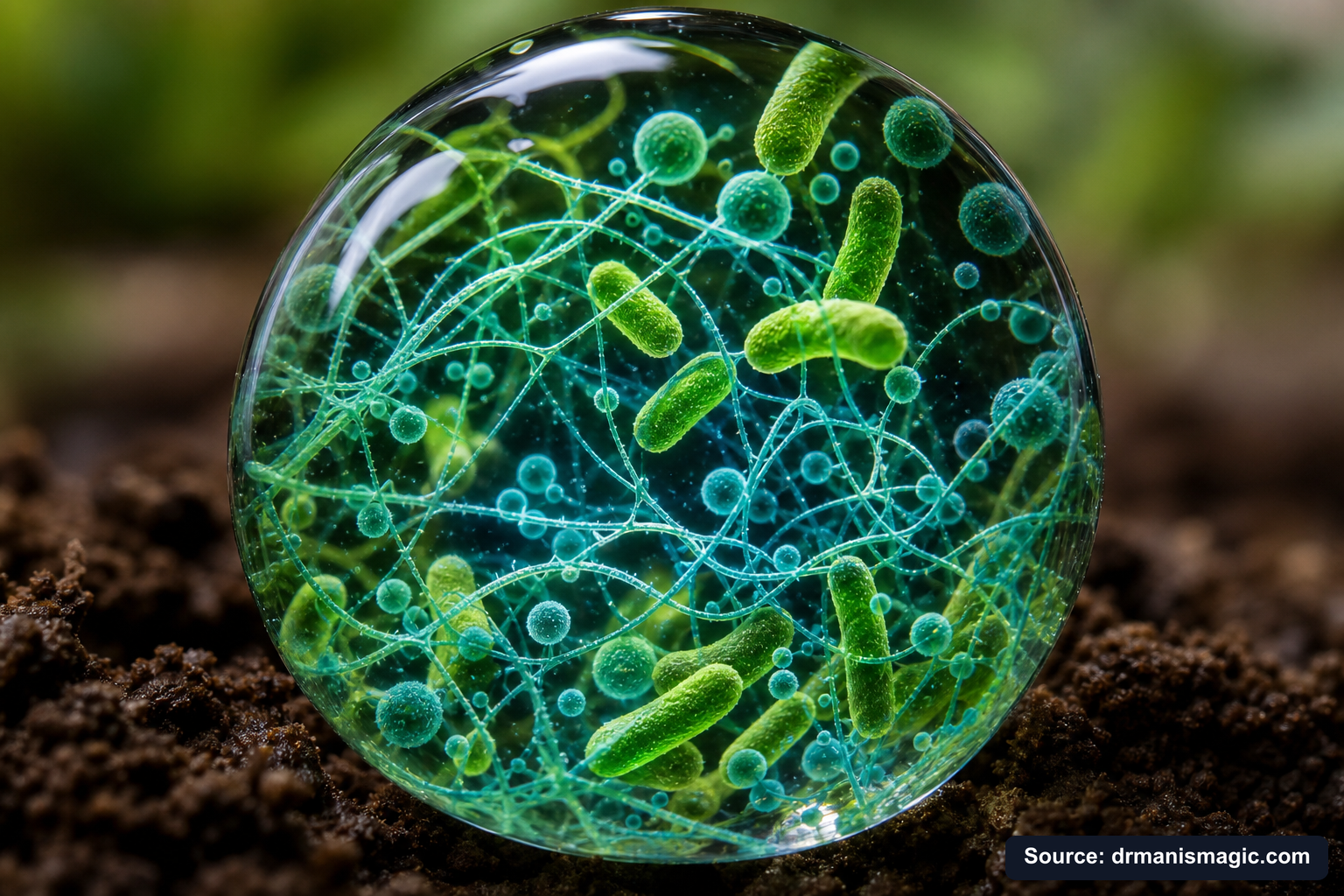
Quick Answer: Before synthetic fertilizers, farmers used manure, compost, green manures, crop rotation, wood ash, cover crops, and animal integration to feed their soil. These practices worked because they fed the billions of living microbes in the soil, which then fed the plants. It was a biological recycling system, not a chemical one.
The first synthetic nitrogen fertilizer was not available until the early 1900s, after Fritz Haber and Carl Bosch figured out how to pull nitrogen from the air and turn it into a product. Before that moment, every crop that ever fed a civilization was grown without it.
How did they do it? Think about what a Roman farmer did. He spread manure across his fields in the fall. He rotated his crops so the same ground grew beans one year and wheat the next. He plowed dead plant matter back into the earth. He let fields rest. He burned wood and spread the ash. None of this felt like science. It was just what worked, passed down through generations.
Here is what most people do not know: every single one of those practices was feeding microbes. The farmer did not know that. He could not see them. But the invisible workforce in his soil responded every time he gave them organic matter to eat. And in return, they fed his crops.
The ancient Chinese used human waste called night soil for thousands of years. The Aztecs built floating garden islands called chinampas that stayed fertile for centuries by cycling organic material. Indigenous farmers across North America planted corn, beans, and squash together in a system called the Three Sisters, where the beans fed nitrogen to the soil, the squash shaded the ground to hold moisture, and the corn gave the beans something to climb. All of it, every bit of it, was biology at work.
What Is the Soil Food Web and Why Does It Feed Your Plants?
Quick Answer: The soil food web is a chain of living organisms in healthy soil: bacteria and fungi break down organic matter, protozoa and nematodes eat the bacteria and release nutrients plants can absorb, and mycorrhizal fungi extend roots to reach water and minerals. Together they form a self-running nutrient factory that ancient farmers relied on without knowing it.
Penn State Extension describes healthy agricultural soil as containing 100 million to 1 billion bacteria in a single teaspoon, along with several feet of fungal strands, thousands of protozoa, and hundreds of nematodes. Penn State Extension: Soil Biology and Soil Health. That teaspoon of living soil is more complex than a rainforest. And it runs on its own, for free, if you feed it right.
Here is how the chain works. Plant roots leak sugar. That is not an accident. Roots do it on purpose to attract bacteria and fungi. Those bacteria and fungi eat the sugars and in return they break down organic matter, decompose dead leaves and manure and old roots, and release nutrients in forms the plant can absorb. Then protozoa eat the bacteria. When protozoa eat bacteria, they release nitrogen right next to the root zone, exactly where the plant needs it. Nematodes eat protozoa and bacteria too, doing the same thing. It is a nutrient recycling loop that runs 24 hours a day, every day, for free.
The University of Minnesota Extension notes that biological processes can supply a major share of plant-available nitrogen and phosphorus in healthy soil. University of Minnesota Extension: Soil Health. That means a living soil is literally manufacturing plant food underground, without any help from a bag or a bottle.
| Organism | What It Does | Benefit to Your Plant |
|---|---|---|
| Bacteria | Break down organic matter, fix nitrogen from air, solubilize minerals | Release nutrients in plant-available forms; suppress disease |
| Fungi (general) | Decompose tough organic material like wood and stems | Build soil structure; release slow nutrients; support root health |
| Mycorrhizal Fungi | Form a second root system extending far beyond the root tips | Deliver phosphorus, water, and micronutrients; dramatically expand root reach |
| Protozoa | Eat bacteria; release nitrogen as waste next to roots | Deliver a steady nitrogen drip exactly where roots can use it |
| Beneficial Nematodes | Eat bacteria, fungi, and protozoa; release nutrients | Cycle nutrients; some species suppress pest larvae in soil |
| Earthworms | Physically mix and aerate soil; deposit nutrient-rich castings | Improve drainage; concentrate nutrients near roots |
This is the engine ancient farmers were running without knowing it. When they spread manure, they were feeding bacteria. When they grew cover crops, they were feeding fungi. When they rotated crops, they were keeping the food web diverse and balanced. They did not need a chemistry degree. They just needed to feed the ground.
How Did Ancient Farming Practices Actually Feed the Soil Food Web?
Quick Answer: Every major ancient farming practice worked by adding organic carbon to soil, which fed bacteria and fungi. Manure brought concentrated microbial life and nutrients. Compost delivered ready-to-use biology. Cover crops grew living roots that fed the food web year-round. Crop rotation kept microbial diversity high. These were not guesses. They were proven systems refined over thousands of years.
Let us walk through the big ones and look at what was actually happening underground.
Manure
When a farmer spread cow or chicken manure, he was doing two things at once. He was adding raw nutrients like nitrogen, phosphorus, and potassium. But more importantly, he was pouring billions of live microbes directly into his soil. Fresh manure is teeming with microbial life. It jump-starts the food web the same way pouring starter fluid onto a fire works. The soil lights up with biological activity.
Compost
A hot compost pile can reach temperatures above 140 degrees Fahrenheit. That heat is not waste. It is a sign of massive microbial activity. Billions of bacteria and fungi are breaking down organic material at full speed. When that finished compost is spread on soil or poured as a liquid called compost tea, it delivers a concentrated dose of living biology directly to the root zone. Gardeners have described fresh compost as almost magical. That is not exaggeration. That is the soil food web waking up.
Green Manures and Cover Crops
Planting a field with clover, legumes, or rye and then plowing it under does something remarkable. Living roots feed the food web while the crop grows. When it is turned under, all that organic matter becomes food for bacteria and fungi. And legumes like clover and beans carry a special bonus: they host nitrogen-fixing bacteria on their roots that pull nitrogen straight from the air and deposit it in the soil. Ancient farmers had no idea about the nitrogen cycle. But they knew that planting beans before wheat made the wheat grow better. Biology was teaching them before science caught up.
Crop Rotation
Different plants feed different microbes. Rotating crops kept microbial diversity high, which kept the food web balanced and resilient. It also prevented any one pathogen from building up to dangerous levels. A disease that attacks corn has no host when beans are growing in that spot. Rotation was natural disease suppression powered by biology.
Fallowing and Mulch
Letting a field rest gave the soil food web time to rebuild. Covering bare soil with mulch or straw kept moisture in, kept the surface cool, and gave surface-dwelling microbes a habitat to live in. Bare soil dries out and bakes. Covered soil stays alive.
What Happens When You Replace Living Soil Biology With Synthetic Fertilizers?
Quick Answer: Synthetic salt-based fertilizers deliver nutrients fast but damage or kill the bacteria and fungi that make soil healthy long-term. Over time, the soil food web collapses. The plant becomes dependent on chemical inputs because the natural nutrient cycle is broken. Root systems weaken, disease pressure increases, and the soil becomes essentially dead ground that needs more and more product to produce less and less result.
Here is the part nobody at the big box store will tell you. Most commercial fertilizers are salt-based. High concentrations of salt in soil water pull moisture away from plant roots and away from soil microbes through a process called osmotic stress. That is the same reason you would not pour salt water on a wound. It draws moisture out by force.
Bacteria and fungi are mostly water. When salt concentrations spike after a synthetic fertilizer application, microbial populations crash. The plant gets a quick green-up because it is absorbing nutrients dissolved in that salty water. But underneath, the food web is dying. And a dead food web cannot recycle nutrients, cannot suppress disease, cannot build soil structure, and cannot maintain the plant through drought or stress.
After a few months, you notice the plant needs more fertilizer to look the same. Then more. Then it starts to decline anyway. The leaves yellow between veins. Fruit does not set well. A pest or disease moves in that the plant cannot fight off. You buy more product. The cycle deepens.
Dr. Mani Skaria, Professor Emeritus of Plant Pathology and founder of the Clean Citrus Program in Texas, watched this play out on citrus trees across the state for decades. He saw growers pouring on synthetic nitrogen and watching their trees slowly lose vitality, even as the leaves looked green. The food web was gone. The tree was on life support.
See also: The Hidden Reason Synthetic Fertilizers Cause Root Rot
You Never Had a Brown Thumb.
You were handed the wrong tools. This free guide hands you the right ones.
You watered it. You fed it. It died anyway.
It was never you. It was the dirt, the salt food, and the bad advice.
This guide shows you what really went wrong, and how to fix it for good.
- Why your plants really died, and why it was never your fault
- The salt hiding in your plant food that quietly burns the roots
- The hidden killer in almost every bag of store soil
- The tiny helpers that grow a whole forest for free
- The rescue trick that brings a half dead plant back to life

Live Microbes vs. Dead Microbe Products: What Is Actually in That Bottle?
Quick Answer: Most commercial microbial products are either dried powders with dormant spores that rarely reactivate, or liquid compost teas that have gone anaerobic and smell like sewage. Neither delivers meaningful living biology to your soil. A genuinely live, full-spectrum microbial product is rare, and you can tell the difference by its smell, its source, and whether it shows visible microbial activity under a microscope.
The microbial product market is hot right now. And like every hot market, it is full of products that promise a lot and deliver very little. Here is what is actually happening behind the labels.
Most commercial microbial products are made in large factory vats. Companies brew up specific species of bacteria or fungi, then dry them into a powder. The idea is that the spores will reactivate when you add water and pour them on soil. After testing dozens of batches on our 250,000-plus trees at US Citrus Nursery, we saw very little to no plant response from these products. The spores may survive drying but they are not the same as genuinely living, active organisms that have been feeding, multiplying, and maintaining metabolic activity.
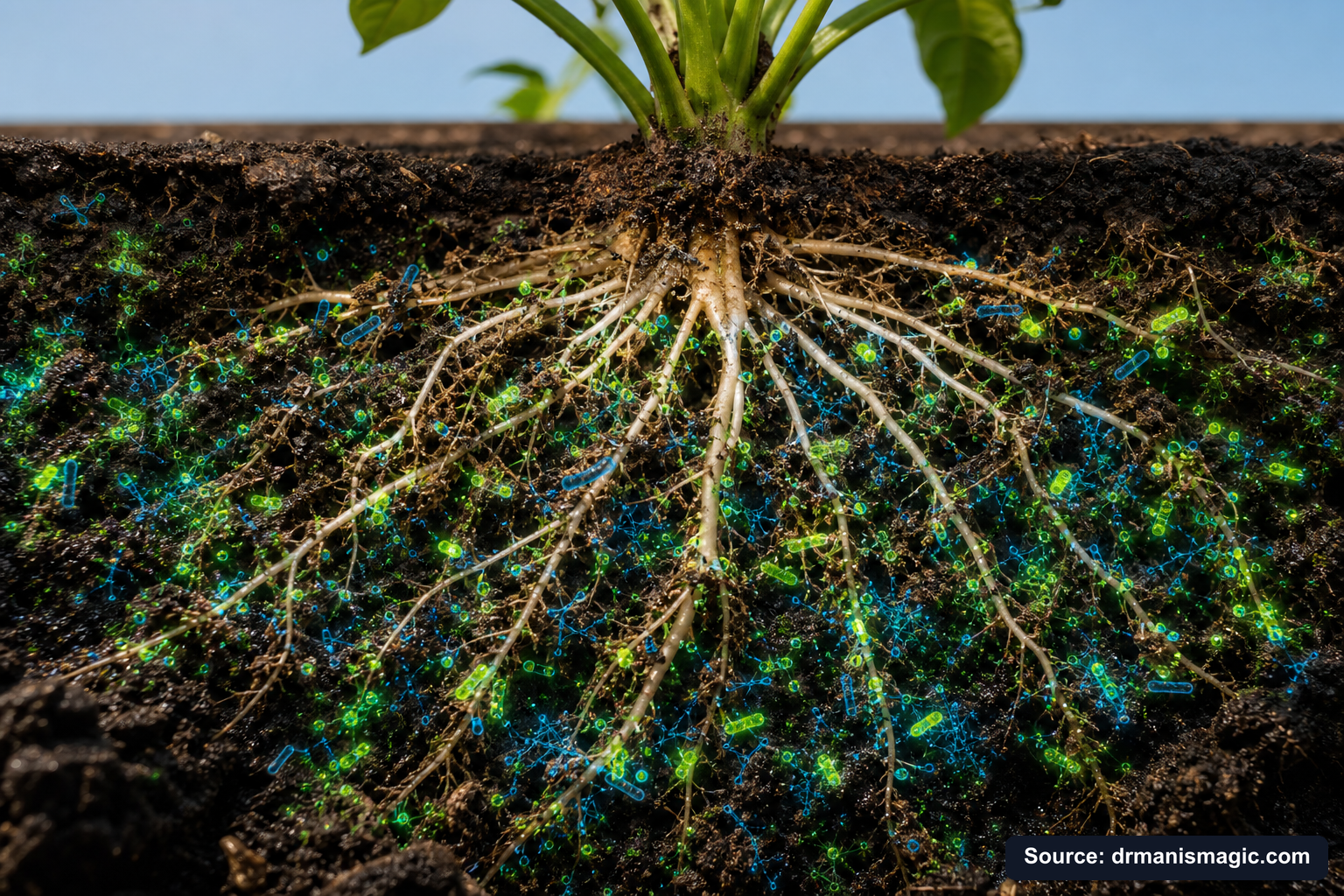
The second type is liquid compost tea products. Some of these start with good organic material. But by the time they travel across the country and sit on a shelf, they have gone anaerobic. The microbes run out of oxygen and start to ferment and die. The telltale sign is the smell. If a microbial product smells like sewage, the biology is dying or dead. Some people still see a small benefit because the product contains humic acid and other organic compounds, but the living organisms are largely gone.
A third type uses lactobacillus, the same bacteria in yogurt. These survive well and stay active. But they are aggressive colonizers that crowd out other beneficial species. Lactobacillus in yogurt is fine. Lactobacillus dominating your root zone is not.
| Product Type | Viability at Use | Spectrum of Organisms | Smell | Results We Saw |
|---|---|---|---|---|
| Dried powder (lab-grown) | Very low | Narrow (1-5 species) | Little or none | No measurable improvement |
| Dried powder rehydrated in liquid | Very low | Narrow | Little or none | No measurable improvement |
| Compost tea (older than 24 hours) | Low (anaerobic) | Partial | Strong sewage odor | Some benefit from organics, not biology |
| Compost tea (fresh, less than 24 hours) | Moderate | Broad | Earthy, then sour | Good results, but very time-sensitive |
| Fresh active compost (on-site) | High | Broad and natural | Earthy | Excellent, but labor-intensive |
| Plant Super Boost (stabilized, full-spectrum) | High (visible under microscope) | 2,000+ bacteria; 400-500 fungi including mycorrhizae; protozoa and nematodes | Earthy, not foul | Strong, consistent plant response |
Plant Super Boost is different because of how it is made. It starts from real compost, not a factory vat. Our lead compost expert, a world-renowned figure who has advised farming programs for governments and royal families, developed a proprietary all-natural technique to stabilize the full spectrum of compost microbes without letting them go anaerobic. The organisms stay alive, active, and metabolically ready. You can put a drop under a microscope and see them moving. Lab analyses confirm their presence and viability. And because they are not rotting, the product smells like earth, not sewage. Zero synthetic salts. Zero biosludge. Zero PFAS. That matters, because your family is near these plants.
Why Do Mycorrhizal Fungi Matter So Much and When Do They Fail?
Quick Answer: Mycorrhizal fungi attach to plant roots and grow a web of threads called hyphae that extend far beyond what roots can reach alone, delivering phosphorus, water, and micronutrients back to the plant. They fail when soil phosphorus is already too high, when the wrong plant species are present, when soil pH or oxygen levels are off, or when the product delivering them contains dead organisms.
If you have ever pulled a weed out of the ground and noticed white fuzzy threads clinging to its roots, you have seen mycorrhizal fungi in action. Those threads are called hyphae, and they are essentially a second root system that the plant grows for free using fungal partners. A single strand of hyphae is far thinner than a root hair, which means it can reach into microscopic pockets of soil that roots simply cannot access. It brings back phosphorus, trace minerals, and water in exchange for sugar that the plant provides.
Ancient farmers did not know about mycorrhizae. But their practices preserved them. When they added compost and manure and kept living roots in the ground, they were maintaining the habitat that mycorrhizal fungi need to survive. When they avoided bare soil and excessive tillage, they were protecting the fungal networks that took years to build.
Here is what most mycorrhizal product sellers will not tell you: inoculation can fail for several reasons. If your soil already has very high phosphorus from years of synthetic fertilizing, the plant has no incentive to form a fungal partnership. It already has plenty of phosphorus. If the product you bought contains dead spores, nothing happens. If the pH, moisture, or oxygen levels in the soil are wrong, the fungi cannot establish. And if the soil has been recently sterilized, fumigated, or treated with broad-spectrum fungicides, you have killed the environment the fungi need to grow in.
This is why the Three Plant Pillars matter as a complete system. Mineral-based soil that drains well and holds oxygen creates the right physical environment. Organic fertilizer that does not spike phosphorus and does not carry synthetic salts keeps the biological incentives in place. And a genuinely live microbial product that includes real, active mycorrhizae gives the partnership a fighting chance. One pillar without the others leaves gaps. All three together recreate what a natural forest floor already has. Learn more about building this foundation at our Three Plant Pillars page.
Synthetic Fertilizer vs. Ancient Organic Practices: An Honest Comparison
Quick Answer: Synthetic fertilizers deliver fast, visible results but gradually destroy soil biology, create dependency, and contribute to root disease over time. Ancient organic practices like compost, manure, and cover crops work slower at first but build a self-sustaining biological system that makes plants more resilient, more productive, and less expensive to maintain over time.
This is not about being anti-science. It is about understanding what kind of science you are applying. Synthetic fertilizers are chemistry. Ancient farming practices are biology. Both involve nutrients. But they operate through completely different mechanisms, and the long-term outcomes are very different.
| Factor | Synthetic Salt-Based Fertilizer | Ancient Organic Practices (Compost, Manure, Green Manure) |
|---|---|---|
| Speed of visible results | Fast (days) | Slower at first (weeks to months), then self-sustaining |
| Effect on soil microbes | Damages or kills beneficial bacteria and fungi | Feeds and multiplies the soil food web |
| Nutrient source | Chemical salts dissolved in water | Organic decomposition and microbial release |
| Root health over time | Declines; salt stress and pathogen vulnerability increase | Improves; mycorrhizae and bacteria protect and extend roots |
| Disease suppression | None; often worsens disease conditions | Strong; diverse biology crowds out pathogens |
| Long-term cost | Increasing; dependency grows as soil biology dies | Decreasing; soil becomes more self-sufficient over time |
| Safety for family and pets | Chemical exposure risk; PFAS, biosludge concerns in many products | Safe; no harsh chemical warnings on the label |
| Soil structure | Degrades over time; compaction and drainage worsen | Improves; fungal glomalin binds soil particles into aggregates |
The real cost of synthetic fertilizer is not the price per bag. It is the time you lose watching a plant struggle, then stall, then slowly go backwards, while you keep spending money trying to figure out what is wrong. We have seen it happen over and over. A grower spends three years on a tree that never thrives. Three years of watering, worrying, and buying products. And the whole time, the answer was underneath the surface: a broken soil food web that no synthetic input was going to fix.
Time is the one thing you cannot get back. The best time to fix your soil was years ago. The second best time is right now.
See also: Why Most Fertilizers Are Actually Salt in Disguise
How Do You Rebuild a Dead or Damaged Soil After Chemical Use?
Quick Answer: Rebuilding damaged soil biology takes consistent action over several months. Stop adding synthetic inputs that harm microbes, flush excess salts, add organic matter, reintroduce live biology, keep living roots in the ground, reduce tillage, and mulch bare surfaces. Recovery happens in stages, not overnight, but the results compound over time and eventually the soil starts running itself.
Here is the honest truth. If your soil has been treated with synthetic fertilizers, herbicides, or fungicides for years, the food web is not going to come back in one application. The damage was done over time. The repair happens over time too. But it does happen. And the results build on themselves.
Here is a practical recovery checklist you can start this week:
- Stop adding salt-based fertilizers immediately. Every application is resetting your recovery. Give the biology a chance to breathe. If you must fertilize during recovery, use organic slow-release options like our Crab, Kelp and Amino Acids formula, which feeds plants without harming microbes.
- Flush accumulated salts. If you are in a container or in ground with poor drainage, water deeply and let it drain fully. Repeat a few times over a week. Salt needs to be physically moved out of the root zone before biology can recover.
- Add organic matter to the surface. Compost, aged wood chips, or mulch spread on top of the soil gives surface microbes food and habitat. Do not bury it deep. Let it sit on top and let biology pull it down naturally.
- Introduce genuinely live microbial biology. Apply a full-spectrum live microbial product monthly. Not a dried powder. Not a foul-smelling liquid. Something with visible, active organisms that smell like earth. This is where a stabilized product like Plant Super Boost earns its place in the system. The diverse cast of bacteria, fungi including mycorrhizae, protozoa, and nematodes gives the food web multiple entry points to rebuild from.
- Keep living roots in the ground. Bare soil is dead soil. If you have open garden space, plant a cover crop. If you have a container, keep the main plant growing. Roots feed the food web through their sugar secretions. No roots means no fuel for bacteria and fungi.
- Reduce or eliminate tillage. Tilling breaks fungal networks. Mycorrhizal hyphae take months to rebuild after major soil disruption. Minimal disturbance lets those networks grow and stay intact.
- Be patient and consistent. Month one, you may see small changes. Month three, roots start reaching deeper. Month six, you notice the plant handles dry spells better. Year one, it fights off pest pressure that used to knock it sideways. The food web is rebuilding, and it compounds just like interest in an account. The longer it runs, the more powerful it gets.
For a complete planting system that walks you through all three pillars step by step, download our Free Plant Care Field Guide. It was built for real growers, not textbooks.
What Can You Do Right Now to Bring Ancient Soil Wisdom Into Your Garden?
Quick Answer: Start by treating your soil as a living ecosystem instead of dead growing media. Add organic matter, stop or reduce synthetic salt inputs, introduce live microbial biology monthly, keep roots growing, and mulch bare soil. These are the same principles ancient farmers used for thousands of years, now understood through modern soil science and proven across more than 250,000 trees at our South Texas nursery.
You do not need to become a soil scientist. You do not need to read a stack of research papers. The ancient farmers who built the richest agricultural civilizations on earth did not have any of that. They had observation, they had experience, and they had respect for the living ground beneath their feet.
What we have learned after three decades at US Citrus Nursery, after testing every input we could find on over 250,000 trees, is that the Three Plant Pillars are the modern version of what those farmers knew. Mineral-based soil that does not compact and collapse. Live microbial biology that runs the nutrient cycle underground. Organic fertilizer that feeds the plant and supports the microbes at the same time, without synthetic salts, without biosludge, without PFAS.
When all three are working together, something shifts. The plant stops struggling and starts thriving. Leaves deepen in color. Roots reach further. Fruit sets. The plant handles heat and drought and stress in ways it never could before. It is not magic, even though it feels like it. It is biology doing what it was designed to do, finally given the conditions it needs.
Think about the plant you most want to see flourish. Maybe it is a fruit tree you have been nursing for two years without much to show for it. Maybe it is a garden that produces less every season. Maybe it is a lawn that never quite bounces back. The living soil secret has been waiting under that ground the whole time. The ancient farmers found it. Dr. Mani Skaria spent forty years confirming it. And now you know it too.
The only question is whether you give your soil the chance to do its job. If you want to see what all three pillars look like working together in a single system, explore the Three Plant Pillars bundle and see what thousands of growers across the country have already discovered. Your plants have been waiting for this a long time. And so, if you are honest about it, have you.
Frequently Asked Questions
You just learned that ancient farmers grew incredible crops without a single bag of synthetic fertilizer. Now you probably have some real questions. Good. These are the questions that separate gardeners who keep losing plants from gardeners who finally figure it out. Let's get straight to the answers.
When did farmers start using synthetic fertilizer?
Synthetic fertilizers showed up in the early 1900s. Fritz Haber and Carl Bosch figured out how to pull nitrogen from the air around 1913. Before that, every civilization on earth grew food without them. That means thousands of years of thriving crops, healthy soil, and real harvests happened before synthetic fertilizer ever existed. The old way worked. It still works. We proved it on over 250,000 trees in South Texas.
What was the first synthetic fertilizer ever made?
Calcium nitrate came first, made in 1903. Then synthetic ammonia arrived after 1913, and the fertilizer industry exploded from there. These products gave farmers a shortcut. But shortcuts have a price. Salt-based synthetic fertilizers kill the living microbes in your soil. No microbes means no real plant health. You get a quick green flush and then a slow decline. That is the cycle big chemical companies profit from.
What are the four main types of fertilizer?
Fertilizers break down into four categories. Nitrogen fertilizers push leafy green growth. Phosphorus fertilizers build roots and flowers. Potassium fertilizers strengthen plants and help them fight stress. Compound fertilizers mix all three together. Most of what you find at big box stores are synthetic versions of these. They deliver a fast hit but burn your soil microbes in the process. Dr. Mani's Magic Crab, Kelp, and Amino Acids fertilizer gives you all three the slow, clean, organic way.
What did farmers use to fertilize before synthetic chemicals existed?
They used manure, compost, wood ash, crop rotation, cover crops, and green manures. None of it was random. Every single practice fed the living organisms in the soil. Those organisms, bacteria, fungi, and microscopic creatures, then fed the plants. It was a biological system, not a chemical one. Dr. Mani spent 35 years studying this and built the Three Plant Pillars around the same truth those ancient farmers discovered by hand.
What farming practices avoid synthetic chemicals entirely?
Organic farming avoids synthetic fertilizers and pesticides completely. It relies on compost, natural minerals, biological inputs, and living soil to grow crops. This is exactly what Dr. Mani's Magic is built on. Mineral-based soil that does not rot. Live microbes that fight disease and unlock nutrients. Organic fertilizer from crab, kelp, and amino acids that feeds plants without burning the soil. No warning labels. No re-entry periods. No fear.
Are synthetic pesticides and chemicals linked to health risks?
Research has raised serious concerns. Studies have found connections between high pesticide exposure areas and increased health risks, including developmental issues in children. That is one reason the safety theme matters so much to us. What is it worth to walk barefoot in your grass without worry? To let your kids and pets play in the garden freely? Dr. Mani's Magic products are all-natural. No toxic splash. No warning labels to read at midnight. Just clean, safe gardening.
How do organic gardeners fertilize without synthetic products?
Organic gardeners use animal by-products, plant-based materials, and mined minerals. These feed the soil slowly and keep the living biology intact. Dr. Mani's Magic Crab, Kelp, and Amino Acids fertilizer works exactly this way. It releases nitrogen, phosphorus, and potassium slowly, the way nature intended. It also does not smell. No fish emulsion stench. No rotting odor. Just clean, earth-smelling nutrition that your plants drink in and your neighbors will never complain about.
About the Author
Ron Skaria, MD
Ron Skaria, MD, is the co-founder of Dr. Mani's Magic and the son of Dr. Mani. He trained as a medical doctor at Baylor College of Medicine, did his residency at UT Health Science Center - San Antonio and fellowship training at Texas Tech University. He now works full time on the family farm at US Citrus and US Citrus Nursery in Hargill, Texas, building Dr. Mani's Magic alongside his dad. He wrote the Brown Thumb Field Guide to put his father's 48 years of plant science into plain words any gardener can use. His belief is simple. You never had a brown thumb. You just never had the right help.


