


Dead Dirt vs. Living Soil: What's Really Killing Your Garden | Dr. Mani's Magic
The Difference Between Dead Dirt and Living Soil (And Why It Changes Everything)
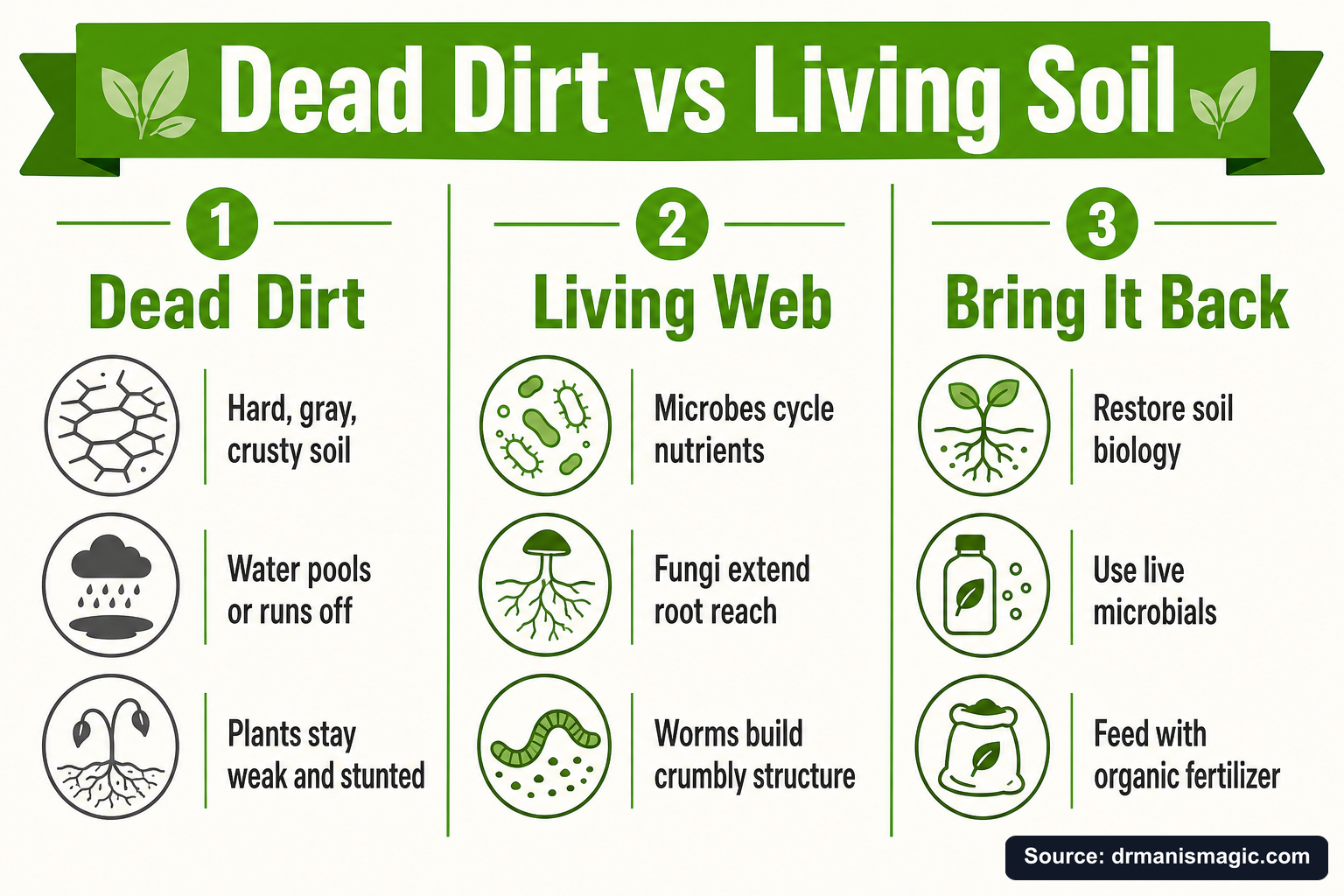
You push a trowel into your garden bed and something feels wrong. The soil doesn't give. It's hard, gray, and dusty. Water pools on top instead of soaking in. You planted something here last spring and it never really took off. You fed it. You watered it. You did everything the bag said to do. And still — nothing. Just a sad, struggling plant doing its best in what feels like concrete.
Here's what nobody told you: the problem wasn't your plant. It wasn't even your watering schedule. The problem was what was living — or not living — underneath it. That gray, crusty stuff? That's not soil. That's dirt. And there's a difference so big it changes whether your garden thrives or slowly dies, whether your fruit trees ever bear fruit in your lifetime, whether your lawn is lush or patchy and brown. The difference between dead dirt and living soil is the difference between a desert and a rainforest.
After 30+ years of growing over 250,000 trees at our South Texas nursery, Dr. Mani Skaria and the team at US Citrus Nursery learned this the hard way. You can spend a fortune on fertilizer, on fancy pots, on the most exotic plants money can buy — and watch it all stall. Or you can understand what's actually happening an inch below the surface. That invisible world is the whole game. Let us show you what we found.
Key Takeaways
- Dead dirt is low-function growing medium — it lacks biology, structure, and the ability to cycle nutrients on its own.
- Living soil is a functioning ecosystem with bacteria, fungi, protozoa, nematodes, earthworms, and roots all working together.
- The soil food web supplies roughly 75% of plant-available nitrogen and 65% of plant-available phosphorus, according to University of Minnesota Extension.
- Synthetic fertilizers, herbicides, and fungicides kill beneficial microbes — making soil less alive over time, not more.
- You can diagnose low-function soil by smell, texture, water behavior, earthworm count, and root appearance.
- Dead or depleted soil can be brought back — but it requires restoring biology, not just adding more fertilizer.
- The Three Plant Pillars — mineral-based soil, live microbials, and organic fertilizer — are the proven foundation for rebuilding living soil fast.
What Is the Real Difference Between Dead Dirt and Living Soil?
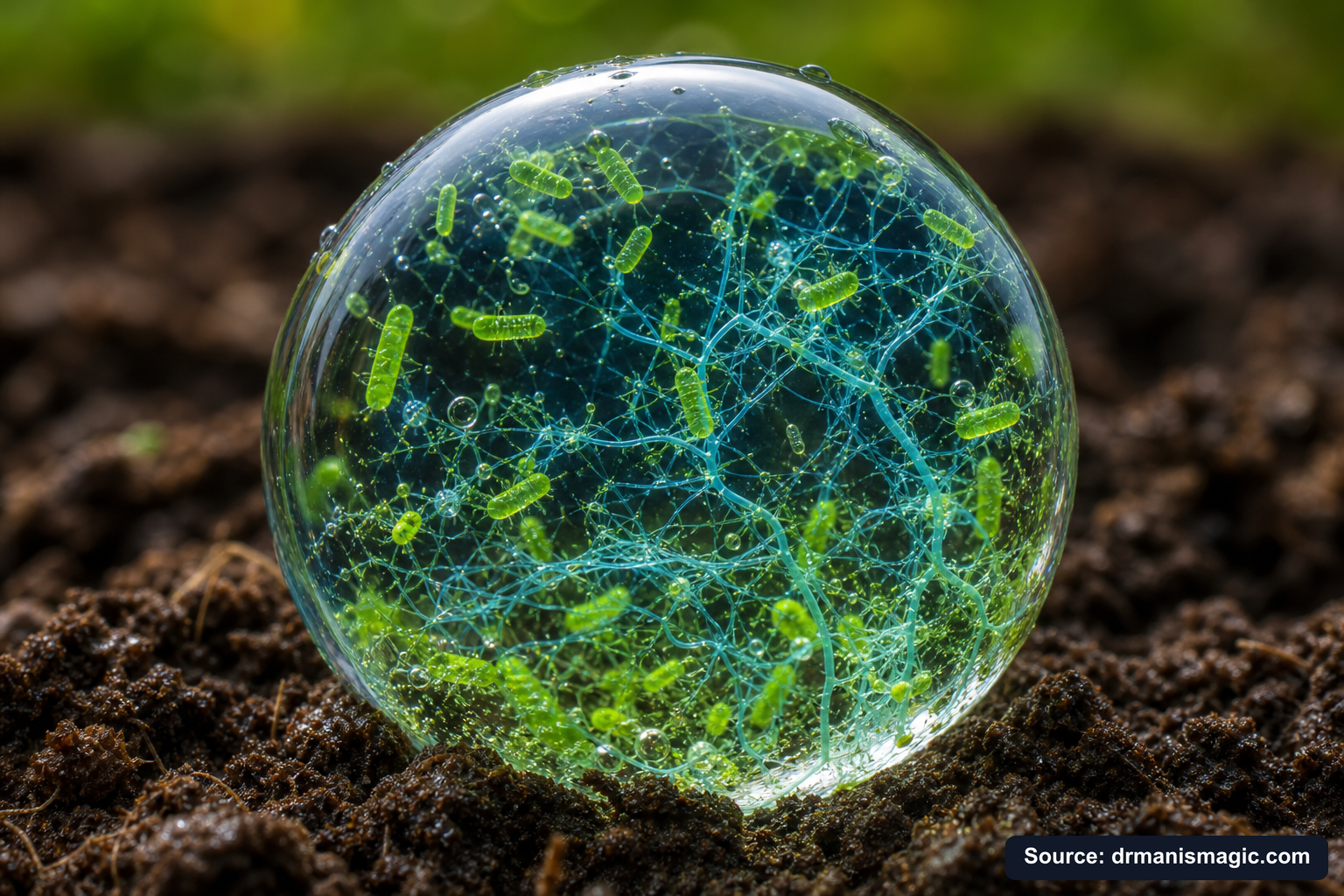
Quick Answer: Dead dirt is biologically empty growing medium with little structure, no nutrient cycling, and nothing living to support your plant roots. Living soil is a complete ecosystem — teeming with bacteria, fungi, protozoa, nematodes, and earthworms — that feeds plants, fights disease, and builds structure all on its own.
Dirt is just particles. Sand, silt, clay — minerals with no life in them. You could fill a pot with beach sand. It would drain perfectly. And your plant would starve and die. That's dirt.
Living soil is something else entirely. The USDA Natural Resources Conservation Service describes healthy soil as a "vital living ecosystem" — not an inert growing medium, but a dynamic, breathing community of organisms that regulate water, cycle nutrients, suppress disease, and give roots a reason to grow deep and strong.
According to the NRCS Soil Health program, bacteria and fungi are at the foundation of this ecosystem. They break down organic matter. They transform raw minerals into food plants can actually use. They build the sticky "glue" (a protein called glomalin) that holds soil particles together into the loose, crumbly structure roots love.
One teaspoon of living soil can hold anywhere from 100 million to 1 billion bacteria. It can hold thousands of feet of fungal threads. It's a city underneath your feet — and when you destroy it, your plants lose their entire support system.
| Feature | Dead Dirt (Low-Function) | Living Soil (High-Function) |
|---|---|---|
| Biology | Little to no microbial life | Billions of bacteria, fungi, protozoa, nematodes, earthworms |
| Structure | Compacted, dense, crusts over | Loose, crumbly, full of pore space |
| Water behavior | Pools on surface, drains poorly or not at all | Absorbs quickly, holds moisture without waterlogging |
| Nutrient cycling | None — nutrients lock up or wash away | Continuous — microbes release nutrients near roots |
| Smell | Sour, chemical, flat, or rotten | Rich, earthy, like a forest floor after rain |
| Root growth | Shallow, stunted, discolored | Deep, white, branching, with fuzzy mycorrhizal threads |
| Disease pressure | High — pathogens dominate unchallenged | Low — beneficial microbes crowd out harmful ones |
| Resilience | Collapses under drought, flood, or heat | Buffers stress — recovers quickly |
| Fertilizer dependence | Total — needs constant input to produce anything | Low — biology cycles nutrients on its own |
| Earthworms present? | Rarely or never | Yes — multiple per handful of healthy soil |
Who Are the Tiny Workers Inside Living Soil? (The Soil Food Web Explained)
Quick Answer: The soil food web is a chain of living organisms — bacteria, fungi, protozoa, nematodes, arthropods, and earthworms — that eat each other, break down organic matter, and release plant-available nutrients right at the root zone. This living chain is what makes soil feed a plant without a bag of fertilizer.
Think of living soil like a busy city with millions of workers, each doing a specific job. Nobody's redundant. Take one group away and the whole system slows down. Here's who's in there and what they actually do.
Bacteria are the fastest workers. They break down fresh organic matter — dead leaves, root debris, compost — and lock nutrients inside their tiny bodies. They also fix nitrogen straight from the air and convert it into a form plant roots can drink. When conditions are right, one bacterium can become millions overnight.
Fungi are the long-distance haulers. Fungal threads called hyphae extend far beyond the reach of any root — sometimes 100 times farther. Mycorrhizal fungi plug directly into plant roots and deliver water and phosphorus in exchange for sugars the plant produces. When you pull up a weed and see white fuzzy threads clinging to the roots? That's mycorrhizae. That's why weeds grow so aggressively. They're tapped into the fungal network. Your garden plants should have the same advantage.
Protozoa are the grazers. They eat bacteria. And when they do, they release nitrogen right next to the root — in a plant-available form the plant can use immediately. According to University of Minnesota Extension, biological processes supply approximately 75% of plant-available nitrogen and 65% of available phosphorus. Protozoa are a huge part of why that happens. Most gardening content skips them entirely. We think that's a big mistake.
Beneficial nematodes are the predators. They eat bacteria, fungi, protozoa, and even harmful nematodes. Their waste releases yet another wave of nutrients. They also move microbes around the soil — like tiny delivery trucks spreading biology to new zones.
Earthworms are the engineers. They shred organic matter, aerate the soil, and leave behind castings that are some of the most nutrient-dense material in nature. A soil with earthworms in it is a soil that's working. A soil with none is a warning sign.
| Organism | Primary Role | Key Benefit to Your Plant |
|---|---|---|
| Bacteria | Decompose residues, fix nitrogen, cycle nutrients | Release nitrogen and other nutrients in plant-ready form |
| Mycorrhizal Fungi | Extend root reach, deliver phosphorus and water | Dramatically increase root surface area and drought resistance |
| Other Fungi | Break down tough organic matter (wood, lignin) | Build soil structure via glomalin; improve aggregation |
| Protozoa | Graze on bacteria; release nutrients near roots | Supply plant-available nitrogen directly at the root zone |
| Beneficial Nematodes | Graze microbes; hunt harmful nematodes | Control pathogens; release nutrients; spread biology through soil |
| Earthworms | Shred organic matter; aerate; create channels | Nutrient-rich castings; improved drainage; deeper root penetration |
| Arthropods | Shred larger debris; move microbes | Speed up decomposition; improve soil mixing |
This is the system that runs every forest, every prairie, every thriving garden on earth — without a single bag of fertilizer. It's been running for 450 million years. The question is whether your soil still has it.
How Do You Know If Your Soil Is Dead or Just Depleted?
Quick Answer: You can diagnose low-function soil with simple tests at home. Look for crusting, compaction, pooling water, zero earthworms, a sour or chemical smell, gray or tan color with no dark organic matter, shallow roots, and plants that need constant fertilizer just to stay green. Any two or three of these together is a serious warning.
You don't need a lab test to know your soil is in trouble. Your senses will tell you most of what you need to know.
The smell test. Scoop up a handful of your soil. Squeeze it. Then smell it. Living soil smells like a forest floor after rain — rich, earthy, slightly sweet. Scientists call that smell "petrichor" and it comes from a compound called geosmin made by soil bacteria. If your soil smells sour, flat, like chemicals, or like rotten eggs, biology is either missing or dying.
The water test. Pour a cup of water onto bare soil. In healthy, living soil it soaks in within a few seconds. In dead or compacted dirt, it sits there, pools, and eventually runs off. That's called hydrophobic soil — it actually repels water. You can spend an hour watering and your roots stay bone dry.
The earthworm test. Dig a hole about 12 inches deep and 12 inches wide. Healthy soil should have at least 10 earthworms per cubic foot. Zero earthworms is a red flag. One or two means the soil is struggling. A handful means you're in good shape.
The root test. Pull up a struggling plant. Look at the roots. Healthy roots are white or cream-colored, thick, and branching. They may even show white fuzzy mycorrhizal threads. Dead-dirt roots are brown, thin, sparse, and sometimes slimy. They smell bad. That's root rot — and it almost always starts with biology loss, not overwatering alone.
The squeeze test. Grab a moist handful of soil and squeeze it. Then open your hand. Healthy soil holds its shape but breaks apart easily when you poke it. Dead dirt either crumbles to dust or stays in a hard, sticky clump that won't break up.
See also: The Hidden Reason Synthetic Fertilizers Cause Root Rot
What Actually Kills the Biology in Your Soil?
Quick Answer: The biggest killers of soil biology are synthetic salt-based fertilizers, herbicides like glyphosate, broad-spectrum fungicides, synthetic pesticides, over-tilling, and compaction. Each one damages or destroys the microbial community that makes soil function. Most modern gardening products do this quietly, over months and years, without you ever knowing.
Here's the part nobody at the big box store will ever tell you.
That bag of quick-release fertilizer? It's salt. Literally. Synthetic fertilizers are salt-based compounds — and salt kills beneficial bacteria and fungi. Every time you pour it on, you're getting a short burst of green while quietly destroying the biology underneath. The plant looks happy for a few weeks. Then it needs another hit. Then another. You're not feeding your plant. You're creating dependency — and slowly turning living soil into dead dirt.
Herbicides like glyphosate are even more direct. Research has shown they disrupt microbial communities, reducing diversity and killing off sensitive beneficial species. Broad-spectrum fungicides don't just kill the bad fungi — they kill mycorrhizae too. The very organism that extends your plant's root system by 100x.
And then there's tilling. Every time you turn soil over, you're breaking up the fungal networks that took months to build. You're also compacting it with machinery and exposing the living communities to sun and drying. A single heavy tilling can set a soil's biology back by years.
The result of all this? A soil that's completely dependent on you and your fertilizer bag. That's exactly what the big chemical companies want. They don't profit from a healthy, self-sustaining soil. They profit from your monthly purchase.
We're not being dramatic. We're being honest.
See also: Why Most Fertilizers Are Actually Salt in Disguise
Is There a Spectrum? Or Is Soil Either Dead or Alive?
Quick Answer: Soil exists on a spectrum from completely sterile (like brand-new potting mix or construction fill) to biologically depleted (damaged by chemicals or compaction) to recovering soil (some biology returning) to resilient living soil (full food web intact). Most home garden soil sits somewhere in the middle — not dead, but not thriving either.
The phrase "dead dirt" is a little dramatic, but it makes a point. The real picture is a spectrum — and knowing where your soil sits helps you choose the right fix.
Completely sterile soil is soil with essentially no biology at all. Think brand-new bagged potting mix, sterilized greenhouse media, or construction fill. It has no pathogens — but it also has no beneficials. It's a blank slate. Plants can survive in it short-term if you feed them constantly. But they'll never truly thrive.
Biologically depleted soil is the most common problem in home gardens. This is soil that once had biology but lost it — through years of synthetic fertilizer use, herbicide application, repeated fungicide use, or just being left bare with no organic matter to feed the microbes. It still has some life in it, but not enough to support your plants without constant intervention.
Recovering soil is depleted soil where biology is starting to come back — maybe you added compost, stopped using synthetics, started mulching. You'll see earthworms returning. Roots look a little better. But it's fragile. One round of salt fertilizer or herbicide can knock it back.
Resilient living soil is the goal. Full food web intact. Earthworms thriving. Roots covered in mycorrhizae. Water soaks in fast. Disease pressure is low because beneficial microbes are crowding out pathogens. Your plants are practically bulletproof.
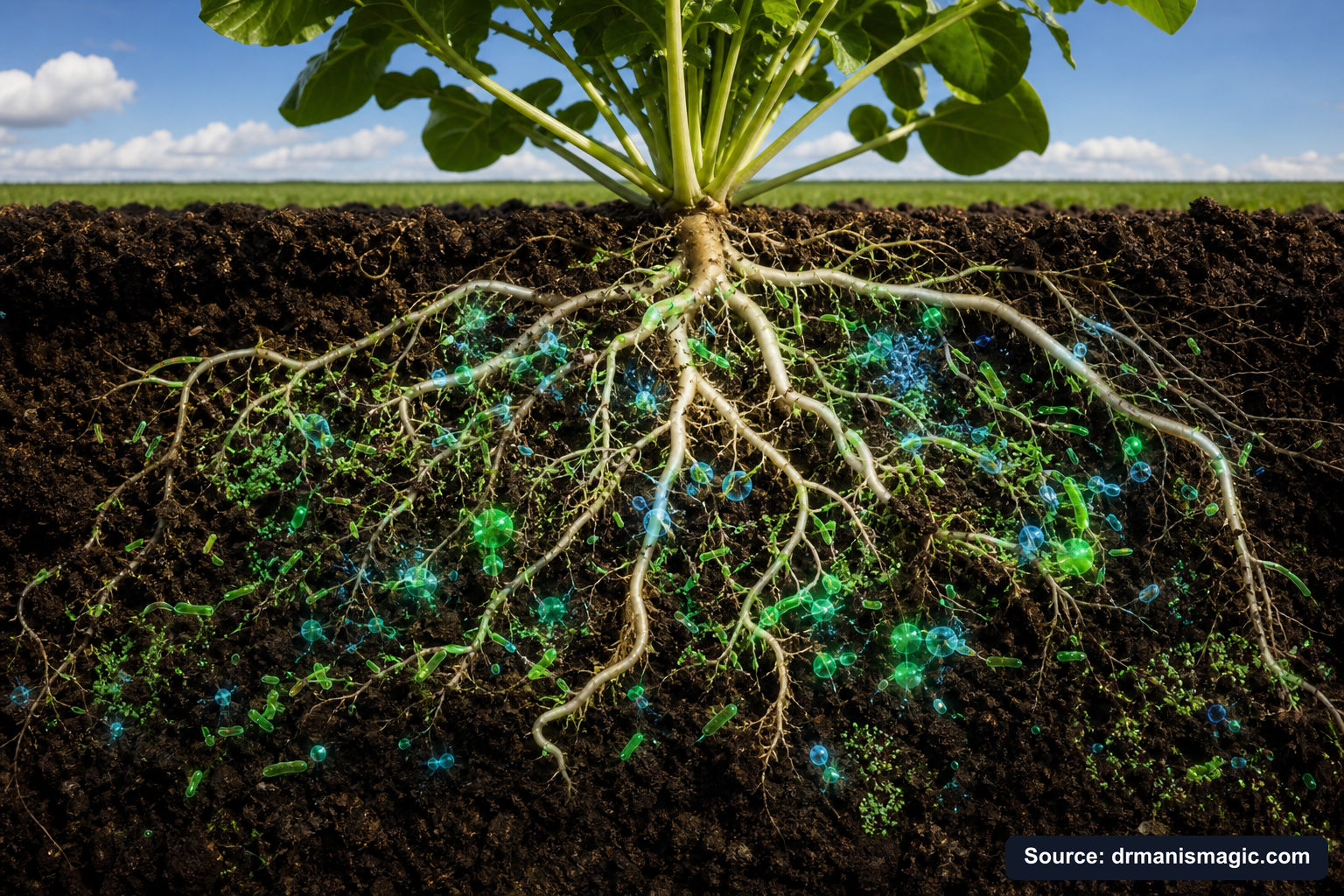
Most people reading this right now are in the "depleted" or "recovering" zone. The good news? You can move the needle fast — if you know what to do.
You Never Had a Brown Thumb.
You were handed the wrong tools. This free guide hands you the right ones.
You watered it. You fed it. It died anyway.
It was never you. It was the dirt, the salt food, and the bad advice.
This guide shows you what really went wrong, and how to fix it for good.
- Why your plants really died, and why it was never your fault
- The salt hiding in your plant food that quietly burns the roots
- The hidden killer in almost every bag of store soil
- The tiny helpers that grow a whole forest for free
- The rescue trick that brings a half dead plant back to life
Can Dead Soil Come Back to Life? (A Step-by-Step Recovery Plan)
Quick Answer: Yes. Depleted soil can recover, but it requires adding living biology back in, feeding that biology with organic matter, improving structure so oxygen and water move freely, and stopping the inputs that killed it in the first place. Recovery happens fastest when all three elements — structure, microbes, and organic nutrition — are restored together.
This is where most gardening advice fails you. People say "add compost" or "try this microbe powder" — but they never explain why those things work, or why they often don't. Let's fix that.
Soil biology is not just about adding microbes. It's about creating a home where microbes can survive, multiply, and do their jobs. That means structure (pore space, oxygen, drainage), carbon inputs (organic matter, root exudates), moisture balance (not bone dry, not waterlogged), and protection from the inputs that kill them.
Here is a practical recovery sequence we've used and refined over 30 years of growing in South Texas:
- Stop the bleeding first. Stop all synthetic salt-based fertilizers, herbicides, and broad-spectrum fungicides. You cannot rebuild biology while continuing to destroy it. This step alone is the most important one.
- Fix your soil structure. If you're in a container, consider switching to a mineral-based soil that doesn't compact and decompose over time. If you're in-ground, add organic matter (compost, aged wood chips, mulch) to the top and let it work down. Avoid tilling if possible — it breaks up fungal networks.
- Test your water and soil pH. Biology thrives in a pH range of roughly 6.0 to 7.0. If your soil is too acidic or too alkaline, even great microbes will struggle. A simple pH test kit costs a few dollars at any garden center.
- Add living biology — not dead powder. This is critical. Most microbe products on the shelf are dried powders with dormant or dead spores. They've been tested. They often don't work. What works is genuinely live, full-spectrum microbial biology applied directly to the root zone. We'll talk more about this below.
- Feed the biology with organic nutrition. Microbes eat organic matter. Give them slow-release organic fertilizer — not salt bombs — so they have the carbon and nitrogen they need to multiply and thrive. Think crab meal, kelp, amino acids. Not urea. Not ammonium nitrate.
- Mulch the surface. Bare soil is dead soil. A 2-3 inch layer of mulch keeps moisture in, regulates temperature, feeds surface microbes, and protects the biology from sun and wind. This single step makes a dramatic difference within weeks.
- Be patient and consistent. Biology takes time. The first application of live microbes kicks off the process. But the real transformation happens over weeks and months as populations grow, food webs reestablish, and structure improves. Repeat your microbial applications monthly. Keep feeding the system organically. Watch the earthworms return.
You can get money back. You cannot get time back. The best time to start this process was last year. The second best time is right now.
Why Do Most Microbial Products Fail to Bring Soil Back to Life?
Quick Answer: Most commercial microbe products are either dried powders with dead or dormant spores that never reactivate properly, or liquid compost teas that have gone anaerobic (oxygen-starved) by the time they reach you — killing the biology and creating a foul smell. Neither type delivers the live, full-spectrum microbial community your soil actually needs.
Walk into any garden center and you'll find shelves of products promising "billions of beneficial microbes." Pretty packaging. Big numbers. And often, very little result.
Here's why.
Problem one: Dried powders. Most commercial microbial products are made in large factories. A handful of specific bacterial or fungal species are grown in giant vats, then dried into a powder. The idea is that the dried "spores" will reactivate when you add water. We've tested dozens of these. Over and over, at our nursery, with our trees, side by side. The results are consistently disappointing. The narrow spectrum of species just doesn't replicate what a full soil food web does.
Problem two: Anaerobic liquid products. Some companies use compost or earthworm castings to create a liquid microbial product. This approach has more potential — but it has a fatal flaw. Once a liquid microbial product goes anaerobic (runs out of oxygen), the biology starts dying and fermenting. You'll know it immediately. The bottle fizzes when you open it. The smell hits you like a wall. That stench is not "earthy." That's death. That's rotting microbes. You're pouring dying biology onto your plants and wondering why nothing improves.
Problem three: Lactobacillus products. Some products use lactobacillus — the same bacteria in your yogurt. Easy to make, stays alive. But lactobacillus is extremely aggressive. It crowds out the beneficial bacteria you actually need. It belongs in fermented food, not in your garden soil.
Dr. Mani Skaria spent years searching for a solution to this exact problem. He needed live, full-spectrum microbes — the kind you find in fresh, steaming compost — available in a stable form that anyone could use at home.
The answer came from an unlikely source: a world-renowned compostologist who had advised royal families and governments on agricultural practices across the globe. He had developed a proprietary all-natural technique to stabilize the full spectrum of living microbes from compost — keeping them alive without going anaerobic. Big chemical companies blacklisted him when large citrus groves started seeing remarkable results. At one point, he feared for his safety. Years later, through what Dr. Mani describes as a providential meeting, he joined the US Citrus Nursery team — and Plant Super Boost was born.
The result is a liquid microbial product harvested from natural compost — not a lab — that smells earthy, not foul, because it isn't going anaerobic. Under a microscope, you can actually watch the microbes moving. That's how you know they're alive. That's the difference.
| Product Type | Viability When You Use It | Spectrum of Species | Smell | Our Assessment |
|---|---|---|---|---|
| Dried powder (lab-grown) | Low — spores rarely reactivate fully | Narrow (3-10 species) | Minimal | We've seen no meaningful results. Avoid. |
| Dry powder rehydrated into liquid | Low — same issue as above | Narrow | Minimal to flat | Same problem. Not recommended. |
| Compost tea (fresh, under 24 hours) | Moderate — if actively aerated | Partial | Earthy to slightly sour | Good if used immediately. Time-sensitive. |
| Compost tea (old, over 24 hours) | Low — anaerobic, biology dying | Partial and declining | Strong, foul, rotten | Not recommended. Dead biology in a bottle. |
| Fresh active compost (on-site) | High — if truly fresh and hot | Broad and natural | Rich and earthy | Excellent. Requires time and effort to make well. |
| Lactobacillus-based products | High — but wrong organisms | Dominated by one aggressive species | Fermented/sour | Crowds out beneficials. Not recommended. |
| Plant Super Boost (stabilized, full-spectrum) | High — live at point of use | 2,000+ bacteria; 400-500 fungi including mycorrhizae; protozoa; nematodes | Earthy — not foul | Harvested from compost, stabilized naturally, verified by lab analysis. Visible movement under microscope. |
What Does Living Soil Actually Feel Like? (The Sensory Difference)
Quick Answer: Living soil feels loose and crumbly in your hand, smells rich and earthy like a forest after rain, absorbs water like a sponge, and shows visible life — earthworms, dark color, root systems covered in white threads. Dead dirt feels dense, dry, or sticky; smells flat or sour; repels water; and shows no signs of biological activity.
Close your eyes for a second. Imagine walking through an old forest. You step off the path onto the ground between the trees. Your foot sinks slightly. The surface is soft. You kneel down and push your fingers in. The soil is dark — almost black in places. It smells incredible. Deep, earthy, alive. Like something is happening in there. Because something is.
That smell — petrichor, geosmin — is produced by actinobacteria, a type of soil bacteria that thrives in healthy, biologically active soil. You're literally smelling life.
Now imagine your backyard after five years of synthetic fertilizer, a few rounds of herbicide, and a summer of compaction from foot traffic. Gray. Crusty. Flat. You dig in and the smell is nothing. Or worse — sour, like something went wrong. The roots you pull up are brown and thin. No earthworms. No white fuzz. Just dirt.
The difference is real. You can feel it, smell it, and see it. And once you know what to look for, you can't unsee it.
Living soil behaves differently in every way. It holds moisture without waterlogging. It drains without washing nutrients away. It feeds your plant without you having to do anything, because the food web is doing the work. Every handful of healthy garden soil is doing more work for your plant than a bag of synthetic fertilizer ever could — and it does it quietly, constantly, for free.
How Do the Three Plant Pillars Rebuild Living Soil Fast?
Quick Answer: The Three Plant Pillars — mineral-based soil structure, live full-spectrum microbials, and organic slow-release fertilizer — work together to restore the three things biology needs to thrive: physical habitat, living organisms, and food. Addressing all three at once is what makes plants turn around within weeks rather than seasons.
Dr. Mani Skaria didn't develop the Three Plant Pillars in a classroom. He developed them in the field, over 30 years of growing at US Citrus Nursery in South Texas, through the kind of trial and error that costs time and money and trees. He saw what worked and, more importantly, he saw what didn't.
Here's the insight that changed everything: you cannot grow a healthy plant by addressing just one piece of the puzzle. You can have the most sophisticated microbial product in the world — but if your soil is compacted pine-bark sludge that's suffocating the roots, those microbes have no habitat to live in. You can have beautiful mineral-based soil with perfect drainage — but if there's no biology in it, the roots are still on their own. You can have both — and then use salt-based fertilizer that kills everything you just built.
The Three Plant Pillars solve all three problems simultaneously.
Pillar One: Mineral Foundation. Most commercial potting mixes are organic-based — pine bark, wood chips, peat. They feel fine when you buy them. But within months, they start breaking down. They compact. They block oxygen from reaching roots. They create the exact wet, airless conditions that root rot thrives in. The fix is mineral-based soil — sandy loam that doesn't decompose, doesn't compact, and keeps roots breathing for years. Not months. Years. Super Soil is built on this principle — a permanent mineral foundation straight from the Rio Grande Valley.
Pillar Two: Microbial Muscle. Once your soil structure is right, biology needs to move in. In nature, this happens automatically — through the soil food web, through root exudates, through organic matter falling and decomposing. In our gardens and containers, we've interrupted that cycle. We have to reintroduce it. That means genuinely live, full-spectrum microbes — bacteria, fungi, protozoa, nematodes — applied regularly so populations build and stabilize. Not dried powder. Not smelly anaerobic liquid. Live biology.
Pillar Three: Organic Nutrition. Microbes need to eat. Plants need to eat. Organic slow-release fertilizer — from sources like crab meal, kelp, and amino acids — feeds both at once. It delivers a complete spectrum of nutrients in gentle, plant-available forms without the salt that kills the biology you just worked so hard to rebuild. No salt burns. No microbial massacre. Just steady, consistent nutrition that builds long-term soil health.
Together, these three pillars create a self-reinforcing cycle. Better structure means more oxygen for microbes. More microbes means more nutrients for plants. More nutrients means stronger roots that feed more sugars back to the microbes. The system becomes self-sustaining. Your garden stops being something you have to fight. It starts working with you.
Learn more about how all three pillars work together at the Three Plant Pillars bundle page.
What Can You Do Right Now to Start Bringing Your Soil Back to Life?
Quick Answer: Start by stopping synthetic inputs, then add structure (mulch or mineral-based soil), introduce live microbials directly to the root zone, switch to organic slow-release fertilizer, and repeat monthly. Most gardeners notice visible improvement — better color, stronger roots, fewer disease problems — within 30 days of addressing all three pillars together.
You don't need to overhaul your entire garden this weekend. Start where you are. Here's what you can do this week.
This week: Do the smell test, the water test, and the earthworm test described above. Know where your soil sits on the spectrum. Stop any synthetic fertilizer or herbicide applications. Add a 2-3 inch layer of mulch to any bare soil you have.
This month: Introduce live microbials to your root zone. Apply them monthly — not once and done. Biology needs to be replenished regularly, especially in containers and in ground soil that's been damaged by years of synthetic inputs. Feed your soil with organic nutrition, not salt bombs. Check your water's pH before applying — chlorinated tap water can stress microbes. Let it sit in a bucket for a few hours first, or use a hose filter.
This season: Watch for the signs of living soil returning. Earthworms coming back. Roots looking white and healthy instead of brown and thin. Water soaking in instead of pooling. Plants staying green without a constant fertilizer hit. That earthy smell after watering. These are not small things. These are the signs that the food web is rebuilding.
We've watched this happen with 250,000+ trees at our South Texas nursery. We've watched it happen in backyard gardens, in houseplant pots, in raised beds, in lawns. The biology wants to come back. It just needs the right conditions and the right inputs to do it.
The people who struggle the longest are the ones who keep doing the same thing — buying the same synthetic fertilizer, using the same herbicide, wondering why nothing changes. They lose months. They lose seasons. They lose years. You can get money back. Time is gone forever. Every month you spend fighting your soil instead of working with it is a month your fruit tree isn't fruiting, your garden isn't producing, your lawn isn't the lush green you pictured when you bought this house.
The good news is that the solution isn't complicated. It's not expensive. And it works fast when all three pillars are in place.
For a complete, practical starting point — with no guesswork and no chasing down five different products from five different companies — download our Free Plant Care Field Guide. It walks you through the Three Plant Pillars step by step for any plant you're growing, whether that's a citrus tree in a container, a vegetable garden, a flower bed, or your front lawn.
Your soil wants to be alive. Give it what it needs, and it will pay you back with stronger plants, bigger harvests, and a garden that actually looks and feels the way you always imagined it would. That's not magic. That's just biology doing what it was designed to do — once you stop getting in its way.
Frequently Asked Questions
You just read about the difference between dead dirt and living soil. Now you probably have questions. Good. These are the exact questions Dr. Mani heard from thousands of gardeners over 30 years of growing 250,000+ trees in South Texas. The answers below could save you months of wasted time and a lot of heartbreak.
What is considered living soil?
Living soil is a full ecosystem working underground. It holds billions of bacteria, miles of fungal threads, and tiny creatures that break down raw materials into food your plant roots can actually drink in. It is not just dirt with some nutrients mixed in. It is a breathing, self-feeding community. When that community is healthy, your plants fight off disease on their own and grow faster than you ever thought possible. Dead dirt has none of that. It is just particles with nothing alive inside.
What is the real difference between dead dirt and living soil?
Dead dirt is biologically empty. It has no living organisms to cycle nutrients, no structure to let roots breathe, and no defense against disease. Water sits on top instead of soaking in. Roots hit a wall. Plants struggle and stall. Living soil is the opposite. It feeds your plant, drains properly, and actually improves over time. Dr. Mani proved this across 250,000+ citrus trees at US Citrus Nursery. The biology underneath is the whole game. Everything else is secondary.
How do you turn dead soil into living soil?
You rebuild it from the ground up using the Three Plant Pillars. First, you need a mineral-based soil that does not compact or rot. Second, you need live microbials like bacteria, fungi, and mycorrhizae to wake the soil back up. Third, you need an organic slow-release fertilizer that feeds the microbes without burning them out. Stop adding synthetic salt-based fertilizers. They kill the very biology you are trying to restore. Start with the right foundation and the soil comes back to life fast.
Can I bring old soil back to life?
Yes, but you cannot do it by just adding more fertilizer. That is like putting gas in a car with no engine. The key is restoring the biology first. Dr. Mani's Plant Super Boost is a bottle of live bacteria, fungi, and mycorrhizae that you mix with water and pour right in. Those microbes get to work immediately. Pair that with an organic fertilizer like Dr. Mani's Crab, Kelp, and Amino Acids blend and your old soil starts cycling nutrients again instead of just sitting there dead.
What should I add to soil to make it richer?
Add life, not just chemicals. Organic slow-release fertilizers made from crab meal, kelp, and amino acids feed your soil's microbes and give plants nitrogen, phosphorus, and potassium in a form they actually crave. Live microbials like mycorrhizal fungi expand root reach so plants can pull in more water and nutrients. Dr. Mani's Magic was built around exactly this approach. It was tested on citrus trees, tropical trees, houseplants, and gardens before it ever went to market. The results speak for themselves.
Can I add new soil on top of old soil?
You can, but layering new over old without mixing creates a drainage problem. Water gets trapped between the two layers and roots suffocate. The smarter move is to loosen the old soil first, then blend in a mineral-based mix that does not compact over time. Dr. Mani's Super Soil is built on sandy loam from the Rio Grande Valley. It does not break down, does not rot, and does not choke roots. You can use it permanently. That alone saves you money and a lot of frustration every single season.
How do I make my own living soil?
A true living soil needs three things working together: a mineral-based structure that drains and breathes, live microbials that build the soil food web, and organic nutrients that feed the whole system without burning it. That is exactly what the Three Plant Pillars are built on. Dr. Mani spent 30 years and 250,000+ trees figuring out the right ratios. His Super Soil, Plant Super Boost, and Crab Kelp and Amino Acids fertilizer were made to work together so you do not have to guess or piece it together yourself.
About the Author
Ron Skaria, MD
Ron Skaria, MD, is the co-founder of Dr. Mani's Magic and the son of Dr. Mani. He trained as a medical doctor at Baylor College of Medicine, did his residency at UT Health Science Center - San Antonio and fellowship training at Texas Tech University. He now works full time on the family farm at US Citrus and US Citrus Nursery in Hargill, Texas, building Dr. Mani's Magic alongside his dad. He wrote the Brown Thumb Field Guide to put his father's 48 years of plant science into plain words any gardener can use. His belief is simple. You never had a brown thumb. You just never had the right help.


