


Clean Processing vs. Rot: What's Really Killing Your Plants | Dr. Mani's Magic
The Difference Between Clean Processing and Rot (And Why It's Killing Your Plants)
Picture this. You walk out to your backyard on a Saturday morning, coffee in hand, and something smells wrong. Not "neighbor's compost bin" wrong. Wrong like something died. You get closer to your favorite potted tree — the one you've been nursing for two seasons — and the leaves are yellow. The soil looks dark and wet. You poke a finger in and it's cold and sour-smelling. Your stomach drops.
You fertilized it three weeks ago. You watered it just like the bag said. You did everything right. So why does it look like it's dying?
Here's the thing most gardening advice never tells you: there is a massive difference between something that is processing and something that is rotting. One of them feeds your plants. The other one suffocates them from the inside out. And if you can't tell them apart, you will keep losing plants, keep wasting money, and — worst of all — keep losing time you can never get back. Let's fix that right now.

Organic Fertilizer | Crab, Kelp & Amino Acids
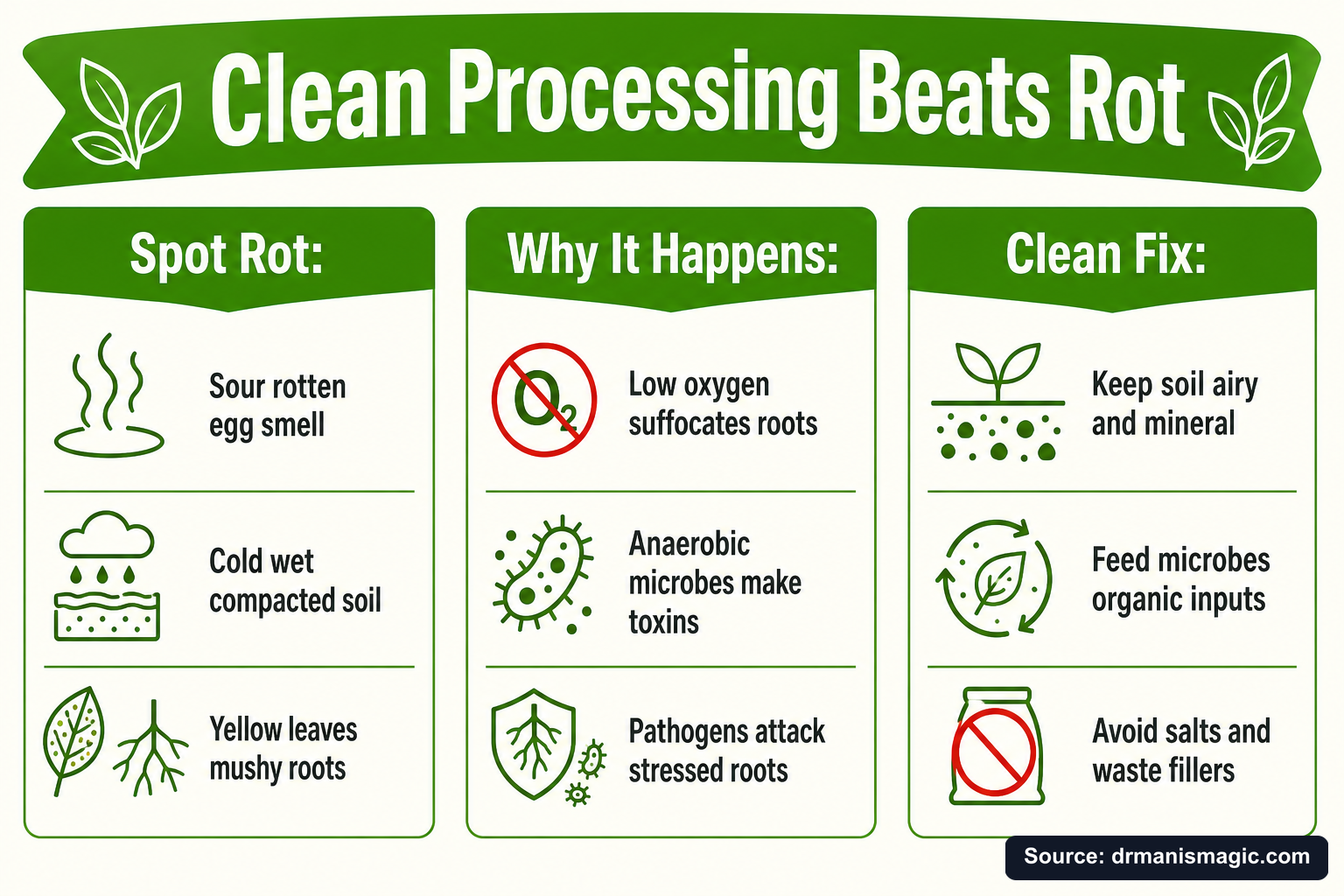
Key Takeaways
- Clean processing is controlled, oxygen-rich biological activity that turns organic matter into plant food. Rot is uncontrolled, oxygen-starved decay that produces toxins and kills roots.
- Salt-based synthetic fertilizers can create "physiological drought" in roots even when the soil is wet — a hidden form of root stress most gardeners never suspect.
- Healthy microbes eat organic fertilizer first, convert it into plant-ready nutrients, and then release it slowly into the root zone after they die — a natural, built-in slow-release system.
- Biosludge, municipal waste fillers, and PFAS "forever chemicals" show up in some bagged fertilizers and composts — clean inputs and full transparency matter more than most people realize.
- The root-zone failure triangle is three things working together: too much salt, too little oxygen, and pathogens like Pythium and Phytophthora moving in on stressed roots.
- Chitin from crab shells, kelp biostimulants, and amino acid nitrogen all feed the soil biology that keeps roots safe — without salt, without burn, without the smell.
- Dr. Mani's Magic Three Plant Pillars — mineral soil, live microbes, and organic fertilizer — are the foundation proven across 250,000+ trees at US Citrus Nursery in South Texas.
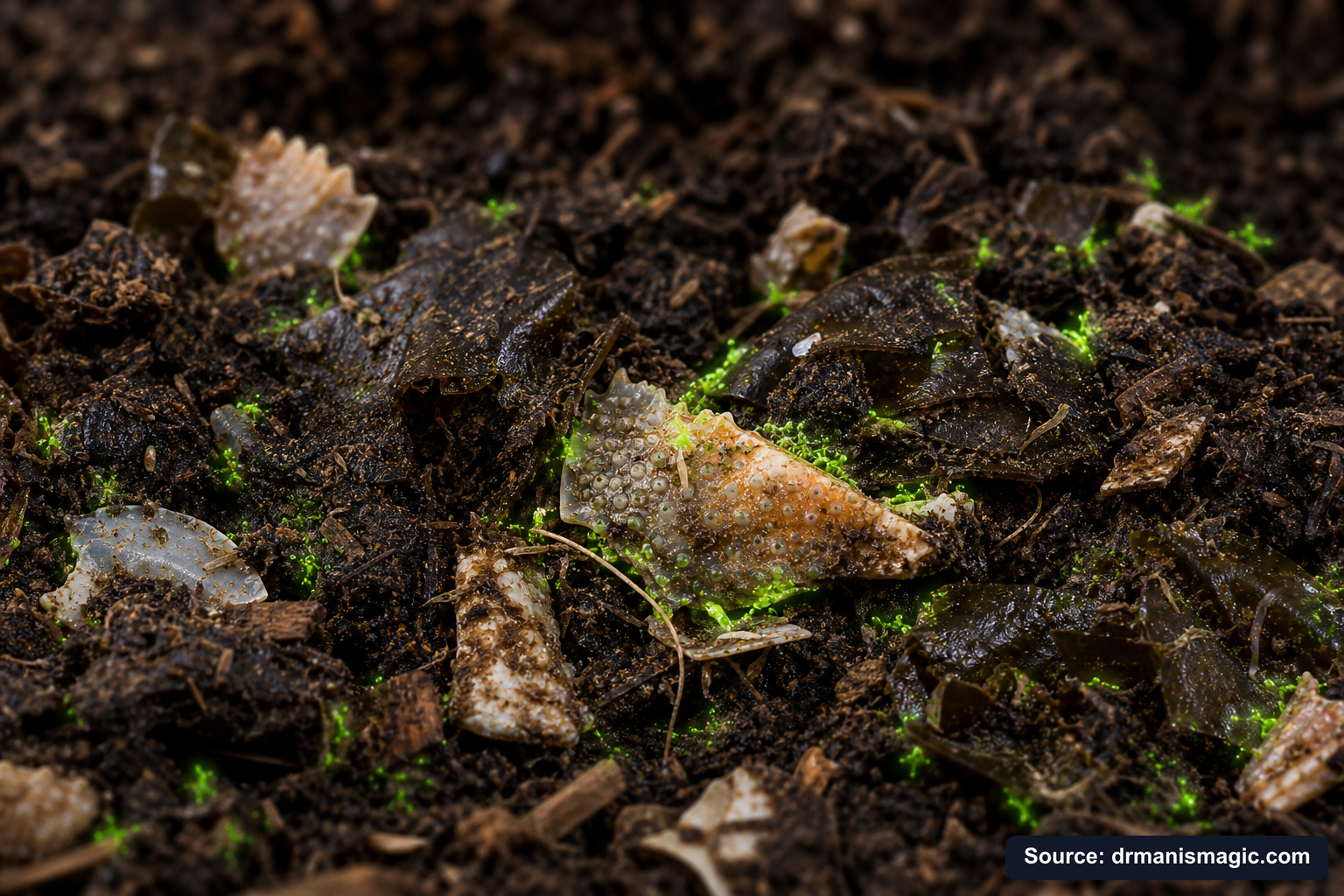
What Is the Difference Between Clean Processing and Rot?
Quick Answer: Clean processing is aerobic decomposition — oxygen is present, the right microbes are active, and organic matter breaks down into stable, plant-safe nutrients. Rot is anaerobic decay — oxygen is gone, the wrong organisms take over, and the result is toxic gases, foul smells, pathogens, and root damage instead of plant food.
The single most important word is oxygen.
When oxygen is present, beneficial bacteria and fungi go to work breaking down organic matter in a controlled, orderly way. The process is called aerobic decomposition. It produces carbon dioxide, water, heat, and a dark, crumbly, sweet-smelling material that looks and acts like chocolate cake for your soil. University extension programs at Colorado State and Penn State both describe this aerobic process as the foundation of healthy composting — a managed biological transformation, not just a pile of stuff rotting in the rain.
When oxygen disappears — because the pile is too wet, too compacted, or sealed off — a different crew of organisms moves in. These are anaerobic bacteria. They don't need oxygen. What they produce instead is methane, hydrogen sulfide (that rotten-egg smell), and organic acids that are toxic to roots and to the beneficial microbes your plants depend on.
That sour, swampy smell coming from your pot? That's not composting. That's rot. And if it's happening in your soil, your roots are in trouble.
| Factor | Clean Processing (Aerobic) | Rot (Anaerobic) |
|---|---|---|
| Oxygen level | High — oxygen present | Low or none — waterlogged or compacted |
| Smell | Earthy, sweet, like forest floor | Sour, sulfur, sewage, rotten egg |
| Temperature | Warm (active microbial heat) | Cold and stagnant |
| End product | Stable humus, plant-available nutrients | Toxic acids, methane, hydrogen sulfide |
| Pathogen risk | Low — pathogens killed by heat and competition | High — Pythium, Phytophthora thrive here |
| Plant response | Roots grow, color improves, plant thrives | Roots brown and mushy, leaves yellow, plant declines |
| Salt level | Low — nutrients are protein-bound and slow-release | Varies — but stressed roots can't tolerate any extra salt |
This distinction matters for every single plant you own. Your citrus tree. Your vegetable garden. Your lawn. Your indoor ficus. The biology is the same across all of them. Roots need oxygen. Microbes need oxygen. When either goes without it, the whole system slides toward rot.
Why Do Roots Need Oxygen to Stay Alive?
Quick Answer: Roots breathe oxygen just like you do. They use it to produce the energy they need to absorb water and nutrients. Without oxygen, roots suffocate, stop functioning within hours, and become easy targets for rot-causing pathogens like Pythium and Phytophthora.
Most people think roots just sit there and drink. They actually work hard. Roots actively pump nutrients against a concentration gradient — moving minerals from the soil into the plant. That process burns energy. And energy requires oxygen.
When soil stays waterlogged too long, the oxygen pockets between soil particles fill with water. The roots can't breathe. They stop working. Within hours, root cells start to die. Within days, rot pathogens like Pythium and Phytophthora — which love wet, low-oxygen conditions — move in and start dissolving the root tissue. By the time you see yellow leaves above ground, the roots below may already be brown and mushy.
This is why Pillar One of the Three Plant Pillars is mineral-based soil. Most potting mixes are loaded with pine bark, sawdust, and other organic matter. When that material breaks down — and it always does — it compacts. It holds water. It blocks oxygen. It turns your pot into a slow-motion suffocation chamber.
Dr. Mani Skaria, Professor Emeritus of Plant Pathology and founder of the Clean Citrus Program in Texas, watched this happen to thousands of trees before he built a mineral-based sandy loam soil that doesn't decompose, doesn't compact, and keeps oxygen moving through the root zone permanently. That was the first breakthrough. But it wasn't the only one.
See also: The Hidden Reason Synthetic Fertilizers Cause Root Rot
How Do Salt-Based Fertilizers Create Root Rot Even in Dry Soil?
Quick Answer: Synthetic fertilizers are salt-based. High salt around roots pulls water out of root cells through osmosis — the same way salt pulls moisture from a cucumber. This is called osmotic stress or physiological drought. Roots shrink, burn, and crack, creating open wounds where Pythium and Fusarium move in.
This is the part that shocks most gardeners. You can have moist soil and still have drought-stressed roots. How? Salt.
Here's the simple physics. Water moves from areas of low concentration to high concentration through a membrane. Roots are membranes. When salt builds up in the soil around roots, the concentration outside the root is higher than inside. Water moves out of the root. The root loses moisture. It shrivels. It burns at the tips. The leaf margins turn brown. You look at the soil and think it's fine. But your plant is thirsty and burning at the same time.
This is called osmotic stress. Some extension programs call it physiological drought. The result looks exactly like underwatering — because in a cellular sense, it is.
Now add one more piece: those burned, cracked root tips are open wounds. And Pythium, Fusarium, and Phytophthora — the pathogens that cause root rot — are always in the soil, waiting for a weak entry point. Salt stress hands them the key.
This is the root-zone failure triangle:
- Soluble salts pull water out of roots (osmotic stress)
- Waterlogging or compacted organic soil removes oxygen
- Pathogens exploit the stressed, damaged tissue
Any one of these is bad. All three together? Your plant doesn't stand a chance. And yet most mainstream fertilizer advice puts you squarely in all three corners at once.
| Symptom | Salt / Fertilizer Burn | Overwatering (Oxygen Loss) | True Root Rot (Pathogen) |
|---|---|---|---|
| Leaf color | Brown tips and margins, scorched edges | Pale yellow, limp, soft | Yellow to brown, sudden collapse |
| Soil condition | Crust on top, white salt deposits | Stays wet long after watering | Soggy, sour-smelling, cold |
| Root appearance | Brown tips, shriveled fine roots | White but inactive, then browning | Brown, mushy, falling apart |
| Smell | Neutral or faint chemical | Slightly stale | Sour, sulfur, sewage |
| Common cause | Over-fertilizing with synthetic salts | Poor drainage, compacted soil | Pythium, Phytophthora, Fusarium |
| When it shows up | Days to weeks after fertilizing | Weeks of wet conditions | Often after salt stress or overwatering |
| Fix it by... | Flush soil, stop synthetic inputs, rebuild microbes | Improve drainage and soil structure | Remove affected roots, treat soil biology, correct drainage |
See also: How Salt-Based Feeding Quietly Destroys Root Systems
What Is Biosludge and Should You Worry About PFAS in Your Fertilizer?
Quick Answer: Biosludge is treated municipal sewage waste used as a filler in some fertilizers — both synthetic and organic. It can contain PFAS "forever chemicals" that don't break down in soil or in your body. Many bagged composts and fertilizers don't disclose this. Knowing what's in your inputs is not optional.
Here's something most fertilizer labels don't tell you.
Some fertilizers — even ones marketed as "organic" — use biosludge as a filler. Biosludge is treated municipal waste. That's a polite way of saying processed human sewage. It gets a Class A or "Exceptional Quality" designation from regulators, meaning it's been treated to reduce pathogens. But treatment doesn't remove PFAS — per- and polyfluoroalkyl substances, also called "forever chemicals."
PFAS don't break down. In soil, they accumulate. In plants, they can be taken up through roots. In humans and animals, they build up in tissue. The science on long-term PFAS exposure is still developing, but what's already known is not good. These are not compounds you want on your lawn where your kids play barefoot, in your vegetable garden, or in the soil of your fruit trees.
The honest answer to "is my fertilizer safe?" starts with: what are the feedstocks?
Dr. Mani's Magic Crab, Kelp & Amino Acids contains zero biosludge, zero PFAS, and zero synthetic salts. The inputs are crab shells, cold-processed kelp, volcanic ash, and amino acids derived from clean animal protein sources. You know what's in it. There are no mystery fillers. That's not a marketing claim — that's a choice Dr. Mani made because he was growing food he fed to his own family, and he wasn't willing to compromise.
All materials are sourced from the USA — because supply chains matter, because quality control matters, and because what goes into your soil eventually goes into your food, your water, and your body.
You Never Had a Brown Thumb.
You were handed the wrong tools. This free guide hands you the right ones.
You watered it. You fed it. It died anyway.
It was never you. It was the dirt, the salt food, and the bad advice.
This guide shows you what really went wrong, and how to fix it for good.
- Why your plants really died, and why it was never your fault
- The salt hiding in your plant food that quietly burns the roots
- The hidden killer in almost every bag of store soil
- The tiny helpers that grow a whole forest for free
- The rescue trick that brings a half dead plant back to life

How Does Organic Fertilizer Actually Feed Plants Without Burning Roots?
Quick Answer: Organic fertilizer feeds the microbes first. Microbes eat the organic material and convert it into forms the plant can easily absorb. When those microbes die, they release all that nutrition directly into the root zone. It's a built-in, living slow-release system that works the way nature designed it — no salt, no burn, no spike, no crash.
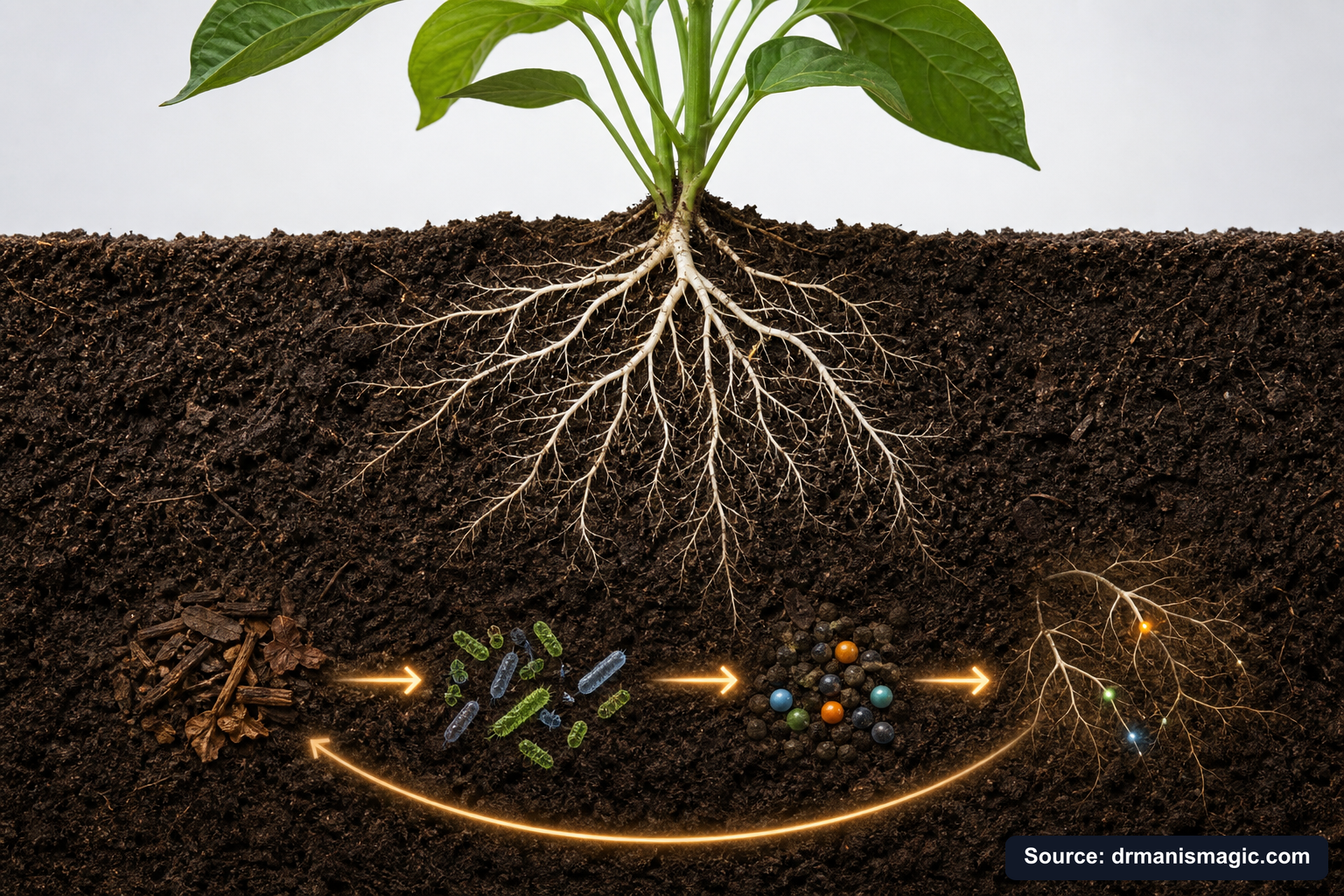
This is the mechanism most people never learn. And it changes everything.
When you apply a synthetic fertilizer, nutrients dissolve immediately into the soil water. The concentration shoots up fast. Salt index spikes. Roots get hit with a wave of soluble salts. Some nutrients get absorbed. A lot wash away. The microbes in the soil take a hit. Fine root hairs burn. A few weeks later, the plant looks green — then stalls. You apply more. The cycle repeats. Each round, the soil biology gets weaker and the plant gets more dependent on the next hit.
Organic fertilizer works completely differently. Take crab, kelp, and amino acids as an example. When you apply it to the soil, it doesn't dissolve into a salt spike. Instead, the microbes already living in your soil — bacteria, fungi, protozoa — recognize it as food. They eat it. As they eat it, they convert it into ammonium, then nitrate, phosphate, potassium ions, and trace minerals. Forms the plant can actually absorb.
Then those microbes die. And when they die, every nutrient they stored in their tiny bodies releases directly into the root zone. No spike. No burn. A steady, gentle, continuous stream of nutrition — exactly the pace plants evolved to use.
The University of Minnesota Extension describes this microbial mineralization process as the key mechanism linking soil organic matter to plant-available nutrients. It's not magic. It's biology. But when you see it work on a plant that used to be struggling, it genuinely feels like magic.
After growing more than 250,000 trees at US Citrus Nursery in South Texas, Dr. Mani Skaria and his team watched this difference play out over and over. Trees fed with salt-based synthetic inputs would green up fast and then crash. Trees fed with clean organic inputs — crab shells, kelp, amino acids — built slow, deep, resilient root systems. They fruited earlier. They fought off disease without intervention. They kept going through heat, through drought, through the hard South Texas summers that break lesser plants.
Why Does Chitin From Crab Shells Matter for Root Health?
Quick Answer: Chitin is the structural compound in crab shells. When chitin breaks down in soil, it activates a class of beneficial bacteria that produce chitinase enzymes. These enzymes attack the cell walls of fungal pathogens like Pythium and Fusarium — the same organisms that cause root rot. It's a natural, built-in defense system triggered by the fertilizer itself.
Crab shells aren't just a nitrogen source. They're a signal.
When chitin enters the soil, specific beneficial bacteria recognize it and multiply. These bacteria produce enzymes called chitinases. Chitinases break down chitin — and since the cell walls of many harmful root pathogens are made of chitin, those pathogens start to get dissolved by the bacteria that are feasting on the crab shell material in your fertilizer.
Your fertilizer is quietly building a defense force against the very organisms that cause root rot. That's not a side benefit. That's one of the main reasons Dr. Mani chose crab shell as a core ingredient.
Chitin also breaks down slowly, releasing calcium and magnesium as it does. Calcium is the primary structural mineral in woody plant tissue — the backbone of cell walls, the mineral that gives stems and trunks their strength. Magnesium sits at the center of every chlorophyll molecule. Without it, photosynthesis fails and leaves turn yellow between the veins. Crab shell delivers both, gently, over time, without a single grain of synthetic salt.
What Do Kelp and Amino Acids Actually Do for Your Soil?
Quick Answer: Kelp delivers natural plant hormones called auxins and cytokinins that trigger root growth and cell division. Amino acids provide a direct, low-energy form of nitrogen that plants absorb faster than nitrate, while also feeding soil microbes. Both work with the soil biology instead of around it.
Cold-processed kelp is not seaweed tea. The cold-processing part matters enormously. Heat destroys the natural plant growth hormones — auxins, cytokinins, and gibberellins — that make kelp worth using in the first place. Cold processing preserves them.
Auxins signal roots to grow longer and branch more. Cytokinins trigger cell division, which means more root tips, more shoot growth, more flowering sites. Gibberellins help with fruit sizing. These aren't nutrients in the traditional sense — they're biological signals. Tiny amounts produce large responses in the plant. Kelp also brings a broad spectrum of trace minerals from the ocean: iodine, selenium, and dozens of others that land-based soils often run low on after years of cropping.
Amino acids are the building blocks of proteins. When amino acid nitrogen enters the soil, microbes use some of it, and plants can absorb some of it directly — without waiting for the nitrogen to cycle through the full conversion process from organic matter to ammonium to nitrate. That makes amino acid nitrogen one of the most efficient and gentle forms of nutrition you can apply. It's fast enough to matter but slow enough not to burn. It feeds the microbes and feeds the plant at the same time.
Together — chitin, kelp, and amino acids — they create what Dr. Mani calls a complete biological nutrition system. Not just N-P-K numbers on a bag. A living, dynamic, self-regulating feeding process that mirrors what happens in healthy forest soil, where no one ever applied a synthetic fertilizer and yet the trees grow tall, strong, and disease-resistant for centuries.
When Should You NOT Fertilize Your Plants?
Quick Answer: Never fertilize a plant that is already stressed by waterlogging, salt injury, root rot, or oxygen deprivation. Adding fertilizer to a declining plant almost always accelerates the decline. Fix the root zone first, then feed.
This is the piece of advice that could save your next plant.
Adding fertilizer to a plant that is already struggling is like pouring coffee into a person who is having a medical emergency. It feels like help. It makes things worse.
Here's a recovery checklist to follow when a plant shows signs of root stress before you reach for any fertilizer:
- Stop watering for a few days. Let the soil dry slightly so oxygen can return to the root zone.
- Check the soil structure. If it smells sour or stays wet for more than 3-4 days after watering, the soil itself may be the problem. Consider repotting into mineral-based soil with proper drainage.
- Flush with plain water. If salt buildup is suspected — white crust on soil surface, brown leaf margins after fertilizing — water deeply several times to push soluble salts below the root zone.
- Add live microbes before you add fertilizer. Reintroduce beneficial bacteria and fungi to the root zone to begin rebuilding soil biology. Healthy microbes outcompete pathogens like Pythium and Phytophthora.
- Let the plant stabilize. Wait until you see new leaf growth or improved color before applying any fertilizer. New growth is the plant's signal that the root zone is functioning again.
- When you do fertilize, use clean, organic, slow-release inputs only. No synthetic salts. No quick-release soluble fertilizers. Not while roots are recovering.
- Test your approach on one plant first. Before changing your routine across your whole garden, watch one plant respond for 2-3 weeks.
The plants that need fertilizer most urgently are often the ones that should receive it last. Fix the oxygen. Fix the biology. Then feed.
How Do You Compare Fertilizer Types and Know Which One Is Safe?
Quick Answer: Synthetic fast-release fertilizers have the highest salt index and the most microbial damage. Synthetic slow-release is better but still salt-based and often coated in plastic. Clean organic fertilizers — especially those using chitin, kelp, and amino acids — have the lowest salt risk and actively support the soil biology plants depend on.
Most fertilizer marketing talks about the numbers on the bag. 10-10-10. 20-20-20. Those numbers tell you what's in it. They don't tell you what it does to your soil.
| Fertilizer Type | Salt Index | Nutrient Release | Microbial Impact | PFAS / Biosludge Risk | Root Burn Risk | Best For |
|---|---|---|---|---|---|---|
| Synthetic fast-release (liquid or soluble granule) | Very high | Immediate spike, then crash | Burns and kills beneficial microbes | Low (but may include fillers) | Very high | Not recommended for home use |
| Synthetic slow-release (plastic-coated prills) | Moderate to high | Slower, but still salt-based | Less acute damage, still suppressive | Plastic shell residue in soil | Moderate | Commercial turf applications only |
| Organic with biosludge filler | Low to moderate | Slow, microbe-mediated | Generally supportive | High — biosludge = PFAS risk | Low | Avoid near edibles or children's play areas |
| Chitin, kelp & amino acid organic (clean inputs) | Very low | Slow and continuous — microbe-mediated | Feeds and protects soil biology | Zero — clean feedstocks only | Near zero | All plants, all seasons, containers and in-ground |
The difference between the first row and the last row is not just chemistry. It's philosophy. One approach treats soil as a delivery medium — just something to hold the roots while you pour chemistry on them. The other approach treats soil as a living system — one you feed, protect, and maintain so it can feed your plants indefinitely.
After 30-plus years and 250,000 trees, Dr. Mani's answer is clear. The living system wins. Every time.
See also: Why Most Fertilizers Are Actually Salt in Disguise
What Does the "Three Plant Pillars" System Have to Do With Clean Processing?
Quick Answer: The Three Plant Pillars — mineral-based soil, live microbes, and organic fertilizer — are a complete system designed to keep the root zone aerobic, biologically active, and free from salt damage. Each pillar prevents one of the three failure points that lead from clean processing into rot.
Here's how they connect:
Pillar One: Mineral-Based Soil. Keeps oxygen flowing. Doesn't compact. Doesn't decompose into an anaerobic sludge. Drains freely so roots can breathe. This is the physical foundation that keeps the root zone out of the rot column on that first table.
Pillar Two: Live Microbes. Bacteria, fungi, and mycorrhizae are the biological engine of clean processing. They break down organic matter, cycle nutrients, outcompete pathogens, and build soil structure that holds oxygen. Without them, even the best organic fertilizer just sits there. With them, it becomes a living slow-release feeding system. A product like Plant Super Boost delivers live, stabilized microbes directly to the root zone — and unlike fish emulsion or compost teas that go anaerobic and smell like sewage, it smells like clean earth because the microbes are healthy and alive, not rotting.
Pillar Three: Organic Fertilizer. Feeds the microbes. Delivers slow-release nutrition with zero salt. Chitin builds root disease resistance. Kelp hormones trigger root growth. Amino acids provide gentle, fast-absorbing nitrogen. Volcanic ash delivers silica and trace minerals that strengthen cell walls and improve drought tolerance. The whole package works with the biology, not against it.
Miss any one pillar and the system cracks. Mineral soil without microbes is just sand. Microbes without organic food go dormant. Organic fertilizer applied to compacted, anaerobic soil with no microbes just sits there and eventually contributes to the rot. The three work together or they don't work at all. That's the lesson Dr. Mani spent decades learning in the field, and it's the foundation of everything built at US Citrus Nursery.
You can explore the complete system at the Free Plant Care Field Guide — it walks through every step in plain language with no jargon and no guesswork.
The Payoff: What Healthy Processing Looks Like in Your Garden
Here's what happens when you get this right.
Your soil smells like a forest floor after rain. Dark, earthy, alive. You can push a finger in and feel it give — not slimy, not sour, not compacted. Your roots are white at the tips. Your leaves are deep green. Your tree puts on new growth in the spring flush that you can almost watch happen in real time.
You're not chasing problems. You're not flushing salt buildup. You're not wondering why your plant is yellow again two weeks after you fertilized it. You're just watering, feeding with something clean, and watching things grow.
That's not a fantasy. That's what happens when the root zone has oxygen, when the microbes are alive and working, and when the fertilizer feeds the biology instead of burning it. We've seen it on 250,000 trees. We've seen it in containers on patios in Houston. We've seen it in raised beds in Phoenix. We've seen it in indoor houseplants that people had given up on.
The best time to get this foundation right was the day you planted. The second best time is right now. Because money you can earn back. Time spent watching a plant slowly decline — waiting, hoping, trying one more product — that time is gone for good.
If you want to start building that foundation today, take a look at Crab, Kelp & Amino Acids — it's the clean-input, zero-salt, zero-biosludge, zero-PFAS fertilizer that feeds your microbes first and your plant second, exactly the way nature designed it. Backed by a 30-day money-back guarantee, because we're confident you'll see a difference, and we want you to feel that confidence too.
Frequently Asked Questions
If your plants keep struggling no matter what you do, the answer might be hiding in your soil right now. These are the questions Dr. Mani hears most from gardeners who are tired of losing plants and wasting time. Get these answers right, and everything changes.
What is the difference between clean processing and rot in soil?
Clean processing happens when oxygen is present and beneficial microbes break down organic matter into real plant food. Rot happens when oxygen disappears, and the wrong organisms take over. Rot produces toxic gases, foul smells, and acids that destroy roots. The Dr. Mani's Magic Three Plant Pillars system is built around keeping oxygen in your soil so clean processing wins every time. That is the difference between a thriving plant and a dying one.
Why does my potted plant smell bad after I fertilize it?
That sour or rotten smell is a warning sign. Most bagged fertilizers and cheap potting mixes go anaerobic fast. Anaerobic means no oxygen. When that happens, the wrong bacteria take over and produce hydrogen sulfide, which smells like rotten eggs or sewage. Dr. Mani's Magic Plant Super Boost uses stabilized live microbes that smell like fresh earth because they are alive and clean, not rotting. If your soil smells bad, your roots are already under attack.
Can fertilizer burn my plant roots even when the soil looks wet?
Yes, and this surprises most gardeners. Salt-based synthetic fertilizers pull water away from roots even in moist soil. Scientists call this physiological drought. The roots are surrounded by water but cannot absorb it because the salt concentration outside the root is too high. This is one reason Dr. Mani's Magic uses slow-release organic fertilizer made from crab, kelp, and amino acids. No salt. No burn. Just steady, natural feeding that roots can actually use.
What makes organic fertilizer different from synthetic fertilizer for soil health?
Synthetic fertilizers are salt-based. They give a quick burst but wipe out the beneficial microbes your soil depends on. Organic fertilizer feeds those microbes first. The microbes process it, die, and release nutrients slowly into the root zone. That is a built-in slow-release system that nature designed. Dr. Mani tested this across more than 250,000 trees at US Citrus Nursery in South Texas. The trees fed with organic inputs stayed healthier longer and never showed the burnout that salt fertilizers cause.
Why does potting mix from the store cause root rot?
Most store-bought potting mix is made from pine bark and wood waste. It breaks down over time, compacts, and blocks oxygen from reaching roots. Compacted soil also holds too much water in the wrong places. That wet, airless environment is exactly where rot thrives. Dr. Mani's Magic Super Soil is built on mineral-based sandy loam from South Texas. It does not decompose. It stays open, drains well, and lets roots breathe freely for years.
What are the signs that my soil has gone anaerobic?
Look for these warning signs: a sour or sulfur smell coming from the pot, dark soggy soil that stays wet too long, yellowing leaves even after watering, and roots that look brown or mushy instead of white and firm. These are all signs that oxygen is gone and rot has taken over. The fix starts with better soil structure and live microbes. That is exactly what the Three Plant Pillars system from Dr. Mani's Magic is designed to restore.
How do live microbes protect plant roots from rot and disease?
Live microbes act like a defense squad around your roots. Beneficial bacteria and fungi crowd out harmful pathogens like Pythium and Phytophthora, which are the organisms most responsible for root rot. They also unlock nutrients that are stuck in the soil and convert organic matter into forms plants can absorb. Dr. Mani's Magic Plant Super Boost delivers these live microbes in a stabilized form so they arrive active and ready to work. No dead product. No foul smell. Just real protection.
About the Author
Dr. Mani Skaria, PhD
Dr. Mani Skaria, PhD, is a plant pathologist and the scientific founder of Dr. Mani's Magic. He spent 48 years studying how plants, soil, and living microbes work together, including his years as Professor Emeritus at Texas A&M and as a member of the USDA NAREEE Advisory Board. He invented micro-budding, a method for growing healthier, stronger trees, and has grown more than 250,000 trees on the family farm in Hargill, Texas - US Citrus Nursery. His life's work takes real lab science and turns it into simple, safe, organic plant care anyone can use at home.


