


The Biological Shortcut Plants Already Use to Feed Themselves | Dr. Mani's Magic
The Biological Shortcut Plants Already Use (And How Salt-Based Fertilizers Break It)
Picture this. You're standing in your backyard on a Saturday morning, coffee in hand, staring at your lawn. It should be green. You've watered it. You've fertilized it. You've done everything the bag told you to do. And yet something looks off. The leaves on your potted lemon tree are pale. The grass has that tired, washed-out color. The roses look like they're just barely hanging on.
You've spent the money. You've put in the time. So why does it feel like you're losing?
Here's what nobody in the fertilizer aisle ever told you. Plants are not waiting for you to feed them. They already have a feeding system built in. A biological shortcut baked into the soil itself. A deal they've been running with invisible partners for millions of years. And every time you pour salt-based fertilizer on the ground, you accidentally blow that deal up. The good news? Once you understand how the shortcut works, you can stop fighting nature and start working with it. That's when things get exciting.

Organic Fertilizer | Crab, Kelp & Amino Acids
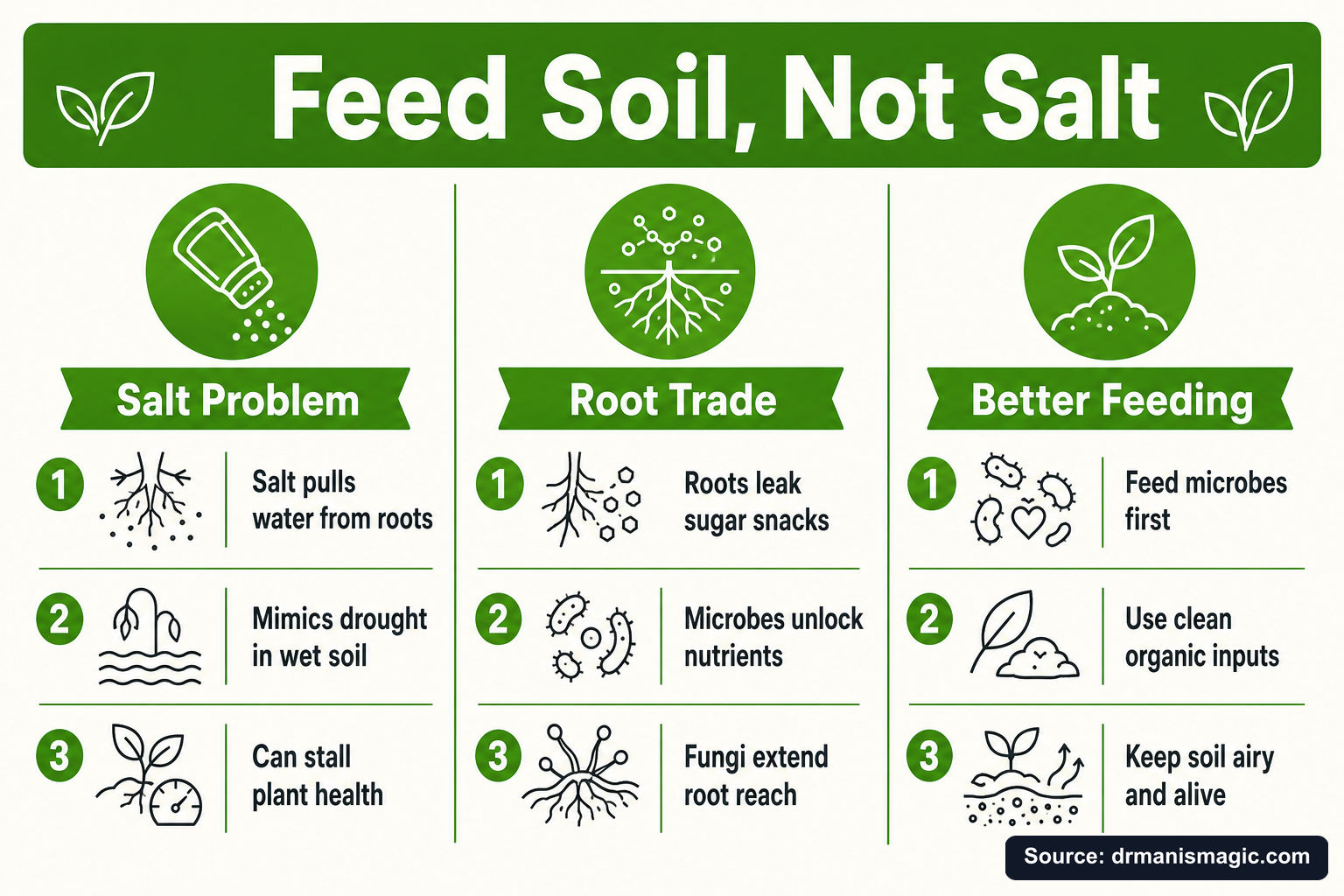
Key Takeaways
- Plants do not simply absorb fertilizer like a sponge. They negotiate with biology in the root zone to get what they need.
- Microbes in healthy soil break down organic matter and convert it into forms roots can actually absorb. No microbes means no system.
- Salt-based synthetic fertilizers create osmotic stress around roots, which pulls water away from plant tissue and causes the same symptoms as drought, even when the soil is wet.
- Root rot is usually an oxygen problem before it is a pathogen problem. Compacted or waterlogged soil suffocates roots, then pathogens move in.
- Biosludge and PFAS "forever chemicals" hide in some fertilizers, including some labeled organic. Clean sourcing matters.
- Organic inputs like crab chitin, kelp, amino acids, and volcanic minerals feed the microbes first, and those microbes feed the plant in a slow, steady release that mirrors how nature works.
- The Three Plant Pillars, developed by Dr. Mani Skaria after growing over 250,000 trees in South Texas, give any plant the biological foundation it needs to thrive.
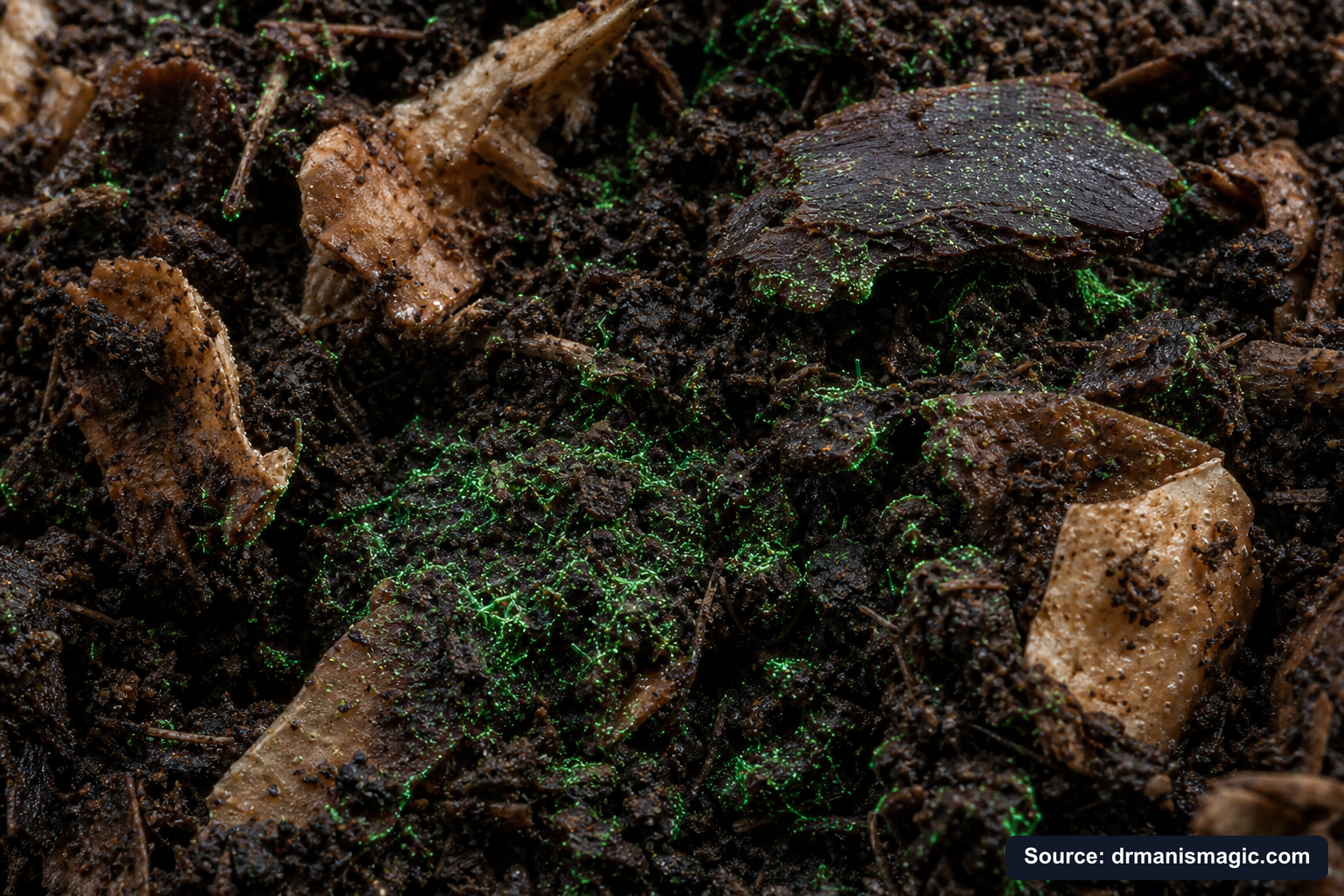
What Is the Biological Shortcut Plants Already Use?
Quick Answer: Plants leak sugar from their roots to attract microbes. Those microbes break down organic matter and minerals into nutrients the plant can absorb. This underground trading system is the real way plants get fed in nature. It works better and lasts longer than pouring synthetic fertilizer on the ground.
Beneath every healthy lawn, garden, and tree is a city of microscopic life. We are talking about bacteria, fungi, and other organisms so small you could fit millions of them on the tip of your finger. These are not pests. They are partners.
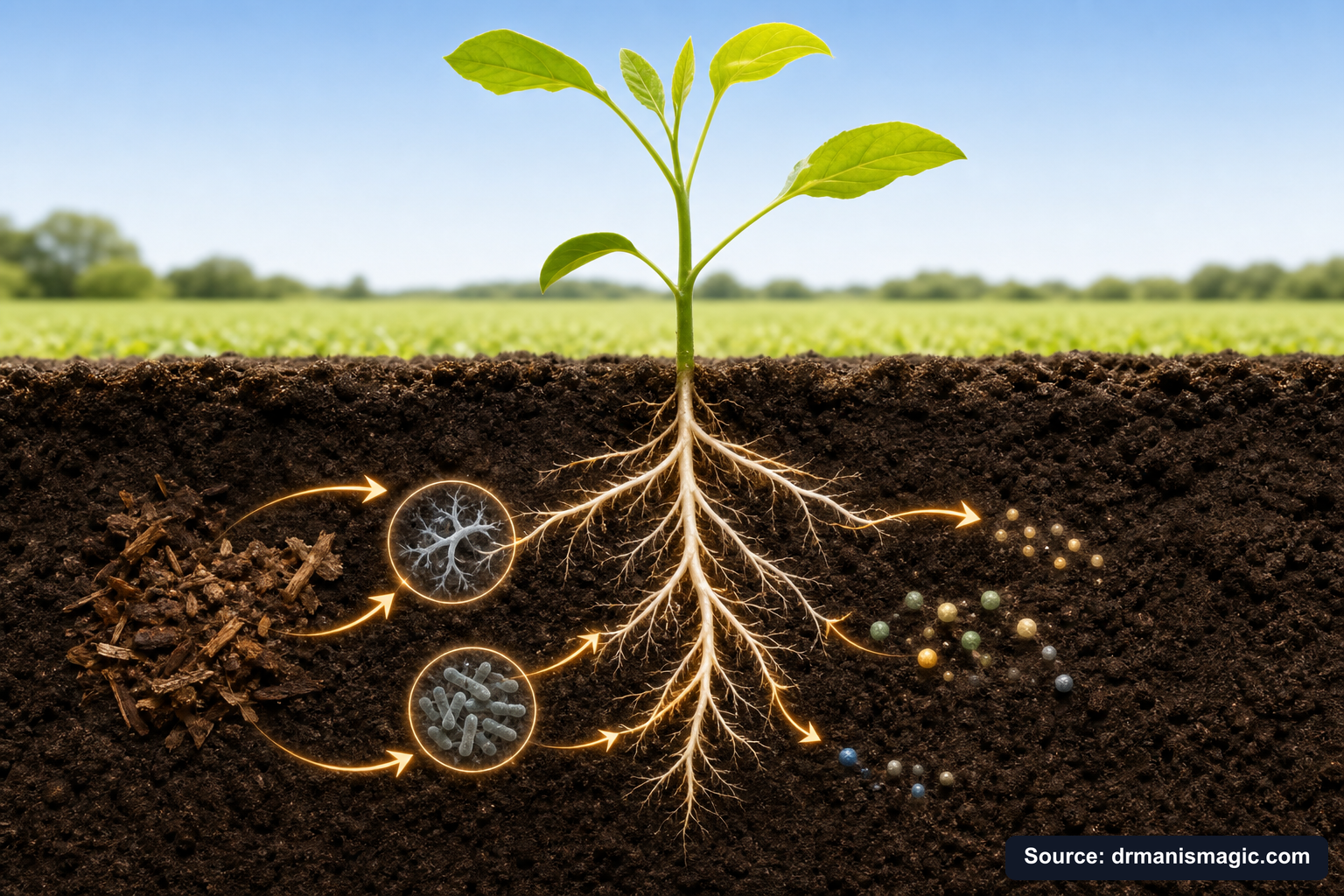
Here is how the deal works. Plant roots leak out sugars and other carbon-rich compounds called exudates. Think of it as the plant offering a snack. In return, the microbes living in that zone, called the rhizosphere, get to work. They break down organic matter. They unlock minerals trapped in the soil. They convert raw nitrogen from the atmosphere into a form the plant can actually drink up through its roots.
The University of California Agriculture and Natural Resources has described this exchange as one of the most important processes in all of agriculture. Microbes cycle carbon, nitrogen, sulfur, and phosphorus. They suppress disease. They build soil structure. They make water infiltration better. And they do all of this for free, as long as you give them a healthy place to live.
Plants evolved this system over hundreds of millions of years. It is not a nice bonus. It is the main event. The fertilizer bag you bought at the hardware store is a very rough, very incomplete imitation of something nature already perfected.
After growing over 250,000 trees at the US Citrus Nursery in South Texas, Dr. Mani Skaria, Professor Emeritus of Plant Pathology and founder of the Clean Citrus Program in Texas, saw this truth play out again and again. The plants that had living, thriving soil biology were the ones that stayed green, resisted disease, and kept producing. The ones fed only with salt-based synthetics would look good for a season. Then they would stall. Then they would decline. Every time.
See also: Why Most Fertilizers Are Actually Salt in Disguise
Why Do Roots Need Live Microbes to Actually Eat?
Quick Answer: Roots cannot absorb most nutrients in their raw form. Microbes act as the digestive system of the soil, breaking complex organic matter and locked minerals into simple molecules roots can take in. Without microbes, most of what you apply never reaches the plant at all.
Think about it this way. You cannot eat a whole raw grain of wheat. Your digestive system has to break it down first. Plants have the same problem, except their digestive system lives in the soil around them.
When you add organic matter to healthy soil, here is exactly what happens. Bacteria and fungi eat the organic material. They convert it into simpler compounds. Nitrogen gets released as ammonium, then converted to nitrates. Phosphorus gets unlocked from mineral bonds. Trace elements become available. The plant's roots can now absorb these simpler forms easily.
But it gets even better. When those microbes eventually die, they release everything stored inside their bodies directly into the root zone. All that nutrition gets delivered in one slow, steady trickle. It is a natural time-release system. No plastic coating needed. No risk of a nutrient spike that burns the roots. Just a steady, gentle supply that mirrors the pace plants actually prefer.
Mycorrhizal fungi take this one step further. They grow directly into the root tissue and extend their threads outward into the soil, sometimes several feet in every direction. They act like an extended root system, pulling in water and phosphorus from places the actual roots could never reach. In exchange, the plant gives them carbon. It is one of the most elegant deals in all of biology.
This is why Pillar 2 of the Three Plant Pillars, developed at US Citrus Nursery, focuses entirely on live microbials. Bacteria, fungi, and mycorrhizae are not optional additions. They are the engine that makes everything else work. You can learn more about the complete Three Plant Pillars system at drmanismagic.com.
How Do Salt-Based Fertilizers Break the Biological Shortcut?
Quick Answer: Salt-based fertilizers raise the salt concentration around roots, which pulls water out of plant tissue through osmosis. This creates fertilizer burn and dehydrates roots even in wet soil. The same high-salt environment kills the beneficial microbes the plant depends on for long-term nutrition.
Here is a fact that will change how you look at every fertilizer bag you ever see again. Most conventional fertilizers are salts. Not table salt exactly, but chemically similar compounds that behave the same way when dissolved in water.
When you pour a high-salt fertilizer onto soil, the concentration of dissolved salts around the roots shoots up. Water moves from areas of low salt concentration to areas of high salt concentration. That is just basic chemistry, called osmosis. In this case, it means water moves out of the root cells and into the salty soil solution around them.
The plant starts to dehydrate. From the inside out. Even if the soil is soaking wet. The leaves show scorch marks along the edges. Needles on conifers go brown. New growth wilts. The plant looks like it is dying of thirst in a wet pot.
This is called osmotic stress. And it is the exact same mechanism that kills plants when road salt or deicing chemicals contaminate the soil. The chemistry is different, but the damage is identical.
Penn State Extension and researchers at University of Wisconsin Extension have both documented this pattern. High soluble salt concentrations create what looks like drought stress, with marginal leaf scorch, wilting, and reduced root function, even when the plant is receiving plenty of water.
Now here is the second hit. That same high-salt environment in the soil kills microbes. The beneficial bacteria and fungi that make up your plant's biological shortcut cannot survive in a salty, hostile root zone. You wipe them out with one application. Then the next application. Then the next. Over time, the soil goes biologically dead. The plant becomes completely dependent on whatever you pour on it, because it has lost its natural support system. This is what Dr. Mani's Magic calls the addiction cycle. The more salt-based fertilizer you use, the more you need, because the biology that would reduce your dependence is gone.
See also: The Hidden Reason Synthetic Fertilizers Cause Root Rot
Why Do Roots Rot in Wet Soil?
Quick Answer: Root rot starts as an oxygen problem, not a pathogen problem. When soil stays waterlogged or compacted, oxygen gets squeezed out. Roots cannot breathe and begin to break down. Pathogens like Pythium and Phytophthora then move into the damaged tissue. The disease is a symptom of suffocation, not the original cause.
Your plant roots breathe oxygen. That might sound strange because we think of plants as producers of oxygen, not consumers. But roots are different. They need oxygen from the air pockets in healthy soil to stay alive and function. Take away that oxygen and the roots start to suffocate within hours.
Here is what happens in compacted or waterlogged soil. The air spaces fill with water. Oxygen levels drop. Root cells cannot respire normally. They weaken. The outer tissue begins to break down. And then the pathogens move in.
Pythium, Phytophthora, Fusarium, and Rhizoctonia are all naturally present in most soils. They are opportunists. They do not cause root rot in healthy, well-oxygenated soil. But once roots are stressed and dying from oxygen deprivation, these pathogens find easy entry. By the time you see wilting, yellowing, and mushy brown roots, the oxygen problem has been going on for a while.
This is why Pillar 1 of the Three Plant Pillars focuses on mineral-based soil. Most commercial potting mixes are loaded with pine bark, wood chips, and sawdust. That material breaks down over months. As it decomposes, it compacts. It blocks drainage. It squeezes out oxygen. It creates the exact conditions that lead to root rot.
The Super Soil developed at US Citrus Nursery uses a permanent mineral base, silica-rich sandy loam from the Rio Grande Valley, that does not decompose. It holds its structure. Drainage stays open. Oxygen keeps flowing to the roots. Pythium and Phytophthora have nothing to work with.
This principle applies to every plant you grow. Your lawn grass. Your rose bushes. Your houseplant on the kitchen windowsill. Your fruit trees in containers. They all need oxygen at the root zone. Give them that, and you eliminate most root rot before it ever starts.
What Does Chitin From Crab Shells Actually Do for Plants?
Quick Answer: Chitin is a natural compound found in crab shells. When added to soil, it feeds beneficial microbes that produce chitinase enzymes. Those enzymes break down the cell walls of harmful fungi and nematodes. Chitin also activates the plant's own immune signaling, helping it recognize and resist disease threats on its own.
When you hear "crab shells in fertilizer," it is easy to picture a gimmick. A marketing story. Something to make the bag look interesting on the shelf. But the science behind chitin is genuinely remarkable, and it has nothing to do with marketing.
Chitin is a structural compound that makes up the shells of crustaceans and the cell walls of certain fungi. When it gets added to soil, the beneficial bacteria and fungi in the root zone go to work on it immediately. They produce enzymes called chitinases to break it down. Here is the important part. Those same chitinase enzymes also attack the cell walls of harmful fungi and root-damaging nematodes. You are essentially arming the good microbes with weapons that happen to be very effective against the bad ones.
At the same time, chitin acts as a molecular signal. The plant's immune system recognizes it as something associated with pathogens and activates its defense response. It is like a fire drill. The plant gets ready to fight before the actual attack ever comes.
Chitin also delivers calcium and magnesium directly to the root zone. Calcium is the primary structural mineral in the woody parts of plants. Without it, cell walls are weak, fruit cracks, and disease resistance drops. Magnesium sits at the center of every chlorophyll molecule. No magnesium means no photosynthesis, no matter how much nitrogen you pour on.
This is why crab meal is one of the foundational ingredients in the organic fertilizer approach Dr. Mani developed after decades of testing. It feeds microbes, activates plant immunity, delivers critical minerals, and does all of this without a single gram of synthetic salt.
What Does Kelp Actually Do? Is It a Fertilizer or a Biostimulant?
Quick Answer: Kelp is a biostimulant, not a primary fertilizer. It contains natural plant hormones called auxins and cytokinins that regulate root growth, stress response, and cell division. It also carries trace minerals, carbohydrates, and compounds that support the microbial community. Kelp makes a plant's whole system work better, especially under stress.
Kelp is one of those ingredients that looks simple on a label and turns out to be extraordinarily complex once you understand what it does inside a plant.
First, kelp is not a significant source of nitrogen, phosphorus, or potassium. The NPK numbers are very low. So if you bought kelp expecting it to green up your lawn the way a bag of synthetic fertilizer does, you would be disappointed. That is not what it is for.
Kelp contains natural plant hormones. Auxins regulate how roots grow and where they branch. Cytokinins control cell division and delay the aging of leaves. These are the same hormones plants produce internally, just delivered from an outside source. When a plant is under heat stress, drought stress, or transplant shock, its hormone balance gets disrupted. Kelp helps restore that balance.
Kelp also carries a wide range of trace minerals from the ocean. Elements like iodine, selenium, and dozens of others that terrestrial soils often lack. It provides carbohydrates that feed soil microbes directly. It contains alginic acid, which improves soil structure and water retention. Cold-processed kelp retains all of these compounds intact. Heat processing destroys most of them.
Think of kelp as the coaching staff for your plant's biology. It does not replace nutrition. It helps the plant use nutrition more efficiently, recover from stress faster, and maintain steady growth through conditions that would otherwise slow things down. For lawns, ornamentals, fruit trees, houseplants, and vegetable gardens, the benefit is the same. A plant that handles stress better is a plant that produces more, looks better, and requires less intervention from you.
You Never Had a Brown Thumb.
You were handed the wrong tools. This free guide hands you the right ones.
You watered it. You fed it. It died anyway.
It was never you. It was the dirt, the salt food, and the bad advice.
This guide shows you what really went wrong, and how to fix it for good.
- Why your plants really died, and why it was never your fault
- The salt hiding in your plant food that quietly burns the roots
- The hidden killer in almost every bag of store soil
- The tiny helpers that grow a whole forest for free
- The rescue trick that brings a half dead plant back to life

Can Amino Acids Feed Plants Without Synthetic Salts?
Quick Answer: Yes. Amino acids are organic nitrogen compounds that plants can absorb directly through roots without microbial conversion. They are gentle, salt-free, and also serve as food for beneficial soil microbes. Amino acid nitrogen is one of the most efficient and least damaging ways to deliver nitrogen to any plant.
Nitrogen is the nutrient plants need most. It drives leaf growth, chlorophyll production, and the enzyme systems that power photosynthesis. Without enough nitrogen, leaves go pale yellow and growth slows to a crawl.
The conventional answer is to dump synthetic nitrogen fertilizer on the soil. It works fast. The lawn turns green in days. But that nitrogen is a salt. It spikes. It burns. It kills microbes. And within weeks the plant needs another hit because nothing in the soil is building long-term nitrogen-cycling capacity.
Amino acids are a completely different path. They are the building blocks of proteins. When amino acid-rich materials like feather meal and tankage are added to soil, something interesting happens. Some of that amino acid nitrogen gets taken up directly by plant roots as intact molecules. The roots do not have to wait for microbial conversion. They absorb it in organic form.
At the same time, the microbial community in the root zone feeds on the amino acids and converts them into ammonium and nitrate through a process called mineralization. This creates a two-stage delivery system. Some nutrition arrives quickly. More arrives over weeks as the microbes work through the material. And when those microbes die, they release still more nutrients in a final wave.
There is no salt spike. No osmotic stress. No microbial massacre. The plant gets what it needs at the pace it can actually use.
This is why amino acids are one of the core inputs in the organic fertilizer program tested at US Citrus Nursery. Combined with crab chitin and kelp, they create a complete, layered nutrition system that works with the plant's biology instead of overriding it.
What Are PFAS and Biosludge, and Why Do They Matter for Your Garden?
Quick Answer: Biosludge is treated municipal waste used as a filler in some fertilizers, including some labeled organic. It can carry PFAS, which are synthetic chemicals that do not break down in soil or in the human body. These "forever chemicals" have been linked to serious health concerns and have no place in a home garden, vegetable bed, or children's play area.
This one is uncomfortable to talk about. But you deserve to know it.
Some fertilizers, both synthetic and organic, use a material called biosludge. Another name for it is biosolids. It is treated municipal wastewater waste, meaning it is processed sewage. It gets blended into fertilizer because it contains nitrogen and phosphorus. And because it is cheap.
The problem is what comes along with it. PFAS, which stands for per- and polyfluoroalkyl substances, are man-made chemicals used in everything from nonstick cookware to firefighting foam. They are called forever chemicals because they do not break down. Not in the environment. Not in your body. PFAS accumulate in soil, in groundwater, and in the tissue of anyone or anything that comes into contact with them over time.
When biosludge-based fertilizer gets applied to a vegetable garden, those PFAS can move into the vegetables you eat. When applied to a lawn, they can move into the soil your children and pets play on. When applied to fruit trees, they can move into the fruit.
Many fertilizer companies do not disclose whether they use biosludge. The label says "organic" and consumers assume that means safe. It does not automatically mean that.
The fertilizer tested and used at US Citrus Nursery, and available through Dr. Mani's Magic, contains zero biosludge, zero PFAS, and zero synthetic salts. That is not a marketing claim. It is a sourcing decision made specifically because of concerns like these. When you have a family, a garden, pets, and neighbors, the inputs you choose matter beyond the plant itself.
Synthetic Fertilizer vs Organic Biological Nutrition: What Is the Real Difference?
Quick Answer: Synthetic fertilizers deliver nutrients fast but at a cost. They are salt-based, they create osmotic stress, they kill microbes, and they leave the soil less capable over time. Organic biological inputs feed the microbial system first, which then feeds the plant steadily and safely. The organic approach builds long-term soil health instead of depleting it.
Let's put this side by side so it is completely clear.
| Feature | Synthetic Fast-Release Fertilizer | Slow-Release Synthetic (Coated) | Organic Biological Nutrition (Crab, Kelp, Amino Acids) |
|---|---|---|---|
| Primary mechanism | Direct salt dissolution in water | Salt released through plastic coating | Microbial breakdown, mineralization, and direct amino acid uptake |
| Salt content | Very high | High (delayed) | Negligible |
| Risk of fertilizer burn | High, especially in containers | Moderate, depends on coating integrity | Very low to none |
| Effect on beneficial microbes | Kills them | Damages them over time | Feeds and supports them |
| Nutrient delivery pace | Fast spike, then crash | Moderate, but still salt-based | Steady trickle that mirrors nature |
| PFAS / biosludge risk | Possible, especially with municipal nitrogen sources | Possible | Zero when sourced cleanly |
| Plastic residue in soil | None | Yes, coating fragments remain | None |
| Long-term soil health | Declines over time | Declines over time | Improves over time |
| Works for lawns, trees, gardens, containers | Yes, short term | Yes, short term | Yes, long term |
The slow-release synthetic option sounds appealing on paper. But those coatings are plastic. They break down into microplastic fragments that stay in your soil indefinitely. And the nutrient inside is still a salt. It still damages microbes when it releases. It is the same problem with a time delay.
The organic biological approach is not slower in the way that matters. Your plants still respond within weeks. But the response builds instead of crashing. The soil gets better instead of worse. And you are not reintroducing salts every season just to maintain the baseline you already had.
How Do You Know If Your Plant Has Salt Damage, Overwatering, or True Root Rot?
Quick Answer: Salt damage, overwatering, and root rot share symptoms but have different causes and solutions. Identifying the root cause correctly is what determines whether your plant recovers or continues to decline. Use the pattern of symptoms, soil feel, and root color to distinguish between them before taking action.
This is the diagnostic question that trips up even experienced gardeners. All three conditions can make a plant wilt. All three can cause yellowing. But they require completely different responses. Treating root rot like drought stress, or treating salt damage like a watering problem, will make things worse.
| Symptom | Salt Damage / Fertilizer Burn | Overwatering Without Root Rot | Active Root Rot (Pythium, Phytophthora) |
|---|---|---|---|
| Leaf appearance | Brown edges and tips, leaf scorch, crispy margins | Yellowing, soft and droopy, sometimes pale green overall | Yellowing, wilting even when soil is wet, leaf drop |
| Soil feel | May feel dry on surface, crust forming, possible white salt crust | Consistently wet or soggy | Wet, possibly with a sour or musty odor |
| Root color and texture | Roots may be brown at tips, otherwise firm | Roots white to tan, firm but waterlogged | Roots brown to black, mushy, fall apart when touched |
| Wilting pattern | Wilts despite watering, worse in heat | Wilts but soil is wet | Progressive wilt that does not recover with any treatment |
| Recent history | Recent fertilizer application, especially granular or liquid synthetic | Frequent watering, poor drainage, heavy potting mix | Extended wet conditions, compacted or decomposed potting mix |
| Correct first response | Flush soil with clean water, stop synthetic fertilizer, add microbes | Reduce watering, improve drainage, let soil dry between sessions | Remove rotted roots, improve soil aeration and oxygen, add beneficial microbes |
If you suspect active root rot, here is a recovery checklist that gives your plant the best chance.
- Remove the plant from its container or gently expose the root zone. Inspect the roots. Healthy roots are white or tan and firm. Rotted roots are brown to black and mushy.
- Trim away all visibly rotted root tissue with clean, sharp scissors. Rinse the remaining roots gently with clean water.
- If repotting, use a mineral-based, well-draining soil mix that will not compact and block oxygen. Decomposing organic potting mixes are a root rot risk.
- Let the repotted plant dry out slightly between waterings. Do not water on a schedule. Water when the top inch or two of soil feels dry.
- Apply live beneficial microbes to the root zone. Beneficial bacteria and mycorrhizal fungi compete with Pythium and Phytophthora and help the damaged roots rebuild.
- Hold off on all fertilizer for two to three weeks while the root system recovers. When you resume, use only a gentle, salt-free organic source.
- Ensure the plant has good air circulation and appropriate light. Stressed plants in low light or stagnant air recover much more slowly.
You can find the Plant Super Boost live microbial blend used in root recovery at drmanismagic.com. It contains the bacteria, fungi, and mycorrhizae that support root rebuilding without any synthetic inputs.
What Do Volcanic Minerals Do That Regular Fertilizer Cannot?
Quick Answer: Volcanic minerals supply a broad spectrum of trace elements that most commercial fertilizers simply do not contain. They weather slowly over time, releasing silica, iron, manganese, zinc, copper, and dozens of other micronutrients at a natural pace. Silica in particular strengthens cell walls, increases drought resistance, and makes plants physically harder for insects to damage.
Most fertilizer labels show three numbers. Nitrogen, phosphorus, potassium. Maybe a few secondary nutrients if you are lucky. But plants need at least 17 essential elements to function properly. The ones that show up in tiny amounts, the micronutrients, are often the limiting factor in plant health that nobody talks about.
The Law of the Minimum is worth understanding here. It says that plant growth is limited by the scarcest nutrient, regardless of how much of everything else is present. So if your soil is low in zinc, your tree will not produce normal fruit even if you apply enormous amounts of nitrogen and phosphorus. The weak link controls the outcome.
Volcanic ash and volcanic minerals contain a naturally broad spectrum of trace elements in forms that weather slowly and become plant-available over time. Silica is one of the most important. It gets incorporated into plant cell walls, making them physically stronger. Stronger cell walls mean better resistance to fungal penetration. They mean less damage from chewing insects. They mean a plant that can hold its shape under heat and drought stress without collapsing.
Silica also reflects excess light and heat, reducing temperature stress on leaves during hot summer months. For lawns, ornamentals, fruit trees, and vegetable gardens across hot climates like South Texas, that matters enormously.
When volcanic mineral inputs are combined with chitin, kelp, and amino acids in a single organic fertilizer blend, you get complete nutrition coverage at every level. Macronutrients from the amino acid fraction. Biostimulants and hormones from the kelp. Immune activation and calcium from the crab. Trace element breadth from the volcanic minerals. It is a full-spectrum approach that no single synthetic NPK product can match.
How Do the Three Plant Pillars Work Together as a Complete System?
Quick Answer: The Three Plant Pillars address the three things every plant needs beyond sunlight and water: a root zone with good structure and oxygen, a living microbial community that cycles nutrients and fights disease, and clean organic nutrition that feeds the biology and the plant together. Miss any one pillar and the other two underperform.
This is the framework Dr. Mani Skaria developed over 40 years of plant pathology research and hands-on nursery growing. It is not a sales concept. It is a first-principles understanding of what plants actually need, stated plainly so any gardener can apply it.
Pillar 1 is mineral-based soil. The root zone must have oxygen. Organic potting mixes break down and compact, blocking oxygen and setting up the conditions for root rot. A permanent mineral base keeps structure, drainage, and aeration intact year after year.
Pillar 2 is live microbials. Bacteria, fungi, and mycorrhizae are the biological shortcut this entire article is built around. They cycle nutrients, suppress disease, extend the root system, and create a self-sustaining soil ecosystem. Without them, the plant is biologically alone.
Pillar 3 is organic fertilizer and biostimulants. Clean, salt-free nutrition that feeds the microbes first, then the plant. Slow release. No osmotic stress. No PFAS. No biosludge. Just the full spectrum of what plants and soil biology need to work at their best.
When all three are in place, something shifts. Plants stop struggling. They start producing. Lawns green up and stay green without constant reapplication. Fruit trees set fruit instead of just leaves. Flowers bloom longer and brighter. Houseplants stop dropping leaves. The whole system builds momentum instead of requiring constant maintenance just to stay even.
That is the real promise of working with the biological shortcut instead of against it. Not a quick green-up followed by a crash. A living system that improves every season.
You can explore the complete Free Plant Care Field Guide at drmanismagic.com to see how the Three Plant Pillars apply to your specific plants, whether that is a container citrus tree, a half-acre lawn, a raised vegetable bed, or a collection of indoor tropicals.
See also: How Salt-Based Feeding Quietly Destroys Root Systems
What Does This Mean for Your Lawn, Garden, Trees, and Houseplants Right Now?
Quick Answer: The biological shortcut is not just for citrus or professional growers. Every plant you own, indoors or outdoors, in a pot or in the ground, benefits from live soil biology, clean organic nutrition, and a root zone with oxygen and good drainage. The Three Plant Pillars work for all of them.
Here is a truth that Dr. Mani has shared with thousands of growers over the years. The number one thing people tell him they want is to see fruit on a tree they planted with their own hands. Not someday. In their lifetime. While they can still share it with the people they love.
That desire is ancient. It is deeply human. We were made to tend growing things. And there is nothing more defeating than watching a plant you cared for struggle and die because the foundational system underneath it was broken from the start.
Time is the resource you cannot replace. Money spent on the wrong inputs is frustrating. But months and years spent watching a tree or garden stall, then decline, then die, while you keep trying the same approaches and hoping for a different result, that is the real cost. You cannot get that time back.
The good news is the solution is not complicated. It is three pillars. Mineral soil. Live microbes. Clean organic nutrition. Put all three in place and the biological shortcut does the rest. The soil comes alive. The roots breathe. The microbes cycle nutrients. The plant grows the way it was designed to grow.
Every product in the Dr. Mani's Magic line was created at US Citrus Nursery to solve this problem for real plants, in real conditions, tested across 250,000 trees in the heat of South Texas. Zero PFAS. Zero biosludge. Zero synthetic salts. Made in the USA. Backed by a 30-day money-back guarantee.
If you are ready to stop guessing and start growing, the Crab, Kelp & Amino Acids organic fertilizer is the cleanest, most complete starting point for any plant, any garden, any lawn. It feeds the biology. The biology feeds the plant. And the whole system builds from there, the way nature always intended.
Frequently Asked Questions
These are the questions most plant owners ask after learning that nature already built a feeding system into the soil. Once you understand how this system works, everything about your lawn, garden, and trees starts to make more sense. The answers below are grounded in what Dr. Mani Skaria learned growing over 250,000 trees in South Texas.
What is the biological shortcut plants already use to feed themselves?
Plant roots leak out sugars to attract microbes in the soil. Those microbes break down organic matter and unlock minerals. Then they hand the nutrients back to the plant in a form the roots can actually absorb. This underground trade has been running for millions of years. It is the real feeding system. The fertilizer bag at the hardware store is just a rough copy of something nature already perfected.
How do salt-based fertilizers break the plant's natural feeding system?
Salt-based synthetic fertilizers create what is called osmotic stress around the roots. That stress pulls water away from plant tissue, so your plant can look drought-stressed even when the soil is wet. Worse, those salts kill the beneficial microbes living in the root zone. Once the microbes are gone, the whole underground trading system collapses. Your plant is now completely dependent on whatever you pour on it next. That is the addiction cycle big fertilizer companies profit from.
Is using microbes in the garden actually safe for kids, pets, and the environment?
Yes. Beneficial microbes are the same organisms already living in healthy soil all over the planet. They are not chemicals. They do not carry warning labels. You do not need to keep kids or pets off the lawn after applying them. Dr. Mani's Plant Super Boost uses stabilized live microbes that smell like earth, not sewage. No harsh fumes, no re-entry wait times, no risk of a splash on your skin sending you hunting for a poison control number.
Can this biological approach work for any plant, not just citrus trees?
Absolutely. The Three Plant Pillars work because they are built on first principles of how all plants grow. Mineral-based soil, live microbes, and clean organic fertilizer form the right foundation for grass, houseplants, fruit trees, roses, vegetables, and tropical trees. Dr. Mani proved the system on over 250,000 citrus trees at US Citrus Nursery. But the same biology that made those trees thrive is the same biology that feeds every plant on earth.
What is the difference between biological plant support and regular pest control?
Regular pest control kills things. Biological plant support builds things. When your soil has a thriving microbial community, the plants growing in it develop stronger immune responses on their own. Healthy roots fed by live microbes are far less vulnerable to rot, fungal attack, and pest pressure in the first place. You are not spraying a problem away. You are building a system that makes the problem less likely to show up at all.
Why does most potting mix make the biological system fail?
Most potting mix is made from pine bark and wood byproducts. Those materials break down over time and compact into a dense, oxygen-blocking sludge. Roots need oxygen to breathe. When the soil compacts, roots suffocate, then pathogens move in. Dr. Mani solved this with Super Soil, a mineral-based blend using silica-rich sandy loam from the Rio Grande Valley. It does not decompose. It stays loose, drains perfectly, and keeps roots breathing for years.
How long does it take to see results when you restore the biological system in your soil?
Most plant owners notice a visible difference within 30 days. Leaves look greener. New growth comes in stronger. Grass gets that deep, rich color back. The full biological system takes a little longer to fully establish, but the improvement starts fast because you are removing the roadblocks nature was fighting against. If you are not happy with your results within 30 days, Dr. Mani's Magic refunds your money. No arguments, no runaround.
About the Author
Dr. Mani Skaria, PhD
Dr. Mani Skaria, PhD, is a plant pathologist and the scientific founder of Dr. Mani's Magic. He earned his doctorate at Purdue University and spent 48 years studying how plants, soil, and living microbes work together, including his years as Professor Emeritus at Texas A&M and as a member of the USDA NAREEE Advisory Board. He invented micro-budding, a method for growing healthier, stronger trees, and has grown more than 250,000 trees on the family farm in Hargill, Texas - US Citrus Nursery. His life's work takes real lab science and practical experience and turns it into simple, safe, organic plant care anyone can use at home.


