


Are Chemical Fertilizers Bad for Your Vegetables? The Truth | Dr. Mani's Magic
Are Chemical Fertilizers Bad for Your Vegetables? The Truth About Salt, Burn, and Living Soil
You did everything right. You bought the fertilizer from the garden center. You followed the directions on the back of the bag. You watered your tomatoes and peppers. And then one morning you walk outside and the leaf edges look scorched. Brown and crispy, like someone held a lighter to them. The plants look worse than before you fed them.
What happened? You were trying to help. And now you're standing there wondering if chemical fertilizers are actually bad for your vegetables. Maybe you feel a little cheated. You spent the money, you put in the time, and your plants are suffering anyway. That feeling of watching something you worked hard to grow start circling the drain is one of the worst feelings in gardening. And the worst part? Nobody told you the real reason it happens.
Here is the truth. Chemical fertilizers are not automatically poison. But the way most of them are made, and the way most people use them, sets up a chain of problems that quietly destroys your vegetable garden from the roots up. Today we are going to break that chain. We have grown over 250,000 trees at our South Texas nursery. We have seen every fertilizer mistake you can imagine. And what we learned will change how you look at feeding your vegetables forever.
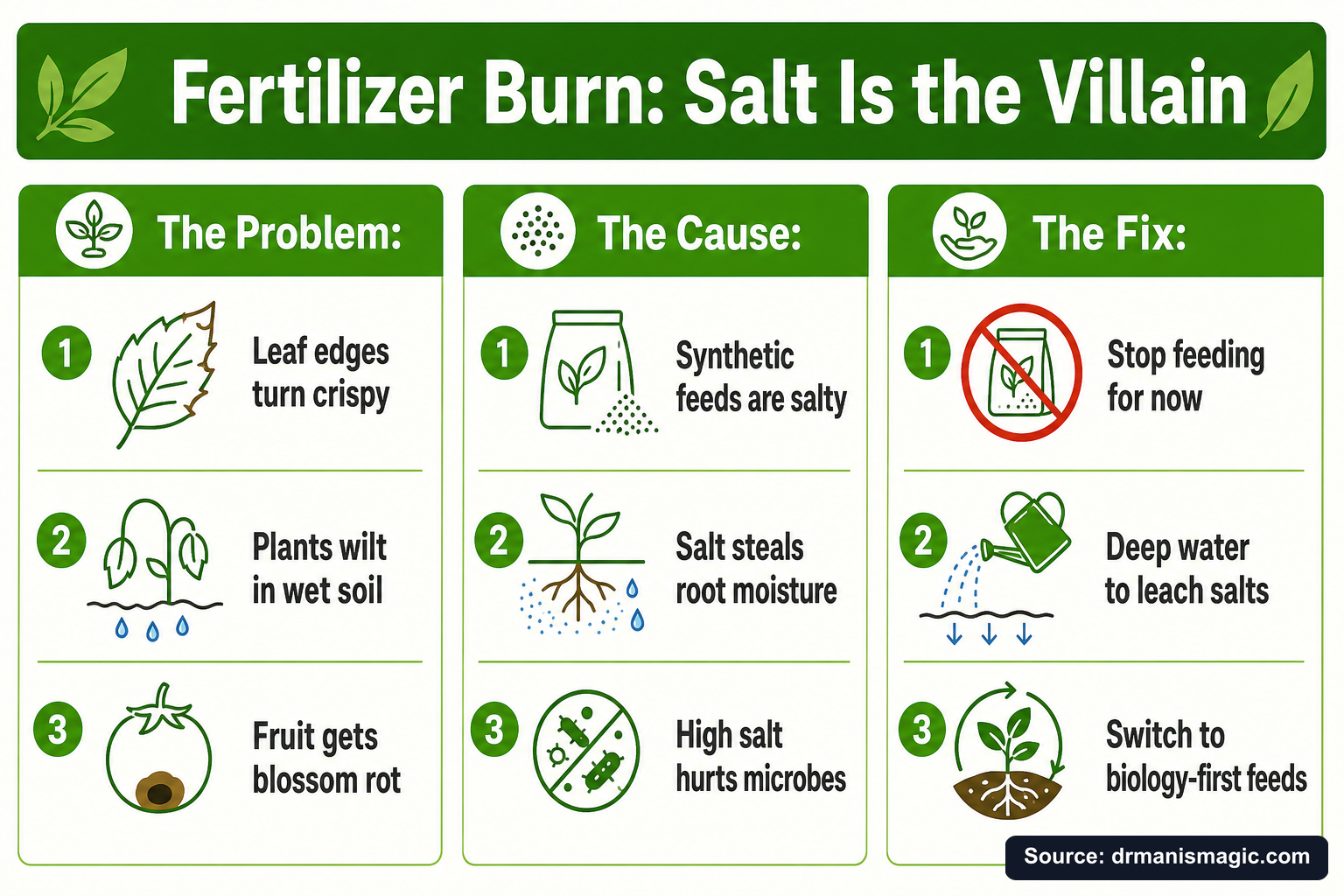
Key Takeaways
- Chemical fertilizers are not automatically bad for vegetables, but they are salt-based, and excess salt is the real villain behind burned leaves, stunted growth, and dying roots.
- Fertilizer burn is a water problem at its core. Salts pull moisture away from root cells, and heat or drought makes it much worse.
- Blossom end rot on tomatoes and peppers is usually not a calcium shortage in the soil. It is a calcium delivery failure caused by inconsistent watering, root stress, and high salt levels.
- Synthetic fertilizers damage the living microbes in your soil. No microbes means no nutrient cycling, no disease protection, and no long-term plant health.
- Containers and raised beds accumulate salts faster than in-ground gardens, making them far more vulnerable to fertilizer burn.
- Organic fertilizers like those made from crab, kelp, and amino acids feed your soil biology first, which then feeds your plants gently and consistently.
- Recovery from overfertilization is possible. Stop feeding, water deeply, and rebuild your soil biology with living microbes.
What Do Chemical Fertilizers Actually Do to Your Vegetable Roots?
Quick Answer: Chemical fertilizers are salt-based. When salts build up around roots, they pull water out of root cells through osmosis, causing the roots to dry out from the inside even when the soil feels moist. This is fertilizer burn, and it is the most common hidden cause of scorched leaves, wilting, and slow vegetable growth.
Think about what happens when you put salt on a cucumber slice. The cucumber sweats. Water rushes out of the cells and pools on the surface. That is osmosis. And that is exactly what happens to your vegetable roots when there is too much fertilizer salt in the soil.
Your roots are made of cells full of water. Roots pull that water upward to feed the whole plant. But when there is too much salt in the soil, the process reverses. Water flows out of the roots and into the salty soil instead. The roots start to dehydrate. The plant wilts even though the soil is wet. The leaf edges turn brown and crispy. The plant looks burned because it is being burned, from the inside out.
The University of Maryland Extension explains this clearly: excess soluble fertilizer salts draw moisture out of root tissue, causing the classic symptoms of marginal leaf scorch, wilting, and stunting. The damage gets worse in hot, dry weather because salts become more concentrated in the root zone when water evaporates quickly.
This is not a fringe idea. It is basic plant science. And it is why the salt content of your fertilizer matters just as much as the nutrient numbers on the bag.
| Symptom You See | What Is Actually Happening | Most Likely Cause | What to Do Right Now |
|---|---|---|---|
| Brown, crispy leaf edges | Salt pulling water from leaf tissue | Too much synthetic fertilizer or granules on leaves | Remove granules, water deeply to leach salts |
| Wilting despite moist soil | Root damage from salt burn; roots cannot move water | Salt overload in root zone | Stop feeding, water gently, let roots recover |
| Seedlings collapsing after feeding | Young roots have almost no tolerance for salt | Any synthetic fertilizer applied too early or too strong | Never fertilize seedlings with synthetic products; use diluted organic only |
| Stunted, slow growth despite feeding | Root damage reducing water and nutrient uptake | Chronic salt buildup in container or raised bed | Flush soil thoroughly; consider soil replacement; switch to organic fertilizer |
| Dark, rotting roots | Salt damage opens the door for root rot pathogens | Salt burn plus poor drainage plus low microbial activity | Improve drainage, add living microbes, stop synthetic fertilizer |
| Yellow leaves on older growth | Nitrogen moving from old leaves to new growth; or salt locking up nutrients | Nitrogen deficiency or salt-induced nutrient lockout | Soil test first; if salt is high, leach before feeding again |
| Dark spot on bottom of tomatoes or peppers | Calcium not reaching developing fruit fast enough | Blossom end rot from inconsistent water plus high salt stress | Water consistently, reduce salt load, support calcium movement through biology |
Are Vegetables Safe to Eat After You Apply Chemical Fertilizer?
Quick Answer: Correctly applied plant nutrients do not make vegetables unsafe to eat. Fertilizer is not the same as a pesticide or herbicide. The real safety concerns are misuse, runoff into waterways, and fertilizers that contain biosludge or PFAS chemicals, which are industrial contaminants found in some conventional and organic fertilizers alike.
This is the question underneath the question. You are not just worried about burned leaves. You are worried about your family. Your kids eating tomatoes off the vine. Your dog walking through the garden. Yourself picking peppers with bare hands.
That worry is completely reasonable. And here is the honest answer.
Plant nutrients like nitrogen, phosphorus, and potassium are not poison to humans in the amounts used for gardening. Plants need these minerals to grow. So do we. The concern is not the nutrients themselves.
The real concern is two things. First, some fertilizers, both synthetic and organic, use biosludge as a filler. Biosludge is treated municipal waste. It can contain PFAS, which are called forever chemicals because they do not break down. They can accumulate in soil and in food over time. Second, synthetic fertilizers can run off into waterways during rain, contributing to water quality problems far beyond your garden.
Neither of these concerns apply to fertilizers made from clean, natural sources like crab shells, kelp, and amino acids. No biosludge. No PFAS. No synthetic salts. Just earth-born nutrition that works with your soil biology instead of against it.
If you want to learn more about how living soil protects your whole garden system, see also: What Are Soil Microbes, and Why Do Your Plants Need Them?
Why Are Containers and Raised Beds So Much More Vulnerable to Fertilizer Burn?
Quick Answer: In a container or raised bed, salts from fertilizer have nowhere to go. In the ground, rain and deep soil dilute and disperse salt naturally. In a closed growing environment, salts concentrate in the root zone with every feeding, building up until they start pulling water away from roots and damaging the plants you worked so hard to grow.
Here is something most garden advice skips completely. The ground has a built-in safety valve. When you overfeed in-ground plants, rain washes excess salts deep into the soil profile. Roots can grow away from the problem. The damage is buffered by millions of cubic feet of soil biology.
A container has no safety valve. A raised bed has a limited one at best.
Every time you apply a synthetic fertilizer to a pot or raised bed, the salts stay right there in the root zone. They accumulate with each feeding. The soil electrical conductivity, which is a measure of how salty your soil is, climbs higher and higher. Eventually it crosses the threshold where roots cannot function properly.
Gardeners who grow tomatoes and peppers in containers or raised beds and use synthetic fertilizers often experience a predictable cycle. Plants look great at first. Then growth slows. Then leaves start scorching. Then fruit quality drops. They add more fertilizer thinking the plants need food. But the plants are already being strangled by the salt they already received.
The fix is not more fertilizer. The fix is a different kind of fertilizer, one that does not carry the salt load in the first place.
What Is the Real Truth About Blossom End Rot on Tomatoes and Peppers?
Quick Answer: Blossom end rot is not usually caused by a lack of calcium in your soil. It is caused by calcium failing to reach developing fruit fast enough. Inconsistent watering, root stress from salt damage, high nitrogen, heat, and drought all block calcium transport into the fruit. Adding calcium products often does not solve it. Fixing the root zone does.
If you have grown tomatoes, you have probably seen it. That dark, sunken, leathery patch spreading across the bottom of a tomato or pepper. It looks like rot. And the internet will tell you to spray calcium on the leaves, add eggshells, pour milk around the base, or buy a calcium supplement.
Here is what the research actually says.
The University of New Hampshire Extension and several other university sources explain that blossom end rot is about calcium movement, not calcium supply. Your soil almost certainly has enough calcium. The problem is that calcium moves slowly through the plant. It travels in water, through the xylem, carried by transpiration. When the plant is stressed, when roots are damaged by salt, when watering is inconsistent, when heat is high, calcium cannot move fast enough to keep up with rapidly developing fruit. The fruit tissue at the bottom of the tomato dies from a localized calcium shortage even though the rest of the plant is fine.
High nitrogen from synthetic fertilizers makes this worse. Nitrogen pushes rapid vegetative growth. The plant is growing so fast that calcium cannot keep pace with demand. The fruit suffers while the leaves look lush and green.
The real solution is consistent moisture, healthy roots, reduced salt load, and a fertilizer that provides a balanced ratio of nutrients including calcium in a slow-release form that does not push growth faster than the plant can handle it.
See also: What Is Blossom End Rot and How Do You Stop It?
See also: How to Grow Bigger Tomatoes Without Burning the Roots
Do Chemical Fertilizers Kill the Beneficial Microbes in Your Soil?
Quick Answer: Yes, synthetic fertilizers can damage and reduce beneficial soil microbes. The salt in chemical fertilizers creates a harsh environment that is hard for bacteria and fungi to survive in. Over time, repeated synthetic fertilizer use depletes the living ecosystem that your vegetables depend on for nutrient cycling, disease protection, and root health.
Most people think about fertilizer as food going directly into the plant. Pour it on, plant absorbs it, done. But that is not how a healthy garden actually works.
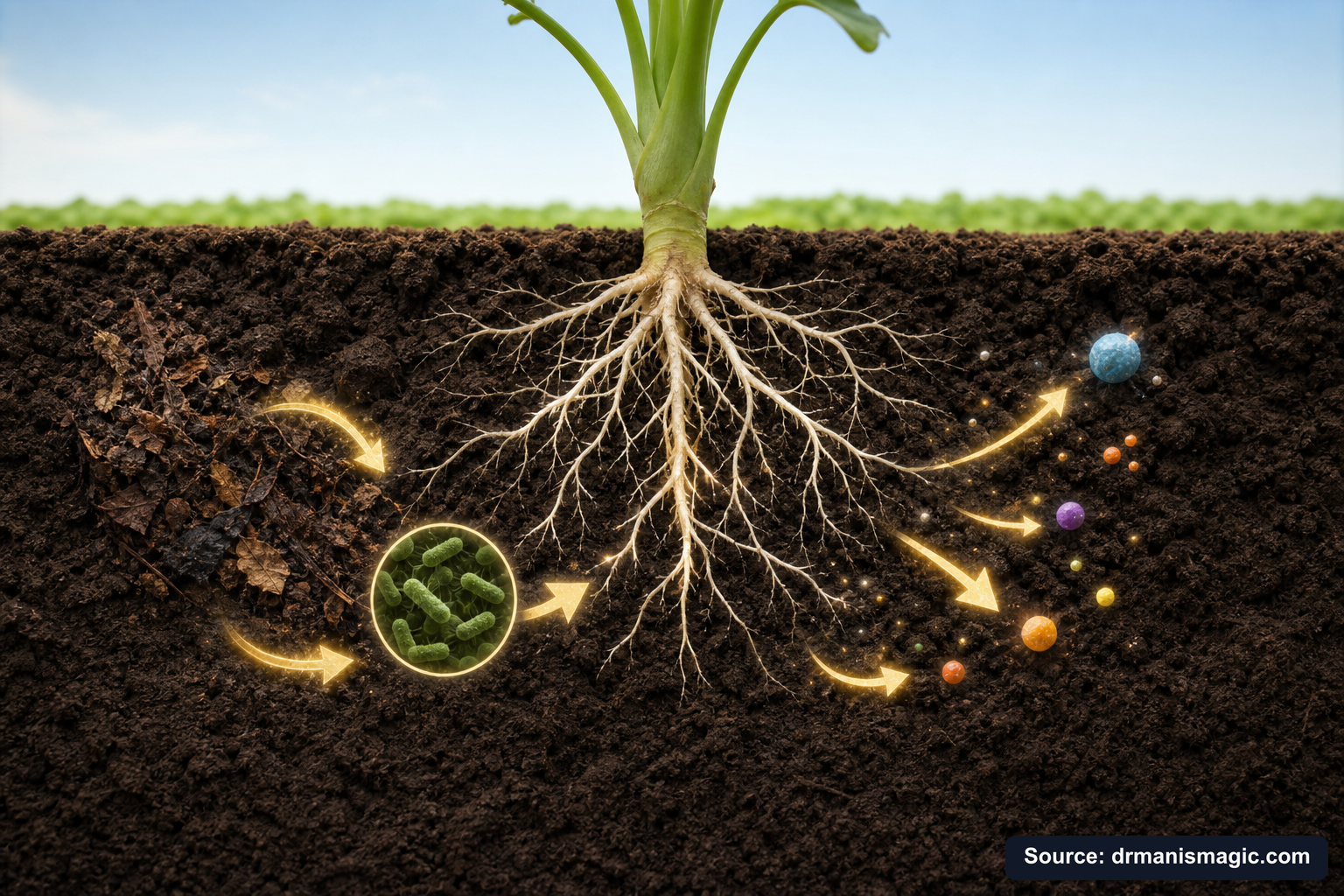
In nature, plants and soil microbes have a partnership that is millions of years old. Bacteria fix nitrogen from the air and make it available to roots. Fungi extend the root system, reaching nutrients and water the roots could never find alone. These microbes also produce compounds that protect plants from disease. They break down organic matter and turn it into forms roots can absorb. They are the engine of a living soil.
When you pour salt-based synthetic fertilizer into that system, the salt burns the microbes just like it burns your roots. The living ecosystem shrinks. Nutrient cycling slows down. Plants become dependent on synthetic inputs because the biology that used to provide for them is gone. You need more fertilizer to get the same result. The cycle gets more expensive and more fragile every season.
After growing 250,000 trees at US Citrus Nursery in South Texas, we saw this pattern play out in real time. Trees fed with salt-based fertilizers looked good for a season or two. Then they started declining in ways that were hard to pin down. The soil under them was nearly biologically dead. Once we switched to living soil systems, the difference was not subtle. It was dramatic.
The University of Minnesota Extension notes that organic fertilizers generally support soil organic matter, drainage, and aeration in ways that inorganic fertilizers do not, and they carry lower salt loads that are safer for soil biology over time.
You Never Had a Brown Thumb.
You were handed the wrong tools. This free guide hands you the right ones.
You watered it. You fed it. It died anyway.
It was never you. It was the dirt, the salt food, and the bad advice.
This guide shows you what really went wrong, and how to fix it for good.
- Why your plants really died, and why it was never your fault
- The salt hiding in your plant food that quietly burns the roots
- The hidden killer in almost every bag of store soil
- The tiny helpers that grow a whole forest for free
- The rescue trick that brings a half dead plant back to life

Organic vs. Synthetic Fertilizer for Vegetables: Which One Actually Works Better?
Quick Answer: Synthetic fertilizers are fast and precise but high in salt, damaging to soil microbes, and prone to causing burn and nutrient lockout with overuse. Organic fertilizers are slower to release but build soil health, feed beneficial biology, carry almost no burn risk when used correctly, and deliver more consistent results over a full growing season.
This is not an ideology debate. This is a practical question. Which one actually helps your vegetables thrive over time.
Here is the honest comparison.
| Factor | Synthetic / Chemical Fertilizer | Organic Fertilizer (e.g., Crab, Kelp, Amino Acids) |
|---|---|---|
| Speed of nutrient release | Fast, often immediate | Slow, steady, microbe-mediated |
| Salt content | High. Salt is the delivery vehicle. | Low. Plants regulate absorption naturally. |
| Risk of burn | High, especially in containers, raised beds, heat, and drought | Very low when used at recommended amounts |
| Effect on soil microbes | Damages and reduces beneficial bacteria and fungi over time | Feeds and supports living soil biology |
| Soil health over time | Degrades soil structure and biology with repeated use | Builds soil organic matter, drainage, and water-holding capacity |
| Blossom end rot risk | Higher. High nitrogen and salt stress block calcium movement. | Lower. Balanced, slow nutrition supports consistent calcium transport. |
| PFAS and biosludge risk | Some products contain plastic-coated slow-release pellets or biosludge fillers | Clean sources like crab, kelp, and amino acids contain zero PFAS and zero biosludge |
| Long-term cost | Ongoing dependence; soil needs more inputs every season | Decreasing inputs over time as soil biology strengthens |
| Safe for children, pets, and family | Concerns around biosludge, PFAS, and runoff | Safe for the whole family when sourced cleanly |
The old way of thinking said faster is better. Pour on the nitrogen and watch it grow. But what you are really watching is the plant burning through its savings account while the bank account of living soil empties out beneath you. A season or two looks fine. Then it starts to fall apart.
The better way is to feed the soil. Let the biology do the work. Let nutrients release slowly and steadily in forms the plant can absorb at its own pace.
Our Crab, Kelp & Amino Acids fertilizer was built on this exact principle. Crab shells provide chitin, calcium, and magnesium. Cold-processed kelp delivers trace minerals and natural plant growth hormones. Amino acids from clean animal sources give roots the building blocks they need without forcing rapid growth faster than the plant can handle. No biosludge. No PFAS. No synthetic salts. A 7-4-4 ratio with 6% calcium built in, because we know how critical calcium delivery is for vegetable crops like tomatoes and peppers.
What Does the "Salt + Water + Roots" Problem Really Mean for Your Vegetable Garden?
Quick Answer: Salt from synthetic fertilizers, inconsistent watering, and root damage form a triangle that causes most vegetable garden failures. When any one of these three factors goes wrong, the other two make it worse. The solution is to remove the salt problem, stabilize the water, and protect the roots with living soil biology.
Let us make this as clear as possible because this is the part most gardening content misses completely.
Salt raises the osmotic pressure in the soil. Osmotic pressure is just a science term for how hard water has to work to cross a membrane. When soil salt is high, water has to work harder to get into root cells. At some point, it cannot get in at all. The root dehydrates. The plant wilts. Then pathogens move in because damaged roots cannot defend themselves.
Heat and drought make this dramatically worse. When the soil dries out, the remaining water becomes saltier because the same amount of salt is now dissolved in less water. That is why fertilizer burn is so much more severe during a hot, dry summer. The plants that looked fine in spring start scorching in July even though you have not changed anything.
Containers and raised beds concentrate this effect. There is nowhere for the salt to go. Every feeding adds more. The electrical conductivity of the soil climbs with each application until it crosses the point where roots fail.
This is why the soil itself matters so much. A mineral-based soil that drains properly and holds healthy microbial communities gives roots the best chance of surviving stress. A sawdust-based potting mix that compacts, repels water, and contains no living biology gives roots almost no defense at all.
Our Super Soil was built around this reality. It uses sandy loam from the Rio Grande Valley, silica-rich and permanent, meaning it does not decompose and steal oxygen from roots the way pine bark potting mix does. It drains properly. It stays open. Roots can breathe. And when roots can breathe, everything else works better.
The potting mix you buy at a big box store is mostly pine bark sawdust. It is cheap. It is light. It is easy to ship. And it begins decomposing the moment you open the bag, consuming the oxygen your roots need, compacting over time, and eventually becoming nearly hydrophobic, meaning it repels water instead of holding it. That is not soil. That is a slow death sentence for your vegetable roots.
How Do You Rescue Overfertilized Vegetables? A Step-by-Step Recovery Plan
Quick Answer: Stop fertilizing immediately. Remove any visible granules from the soil surface. Water deeply to flush salts through the drainage holes. Avoid drought stress while roots recover. Do not prune green leaves even if they look stressed. Wait for new growth before feeding again, and switch to an organic, low-salt fertilizer when you do.
You can save most overfertilized vegetable plants if you act quickly. Here is the step-by-step process we recommend based on what we have seen work across thousands of plants.
- Stop all fertilizing immediately. Do not add anything else to the soil. Not even a small dose. The root zone needs a break.
- Remove visible granules from the soil surface. Pick them off by hand or brush them away gently. Do not let them continue dissolving into the root zone.
- Water deeply and slowly. If the container or raised bed has drainage, water until it flows freely from the bottom. This leaches salts downward and out. Repeat once or twice over the next few days.
- Do not let the soil dry out completely during recovery. Dry soil concentrates salts. Keep moisture consistent but not waterlogged.
- Mulch the surface if possible. Mulch slows evaporation and helps buffer soil temperature, reducing the salt-concentrating effect of heat and sun.
- Do not prune green tissue. Even stressed leaves are still working. Leave them alone. Only remove tissue that is fully dead and brown.
- Wait for new growth before feeding again. When you see fresh green leaves emerging, the roots are recovering. At that point, start with a gentle organic fertilizer at half the recommended rate and build back slowly.
If symptoms persist after a thorough leaching, your soil may have accumulated salts beyond what watering alone can fix. In that case, replacing the growing medium with a mineral-based, salt-free soil is the fastest path to recovery.
See also: Why Are My Tomato Leaves Turning Yellow at the Bottom?
See also: The Best Organic Fertilizer for a Vegetable Garden
What Is the Three Plant Pillars Approach and Why Does It Matter for Vegetables?
Quick Answer: The Three Plant Pillars are a root-cause framework developed and proven at US Citrus Nursery over 30 years and 250,000 trees. The three pillars are mineral-based soil that does not rob roots of oxygen, living microbes that unlock nutrients and protect roots, and organic fertilizer that feeds plants gently without salt damage. Together, they create a vegetable garden that almost runs itself.
After decades of watching gardeners struggle with the same problems over and over, Dr. Mani Skaria, Professor Emeritus of Plant Pathology and founder of the Clean Citrus Program in Texas, identified the root cause. It was never about which fertilizer brand to buy. It was never about adding more products. It was about getting three fundamental things right.
The first pillar is mineral-based soil. Not potting mix. Not pine bark sawdust. Real mineral soil that does not decompose, does not steal oxygen, and does not compact into a root-choking sludge. Roots need oxygen just like you do. Give them soil that allows air to move freely.
The second pillar is living microbes. Bacteria, fungi, and mycorrhizae that create the same underground ecosystem your vegetables evolved to grow in. These microbes unlock nutrients that are already in your soil but locked up in forms roots cannot use. They protect roots from pathogens. They extend the root system's reach. Without them, your vegetables are defenseless.
The third pillar is organic fertilizer with biostimulants. Not a salt bomb. Not a quick hit of synthetic nitrogen that forces fast growth and crashes the soil biology. Slow-release, earth-born nutrition that the plant absorbs at its own pace, in amounts it actually needs, without the osmotic damage that burns roots and blocks calcium movement.
When all three pillars are in place, the garden changes. Vegetables grow consistently. Blossom end rot becomes rare because roots are healthy and calcium moves freely. Leaf scorch disappears because there is no salt overload. Pest and disease pressure drops because the soil biology is fighting for your plants.
Learn more about the full system at the Three Plant Pillars guide, where we walk you through exactly how to set up this foundation for any vegetable garden, container, or raised bed.
You can also download the Free Plant Care Field Guide to get a complete, plain-English walkthrough of how to apply these pillars to your specific plants and growing setup.
The Bottom Line: Chemical Fertilizers Are Not Evil, But Salt Is the Real Problem
Here is where we land after all of this.
Chemical fertilizers are not automatically bad for your vegetables. The nutrients inside them, nitrogen, phosphorus, potassium, are the same nutrients every plant on earth needs to grow. The problem is the delivery system. Salt. And salt, misused, in the wrong amounts, in the wrong growing environment, at the wrong time, is genuinely harmful to your roots, your soil biology, your fruit quality, and over time, your entire garden.
The people selling you salt-based fertilizers are not evil either. But they profit most when you keep buying. They profit when your plants struggle and you need another product to fix the problem the last product created. That cycle has been running since the 1950s, and most gardeners have been inside it without even knowing.
The way out is not complicated. It is just different from what you have been told.
Feed the soil, not just the plant. Protect the microbes. Use nutrition that releases slowly and works with your roots instead of burning them. Start with a soil that actually drains and breathes. Do those three things and your vegetable garden will show you what it is capable of in a way that synthetic fertilizer has never been able to deliver.
You cannot get back the seasons you spent watching plants struggle. But you can start right now, with the right foundation, and see fruit on your vine, peppers on your plant, and tomatoes bigger than you thought possible, all without burning a single root or poisoning a single microbe in the process.
If you are ready to see what the Three Plant Pillars can do for your vegetable garden, read what other growers experienced when they made the switch, and then grab your free field guide to get started on the right foot.
Frequently Asked Questions
If you have ever walked outside to find your vegetable leaves scorched and crispy after feeding them, you are not alone. These are the most common questions gardeners ask after realizing chemical fertilizers may be working against them. The answers below are grounded in over 30 years of hands-on growing and more than 250,000 trees tested at our South Texas nursery.
What is the safest fertilizer for vegetables?
The safest fertilizer for vegetables is a slow-release organic blend made from natural ingredients like crab meal, kelp, and amino acids. These feed your soil's living microbes first, and those microbes gently deliver nutrients to your plant roots over time. There is no salt spike, no burn risk, and no toxic residue on the food you eat. That is exactly how the Dr. Mani's Magic Crab, Kelp, and Amino Acids fertilizer works. It is one of the Three Plant Pillars that has been proven across hundreds of thousands of plants.
What do chemical fertilizers actually do to vegetable roots?
Chemical fertilizers are salt-based. When those salts build up in the soil, they pull water out of your root cells through osmosis. Your roots dry out from the inside even when the soil feels wet. That is why you see brown, crispy leaf edges after feeding. It looks like a burn because it is one. The roots are being dehydrated by the very product you used to help them. This is not rare. It is one of the most common hidden causes of struggling vegetable gardens across the country.
What is the best fertilizer for tomatoes and vegetables?
The best fertilizer for tomatoes and vegetables feeds the soil first, not just the plant. An organic slow-release blend rich in phosphorus and potassium, combined with live soil microbes, gives your plants steady nutrition without the salt damage that causes blossom end rot and leaf scorch. Dr. Mani's Magic uses crab, kelp, and amino acids together with Plant Super Boost microbes. This combination was tested on citrus, tropical trees, and vegetables at our South Texas nursery and consistently outperforms synthetic options over a full growing season.
What is the best fertilizer for a veggie garden overall?
The best approach for a veggie garden is to stop thinking about fertilizer alone and start thinking about all Three Plant Pillars together. You need mineral-based soil that drains well and does not compact. You need live microbes that protect roots and unlock nutrients. And you need organic fertilizer that feeds slowly without burning. When all three work together, your vegetable garden builds real momentum. Plants get stronger each month instead of stalling out. That is the system Dr. Mani spent decades developing and testing before bringing it to home gardeners.
What fertilizer is good for cucumbers?
Cucumbers need balanced early nutrition and then a shift toward potassium and phosphorus once they start flowering. The biggest mistake gardeners make is pushing nitrogen too hard, which grows big leafy vines but very few cucumbers. A slow-release organic fertilizer with kelp and amino acids supports steady growth without that nitrogen spike. Pair it with live soil microbes and you get roots that absorb nutrients efficiently at every stage. This approach works for cucumbers, squash, and all vining crops that tend to stall out mid-season.
Is 10-10-10 fertilizer good for vegetables?
A 10-10-10 fertilizer is a synthetic, salt-based product with equal parts nitrogen, phosphorus, and potassium. It can give a quick green flush early in the season, but the salt load damages the living microbes in your soil. Once those microbes are gone, your soil loses its ability to cycle nutrients naturally. Plants become dependent on the next synthetic application. Over time, the soil gets worse, not better. For vegetables, a lower-salt organic option that builds soil biology gives you far better results across an entire season and into the next year.
What is the best homemade fertilizer for vegetables?
Compost is the best homemade option because it feeds soil microbes and improves soil structure at the same time. Comfrey tea and diluted weed tea can add a quick nitrogen and potassium boost for heavy feeders like tomatoes and corn. Crushed eggshells near the base of plants help prevent blossom end rot by adding calcium slowly. These homemade methods work because they support living soil biology rather than bypassing it. If you want to take your homemade approach further, adding a live microbial product like Plant Super Boost amplifies everything your compost is already doing.
About the Author
Ron Skaria, MD
Ron Skaria, MD, is the co-founder of Dr. Mani's Magic and the son of Dr. Mani. He trained as a medical doctor at Baylor College of Medicine, did his residency at UT Health Science Center - San Antonio and fellowship training at Texas Tech University. He now works full time on the family farm at US Citrus and US Citrus Nursery in Hargill, Texas, building Dr. Mani's Magic alongside his dad. He wrote the Brown Thumb Field Guide to put his father's 48 years of plant science into plain words any gardener can use. His belief is simple. You never had a brown thumb. You just never had the right help.


