


Why Animal-Based Aminos Work Differently Than Salt Fertilizers | Dr. Mani's Magic
Why Animal-Based Aminos Work Differently Than Salt Fertilizers (And Why Your Roots Can Feel the Difference)
Picture this. You're standing in your backyard on a Saturday morning. Coffee in hand. The sun is just coming up. You walk over to your lemon tree — the one you've been nursing for two years — and you notice the leaves are curling. A little yellow at the edges. The soil looks fine. You watered it. You fertilized it last week with that blue stuff from the big box store. You did everything right.
So why does your tree look like it's slowly giving up?
Here's what nobody at that store told you. That blue fertilizer? It's made mostly from salts. Soluble, aggressive, ionic salts. And when those salts hit your root zone, they don't just feed your tree. They pull water out of the roots. They create what scientists call osmotic stress — a kind of invisible drought happening right at the tips of your roots, even when the soil is wet. Meanwhile, the billions of microbes living in your soil — the tiny workers your plant actually depends on to eat, grow, and fight disease — are getting torched. One by one. And without those microbes, no fertilizer in the world can do its job properly. You're not feeding your plant. You're slowly suffocating it.

Organic Fertilizer | Crab, Kelp & Amino Acids
Now imagine something different. Imagine a fertilizer that doesn't dump a salt bomb into your soil. One that actually feeds the microbes first. The microbes eat it, process it, and release it slowly — in exactly the form your plant's roots want. That's what animal-based amino acids do. And after growing over 250,000 trees at our South Texas nursery, we can tell you: the difference isn't small. It's everything. Let's break down exactly why — in plain English, no lab coat required.
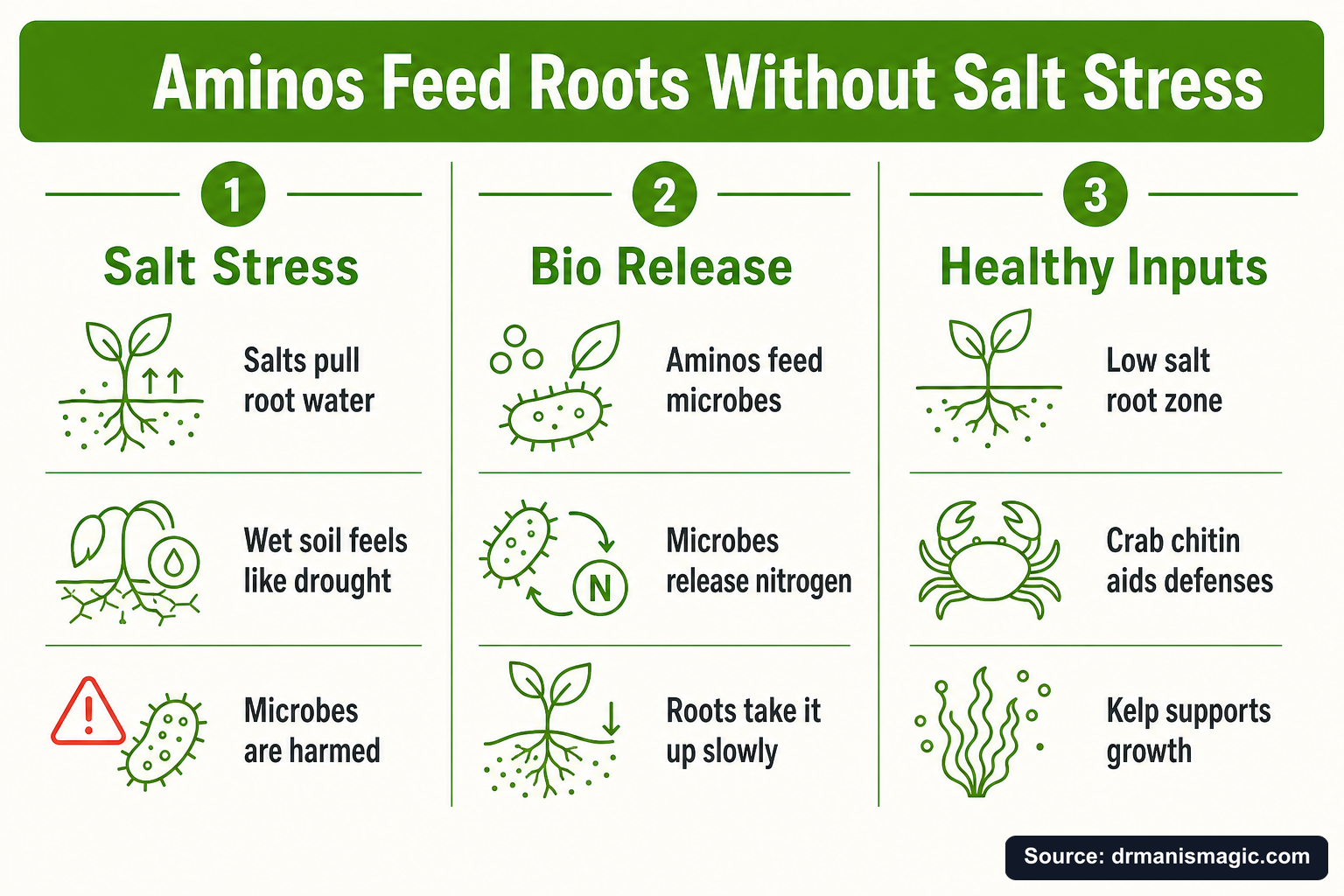
Key Takeaways
- Salt-based synthetic fertilizers create osmotic stress (a chemical drought) in the root zone, even when soil is moist.
- Animal-based amino acids feed soil microbes first, which then slowly release plant-ready nitrogen — a gentle, natural process that mirrors how nature works.
- Microbial life is the engine of your soil. Salt kills it. Organic amino inputs protect and grow it.
- Chitin from crab shells triggers natural pest and disease resistance in your plants.
- Kelp adds natural growth hormones, trace minerals, and carbohydrates that help roots, shoots, and fruit all at once.
- Clean animal-based amino products contain zero biosludge, zero PFAS, and zero synthetic salts — a critical difference from some "organic" fertilizers on the market.
- This system works for lawns, gardens, houseplants, fruit trees, flowers, and ornamentals — not just citrus.
What Is Osmotic Stress and Why Does It Happen When You Fertilize?
Quick Answer: Osmotic stress happens when salt concentrations around plant roots get higher than inside the root cells. Water flows out of the roots instead of in. The plant experiences drought-like symptoms even in moist soil. This is the hidden damage salt-based fertilizers cause every time you apply them, especially in containers and compacted ground.
Think of it like this. Your plant's root cells are tiny water balloons. They stay plump and healthy when the liquid around them has less salt than the liquid inside them. That's how water flows in — from low salt to high salt, through the root membrane.
Now pour a synthetic fertilizer into the soil. Suddenly the salt concentration outside the root skyrockets. The math flips. Water starts flowing out of the root, not in. Your plant is sitting in wet soil and still going thirsty. This is called physiological drought, and it's exactly what Utah State University Extension describes when explaining fertilizer burn and salt stress in garden plants.
The symptoms look like drought stress. Leaf curl. Tip burn. Yellowing. Wilting. Growers add more water. Nothing improves. Some add more fertilizer, thinking the plant is hungry. It gets worse. The real problem was never a lack of nutrients. It was too much salt in the root zone.
In containers, this gets even more dangerous. Salts have nowhere to go. They build up with every application. The electrical conductivity (EC) of the soil climbs. And when EC gets too high, roots stop working. Seedlings are especially vulnerable. Lawns, ornamentals, and fruit trees in pots are all at risk. Every. Single. Time you use a high-salt fertilizer.
Animal-based amino products work at a fundamentally different starting point. They are not salt-based. Their nitrogen is locked inside organic molecules — peptides, amino acids, and proteins — not loose ions floating in water. The EC impact is dramatically lower. The root zone stays calm. And the process of releasing that nitrogen takes a completely different path.
How Do Animal-Based Amino Acids Actually Release Nitrogen to Plants?
Quick Answer: Animal-based amino acids release nitrogen through a biological chain. Soil microbes eat the organic amino compounds, break them down into ammonium and then nitrate, and the plant absorbs those. Some amino acids can also be taken up directly by roots. The whole system releases nitrogen slowly, steadily, and in sync with what the plant actually needs.
Here's the mechanism most people never hear about. And it's the one that changes everything.
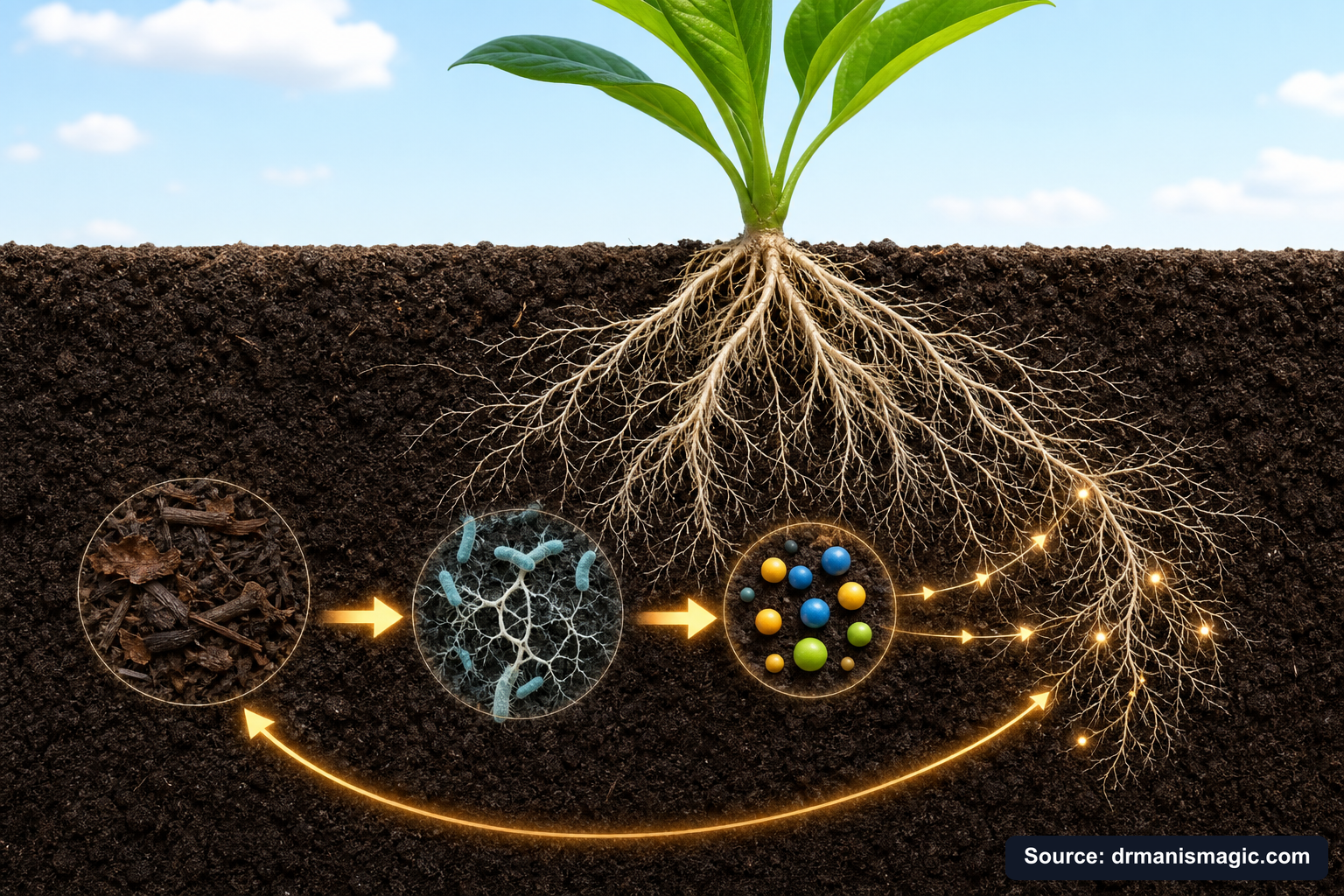
When you apply an animal-based amino fertilizer to your soil, it doesn't dissolve instantly like a salt would. Instead, it sits in the soil in organic form — as peptides and amino acid chains. Bacteria in the soil start eating it. They use it as food and energy. As they process it, they release ammonium. Other bacteria convert that ammonium into nitrate. The plant's roots absorb both. Some research also shows that plant roots can take up certain short amino acids directly, skipping the microbial step entirely — though most of the nitrogen still travels through the microbe pathway.
This is a living system. It runs on biology, not chemistry. And it has a natural governor built in. The microbes only process as fast as conditions allow — temperature, moisture, soil oxygen, and pH all play a role. That means nitrogen is released in a slow, steady trickle rather than a sudden flood. The plant gets what it needs when it needs it. No spike. No crash. No salt buildup.
And here's the part that really matters. When those microbes eventually die — which they do, as part of their natural life cycle — they release ALL the nutrition they were carrying directly into the soil around your roots. Their tiny bodies become plant food. It's a natural slow-release capsule system that keeps feeding your plant long after the original application. No plastic coating. No synthetic chemistry. Just biology doing what it has done for millions of years.
Penn State Extension explains this process clearly: nitrogen in organic matter must be mineralized by soil microbes before plants can use most of it. That mineralization step is not a weakness. It is a feature. It prevents the sudden osmotic spike that causes fertilizer burn and protects the soil food web at the same time.
We watched this play out across 250,000 citrus trees at our South Texas nursery. Trees fed with organic amino inputs consistently showed healthier root systems, deeper green color, and stronger resistance to stress than trees given high-salt synthetic feeds. The microbes were the difference every single time.
Why Does Feeding the Microbes First Make Your Plant Stronger?
Quick Answer: Soil microbes don't just release nutrients. They also suppress disease, build soil structure, help roots absorb water, and produce compounds that stimulate plant growth. When you feed microbes with organic amino inputs instead of killing them with salt, your plant gains an entire underground defense system — not just a dose of nitrogen.
Most people think of fertilizer as something that goes directly from the bag to the plant. Feed plant. Plant grows. Simple.
But that's not how nature works. In a healthy soil, there is no direct path. Every nutrient moves through a web of life first. Bacteria. Fungi. Nematodes. Protozoa. Mycorrhizal networks. These organisms don't just process nutrients. They suppress root diseases like Pythium and Phytophthora. They glue soil particles together into aggregates that hold air and water. They produce hormones and enzymes that help roots grow faster and reach farther. They are, in every meaningful sense, the immune system of your plant.
Salt-based fertilizers damage this system. Every application is a small massacre. The ionic salts are indiscriminate. They don't know the difference between a harmful pathogen and a beneficial bacterium. They just raise the osmotic pressure and burn everything in range. Over time, soils treated with heavy synthetic fertilizer become biologically dead. They need more and more fertilizer to produce the same result. It's an addiction cycle. And the plant — your lemon tree, your lawn, your roses, your vegetable garden — pays the price.
Animal-based amino acids do the opposite. They are organic compounds that microbes recognize as food. Applying them is like setting out a feast for your underground workforce. The microbes multiply. The soil comes alive. And as that microbial population grows, so does everything it protects and provides.
This is the foundation of what we call the Three Plant Pillars — the framework Dr. Mani Skaria developed over 40 years of plant science and nursery work. Pillar Two is microbial health. Pillar Three is organic fertilizer. They are inseparable. Feed the microbes. The microbes feed the plant. The plant becomes nearly bulletproof.
What Does Chitin From Crab Shells Actually Do for Your Plants?
Quick Answer: Chitin is a natural compound found in crab and shrimp shells. When added to soil, it feeds a specific group of bacteria that produce chitinase enzymes. Those enzymes break down the exoskeletons of fungal pathogens and harmful insects in the soil. Your plant's immune system also gets activated by chitin signals, building resistance from the inside out.
This one surprises people every time we explain it.
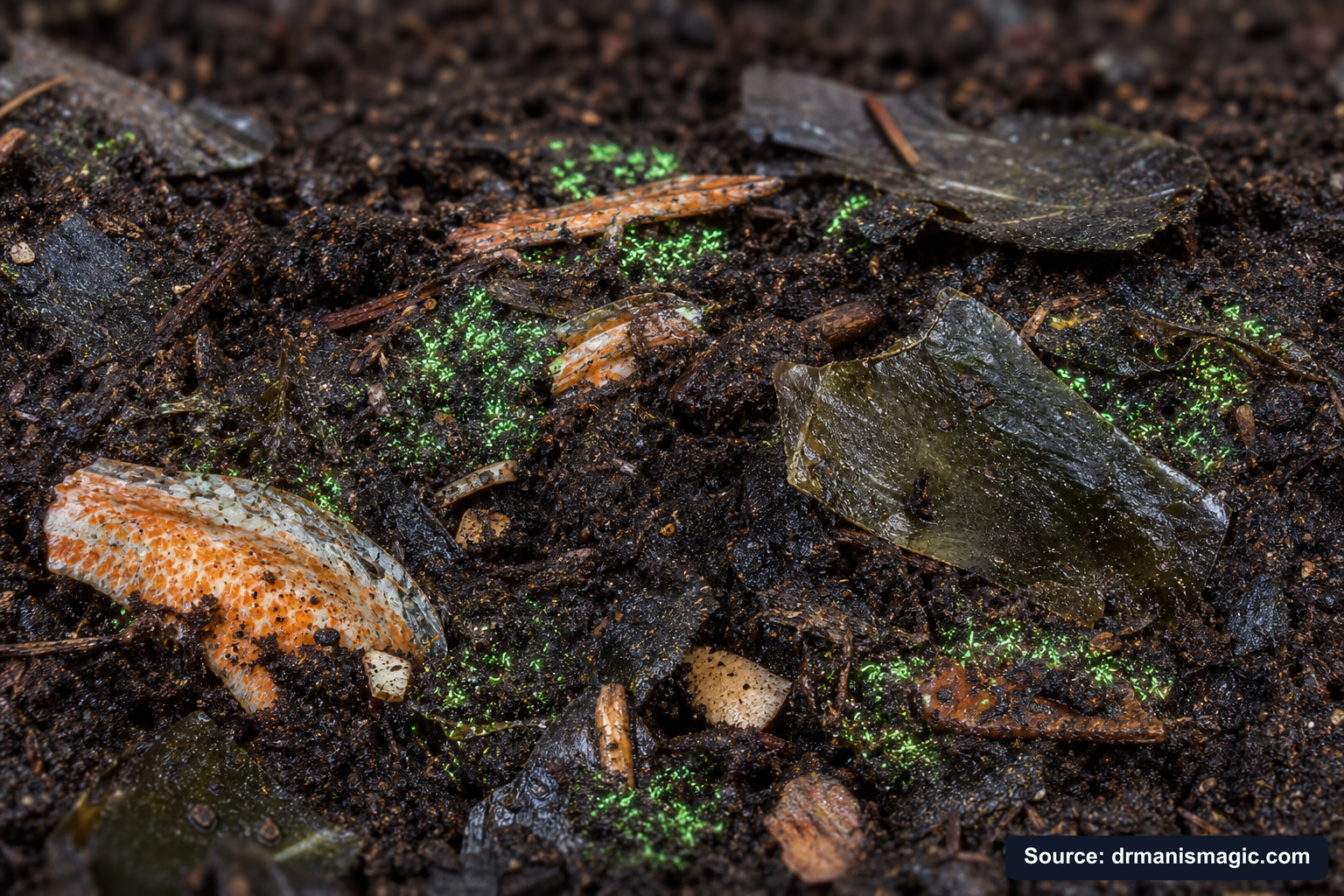
Crab shells aren't just a nitrogen source. They contain a compound called chitin — the same material that makes up the shell of insects and the cell walls of many harmful fungi. When chitin enters your soil, it wakes up a specific population of bacteria called chitinolytic bacteria. These bacteria love chitin. They produce enzymes called chitinases that literally dissolve the outer shells of fungal pathogens and soil-dwelling pest larvae.
So the crab meal in an amino-based fertilizer is, in effect, teaching your soil to fight its own battles. The plant also senses chitin as a signal of nearby insect or fungal activity. It responds by activating its own systemic resistance pathways — essentially putting its immune system on alert. This is called induced systemic resistance, and it's a well-documented plant defense response.
Crab meal also brings calcium and magnesium — two nutrients that are often overlooked but absolutely critical. Calcium builds cell walls and makes stems and branches strong and woody. Magnesium sits at the center of every chlorophyll molecule. Without it, your plant literally cannot photosynthesize. Our Crab, Kelp & Amino Acids formula is over 6% calcium by weight — which matches the reality that calcium makes up the largest mineral fraction of the woody mass of most plants.
What Does Kelp Add That Synthetic Fertilizers Can Never Provide?
Quick Answer: Kelp provides natural plant growth hormones called auxins and cytokinins, plus trace minerals, complex carbohydrates, and biostimulants that no synthetic fertilizer can replicate. These compounds accelerate root development, improve stress tolerance, and stimulate flowering and fruiting in ways that go far beyond simple NPK nutrition.
Walk into any garden center and look at the fertilizer labels. You'll see numbers. 10-10-10. 20-0-0. NPK percentages. That's the whole story those products tell.
Kelp tells a completely different story.
Cold-processed kelp — the kind that hasn't been cooked or chemically extracted — contains natural hormones called auxins and cytokinins. Auxins push root cells to elongate and multiply, giving you faster, deeper root development. Cytokinins signal the plant to divide cells and push new growth. Together, they act like a biological accelerator for both the root system underground and the canopy above.
Kelp also contains alginic acid, a complex carbohydrate that feeds soil microbes directly. It carries over 70 naturally occurring trace minerals in bioavailable form. It provides betaines — compounds that help plants manage heat and drought stress. And because it's cold-processed, those biologically active compounds are preserved, not destroyed.
This is why plants fed with kelp-based organic fertilizers often show improved stress tolerance, better flowering, and more consistent fruit set — not just greener leaves. You're not just filling a nutrient bucket. You're communicating with the plant's biology in a language it evolved to understand.
Synthetic fertilizers have no hormones. No carbohydrates. No trace mineral complexity. They deliver a narrow band of soluble ions and nothing else. Your plant can survive on that. But it won't thrive on it the same way.
Synthetic Salt Fertilizer vs. Animal-Based Amino Inputs: A Root-Zone Comparison
Quick Answer: Salt-based fertilizers dump immediately soluble ions into the root zone, spike EC levels, create osmotic stress, and kill soil microbes. Animal-based amino inputs enter the soil in organic form, feed microbes, release nitrogen slowly through mineralization, and support the entire soil-plant biology system. The root-zone experience is completely different.
| Factor | Synthetic Salt Fertilizer | Animal-Based Amino Inputs |
|---|---|---|
| Nitrogen form | Immediately soluble nitrate or ammonium salts | Organic peptides and amino acids, released through microbial mineralization |
| EC / Salt Index | High — spikes electrical conductivity rapidly | Low — minimal salt impact on root zone |
| Osmotic stress risk | High — can cause physiological drought at the root tips | Very low — no sudden osmotic pressure change |
| Microbial impact | Damages and kills beneficial bacteria and fungi | Feeds and multiplies beneficial microbes |
| Nitrogen release speed | Immediate — fast spike, fast crash | Slow and steady — mirrors how nature feeds plants |
| Burn risk | High — especially for seedlings, containers, lawns | Very low — nearly impossible to over-apply |
| Soil structure over time | Degrades — salts break down aggregates | Improves — microbial activity builds soil structure |
| Disease suppression | None — can increase susceptibility | Active — chitin, microbial competition, induced resistance |
| PFAS / biosludge risk | Some products use biosludge fillers | Clean inputs — zero biosludge, zero PFAS (verify by brand) |
| Long-term soil health | Declining — creates dependency cycle | Improving — builds a self-sustaining soil ecosystem |
See also: How Salt-Based Feeding Quietly Destroys Root Systems
See also: The Hidden Reason Synthetic Fertilizers Cause Root Rot
You Never Had a Brown Thumb.
You were handed the wrong tools. This free guide hands you the right ones.
You watered it. You fed it. It died anyway.
It was never you. It was the dirt, the salt food, and the bad advice.
This guide shows you what really went wrong, and how to fix it for good.
- Why your plants really died, and why it was never your fault
- The salt hiding in your plant food that quietly burns the roots
- The hidden killer in almost every bag of store soil
- The tiny helpers that grow a whole forest for free
- The rescue trick that brings a half dead plant back to life

When Do Animal-Based Aminos Help — and When Won't They Fix Your Problem?
Quick Answer: Animal-based amino inputs work best when soil has oxygen, reasonable moisture, and living microbes to process the organic compounds. They won't rescue a plant in waterlogged, anaerobic soil, fix a severe existing root rot infection alone, or replace a full soil correction in heavily compacted or chemically burned ground without addressing those root causes first.
We believe in being honest with you. That's the only way trust works.
Animal-based amino fertilizers are not magic wands. They work through biology. And biology needs the right conditions. Here's a practical guide to where they shine — and where you need to fix something else first.
| Situation | Will Aminos Help? | What Else You May Need |
|---|---|---|
| Healthy lawn needing consistent feeding | Yes — excellent, steady nitrogen without burn risk | Consistent watering and mowing |
| Fruit trees in containers | Yes — low salt buildup, supports root health | Mineral-based soil with good drainage |
| Vegetable garden or raised beds | Yes — safe for edibles, feeds soil biology | Live microbials to maximize mineralization speed |
| Transplant shock recovery | Yes — gentle nutrition won't add osmotic stress | Root-zone microbial inoculant to rebuild biology |
| Salt-damaged soil from prior synthetic use | Yes, over time — helps rebuild microbial community | Flush excess salts with water first; add live microbes |
| Seedlings and young plants | Yes — very low burn risk compared to synthetics | Light application rates; good drainage essential |
| Ornamentals and flowering plants | Yes — kelp hormones support bloom and root growth | Regular application for best results |
| Waterlogged or anaerobic soil | Limited — microbes need oxygen to mineralize | Fix drainage first; switch to mineral-based soil |
| Active Pythium or Phytophthora root rot | Supportive only — won't cure an active infection alone | Drainage correction, microbial inoculants, soil replacement |
| Severely compacted hardpan soil | Minimal until structure is corrected | Aerate, add mineral soil structure, then use aminos |
The pattern you see here is simple. Animal-based amino inputs work brilliantly when the soil can breathe and the microbes are alive. When those conditions are missing, you have to fix the foundation first. That's exactly why we built the Three Plant Pillars as a complete system — not just a fertilizer swap.
What Is the PFAS and Biosludge Problem With "Organic" Fertilizers?
Quick Answer: Some fertilizers labeled "organic" use biosolids — treated municipal waste, also called sewage sludge — as a filler. Biosolids can contain PFAS ("forever chemicals"), heavy metals, pharmaceuticals, microplastics, and pathogens. Animal-based amino hydrolysates from clean animal byproducts like crab, feather, and kelp are a completely different category and carry none of those risks when properly sourced.
This is the part of the organic fertilizer conversation that almost nobody wants to talk about. But you deserve to know it.
When you see the word "organic" on a fertilizer bag, it does not automatically mean clean. Organic, in the legal fertilizer sense, simply means the nitrogen came from a carbon-based source. That source could be beautiful crab shells and cold-processed kelp. Or it could be treated human sewage waste — what the industry calls biosolids or biosludge.
Biosolids are a real and documented concern. University extension programs and environmental researchers have found that biosolid-based fertilizers can carry PFAS compounds — synthetic chemicals that do not break down in the environment or in the human body. They can also carry heavy metals, pharmaceutical residues, microplastics, and in some cases, pathogens that survived the treatment process. The PFAS concern in particular has grown significantly in recent years as testing has improved.
Animal-based amino hydrolysates — from sources like crab meal, feather meal, and fish tankage — are a fundamentally different product. They come from food-industry animal byproducts, not municipal waste streams. They are processed through hydrolysis, which breaks the proteins into peptides and amino acids. Done correctly with clean source materials, they contain no biosludge, no PFAS, and no pharmaceutical contamination.
Our Crab, Kelp & Amino Acids contains zero biosludge, zero PFAS, and zero synthetic salts. That's a promise we make because Dr. Mani Skaria built his career on plant health science, not marketing shortcuts. When you're feeding your lawn where your kids play barefoot, or your vegetable garden where you pick tomatoes for dinner, that matters. A lot.
If you're evaluating any amino-based fertilizer, ask the company directly: Does this contain biosolids? Can you provide third-party testing for PFAS? A trustworthy company will answer both questions without hesitation.
What Is the Volcanic Ash Doing in an Amino-Based Fertilizer?
Quick Answer: Volcanic ash provides naturally occurring silica and a broad spectrum of trace micronutrients in a form that is highly bioavailable to plants. Silica strengthens cell walls, increases drought and heat tolerance, and improves overall plant resilience. It also supports the soil ecosystem as a long-lasting mineral substrate that doesn't decompose.
Most fertilizers stop at NPK. Nitrogen, phosphorus, potassium. Three numbers. Done.
But plants don't run on three things. They run on at least 12 essential nutrients — and dozens of trace elements that play supporting roles in enzyme activation, hormone production, immune response, and stress tolerance.
Volcanic ash is one of the most mineral-rich natural materials on earth. When added to a fertilizer blend, it delivers silica and a wide array of trace micronutrients — iron, manganese, zinc, copper, boron, molybdenum — in forms that microbes can make available to roots. These aren't afterthoughts. They're the difference between a plant that survives and a plant that thrives.
Silica in particular is fascinating. It deposits into the cell walls of leaves and stems, making them physically stronger and harder for insects and fungal spores to penetrate. Plants with adequate silica tolerate heat and drought better. They hold their structure under stress. Think of it as building your plant's skeleton with reinforced material instead of soft wood.
And unlike synthetic chelated micronutrients — which are engineered in a lab and can still contribute to salt load — volcanic ash minerals are naturally slow-releasing, inorganic, and permanent in the soil. They don't break down and disappear in six months. They stay and keep working. That aligns perfectly with the mineral permanence principle behind our Super Soil — mineral-based, permanent, non-decomposing.
If Your Plant Has Already Been Damaged by Salt Fertilizers, How Do You Recover?
Quick Answer: Salt damage is reversible if you catch it before root rot has progressed too far. The recovery process involves flushing accumulated salts, rebuilding microbial life, and switching to low-salt organic nutrition. Most plants show visible improvement within four to eight weeks when all three steps are taken together.
Time matters here. The longer you wait, the harder recovery becomes. But it's not too late if your plant still has green on it.
Here is a practical recovery checklist for salt-damaged plants — whether that's a lawn, a container tree, a garden bed, or an ornamental:
- Stop the synthetic fertilizer immediately. Every additional application adds more salt load to an already stressed root zone. Give the soil a break.
- Flush the root zone deeply with clean water. For containers, water until it pours freely from the drainage holes, then do it again. For in-ground plants, deep-soak the root zone two to three times over a week to move accumulated salts down and away from roots.
- Check your drainage. Salt damage and root rot often go together. If water is sitting in the pot or soil for more than 30 minutes after watering, drainage is the problem. Fix it before adding anything else.
- Reintroduce living microbes. The salt has likely killed much of your soil biology. Add a live microbial inoculant — bacteria, fungi, and mycorrhizae — to begin rebuilding the underground workforce that your plant depends on. See also: Why Most Fertilizers Are Actually Salt in Disguise
- Begin gentle organic amino nutrition. Once the soil is flushed and microbes are back, start a light application of animal-based amino fertilizer. The low salt index won't re-stress the recovering roots. The microbes will begin mineralizing nitrogen slowly and safely.
- Be patient with new growth signals. Roots recover before leaves show it. You may see two to four weeks of no visible change while the root system rebuilds. Trust the process. New leaf flush and improved color will follow.
- Maintain consistency going forward. The biggest mistake after recovery is going back to what caused the problem. Monthly applications of organic amino nutrition, paired with live microbials, create a self-sustaining system that gets better over time — not worse.
We have seen this recovery pattern play out on trees that looked nearly dead. Curled leaves. Brown tips. Sparse canopy. Six to eight weeks of the right system and those same trees were pushing new growth and holding fruit. The biology works. You just have to stop fighting it.
How Does This Apply to Lawns, Houseplants, Gardens, and Ornamentals — Not Just Trees?
Quick Answer: The soil-microbe-nutrition system is the same for every plant on earth. Whether you're feeding a bermuda grass lawn, a potted peace lily, a rose garden, a vegetable patch, or a backyard fruit tree, the principles don't change. Organic amino inputs support the soil biology that every plant depends on, regardless of what you're growing.
Dr. Mani Skaria spent 40 years studying citrus. But what he discovered wasn't a citrus secret. It was a plant secret.
The soil food web that makes a lemon tree thrive is the same food web that makes your fescue lawn green, your tomatoes heavy, your roses fragrant, and your fiddle-leaf fig stop dropping leaves. The Three Plant Pillars work because they address what every plant on earth actually needs — not what the fertilizer industry decided was easiest to put in a bag.
We tested our system on over 250,000 citrus trees at our South Texas nursery. We also tested it on houseplants, tropical ornamentals, and our production grove. The results were consistent. When the soil breathes, when the microbes are alive, and when nutrition comes from clean organic sources — plants thrive. When one of those pillars is missing, they struggle.
That's true for your backyard peach tree. Your container herb garden. Your front-yard St. Augustine grass. Your grandmother's rose bushes. Your indoor monstera. All of them respond to the same biology. All of them suffer from the same salt damage. And all of them recover — and grow stronger — when you switch to a system built on how nature actually works.
You can read more about building that complete system in our Free Plant Care Field Guide.
See also: Why "Instant Green-Up" Comes With a Cost
The Real Cost of Doing Nothing Different
Here's the honest truth about time.
You can always earn more money. You can buy another bag of fertilizer. You can replace a plant that died. But the months and years that passed while your tree sat stressed, your lawn stayed patchy, your garden underperformed — those don't come back. The number one thing people tell us, over and over, is that they want to see their trees bear real fruit while they can still enjoy them. That drive is primal. It's why we garden. It's why Dr. Mani spent his career on this.
Every season you spend fighting a system that works against your soil biology is a season you don't get back. The old way — salt-based fertilizers, compacted soil, dead microbes, repeat purchases, repeat disappointment — is not a plan. It's a hamster wheel. And the big chemical companies designed it that way. When your plants struggle, you buy more. That's good for them. It's terrible for you.
The better path is to build the foundation once and let it compound. Mineral soil that doesn't decompose. Living microbes that multiply and protect. Organic amino nutrition that feeds the whole system gently and consistently. Once those three pillars are in place, gardening stops being frustrating and starts being something else entirely — something that actually works the way you always hoped it would.
If you're ready to see what that feels like, start with what we've formulated and tested on a quarter-million trees: Crab, Kelp & Amino Acids — clean, slow-release, biology-friendly nutrition with zero synthetic salts, zero biosludge, and a 30-day money-back guarantee. Your plants will feel the difference before you finish the bag. And this time, the results won't stall out in three months and go backwards. They'll keep building. Season after season. The way nature intended.
Frequently Asked Questions
If you have ever stared at a yellowing plant and wondered what went wrong, you are not alone. These are the questions real gardeners ask after they discover that the fertilizer they trusted was actually working against them. The answers below are grounded in over 30 years of hands-on growing at our South Texas nursery, where we tested every one of these ideas on more than 250,000 trees.
How long does it take for animal-based amino acids to start working in the soil?
You can expect to see signs of improvement within two to four weeks. Soil microbes start breaking down the amino acids almost right away. Within days, roots begin absorbing nutrients more easily. Within a few weeks, you may notice deeper green color, stronger new growth, and better overall plant energy. This is not a quick chemical spike. It is a steady, natural build that keeps getting better over time.
Why do animal-based amino acids work differently than salt fertilizers?
Salt fertilizers dump a concentrated dose of ionic salts into your root zone. Those salts pull water out of your roots, even when the soil is wet. Your plant gets thirsty in moist dirt. Animal-based amino acids do the opposite. They feed your soil microbes first. The microbes process the aminos and release nutrients slowly, in a form roots actually want. No salt shock. No microbial die-off. Just steady, natural feeding the way nature designed it.
Are animal-based amino acid fertilizers safe for kids, pets, and edible gardens?
Yes. Dr. Mani's Magic Crab, Kelp, and Amino Acids fertilizer contains zero synthetic salts, zero biosludge, and zero PFAS. It is made from crab shells, kelp, and clean amino acid sources. You can use it around children and pets without fear. You can also apply it to edible gardens, fruit trees, and vegetables. No scary warning labels. No re-entry waiting periods. Just clean, earth-born ingredients that feed your plants and protect your family.
What does chitin from crab shells actually do for plants?
Chitin is a natural compound found in crab shells. When it enters your soil, it signals your plant's immune system to wake up. The plant starts producing natural defenses against common pests and fungal diseases. Think of it like a fire drill for your plant's immune response. It gets ready before trouble arrives. This is one reason our fertilizer does more than just feed your plants. It helps them fight back on their own.
Can animal-based amino fertilizers be used on all plants, not just citrus trees?
Absolutely. We developed and tested the Three Plant Pillars on over 250,000 citrus trees at our South Texas nursery. But the same science works for lawns, houseplants, flower beds, vegetable gardens, tropical trees, and ornamentals. Every plant on earth depends on healthy soil microbes, proper mineral structure, and clean nutrition. That is exactly what our system delivers, no matter what you are growing or where you are growing it.
Will animal-based fertilizer smell bad inside my home or near my garden?
This is a fair concern. Many organic fertilizers, especially fish emulsion, smell like rotting sewage. That happens when ingredients go anaerobic and break down in the bottle. Dr. Mani's Magic fertilizer uses stabilized inputs that do not rot. The crab, kelp, and amino acid blend has a mild, earthy scent. Nothing that will drive you or your pets out of the room. You can use it on indoor houseplants without holding your breath.
Why do salt-based fertilizers cause more problems over time even if they seem to work at first?
Salt fertilizers give you a quick green flush because they force-feed your plant with soluble nutrients. But every application also kills off beneficial soil microbes. Over months and years, your soil loses its living ecosystem. The plant becomes dependent on chemical inputs just to survive. Growth stalls. Then it goes backward. You spend more money chasing the same results and losing valuable growing time you can never get back. That is the cycle the Three Plant Pillars are designed to break for good.
About the Author
Ron Skaria, MD
Ron Skaria, MD, is the co-founder of Dr. Mani's Magic and the son of Dr. Mani. He trained as a medical doctor at Baylor College of Medicine, did his residency at UT Health Science Center - San Antonio and fellowship training at Texas Tech University. He now works full time on the family farm at US Citrus and US Citrus Nursery in Hargill, Texas, building Dr. Mani's Magic alongside his dad. He wrote the Brown Thumb Field Guide to put his father's 48 years of plant science into plain words any gardener can use. His belief is simple. You never had a brown thumb. You just never had the right help.


