


The Ancient Partnership Between Roots and Microbes Explained | Dr. Mani's Magic
The Ancient Partnership Between Roots and Microbes: How Soil Life Built the Plant World
Picture this. You're standing in an old-growth forest. Maybe it's the Smoky Mountains. Maybe it's a quiet stretch of the Texas Hill Country. Either way, nobody planted these trees. Nobody fertilized them. Nobody sprayed them with fungicide or hauled in bags of potting mix. And yet the trees are massive. The leaves are deep green. The roots grip the earth like the trees have been there forever — because they have.
Now walk back to your backyard. Your potted lemon tree is yellowing. Your garden bed looks tired. Your lawn has those brown patches that won't quit. You've tried the stuff from the big box store. You've followed the instructions on the bag. And still, something feels off. Like you're missing a piece of the puzzle. Like no matter what you pour on the soil, the plants just won't respond the way you hoped. You start to wonder if you've got a brown thumb.
You don't. Here's what nobody told you: the forest doesn't need your help because the forest has an ancient army working underground. An invisible workforce that has been running the show for 450 million years. Roots and microbes built every terrestrial ecosystem on this planet together — long before humans showed up with fertilizer bags and spray bottles. And the moment you understand how that partnership works, everything about growing plants changes. Let's go underground.

Organic Fertilizer | Crab, Kelp & Amino Acids
Key Takeaways
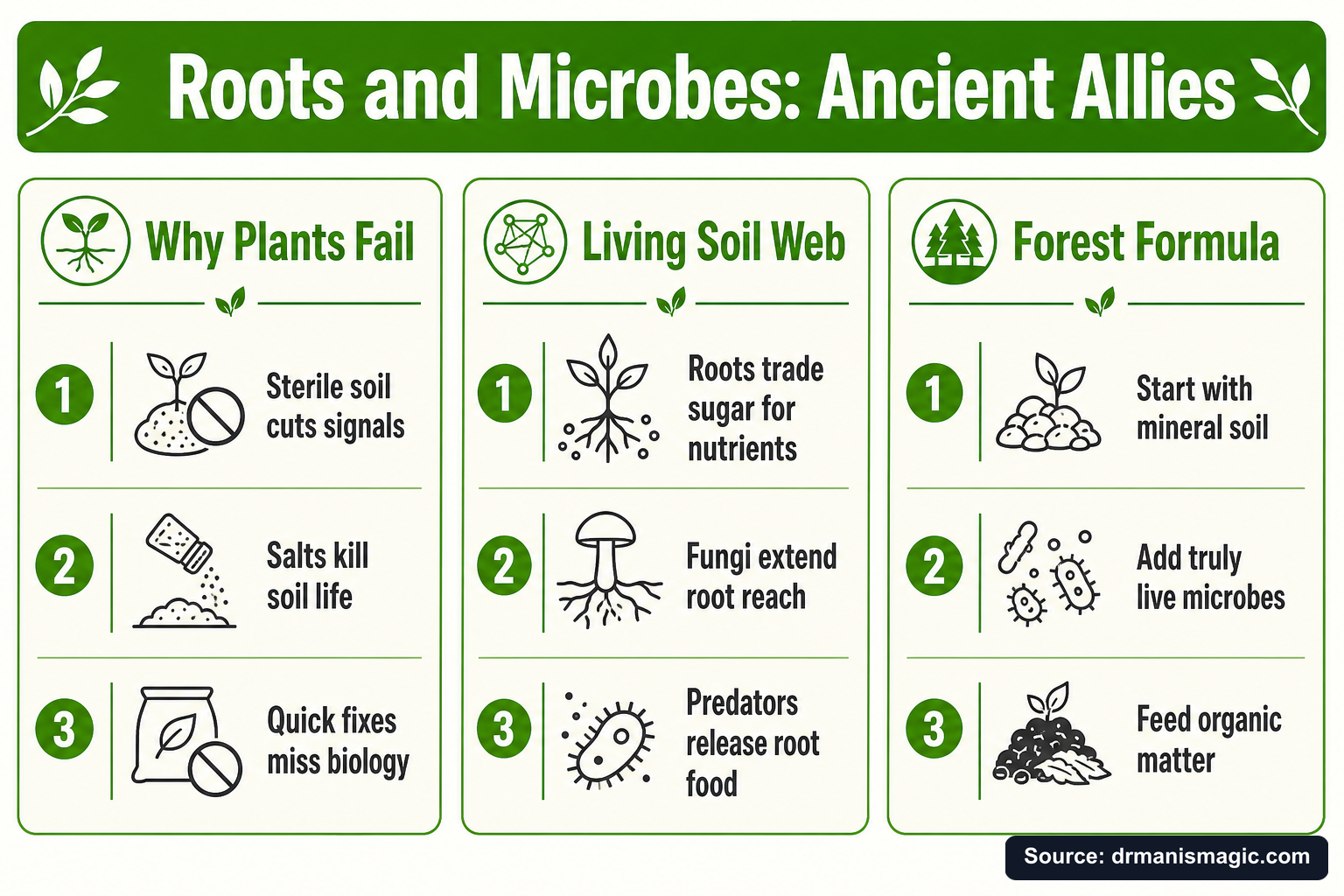
- The partnership between plant roots and soil microbes is roughly 450 million years old — and it is the reason plants conquered land in the first place.
- The soil food web is a living nutrient factory: bacteria, fungi, protozoa, and beneficial nematodes convert raw materials into exactly what roots need, right where roots need it.
- Roots are not passive straws. They actively release sugars to attract and feed specific microbial partners — a two-way exchange that supercharges plant growth.
- Salt-based fertilizers, synthetic pesticides, and herbicides kill the very microbes your plants depend on — quietly, invisibly, and over time.
- Most bottled microbial products on shelves today are either dried and dead or fermenting and rotten by the time you open them.
- Rebuilding damaged soil biology takes deliberate steps — not just one bottle of inoculant dumped and forgotten.
- The Three Plant Pillars — mineral-based soil, live microbials, and organic fertilizer — mirror the ancient formula the forest has always used.
How Did Roots and Microbes First Become Partners?
Quick Answer: About 450 million years ago, early plants could not survive on land without fungal partners to help them absorb water and nutrients from bare rock and mineral soil. That ancient alliance is still alive in every healthy plant root system today. Without it, land plants likely never would have existed.
Here is a fact that should stop you in your tracks.
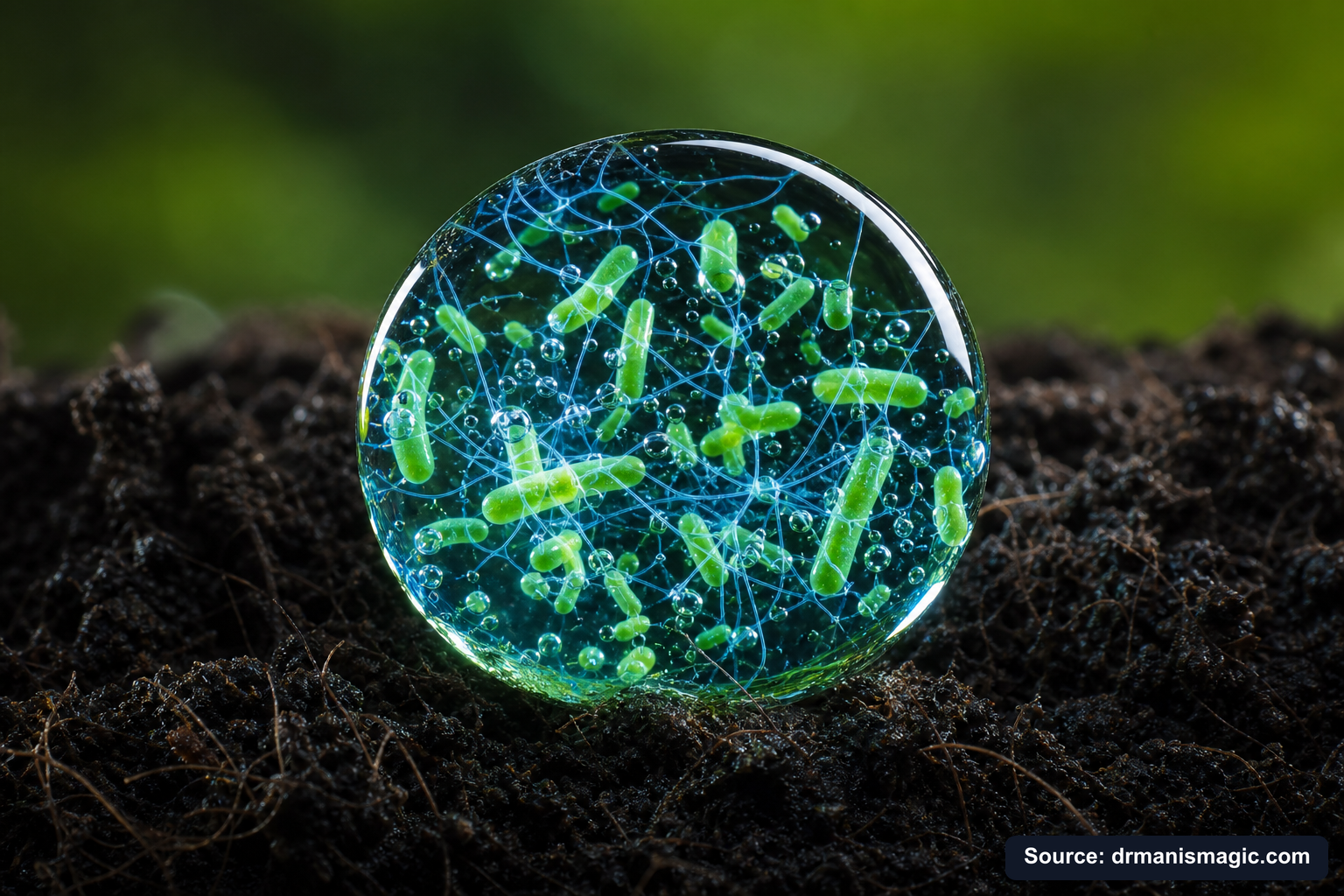
The first plants to ever crawl out of the ocean and set root on dry land had almost nothing to work with. No rich topsoil. No decomposed organic matter. Just mineral rock, wind, and sun. By all logic, they should have died. They didn't. And researchers at Duke University have traced why: those first plants arrived on land with fungal partners already attached to their roots. The signaling pathways that allow plant roots to communicate with arbuscular mycorrhizal fungi are conserved across the entire plant kingdom — meaning every major plant lineage on Earth inherited this partnership from a single common ancestor. That research points to a co-invented origin — plants and fungi did not just find each other. They built terrestrial life together.
Think about what that means. When you grow a tomato in your backyard, or a citrus tree in a container, or a rose bush along your fence — every single one of those plants carries ancient wiring designed to link up with soil microbes. That wiring does not go away. But it only works when the microbes are there to receive the signal.
Take the microbes away — through chemical salt fertilizers, synthetic fungicides, herbicides, or sterile potting mix — and you have cut the cord on 450 million years of evolution. You have handed your plant a cell phone with no signal tower in range. It can try to function. But it is working at a fraction of what it was designed to do.
This is not a niche theory. This is the foundational biology behind every thriving plant on Earth.
What Is the Soil Food Web and Why Does It Feed Your Plants?
Quick Answer: The soil food web is a living nutrient-conversion network where bacteria and fungi break down organic matter, protozoa and nematodes eat the bacteria and release nutrients right next to roots, and earthworms and insects improve soil structure. Together they deliver nitrogen, phosphorus, and other nutrients in plant-ready form — for free.
Most people think of soil as dirt. Brown stuff that holds a plant upright. But healthy soil is closer to a city than a pile of sand. There are more living organisms in a single teaspoon of healthy topsoil than there are people on Earth. And each one of them has a job.
The University of Minnesota Extension describes the soil food web as a nutrient-conversion system — not just a biodiversity curiosity. Their soil biology research shows that the web drives nutrient cycling, water retention, disease suppression, and soil aggregation — the four pillars of productive growing ground.
Here is how the cast of characters works together:
| Organism | What It Does | Benefit to Your Plant |
|---|---|---|
| Bacteria | Break down organic matter; fix nitrogen from the air; solubilize bound minerals | Converts raw materials into plant-available nutrients; feeds roots directly |
| Mycorrhizal Fungi | Extend root reach up to 100x; deliver phosphorus, water, and minerals; produce glomalin (binds soil particles) | Massive nutrient and water uptake; drought resistance; better soil structure |
| Protozoa | Graze on bacteria near roots; release excess nitrogen as plant-available ammonium | Delivers nitrogen right at the root zone — the most targeted nutrient delivery system in nature |
| Beneficial Nematodes | Feed on bacteria, fungi, and harmful nematodes; release nutrients; suppress pathogens | Nutrient cycling and pest suppression without chemicals |
| Earthworms | Shred organic residue; create channels; produce castings rich in microbes | Improved drainage, aeration, and microbial diversity |
| Arthropods (beetles, mites, etc.) | Fragment large organic matter; transport microbes through soil layers | Speeds up decomposition; spreads beneficial biology deeper into root zone |
Notice something most soil content never talks about: protozoa and beneficial nematodes. These are the unsung heroes. When bacteria multiply near roots, protozoa eat them. When protozoa eat bacteria, they release the nitrogen those bacteria were holding — right next to the root tip, right when the plant needs it. It is the most precise nutrient delivery system in existence. No bag of fertilizer can match that timing or that placement. And it runs on its own, completely free, as long as the biology is intact.
How Do Roots Actually Feed and Talk to Microbes?
Quick Answer: Roots release sugars, amino acids, and other compounds called exudates into the surrounding soil. These exudates act like a dinner bell for specific microbial partners. In exchange, microbes unlock and deliver nutrients, water, and disease protection. It is a two-way conversation that plants have been having with soil life for hundreds of millions of years.
Here is what most gardening content gets wrong. It shows roots as passive pipes — straws that suck up whatever nutrients happen to be floating nearby. That is not even close to what is happening.
Researchers at Penn State's Root Lab have shown that roots are active microbial gardeners. Their work on root architecture and the rhizosphere demonstrates that different root classes, root tips, and soil depths attract entirely different microbial communities. The plant chooses its partners. It selects them by adjusting what it releases into the soil.
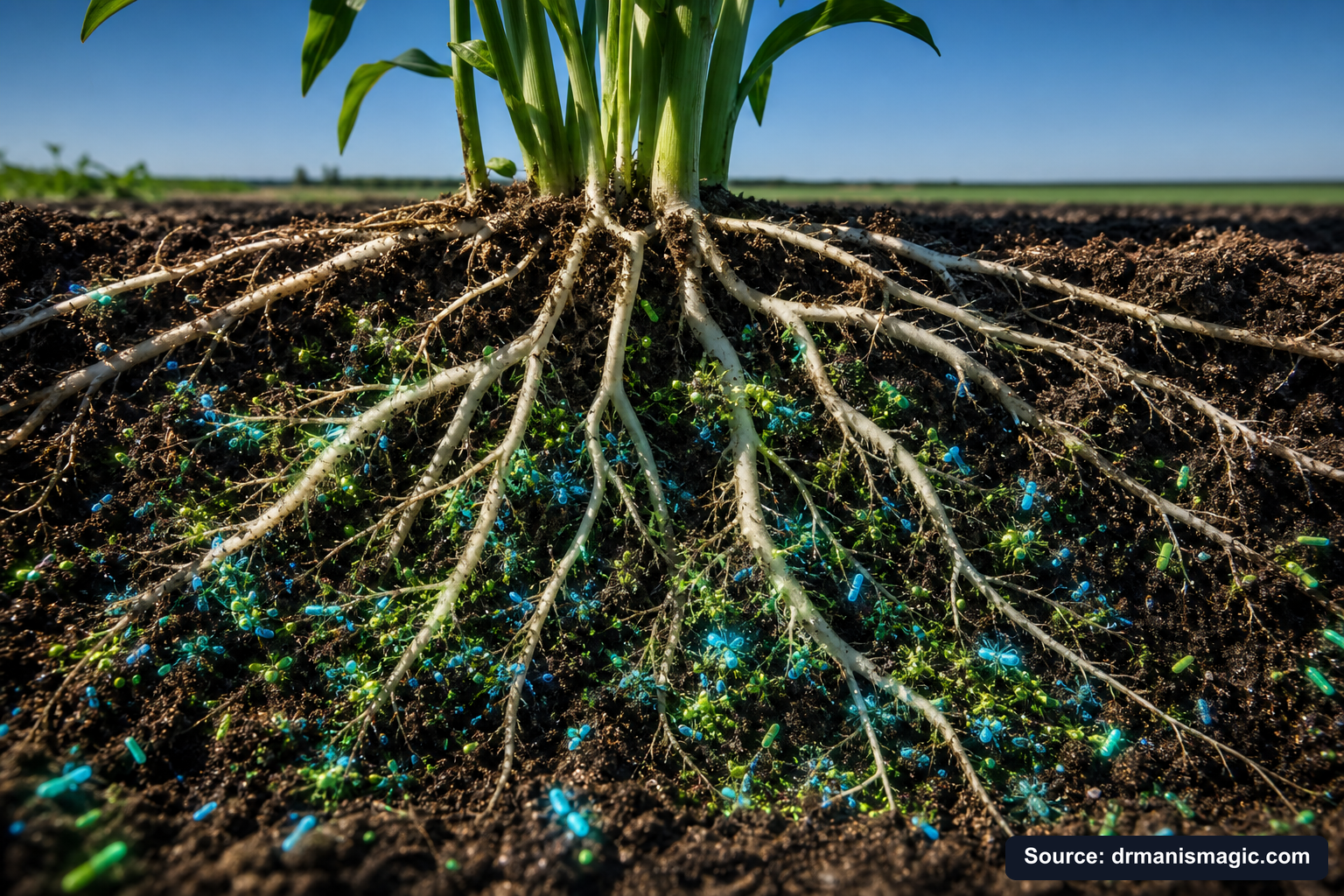
The zone right around the root — called the rhizosphere — is the most biologically active real estate on the planet. A single root tip can be surrounded by hundreds of millions of bacteria per gram of soil. The plant feeds them. They feed the plant. The whole system pulses with chemical signals that we are only beginning to decode.
When you grow a plant in sterile potting mix with no microbial life, you have placed it in sensory isolation. The root is releasing signals and getting nothing back. No mycorrhizal threads extending outward. No bacteria converting locked-up minerals. No protozoa cycling nutrients at the tip. The plant is alive, but it is alone. And alone plants struggle.
After growing over 250,000 trees at the US Citrus Nursery in South Texas, Dr. Mani Skaria saw this play out in tree after tree. The plants in living soil — soil with a full microbial community — simply outperformed everything else. Faster root growth. Deeper green color. More fruit. More disease resistance. The biology was doing the work that no bottle of salt fertilizer could replicate.
What Are Mycorrhizal Fungi and Why Do Your Roots Need Them?
Quick Answer: Mycorrhizal fungi attach to plant roots and extend into soil like an extra root system, sometimes reaching 50 to 100 times farther than the root itself. They deliver phosphorus, water, and minerals to the plant in exchange for sugars. They also produce a sticky protein called glomalin that binds soil particles together, improving drainage and aeration.
Pull a weed out of healthy soil sometime. Look at the white fuzz clinging to the root hairs. That is mycorrhizae. That is why the weed grew so fast and was so hard to kill.
Mycorrhizal fungi are the original root extension system. They thread through soil in networks thinner than a human hair, reaching into pockets and crevices that roots can never physically access. When they find a mineral or a water source, they pipe it back to the root. The plant gets phosphorus, zinc, copper, and water from places it could never reach on its own.
In return, the plant sends sugars down through the root into the fungal network. It is a fair trade that has been running on autopilot for 450 million years.
Mycorrhizal fungi also produce a glue-like protein called glomalin. This protein binds soil particles into clumps called aggregates. Those clumps create the air pockets and water channels that roots need to breathe. Healthy mycorrhizal soil has structure. Sterile soil collapses into a dense, airless slab. That is exactly what happens to most store-bought potting mixes within six to twelve months — the biology is gone, the structure collapses, and the roots suffocate.
See also: Why Most Potting Mix Collapses Within 6-12 Months
Are All Nematodes Bad for Plants?
Quick Answer: No. Harmful nematodes attack roots and cause serious damage. But beneficial nematodes eat bacteria, fungi, and pest insects in the soil. They release nutrients near roots and help suppress the bad nematodes. A healthy soil food web keeps the balance — predatory nematodes in check, beneficial ones thriving.
Nematodes have a bad reputation. Mention them to a grower and the first response is usually a grimace. Root-knot nematodes cause real damage — swollen roots, stunted plants, the whole nightmare. That part is true.
But there are thousands of nematode species. Most of them are not attacking your roots. They are grazing on bacteria and fungi. They are hunting down pest insects in the soil. They are cycling nutrients and releasing them right at the root zone. In a healthy soil food web, beneficial nematodes are some of the most important nutrient delivery agents you have.
The problem is that when you strip the biology from soil — through fumigants, broad-spectrum pesticides, or salt overload — you knock out the beneficial nematodes first. The harmful ones, which are tougher, survive. And now they have no competition. That is when root-knot problems explode.
This is the pattern we see over and over. Growers try to kill the bad guys and end up eliminating the good ones. The solution is not more chemicals. The solution is restoring the full biological community so the balance regulates itself — the way it has always done in nature.
You Never Had a Brown Thumb.
You were handed the wrong tools. This free guide hands you the right ones.
You watered it. You fed it. It died anyway.
It was never you. It was the dirt, the salt food, and the bad advice.
This guide shows you what really went wrong, and how to fix it for good.
- Why your plants really died, and why it was never your fault
- The salt hiding in your plant food that quietly burns the roots
- The hidden killer in almost every bag of store soil
- The tiny helpers that grow a whole forest for free
- The rescue trick that brings a half dead plant back to life

What Kills the Soil Food Web in Home Gardens and Pots?
Quick Answer: Salt-based synthetic fertilizers, synthetic herbicides like glyphosate, broad-spectrum pesticides, synthetic fungicides, and sterile potting mixes all strip or suppress beneficial soil biology. Each application does incremental damage. Over months and years, the soil goes biologically dead — and plants respond with declining health, root rot, and disease pressure.
Here is the part that nobody at the big box store will tell you.
Every bag of salt-based synthetic fertilizer is a trade. You get a short burst of green. Your plant looks happy for a few weeks. But the salt in that fertilizer damages the very microbes that were doing the long-term nutrient work. The bacteria dry out. The mycorrhizal threads shrink back. The protozoa population crashes. The food web frays.
Then the plant needs more fertilizer to compensate for what the biology used to provide for free. So you buy more. The soil gets saltier. More biology dies. The cycle continues. It is not an accident. It is a business model.
Synthetic fungicides are just as damaging in a different way. They do not distinguish between the Phytophthora pathogen destroying your roots and the mycorrhizal fungus protecting them. They kill both. Every application of broad-spectrum anti-fungal product sets back the fungal community your plant depends on.
See also: The Hidden Reason Synthetic Fertilizers Cause Root Rot
And then there is potting mix. Most commercial potting mixes start sterile — no beneficial biology at all. They are built from pine bark, peat, and sawdust. Those organic materials break down over time. As they decompose, they compact. They steal oxygen from roots. They create the wet, airless environment where root rot thrives. Within six to twelve months, a plant in standard potting mix is fighting two battles: no biology and no structure. It is a setup for failure.
| Input or Practice | How It Damages Soil Biology | Long-Term Result | Better Alternative |
|---|---|---|---|
| Salt-based synthetic fertilizer | High salt concentration kills beneficial bacteria and impairs mycorrhizae | Biology collapses; plant becomes dependent on chemical inputs | Organic slow-release fertilizer with no synthetic salts |
| Synthetic herbicide (glyphosate) | Disrupts microbial communities; chelates minerals away from roots | Reduced diversity; nutrient lockup; disease vulnerability | Mechanical control; targeted organic options |
| Broad-spectrum pesticide | Non-selective toxicity wipes out beneficial bacteria and insects | Imbalanced biology; pest resurgence; weakened root zone | Organic pest control; restore biology after any application |
| Synthetic anti-fungal | Kills mycorrhizal fungi alongside pathogens | Loss of soil structure; phosphorus lockup; drought stress | Live microbial inoculants with fungal diversity to restore balance |
| Standard sterile potting mix | Starts with no biology; organic matter decomposes and compacts | Root rot; oxygen deprivation; structural collapse within months | Mineral-based soil that does not decompose; add live microbials |
Do Microbial Inoculant Products Actually Work?
Quick Answer: Most do not — not because the science is wrong, but because most products deliver dead or dying microbes. Dried powders rarely reactivate. Liquid products from compost often go anaerobic and rotten before they reach you. The key is genuinely live, stabilized microbes from a full-spectrum source, not lab-grown monocultures dried into powder and put in a bag.
Walk the garden aisle of any big box store. You will see shelf after shelf of microbial products. Bags of mycorrhizal powder. Bottles of "beneficial bacteria." Tabs of "root stimulant." The claims are exciting. The results, in most cases, are disappointing. Here is why.
Most commercial microbial products are made in one of a handful of large factories. Scientists culture specific bacterial or fungal species in giant vats. Then the organisms are dried into a powder — the hope being that spores will reactivate when water is added. We have tested dozens of batches at US Citrus Nursery. The trees did not respond. The plants showed no measurable difference. The dried microbes simply did not perform.
The second category is liquid products made from compost or earthworm castings — what people call compost tea. When it is fresh, within the first twenty-four hours, it is genuinely powerful. Gardeners who make their own fresh compost tea see real results. But by the time a bottled version has been manufactured, shipped, and sits on a shelf, the microbes inside have gone anaerobic. They are dying. The bottle may fizz when you open it — that is the gas from fermentation, the sign of a dying microbial community. The smell tells the whole story. If it stinks, the biology is gone.
There is a third category nobody talks about: lactobacillus-based products. Yes, like yogurt bacteria. They are easy to grow and they stay alive. But they overtake and crowd out the beneficial microbes your soil actually needs. Lactobacillus belongs in your gut, not your garden.
Live vs. Dead: The Microbial Product Truth Table
| Product Type | Viability at Application | Spectrum of Organisms | Odor Signal | Real-World Result |
|---|---|---|---|---|
| Dried powder (lab-grown) | Very low — spores rarely reactivate in soil | Narrow — a few specific species | Low odor | Little to no measurable plant response in our testing |
| Dried powder rehydrated into liquid | Very low — same problem, different form | Narrow | Low odor | Same weak results |
| Compost tea (fresh, under 24 hours) | Moderate to high — if actively aerated | Broad but variable | Earthy — good sign | Strong results — but requires your own compost setup |
| Bottled compost tea (old) | Low — anaerobic by the time it ships | Partial — many organisms dead | Strong, rotten stench | Some humic/fulvic acid benefit but biology is largely gone |
| Lactobacillus-based products | High — stays alive easily | Narrow — one dominant species | Sour smell | Crowds out beneficial microbes — net negative for soil biology |
| Plant Super Boost (stabilized, full-spectrum) | High — stabilized by all-natural method, visibly alive under microscope | Full spectrum: 2,000+ bacteria species, 400-500 fungi including mycorrhizae, plus protozoa and nematodes | Earthy — smells like healthy soil | Consistent positive plant response across 250,000+ trees tested at US Citrus Nursery |
The difference with Plant Super Boost comes down to one thing: how the microbes are kept alive. Dr. Mani partnered with a world-renowned compost expert — a man who had advised farming operations for royal families and governments before being pushed out by big chemical interests — to develop a proprietary, all-natural stabilization method. The microbes are harvested from living compost, not grown in a factory lab. They are stabilized without going anaerobic. You can take a drop of Plant Super Boost, put it under a microscope, and watch the microbes move. That is what alive looks like. Zero synthetic chemicals. Zero PFAS. Zero biosludge. Zero synthetic salts. Made right here in South Texas.
How Do You Rebuild Dead or Damaged Soil Biology?
Quick Answer: Rebuilding soil biology takes more than one application of inoculant. You need to remove the stressors killing the biology, restore physical structure so microbes have somewhere to live, add organic carbon as their food source, keep living roots in the ground, and reintroduce a full-spectrum microbial community on a consistent monthly schedule. Expect real improvement in weeks, lasting transformation in months.
This is the part most soil health content skips. They say "add microbes" and leave it there. But pouring microbes into damaged soil is like releasing fish into a pool of bleach. If the conditions are wrong, the biology cannot survive long enough to do its work.
Here is a practical recovery sequence built on what we have learned across decades of growing:
- Stop the damage first. If you are using salt-based synthetic fertilizers, herbicides, or broad-spectrum fungicides, that is the first thing to change. You cannot rebuild biology while continuing to destroy it. Every synthetic salt application is a step backward.
- Fix the physical structure. If you are growing in standard potting mix that has compacted into a dense slab, no microbe can thrive in that environment. Roots cannot breathe. Water cannot drain. Switch to a mineral-based soil that holds structure permanently — one that does not decompose, compact, or steal oxygen. The Super Soil formula developed at US Citrus Nursery uses Rio Grande Valley sandy loam — silica-rich mineral soil that does not break down — blended with coco coir, rice hulls, and biochar for aeration and microbial habitat.
- Feed the biology with organic carbon. Microbes eat organic matter. Add compost, mulch, or organic fertilizer to give them a food source. Compost also introduces some native biology from your local environment.
- Keep living roots in the ground. Roots release exudates that feed microbes. Bare soil is biologically quiet soil. If you are between plantings, consider a cover crop. Roots in the ground keep the microbial community active and fed.
- Reintroduce a full-spectrum microbial community. Apply a live, stabilized microbial inoculant monthly. Not a dried powder. Not an old smelly liquid. Genuinely live biology — bacteria, fungi, mycorrhizae, protozoa, and nematodes — in a stable form that can actually colonize your root zone. This is not a one-time fix. Ongoing monthly applications keep the population dense and competitive against the pathogens that are also multiplying.
- Feed the plant with organic fertilizer. Salt-free, slow-release organic nutrients feed the plant without burning the microbes you just worked to restore. The Crab, Kelp and Amino Acids formula provides nitrogen, phosphorus, potassium, trace minerals, and biostimulants in a form that works with soil biology — not against it.
- Watch the plant respond and stay consistent. You will see early signs within a few weeks — deeper color, better root density, stronger new growth. But full biological recovery is a months-long process. Soils that have been chemically damaged for years do not turn around overnight. Stay the course. The biology compounds over time.
This is exactly the framework behind the Three Plant Pillars that Dr. Mani Skaria developed after decades of growing citrus at US Citrus Nursery. Mineral-based soil for structure. Live microbials for biology. Organic fertilizer for nutrition. Three pillars. One system. The same system the forest has always used — just in a form you can apply to any plant, anywhere. You can explore the complete system through the Three Plant Pillars bundle.

What Does This Ancient Partnership Mean for You Right Now?
Here is the honest truth about time and plants.
You can get money back. You cannot get time back. The best time to start working with soil biology was years ago. The second best time is today. We hear from growers every week — people who have spent years fighting their plants, buying product after product, watching trees stall and decline — who finally turned the corner when they stopped fighting nature and started working with it.
The number one thing people tell Dr. Mani they want? To see fruit on a tree they planted with their own hands. To harvest something they grew. To taste it, smell it, feel the weight of it. That desire is ancient and real. It is wired into us. And it is absolutely within reach — but only if the foundation is right. Go the old way, with salt fertilizers and sterile soil and no biology, and you will spend months watching things stall. Then years watching things slide backward. Because you cannot grow against the grain of nature. You can only grow with it.
The forest figured that out 450 million years ago. It is time to bring that intelligence into your backyard.
If you want to see what living soil biology can do for your plants — trees, flowers, vegetables, lawn, houseplants, all of it — start with the Free Plant Care Field Guide from Dr. Mani's Magic. It walks you through the Three Plant Pillars in plain language, with no guesswork and no fluff. Just the system that has worked across 250,000 trees and counting — brought to your door, made in the USA, backed by a 30-day money-back guarantee.
The ancient partnership is waiting. Your roots are ready. Give them their army back.
Frequently Asked Questions
The partnership between roots and microbes is the oldest secret in gardening. Most people have never heard of it. Once you understand it, you will never look at your soil the same way again. These questions cut straight to what matters most for your plants right now.
What is the ancient partnership between roots and microbes?
About 450 million years ago, plants and fungi teamed up to survive on dry land. Roots release sugars into the soil. Microbes like bacteria and fungi eat those sugars. In return, they unlock nutrients and water for the plant. This two-way deal is still running in every healthy plant today. It is not a trick. It is how nature built every forest on earth.
Why are the microbes in my soil so important for plant growth?
Microbes are the invisible workforce under your feet. They break down raw materials and turn them into food your roots can actually use. They fight off diseases. They loosen the soil so oxygen can reach the roots. Without them, your plant is basically a soldier with no army. That is why plants in dead, chemical-soaked soil always seem to struggle no matter what you pour on them.
Do salt-based fertilizers really kill soil microbes?
Yes. Salt-based fertilizers are like a bomb going off underground. They give your plant a quick green-up, but they wipe out the beneficial bacteria and fungi living in the root zone. Once those microbes are gone, your plant becomes dependent on more and more fertilizer just to survive. Dr. Mani saw this cycle play out for decades before he cracked the code with the Three Plant Pillars.
What are the Three Plant Pillars and how do they connect to this ancient partnership?
The Three Plant Pillars are mineral-based soil, live microbials, and organic fertilizer. Together they copy what the forest does naturally. Mineral soil gives roots room to breathe and grow deep. Live microbes rebuild the underground army your plant was born to work with. Organic fertilizer feeds both the plant and the microbes slowly, the way nature intended. Dr. Mani tested this system on over 250,000 trees at US Citrus Nursery before bringing it to you.
How do I know if the microbial product I buy is actually alive?
Most bottled microbial products on store shelves are already dead or rotting by the time you open them. A dead product does nothing for your soil. Dr. Mani's Plant Super Boost uses a special stabilization method to keep the bacteria, fungi, and mycorrhizae alive in the bottle. When it arrives at your door, those microbes are ready to go to work. It even smells like clean earth instead of something gone bad.
Can this ancient root-microbe partnership work in containers and pots, not just in the ground?
Absolutely. The root-microbe partnership works wherever roots live. The problem is that most potting mixes are made from pine bark and sawdust that break down fast, compact, and choke roots. Dr. Mani's Super Soil uses mineral-based sandy loam from South Texas. It does not decompose. It stays open and airy so microbes can thrive and roots can breathe, whether you are growing in a container on a patio or in a raised bed out back.
How long does it take to see results when I start feeding the root-microbe partnership the right way?
Most people start seeing a real difference within 30 days. Leaves look greener. New growth pushes out faster. Roots get stronger underground even before you notice it above the soil. The longer you stay with the Three Plant Pillars system, the better it gets. Your soil builds real, lasting health instead of the fake quick-green you get from synthetic fertilizers that fade and leave damage behind.
About the Author
Ron Skaria, MD
Ron Skaria, MD, is the co-founder of Dr. Mani's Magic and the son of Dr. Mani. He trained as a medical doctor at Baylor College of Medicine, did his residency at UT Health Science Center - San Antonio and fellowship training at Texas Tech University. He now works full time on the family farm at US Citrus and US Citrus Nursery in Hargill, Texas, building Dr. Mani's Magic alongside his dad. He wrote the Brown Thumb Field Guide to put his father's 48 years of plant science into plain words any gardener can use. His belief is simple. You never had a brown thumb. You just never had the right help.


