


Why Clean Nutrition Is Easier on Plants Than Salt-Based Fertilizers | Dr. Mani's Magic
Why Clean Nutrition Is Easier on Plants: A Root-First Guide to Gentler Fertility
Picture this. You just spent a Saturday afternoon feeding your plants. You measured carefully. You followed the bag instructions. You watered it all in. You stood back, wiped your hands, and felt good about what you did.
Then, two weeks later, the leaves start to curl. The tips turn brown. The grass looks scorched. Your container tree looks thirsty — even though the soil is wet. You water more. Nothing helps. You add more fertilizer. It gets worse. You start Googling at midnight, wading through forums full of contradicting opinions, wondering if you have a brown thumb. You don't. You were just never told the truth about what that bag of fertilizer actually does inside your soil.
Here's what most people never hear: the problem isn't that you fed your plants too little. The problem is that what you fed them was working against them — burning the very roots and microbes that were supposed to be doing the feeding. After growing over 250,000 trees at our South Texas nursery, we learned something that changed everything. Plants don't just drink nutrients from a bag. They rely on a living underground system — roots, oxygen, water, and billions of microbes — to turn raw ingredients into something they can actually use. When you understand that system, clean nutrition stops being a buzzword. It becomes the only thing that makes sense.
Key Takeaways
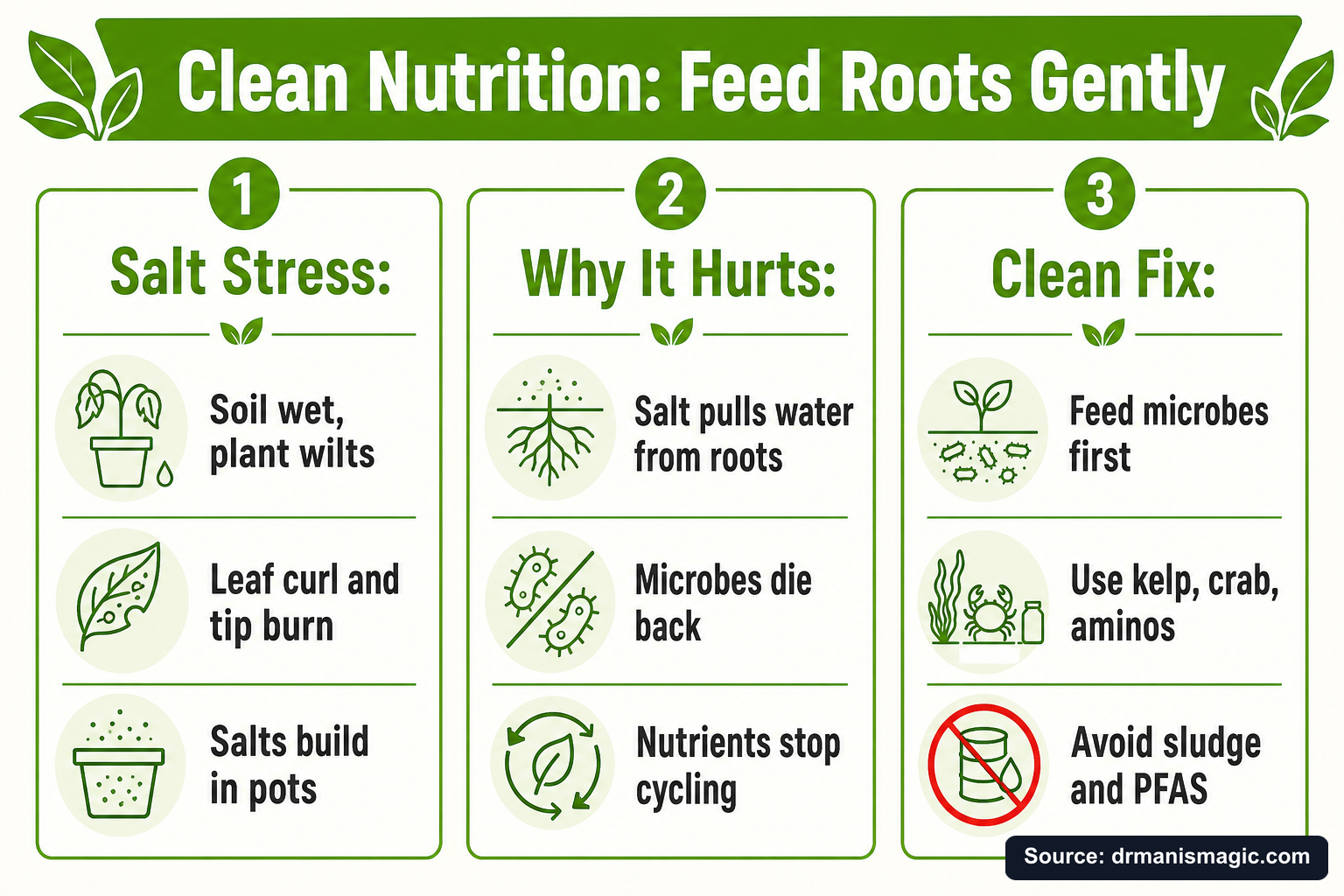
- High-salt synthetic fertilizers can make plants look thirsty even when soil is soaking wet — a condition called osmotic stress or physiological drought.
- Salt kills the beneficial soil microbes that convert nutrients into plant-ready forms, creating a cycle of dependency and decline.
- Clean nutrition feeds the microbes first. The microbes then feed the plant — slowly, steadily, and safely.
- Organic inputs like crab shells (chitin), kelp, and amino acids work with soil biology instead of burning it.
- Some fertilizers — both synthetic and certain organic brands — contain biosludge, sewage sludge, and PFAS "forever chemicals" that can contaminate your lawn, garden, and food-growing soil.
- The Three Plant Pillars — mineral-based soil, live microbes, and organic fertilizer — form the root-first foundation every plant needs, from lawns to fruit trees to houseplants.
- Clean nutrition is not just gentler. It is smarter, safer, and more effective over time than the salt-based shortcut most gardeners were sold.
What Does "Clean Nutrition" Actually Mean for Plants?
Quick Answer: Clean nutrition means feeding your plants with inputs that support the soil-root-microbe system rather than bypassing or burning it. It is low in soluble salts, free of sewage sludge and PFAS contaminants, and delivers nutrients slowly in forms that biology can handle — without scorching roots or wiping out beneficial microbes.
Clean nutrition is not just a marketing word. It describes a real difference in how nutrients get to your plant's roots.
Think of it like this. You could hand a hungry child a fistful of raw, unprocessed ingredients — hard seeds, dry powder, chemical compounds. Or you could give them a warm meal their body already knows how to digest. Both contain "nutrition." But only one actually nourishes.
Conventional synthetic fertilizers are the raw fistful. They dissolve fast, flood the soil with salt, and overwhelm the delicate root system. Clean nutrition — inputs like crab shells, kelp, amino acids, and biological slow-release compounds — is the warm meal. It matches how plants actually eat in nature.
University extension programs across the country, including guidance from Penn State Extension, consistently describe healthy soil as a living system where microbes do the real nutrient-cycling work. Clean inputs support that system. Salt-heavy inputs destroy it.
The result? With clean nutrition, your plant gets fed steadily, safely, and completely. With salt-based inputs, your plant gets a quick jolt — and then a slow unraveling that takes months before you even notice it.
See also: Why Most Fertilizers Are Actually Salt in Disguise
Why Do High-Salt Fertilizers Make Plants Look Thirsty Even When Soil Is Wet?
Quick Answer: Salt in fertilizer raises the osmotic pressure around the roots. This pulls water out of root cells instead of letting it flow in. The plant wilts and scorches even when the soil is moist. Scientists call this osmotic stress or physiological drought — and it is one of the most common causes of unexplained plant decline.
This is one of the most confusing things gardeners ever face. The soil is wet. But the plant looks parched. The leaves curl. The tips burn brown. You water more. Nothing changes.
What is happening inside the root zone is actually simple, once you see it.
Water always moves from areas of low salt to areas of high salt. That is basic osmosis — the same force that makes a cucumber shrivel in a salty brine. When you pour high-salt fertilizer into your soil, the salt concentration around the roots spikes. Suddenly, the water that should be flowing into the root is being pulled out of it instead.
The plant is literally losing moisture to the soil — even when the soil is wet. This is called osmotic stress, and it causes the same symptoms as drought: wilting, leaf curl, tip burn, and stunted growth. Researchers at University of Maryland Extension describe this exact mechanism as "fertilizer burn" — one of the most common causes of plant injury from over-application of soluble nutrients.
In containers, it gets worse. There is no deep soil for salts to leach down into. They build up. Layer by layer. Application by application. Until a white crust forms on the soil surface and the roots are living in a salt bath they cannot escape.
Clean nutrition — delivered through slow-release, low-salt organic inputs — never triggers this response. There is no sudden salt spike. The osmotic balance around the roots stays stable. Water flows in freely. The plant drinks easily. That is not a small thing. That is the difference between a plant that thrives and one that quietly suffers.
See also: The Osmotic Shock Your Plants Feel From Synthetic Nutrients
How Does Salt in Fertilizer Kill the Microbes Your Plant Needs?
Quick Answer: Soil microbes — the bacteria and fungi that convert nutrients into plant-usable forms — are just as vulnerable to salt as plant roots are. High-salt fertilizers can wipe out entire communities of beneficial microbes with a single application, stripping the soil of its natural nutrient-cycling ability and leaving your plant dependent on the next bag of chemicals to survive.
Your soil is not just dirt. It is a living city, packed with billions of microorganisms — bacteria, fungi, and mycorrhizae — that do something remarkable. They eat organic matter and transform it into nutrients your plant can absorb. They protect roots from disease. They build the soil structure that lets oxygen and water flow freely. They are the engine behind everything green and growing.
Salt kills them.
This is not a metaphor. When high-salt fertilizers flood the root zone, they cause the same osmotic stress in microbial cells that they cause in root cells. The microbial population collapses. The soil goes quiet. The living ecosystem that was doing the nutrient work is gone.
And here is the trap that nobody tells you about. Once the microbes are gone, the plant cannot process organic nutrients anymore. It becomes totally dependent on soluble synthetic inputs to survive. So you keep buying bags. The plant keeps declining. The company keeps profiting. The cycle continues — and you think it is your fault.
It is not your fault. The deck was stacked against you from the start.
Dr. Mani Skaria, a Professor Emeritus of Plant Pathology who spent over 40 years at the Texas A&M Citrus Center, watched this cycle play out on thousands of trees. His response was to build the Three Plant Pillars — a root-first system that puts live microbes back at the center of plant nutrition, where they belong.
See also: The Hidden Reason Synthetic Fertilizers Cause Root Rot
How Does Organic Fertilizer Actually Feed Plants Through the Microbes?
Quick Answer: Organic fertilizer does not go straight from the bag to the plant. First, soil microbes eat it and break it down. Then those microbes release nutrients directly into the root zone in easy-to-absorb forms. When the microbes die, they release even more nutrition. The whole process acts like a natural, built-in time-release system — steady, safe, and self-sustaining.
This is the most important thing to understand about clean nutrition. And almost nobody explains it clearly. So let us walk through it step by step.
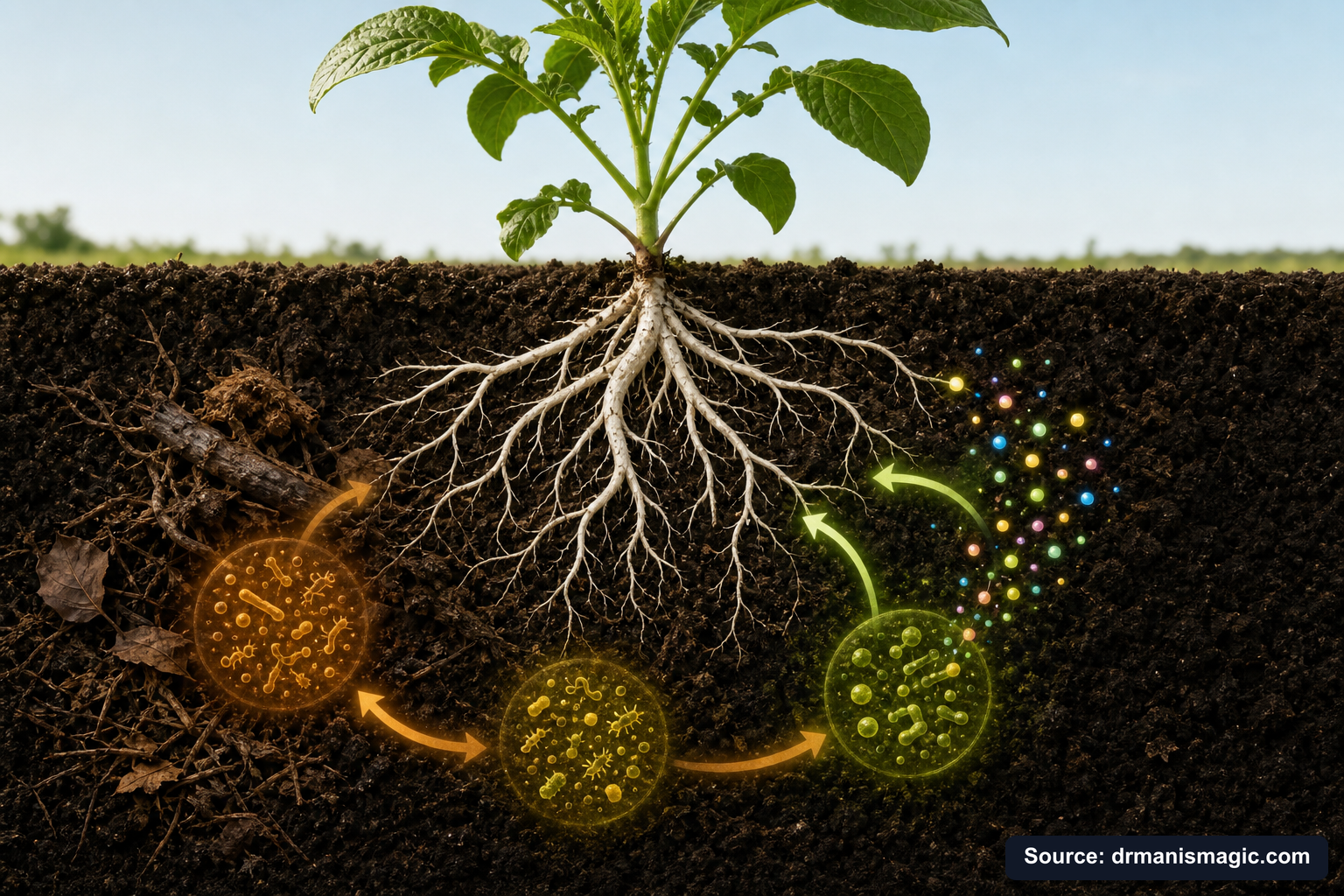
When you sprinkle organic fertilizer on your soil, the microbes find it first. Bacteria and fungi treat it like a meal. They digest it. In doing so, they break the nutrients down into simpler, smaller forms — amino acids, mineral ions, plant hormones — that roots can absorb directly through their cell walls.
The plant gets fed. Steadily. Without a flood. Without a spike. Without salt.
But here is the part that most people miss. When those microbes eventually die — and microbes have short life cycles — their bodies become fertilizer too. All the nutrients locked inside their tiny cells release straight into the root zone. Your plant gets a second feeding. Then a third. Then a fourth. One application of good organic fertilizer keeps working for weeks, sometimes months, long after you have moved on to other things.
This is not a trick. This is exactly how nutrient cycling works in every forest, prairie, and healthy garden on earth. Plants and microbes evolved together over millions of years. They speak the same biological language. Clean nutrition simply respects that relationship instead of bulldozing it.
The contrast with synthetic fertilizer could not be sharper. Synthetic inputs skip the microbes entirely. They flood the soil with immediately soluble salt-based compounds that roots can technically absorb — but at a cost. The salt burns root tips. It collapses microbial communities. And the moment you stop applying it, there is nothing left in the soil to carry on the work. The system has no memory. No momentum. No life.
What Makes Crab Shells, Kelp, and Amino Acids Different From Regular Fertilizer?
Quick Answer: Crab shells deliver chitin, calcium, and magnesium that trigger plant immune responses and feed beneficial microbes. Kelp provides natural growth hormones, trace minerals, and carbohydrates that stimulate root development. Amino acids supply nitrogen in a form the plant can absorb directly, bypassing the most energy-intensive steps. Together they nourish, protect, and stimulate — without a single grain of synthetic salt.
Let us go inside each ingredient and see what it actually does.
Crab Shells and Chitin: Nature's Defense Activator
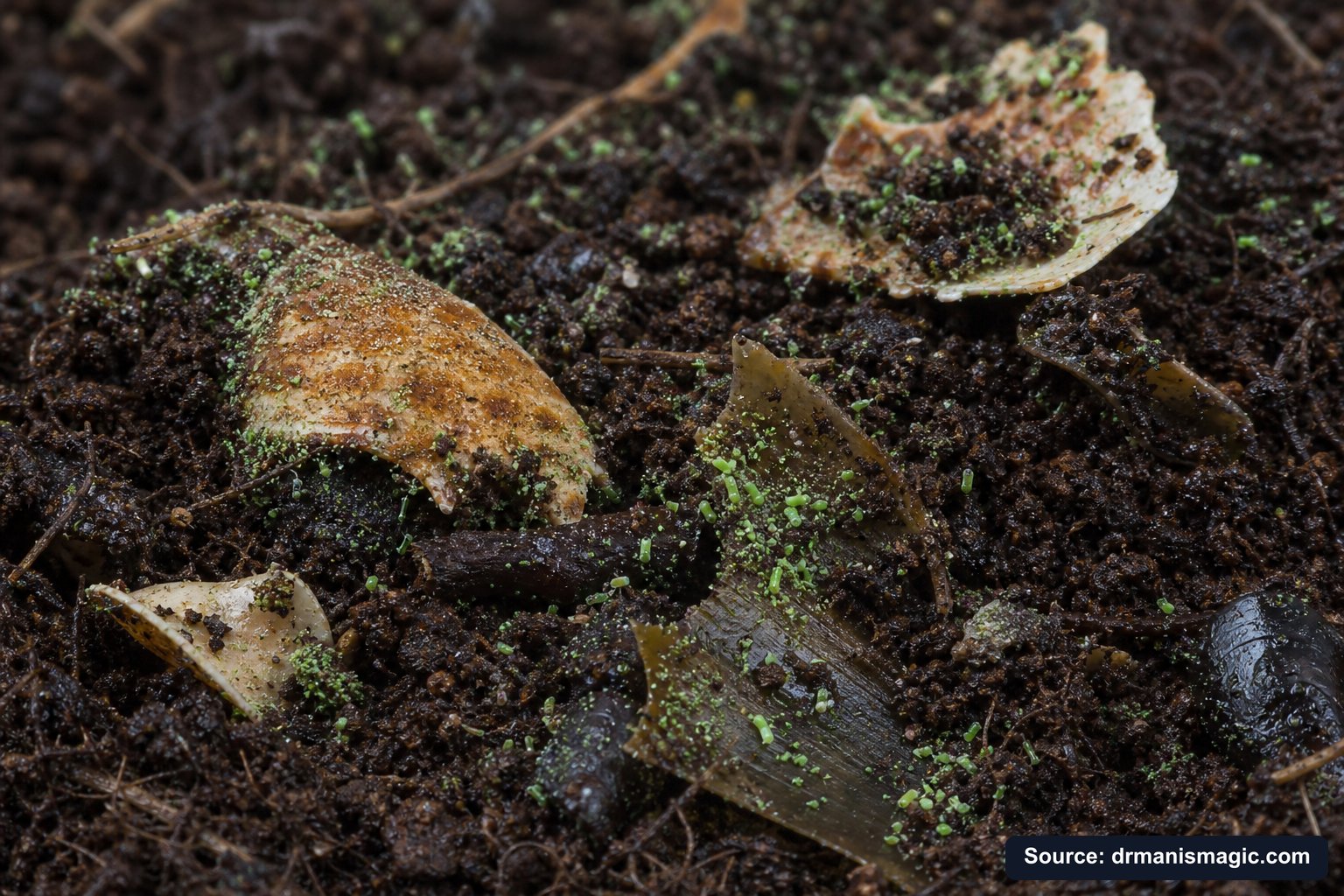
Crab shells are loaded with a compound called chitin. You pronounce it KY-tin. Chitin is remarkable. When it breaks down in soil, it feeds a specific group of beneficial microbes that produce chitinase — an enzyme that attacks the outer shells of harmful insects and fungal pathogens. In plain terms: the crab shell feeds the microbes, and the microbes make your plant harder to kill.
Chitin also releases calcium and magnesium as it breaks down. Calcium builds strong cell walls. Magnesium is the central atom inside every chlorophyll molecule — without it, your plant cannot photosynthesize. These are not bonus nutrients. They are structural essentials.
Kelp: Growth Hormones From the Ocean
Cold-processed kelp is one of the most nutrient-dense substances in the natural world. It carries natural plant growth hormones called auxins and cytokinins. These hormones signal roots to grow deeper and faster. They stimulate cell division. They help flowers set and fruit develop.
Kelp also delivers a broad spectrum of trace minerals that land-based soils often lack. It contains carbohydrates that directly feed soil microbes. And because it is cold-processed — not heat-extracted — those living compounds remain intact and active when they hit your soil.
Amino Acids: Nitrogen the Plant Already Knows
Nitrogen is the nutrient plants need most. But not all nitrogen is the same. Synthetic nitrogen comes as ammonium nitrate or urea — simple, soluble, salty compounds that shock the soil. Amino acid nitrogen is different. Amino acids are the building blocks of proteins. Plants can absorb certain amino acids directly through root cells without converting them first. This skips the most energy-intensive steps in the nutrient uptake process and delivers nitrogen in a form the plant already recognizes.
Amino acids also feed beneficial microbes, support enzyme activation, and contribute to the building of chlorophyll, enzymes, and structural proteins throughout the plant. They are gentle, complete, and biologically familiar.
These three ingredients — crab, kelp, and amino acids — form the heart of Crab, Kelp & Amino Acids, the organic slow-release fertilizer Dr. Mani developed after decades of testing at US Citrus Nursery. It contains zero synthetic salts, zero biosludge, and zero PFAS — just clean, biologically active nutrition at a 7-4-4 NPK ratio that works for citrus, lawns, gardens, houseplants, fruit trees, and flowers alike.
Volcanic Ash: Trace Minerals From the Earth's Core
Volcanic ash rounds out the formula with silica and a wide array of trace micronutrients. Silica strengthens plant cell walls, making stems sturdier and leaves more resilient. It boosts drought tolerance and helps plants resist pest pressure. You rarely find it in conventional fertilizers. In nature, volcanic soil is some of the most fertile on earth — and this is a big reason why.
What Is the PFAS and Biosludge Risk Hiding in Some Fertilizers?
Quick Answer: Some fertilizers — both synthetic and certain "organic" brands — use treated municipal waste (sewage sludge) as a filler. This waste can carry PFAS, known as "forever chemicals," that accumulate in soil, plants, and groundwater. They do not break down. They are not safe for food-growing soil, lawns where children play, or gardens where pets roam. Zero biosludge, zero PFAS inputs are the only responsible choice.
Here is something most fertilizer companies hope you never look up.
Sewage sludge — sometimes labeled "biosolids" — is treated municipal waste. In plain English: processed human waste from water treatment plants. It is used as a filler in some fertilizers because it is cheap and nitrogen-rich. Some products that carry the word "organic" on the label still contain it.
The problem is what comes with it. PFAS — per- and polyfluoroalkyl substances — are industrial chemicals used in nonstick coatings, firefighting foam, food packaging, and hundreds of other products. They end up in the human waste stream. They do not break down. They accumulate in soil. They can move into plant tissue. They can leach into groundwater. Scientists call them "forever chemicals" because that is exactly what they are.
If you are growing vegetables, herbs, or fruit trees, the idea of PFAS in your fertilizer should stop you cold. If your children or pets are on your lawn, the idea should do the same.
This is not a fringe concern. It is a documented issue that affects real home gardens and real families across the country.
Dr. Mani's Magic Crab, Kelp & Amino Acids contains none of this. No biosludge. No municipal waste. No PFAS. No synthetic salt. No plastic-coated slow-release pellets that leach microplastics into your soil. Just clean, sourced, USA-made ingredients you can feel good about putting on your food garden, your lawn, and around your family.
That is not a marketing claim. It is a commitment that comes from 30 years of growing food for real people in South Texas — including our own families.
You Never Had a Brown Thumb.
You were handed the wrong tools. This free guide hands you the right ones.
You watered it. You fed it. It died anyway.
It was never you. It was the dirt, the salt food, and the bad advice.
This guide shows you what really went wrong, and how to fix it for good.
- Why your plants really died, and why it was never your fault
- The salt hiding in your plant food that quietly burns the roots
- The hidden killer in almost every bag of store soil
- The tiny helpers that grow a whole forest for free
- The rescue trick that brings a half dead plant back to life

How Does Root Health Determine Whether Nutrition Works at All?
Quick Answer: If the roots are damaged — from salt burn, compaction, overwatering, or disease — even the best fertilizer in the world cannot help. Roots need oxygen, water flow, and healthy soil structure to absorb anything. Nutrition only works when the root zone is alive and breathing. This is why root health always comes before fertilizer strategy.
Here is a hard truth that most fertilizer advice skips entirely.
It does not matter how much nutrition you apply if the roots cannot receive it. A root system under stress — from salt, from standing water, from compaction, from disease — is a closed door. The nutrients pile up at the threshold. The plant starves. You apply more. The door stays shut.
Root health depends on three things working together. Oxygen. Water movement. Microbial support. When any one of these fails, the whole system breaks down.
Compacted or waterlogged soil pushes oxygen out of the pore spaces. Roots need oxygen to breathe — yes, even though the leaves absorb carbon dioxide, the roots require oxygen for cellular respiration. Without it, they cannot generate the energy needed to absorb nutrients. They begin to die. And in low-oxygen, wet conditions, opportunistic pathogens like Phytophthora, Pythium, Fusarium, and Rhizoctonia move in. Root rot sets in. The plant declines fast.
This is why Pillar One of the Three Plant Pillars is mineral-based soil — not fertilizer, not microbes, but soil structure. Dr. Mani's Magic Super Soil is built on silica-rich sandy loam from the Rio Grande Valley. It does not compact. It does not decompose into root-choking sludge. It holds its structure permanently, maintaining the drainage and aeration that roots need to breathe and feed.
Only when the root zone is oxygenated, draining, and biologically active does clean nutrition get to do its job. You cannot fertilize your way out of a bad soil. But with the right soil, even modest nutrition produces dramatic results.
See also: How Salt-Based Feeding Quietly Destroys Root Systems
Clean Nutrition vs. Synthetic Fertilizer vs. Biosludge-Based Inputs: A Full Comparison
Quick Answer: Synthetic fertilizers are fast but salty and microbially destructive. Biosludge-based "organic" fertilizers can carry PFAS and contamination risk. Clean organic inputs — crab, kelp, amino acids — are slow, safe, biologically supportive, and free from contaminants. For edible gardens, lawns, containers, and trees, clean nutrition wins across every category that matters long-term.
| Category | Synthetic Fast-Release | Biosludge-Based "Organic" | Clean Organic (Crab, Kelp, Amino Acids) |
|---|---|---|---|
| Salt content / salt index | High — osmotic stress risk | Variable — often moderate to high | Low — root-friendly by design |
| Root burn risk | High, especially in containers | Moderate | Very low |
| Microbial impact | Kills beneficial microbes | Mixed — may support or harm | Feeds and supports microbes |
| Nutrient release pattern | Fast spike, then crash | Moderate, less predictable | Slow, steady, self-regulating |
| PFAS / forever chemical risk | Low (unless biosludge filler used) | High — sewage sludge source | Zero — clean sourced ingredients |
| Safe for edible gardens | Concern (residue, salt) | Serious concern (PFAS) | Yes — no contaminants |
| Safe for lawns with children/pets | Use with caution | Not recommended | Yes — family and pet safe |
| Container use | High salt accumulation risk | Moderate risk | Ideal — no accumulation issue |
| Long-term soil health | Degrades over time | May add contaminants | Improves with every application |
| Works for trees, lawns, flowers, gardens | Yes, short-term | Partial | Yes — broad spectrum |
How Can You Tell If Your Plant Has Salt Damage vs. Overwatering vs. True Root Rot?
Quick Answer: Salt damage shows up as brown tips, leaf scorch, and white crust on soil — even when the plant is watered well. Overwatering causes yellowing, soft stems, and soggy soil. True root rot from pathogens like Phytophthora or Pythium causes black, mushy, foul-smelling roots and rapid collapse. All three can look alike on the surface — but the cause and fix are completely different.
This is where so many gardeners go wrong. The symptoms look similar. The plant is struggling. But watering more makes salt damage worse. Adding fertilizer to rotted roots makes everything worse. You need to identify the real cause before you can fix it.
| Symptom | Salt / Fertilizer Burn | Overwatering Stress | Root Rot (Phytophthora / Pythium) |
|---|---|---|---|
| Leaf tips / edges | Brown, crispy, scorched | Yellow, then brown | Yellow to brown, widespread |
| Soil surface | White crust visible | Stays wet, may smell | Wet, compacted, foul odor |
| Stem / base | Firm, may look healthy | Soft near base | Dark, mushy at or below soil line |
| Root appearance | Tips brown, damaged | Pale, limp but intact | Black, slimy, easily pulled apart |
| Soil moisture at time of symptom | Normal or moist | Saturated | Saturated, low oxygen |
| Speed of decline | Gradual over weeks | Gradual to moderate | Rapid — can collapse in days |
| Fix | Flush soil, switch to clean nutrition | Improve drainage, reduce watering | Remove affected roots, improve soil structure, add live microbes |
A Simple Recovery Checklist If Your Plant Is Struggling
- Stop all synthetic fertilizer immediately. Let the soil rest. Flushing the container with clean water two to three times can help push accumulated salts down and out.
- Check drainage. If water sits on top or drains slowly, the soil structure may have collapsed. Consider repotting into a mineral-based soil that holds its structure permanently.
- Inspect the roots. Healthy roots are white or tan and firm. Brown tips indicate salt burn. Black, mushy roots indicate pathogen-driven root rot. Trim away dead material with clean scissors.
- Reintroduce live microbes. Drench the root zone with a live microbial solution — bacteria, fungi, and mycorrhizae — to rebuild the biological community the salt wiped out.
- Apply clean, low-salt organic nutrition. Once the root zone is stable and microbes are present, begin a gentle program of slow-release organic fertilizer at the recommended rate. Do not rush.
- Water properly — not on a schedule, but on need. Stick your finger two inches into the soil. If it is still moist, wait. Most plants are overwatered, not underwatered.
- Give it time. Root recovery is slower than leaf recovery. A plant that looked terrible three weeks ago can look completely different in six weeks when the root zone is healthy and feeding again.
Why Does Slow Release Match the Way Plants Actually Eat in Nature?
Quick Answer: In nature, plants never receive a sudden flood of dissolved nutrients. They receive a slow, continuous trickle from microbial activity, decomposing matter, and rainfall. Slow-release organic fertilizer mirrors this natural pace exactly. The plant takes what it needs, when it needs it — without the shock, without the burn, without the crash that follows a synthetic spike.
Think about a tree in an old-growth forest. Nobody fertilizes it. Nobody brings bags of ammonium nitrate. And yet it grows enormous, lives for centuries, and fruits every year with no help at all.
How?
The leaf litter falls. The fungi break it down. The bacteria fix nitrogen from the air. The roots pick up what they need. Slowly. Constantly. In perfect rhythm with the seasons.
That is the pace plants evolved to eat at. Not a flood. A trickle. A conversation between root and soil that never stops.
When you pour a water-soluble synthetic fertilizer into the pot, you are not starting a conversation. You are shouting. The roots are overwhelmed. The salt spikes. The microbes die. The plant absorbs what it can in a panic and then crashes when the spike passes. You see a burst of green, then a slow fade. And you think you need to feed again. So the cycle continues.
Slow-release organic nutrition — derived from crab shells, kelp, amino acids, and other biological sources — feeds at the pace the plant prefers. Microbes control the release rate. They speed up when the plant grows fast in warm weather. They slow down in cool weather when the plant is resting. The system is self-regulating. It cannot overfeed. It cannot burn. It simply works — the way nature designed it to.
This is true for your Meyer lemon tree in a container on the patio. It is true for your front lawn. It is true for your raised vegetable bed, your rose bushes, your indoor ficus, and your peach tree in the backyard. The biology is the same. The benefit is the same. The only thing that changes is the plant. The principle never does.
What Is the Three Plant Pillars System and Why Does It Matter for Every Plant You Own?
Quick Answer: The Three Plant Pillars — mineral-based soil, live microbes, and organic fertilizer — form a complete, root-first growing system developed and tested on over 250,000 trees at US Citrus Nursery in South Texas. Together they create the conditions every plant needs to thrive: oxygen for roots, biological support for nutrient cycling, and clean slow-release nutrition that works with the soil instead of against it.
Dr. Mani Skaria did not develop the Three Plant Pillars as a marketing concept. He developed them out of necessity.
For years, he watched trees struggle at his South Texas nursery — not from lack of care, but from the wrong inputs. Synthetic fertilizers that burned roots. Potting mixes that decomposed into oxygen-blocking sludge. Soil that compacted over time and starved roots of the air they needed. He tried what everyone else was using. It kept failing.
So he started from scratch. He asked one question: what does a plant actually need to thrive, from the ground up?
The answer was three things. And only three things.
Pillar One: Mineral-Based Soil. A permanent, non-decomposing soil structure that holds its shape, drains freely, and lets roots breathe. Not bark. Not sawdust. Not pine fines. Silica-rich sandy loam that does not compact, does not rob oxygen, and does not need to be replaced every year.
Pillar Two: Live Microbes. The biological engine that converts organic matter into plant-available nutrients, protects roots from pathogens, and maintains the living ecosystem that makes everything else work. Without microbes, there is no nutrient cycling. Without nutrient cycling, there is no plant health — just chemical dependency.
Pillar Three: Organic Fertilizer and Biostimulants. Clean, slow-release nutrition derived from biological sources. No synthetic salts. No biosludge. No PFAS. Just the full spectrum of macronutrients, micronutrients, amino acids, hormones, and trace minerals that plants recognize and can use — delivered at the pace they prefer.
When all three pillars are in place, the results are not subtle. Roots grow deeper and faster. Leaves are darker and richer. Flowers bloom more fully. Fruit sets and ripens with better flavor. Plants that once struggled through every season become — in Dr. Mani's words — practically bulletproof.
We tested this system on 250,000 citrus trees. We have seen it work on lawns, vegetable gardens, houseplants, tropical trees, rose beds, and backyard orchards. The biology does not care what species you are growing. It only cares whether the three conditions are met. When they are, growth follows. Every time.
You can explore the full Three Plant Pillars system here — and find the complete products Dr. Mani formulated to fulfill each pillar from day one.
What Is the Real Cost of Doing Nothing — or Doing It the Old Way?
Quick Answer: The real cost of salt-based fertilizer and poor soil is not just money spent on dead plants. It is time — months and years of watching a plant struggle, decline, and fail while you try one product after another. Time cannot be refunded. The best moment to build a proper root-first foundation was the day you planted. The second best moment is right now.
You can get money back. You cannot get time back.
That is not a slogan. That is the thing people feel most deeply when they come to us. The number one thing we hear — more than anything else — is some version of: "I just want to see fruit on my tree while I still can." Not someday. Not eventually. Now. While there is still time to enjoy it.
And here is the painful truth about doing it the old way. The salt-based fertilizers, the pine bark potting mix, the synthetic quick-green-up products — they work for a little while. The plant looks better for a few weeks. You feel hopeful. Then, slowly, quietly, things start going backward. The microbes are gone. The roots are burned. The soil has compacted. And one day you realize the plant that gave you so much hope six months ago is circling the drain — and you have spent a season of growing time on a path that was always going to lead here.
That lost time is the real price. Not the $20 bag of fertilizer that burned your roots. The six months of growth you will never get back. The season of fruiting that did not happen. The years that passed while the plant struggled instead of thrived.
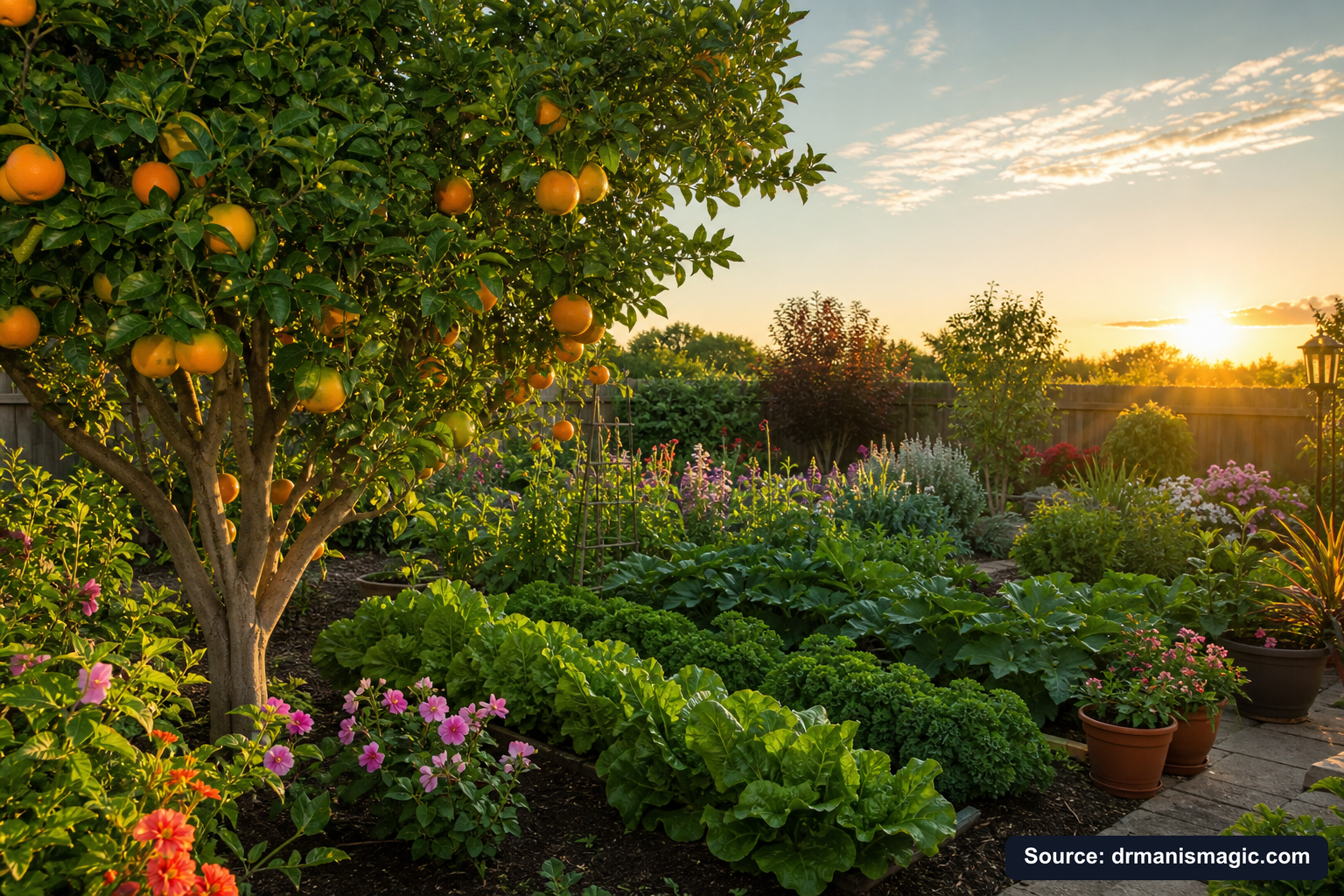
The Three Plant Pillars exist to stop that loss. To give you a foundation so solid, so aligned with how nature actually works, that your plants do not just survive — they accelerate. And the fruits, the flowers, the lush green lawn, the thriving garden you pictured — they actually show up. In your lifetime. While you are there to enjoy them.
That is what clean nutrition is really about. Not a label. Not a trend. A decision to work with nature instead of against it — and to stop losing time to a system that was never designed to help you win.
If you are ready to give your plants the root-first foundation they deserve — clean nutrition, living soil, and real biological support — the Free Plant Care Field Guide is a great place to start. It walks you through the Three Plant Pillars in plain language, covers what your specific plants need, and helps you build the kind of growing foundation that makes gardening feel easy — maybe even like magic.
Frequently Asked Questions
If you have ever wondered why your plants look hungry even after feeding them, you are not alone. These are the questions gardeners ask most after learning about clean nutrition. The answers might surprise you, and they are grounded in what we learned growing over 250,000 trees in South Texas.
Why is nutrition so important for plants?
Plants need nutrients to grow roots, make food, fight disease, and produce fruit or flowers. But here is the part most people miss. Plants do not eat nutrients straight from a bag. They rely on living microbes in the soil to break nutrients down into forms roots can actually use. Feed the microbes right, and your plants get fed right. Skip that step, and even expensive fertilizer goes to waste.
What does clean nutrition mean for plants?
Clean nutrition means feeding your plants with inputs that work with the soil, not against it. Think slow-release organic sources like crab shells, kelp, and amino acids. These feed the microbes first. The microbes then feed the plant steadily and safely. No salt burn. No wiped-out soil life. No scorched roots. Just steady, natural growth the way plants were designed to eat. That is what the Three Plant Pillars are built on.
How do plants actually absorb nutrition from the soil?
Roots pull water and dissolved minerals up from the soil. But the real magic happens before that. Billions of bacteria and fungi in healthy soil break down raw materials into plant-ready forms. They unlock nutrients that would otherwise stay trapped. Without those microbes, your soil is basically a locked pantry. That is why Dr. Mani's Plant Super Boost adds live microbes back into the soil, so the whole system works together the way nature intended.
Can a plant look thirsty even when the soil is wet?
Yes, and it happens more than you think. High-salt synthetic fertilizers pull water away from roots through a process called osmotic stress. The roots cannot drink even when moisture is right there. Your plant wilts. You water more. Nothing helps. This is one of the most common problems we saw before switching to clean, organic inputs. Once you remove the salt problem, roots can breathe, drink, and grow again.
Do plants suffer when nutrients are missing?
Absolutely. Yellow leaves, brown tips, stunted growth, and poor fruiting are all signs something is off below the surface. But here is what most gardeners do not know. The missing link is usually not the nutrient itself. It is the missing microbes that were supposed to unlock it. That is why we built the Three Plant Pillars around mineral-based soil, live microbes, and organic fertilizer working together. All three have to be in sync for plants to truly thrive.
What is wrong with using regular chemical fertilizers to grow plants faster?
Salt-based synthetic fertilizers give a quick green flush, but they burn soil microbes in the process. Once those microbes are gone, your plant loses its natural feeding system. You end up buying more fertilizer just to keep things alive. It is a cycle that costs you money and time. We proved this over decades of testing at our South Texas nursery. Organic inputs like crab, kelp, and amino acids grow plants more slowly at first, but the results last and keep building.
What is the fastest safe way to improve plant nutrition starting today?
Start with the Three Plant Pillars. First, give roots a mineral-based soil that drains well and does not compact. Second, add live microbes so the soil comes alive and starts working for you. Third, feed with slow-release organic fertilizer that does not burn. That is exactly what Dr. Mani's Magic Super Soil, Plant Super Boost, and Crab Kelp and Amino Acids do together. We tested this system on over 250,000 citrus trees. It works on any plant you grow.
About the Author
Ron Skaria, MD
Ron Skaria, MD, is the co-founder of Dr. Mani's Magic and the son of Dr. Mani. He trained as a medical doctor at Baylor College of Medicine, did his residency at UT Health Science Center - San Antonio and fellowship training at Texas Tech University. He now works full time on the family farm at US Citrus and US Citrus Nursery in Hargill, Texas, building Dr. Mani's Magic alongside his dad. He wrote the Brown Thumb Field Guide to put his father's 48 years of plant science into plain words any gardener can use. His belief is simple. You never had a brown thumb. You just never had the right help.


