


The Microbial Middlemen Plants Depend On for Healthy Soil | Dr. Mani's Magic
The Microbial Middlemen Plants Depend On: Why Soil Biology Matters More Than NPK
Picture this. You're standing at your kitchen counter, slicing open a lemon from a tree you grew yourself. The smell hits you first — bright, sharp, clean. You squeeze it over your water and smile. Not because it was hard. Because it was easy. And because you finally understood the one thing nobody ever told you about plants.
But right now, you're not there yet. Right now, maybe your tree has yellowing leaves. Maybe your lawn looks thin and tired no matter what you spray on it. Maybe you've bought bag after bag of fertilizer from the big box store, followed the directions exactly, and still watched your plants slowly lose ground. You're not doing it wrong. You're just missing something invisible. Something that lives in the soil. Something that was doing all the real work long before fertilizer was ever invented.
That something is microbes. Billions of them. Tiny living organisms that act like a middleman between the soil and your plant's roots. When they're healthy, your plants thrive. When they're gone, your plants struggle — no matter how much fertilizer you add. After growing over 250,000 trees at our South Texas nursery, we can tell you this with complete confidence: the microbes are the magic. Everything else is just support.

Organic Fertilizer | Crab, Kelp & Amino Acids
Key Takeaways
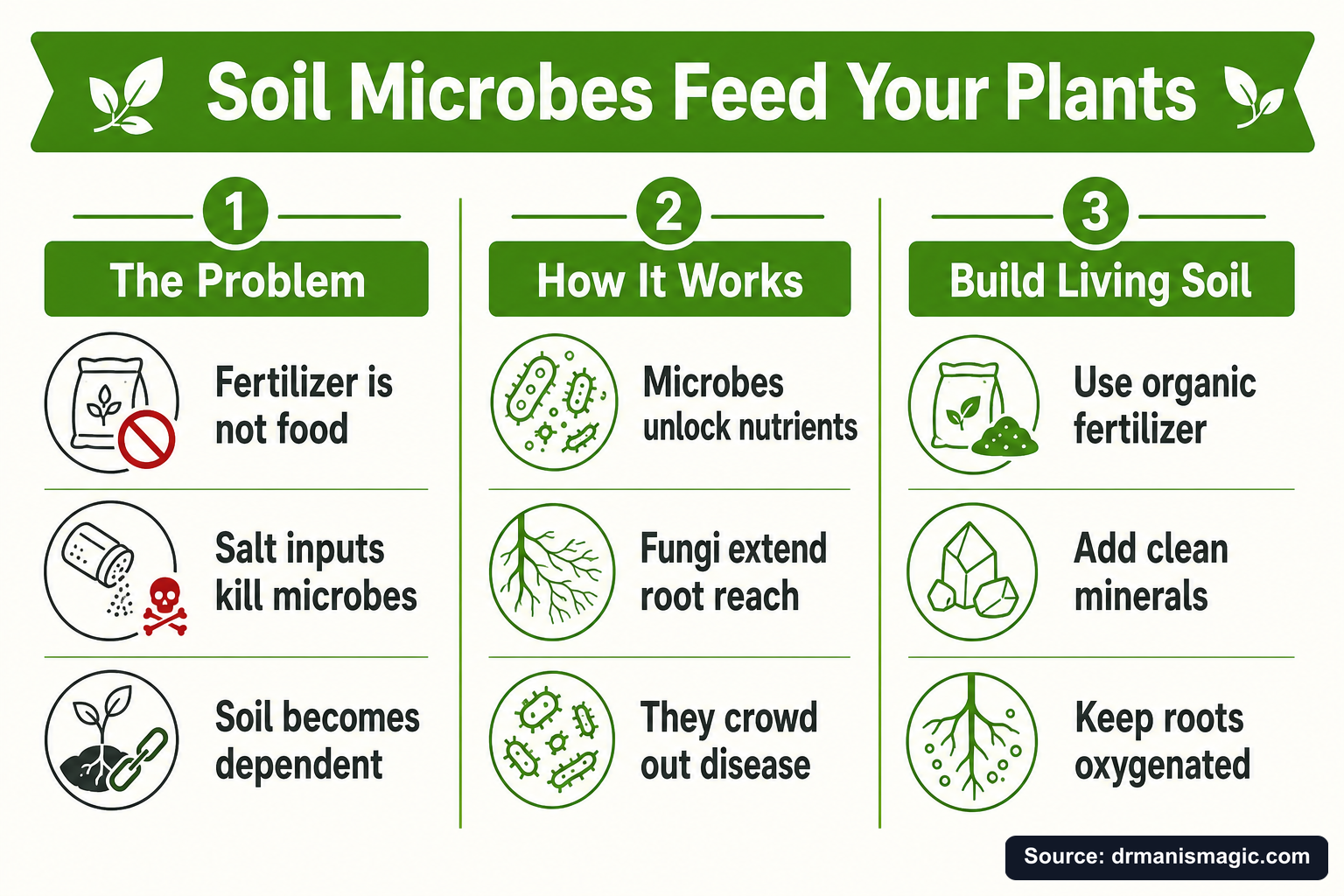
- Plants do not absorb fertilizer directly — soil microbes convert nutrients into forms plants can actually use.
- Salt-based synthetic fertilizers kill the very microbes your plants depend on, creating a cycle of dependency and decline.
- Root rot is almost always an oxygen-plus-pathogen problem, not just a watering problem.
- Organic fertilizer feeds microbes first — the microbes then slowly release nutrients straight to the roots, like a natural time-release system.
- Chitin from crab shells, hormones from kelp, and trace minerals from volcanic ash work together to build resilient, disease-resistant plants.
- PFAS "forever chemicals" from biosludge-based fertilizers are a real risk — clean inputs matter for your family's safety.
- The Three Plant Pillars — mineral-based soil, live microbes, and organic fertilizer — give any plant, lawn, tree, or garden the foundation it needs to thrive.
What Are the Microbial Middlemen and What Do They Actually Do?
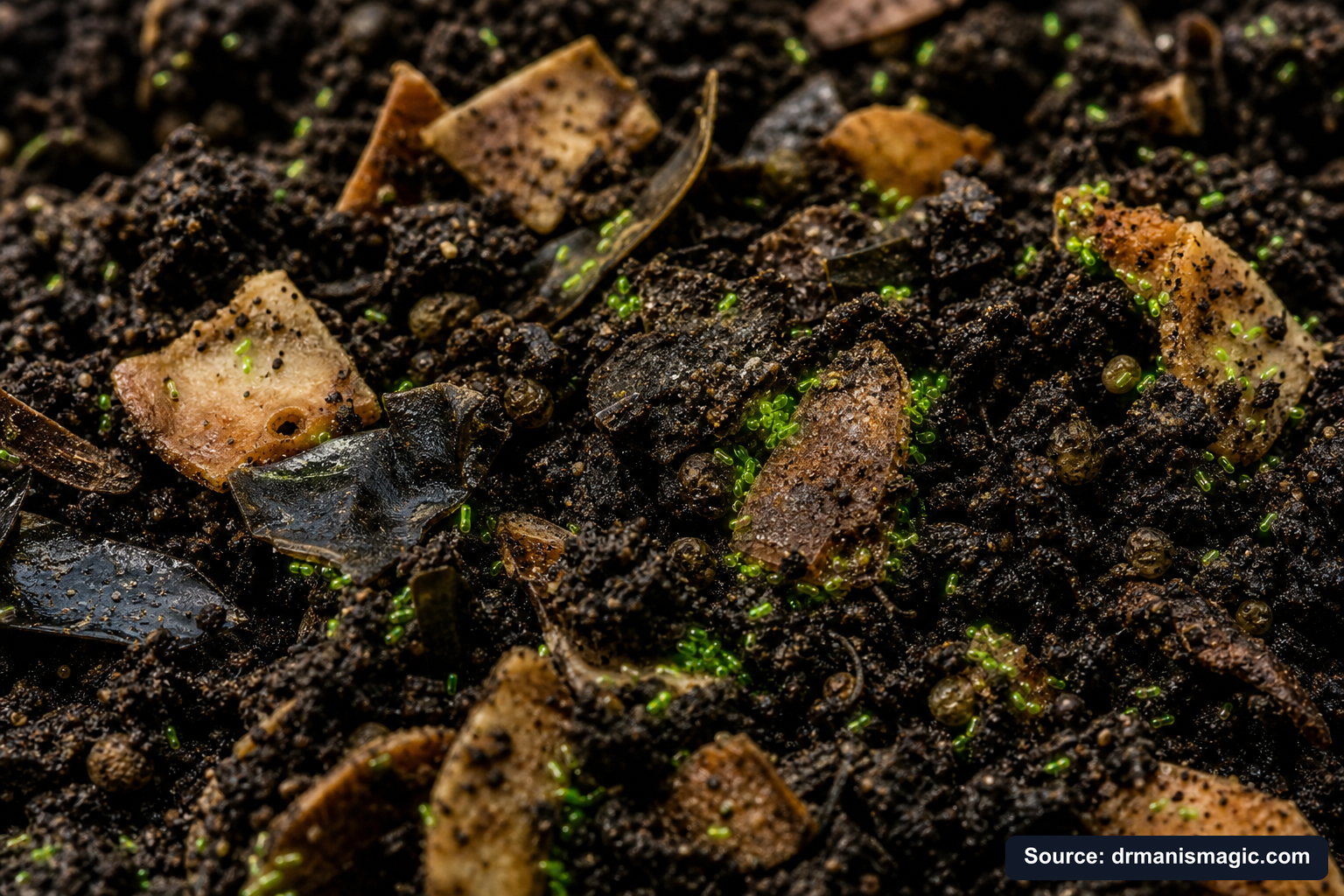
Quick Answer: Microbial middlemen are billions of bacteria, fungi, and other tiny organisms living around your plant's roots. They break down organic matter, unlock nutrients locked in the soil, fix nitrogen from the air, and protect roots from disease. Without them, most of the nutrition in your soil stays locked up and unavailable to your plants.
Here is the truth that changed everything for us.
Plants cannot eat fertilizer straight from the bag. That is not how it works in nature. In nature, there is no bag. There is only soil — and the invisible army living inside it.
The zone right around your plant's roots has a name. Scientists call it the rhizosphere. It is one of the most biologically active places on earth. Inside that thin layer of soil, bacteria are breaking down dead organic matter and releasing nitrogen. Fungi are threading microscopic networks called mycorrhizae through the soil, reaching nutrients and water that roots could never find on their own. Other microbes are dissolving bound-up phosphorus, turning it from a locked mineral into a form the plant can drink. Some bacteria are pulling nitrogen right out of the air and converting it into plant food — a process called nitrogen fixation. Others are producing compounds that suppress root diseases and crowd out pathogens like Pythium and Phytophthora before they can take hold.
This is not a side benefit. This is the whole system. Penn State Extension confirms that soil biological activity drives nearly every nutrient cycle plants depend on. The University of Minnesota Extension puts it plainly: healthy soil microbiomes are foundational to plant productivity, not optional.
And here is the part that most fertilizer companies do not want you thinking about.
When you pour a salt-based synthetic fertilizer into your soil, you are not feeding your plant. You are bypassing the microbes entirely — and in the process, burning them. Salt draws water out of microbial cells just like it draws water out of a slug. It does not discriminate. It kills the beneficial bacteria. It kills the mycorrhizal fungi. It collapses the very system your plant evolved to depend on over millions of years.
Then you have to buy more fertilizer next month. Because nothing in the soil is alive enough to feed the plant naturally anymore.
That cycle — buy, apply, watch it fade, buy again — is not your fault. It is the design. Dr. Mani Skaria, plant pathologist and founder of the Clean Citrus Program in Texas, spent decades watching this pattern destroy otherwise healthy trees. He called it what it is: a slow, quiet bankruptcy of your soil's living ecosystem.
How Do Microbes Actually Turn Soil Into Plant Food?
Quick Answer: Microbes eat organic matter and convert it into simple nutrients like nitrate and phosphate that plant roots can absorb. When the microbes die, they release even more nutrition directly into the root zone. The whole process is a slow, continuous, self-replenishing feeding system — nothing like a one-time fertilizer spike.
Think of it like this. Imagine you have a kitchen, but the only food available is raw, unprocessed ingredients — whole grains still in the husk, bones still in the animal. You cannot eat any of it directly. You need a cook to prepare it first.
Microbes are your soil's cooks.
They take complex organic materials — dead leaves, crab shell, kelp, feather meal, old roots — and they break them down into simple, soluble nutrients. Nitrogen locked in a protein molecule gets converted into ammonium, then nitrate. Phosphorus locked in a mineral crystal gets dissolved by acid-producing bacteria and made available to roots. This process has a name: mineralization. And it is the real engine behind plant nutrition in every forest, meadow, and garden on earth.
But here is the part that truly changed how we think about fertilizing.
Organic fertilizer does not just avoid killing the microbes. It feeds the microbes first. The bacteria and fungi eat the organic material — the crab shell, the amino acids, the kelp. They digest it. They multiply. And as they do their work, they release a slow, steady trickle of nutrients right into the root zone. Then, when those microbes die, they release everything stored in their tiny bodies — nitrogen, phosphorus, trace minerals — directly into the soil in exactly the forms plants can absorb.
It is a natural time-release system. One that has been running without human interference since the first plant took root on this planet.
You apply organic fertilizer once. The microbes go to work. They feed the plant today, tomorrow, next week, and next month. The plant does not get a spike and a crash. It gets a slow, even, consistent supply — the way it was designed to eat.
Contrast that with a soluble synthetic fertilizer. It hits the soil and immediately dissolves into ions. Salt ions. The plant gets a rush of nutrition — and a rush of osmotic stress. The salt pulls water out of root cells through a process called osmotic stress. Roots that should be expanding and exploring start pulling back. Microbial populations crash. Within weeks, the soil is quieter than it was before you started. And the plant, now dependent on you for every meal, is weaker than it looks.
See also: The Hidden Reason Synthetic Fertilizers Cause Root Rot
Why Do Salt-Based Fertilizers Damage Roots and Kill Soil Microbes?
Quick Answer: Salt-based fertilizers raise the osmotic pressure around roots and microbial cells. This pulls water out of those cells, causing root tip burn, physiological drought, and mass microbial die-off. Even if the plant looks green for a few weeks, the biological foundation of the soil is collapsing underneath it.
Salt does one thing very well: it attracts water.
When you pour a high-salt fertilizer into your soil, the salt concentration outside the root cells becomes greater than the concentration inside. Water moves from high concentration to low concentration — so water moves out of the roots and out of the microbial cells surrounding them. This is called osmotic stress, and it is the same reason you should not drink seawater when you are thirsty. The more you drink, the more dehydrated you become.
Your plant's roots experience the same thing. They are surrounded by what feels, to them, like a drought — even if you just watered. Scientists call this physiological drought. The water is there. The plant just cannot access it because of the salt pressure blocking uptake.
Meanwhile, the beneficial bacteria and fungi in the rhizosphere — the same ones breaking down organic matter and protecting roots from pathogens — are being burned alive. Their cell membranes rupture. Their populations collapse. The soil goes quiet.
And quiet soil is dangerous soil.
When the beneficial microbes are gone, the pathogens move in. Pythium, Phytophthora, Rhizoctonia, and Fusarium thrive in microbially depleted, oxygen-starved soil. These are the organisms behind root rot — the slow brown death that starts at the root tips and works its way up. By the time you see yellow leaves, the damage underground is already severe.
The University of Delaware Extension and Nevada Cooperative Extension both document how repeated soluble fertilizer applications lead to salt accumulation in container and garden soils, creating a self-reinforcing cycle of root damage and nutrient lockout.
The salt index — a measure of how much a fertilizer raises the osmotic pressure of the soil solution — varies widely between products. Most synthetic fast-release fertilizers carry a high salt index. Most organic inputs carry a very low one. That difference is not a minor footnote. It is the difference between a soil that is alive and one that is not.
See also: How Salt-Based Feeding Quietly Destroys Root Systems
What Is Root Rot Really — and Why Does Oxygen Matter More Than You Think?
Quick Answer: Root rot is almost never just a watering problem. It is a two-part failure: oxygen disappears from the soil (from overwatering, compaction, or poor drainage), and then fungal pathogens like Pythium and Phytophthora rush in to attack the suffocating roots. Fix the oxygen first, and root rot becomes much easier to prevent.
Most people think root rot is about too much water. They cut back on watering and wonder why the plant keeps declining.
Here is what is actually happening.
Roots breathe oxygen. Not carbon dioxide — oxygen. When soil pore spaces fill with water and stay full, the oxygen is pushed out. Roots start to suffocate within hours. Root cell membranes weaken. The root tips, which are the plant's primary tool for absorbing water and nutrients, begin to die.
This is when the pathogens arrive. Pythium and Phytophthora are what scientists call water molds. They love wet, oxygen-depleted conditions. They swim through saturated soil and attack weakened, suffocating root tissue. Once they are established, they move fast.
But here is the part most gardening advice skips entirely.
The same salt-based fertilizers that kill your beneficial microbes also make this problem worse. A soil that has lost its microbial life also loses its structure. Beneficial fungi called mycorrhizae create a sticky network of threads called hyphae that bind soil particles together into aggregates — little clumps of soil with air spaces between them. Those air spaces are where oxygen lives. When you kill the mycorrhizae with salt fertilizers, those aggregates collapse. The soil compacts. Drainage fails. Oxygen disappears. And the very conditions that invite Pythium and Phytophthora are created.
So root rot is not just a watering problem. It is a soil biology problem. It is an oxygen problem. And in many cases, it is a fertilizer problem.
UC IPM and Penn State Extension both document this pattern: waterlogging plus pathogen pressure equals root rot, and the severity is dramatically worsened when soil structure and microbial populations have been compromised.
The fix starts underground. With structure. With oxygen. With living microbes that protect and support root tissue before the pathogens arrive. That is exactly what mineral-based Super Soil and Plant Super Boost are designed to provide.
Root Problem Diagnostic: Salt Damage vs. Overwatering vs. True Root Rot
| Symptom | Salt / Fertilizer Burn | Overwatering / Oxygen Stress | True Root Rot (Pythium / Phytophthora) |
|---|---|---|---|
| Leaf appearance | Tip burn, brown edges, crispy margins | Yellowing, soft, droopy even when wet | Yellow to brown, wilting despite water, rapid decline |
| Root appearance | Brown root tips, stunted new growth | White roots turning soft and brown | Mushy, dark brown or black, foul smell |
| Soil condition | Crusty white deposits on surface, dry | Stays wet for days, no drainage | Saturated, compacted, anaerobic, low oxygen |
| Timeline | Days to weeks after fertilizing | Gradual over weeks | Can progress rapidly once established |
| Primary cause | High salt index fertilizer, osmotic stress | Poor drainage, wrong soil type, overwatering | Oxygen depletion plus pathogen pressure |
| Microbial factor | Beneficial microbes killed by salt | Aerobic microbes die, anaerobes take over | No beneficial microbes left to suppress pathogens |
| Best correction | Flush soil, switch to organic, low-salt inputs | Improve drainage, reduce watering frequency | Remove affected roots, repot in mineral soil, restore microbes |
Recovery Checklist: When Your Plant Is in Decline
- Stop all synthetic fertilizer immediately. Give the salt pressure time to ease.
- Check drainage. Water should flow freely out the bottom within 30 seconds of watering.
- If roots are mushy or dark, remove the plant, trim affected roots, and repot in mineral-based soil that does not compact or hold excess moisture.
- Apply a live microbial drench — beneficial bacteria and mycorrhizal fungi — to recolonize the root zone and begin suppressing residual pathogens.
- Wait two weeks before any fertilizing. Let the biology re-establish first.
- Resume feeding with a low-salt, organic fertilizer in small amounts. Let the microbes do the converting.
- Monitor new leaf color and root tip growth over the next 30 days. Green, firm new growth means the biology is working.
You Never Had a Brown Thumb.
You were handed the wrong tools. This free guide hands you the right ones.
You watered it. You fed it. It died anyway.
It was never you. It was the dirt, the salt food, and the bad advice.
This guide shows you what really went wrong, and how to fix it for good.
- Why your plants really died, and why it was never your fault
- The salt hiding in your plant food that quietly burns the roots
- The hidden killer in almost every bag of store soil
- The tiny helpers that grow a whole forest for free
- The rescue trick that brings a half dead plant back to life

What Do Chitin, Kelp, and Amino Acids Actually Do for Your Plants?
Quick Answer: Chitin from crab shells triggers your plant's natural immune defenses and feeds beneficial soil microbes. Kelp provides natural growth hormones, trace minerals, and carbohydrates that accelerate root and shoot development. Amino acids deliver nitrogen in the most plant-ready form possible, bypassing the need for microbial conversion and delivering nutrition directly and gently.
Not all organic fertilizers are created equal.
Some are just composted manure. Some are fish emulsion — effective, but famous for making your entire house smell like low tide for a week. Some contain biosludge: processed municipal wastewater solids that can carry PFAS, the so-called "forever chemicals" that accumulate in soil, water, and human tissue. Maine, Pennsylvania, and Michigan have all flagged biosludge-contaminated compost as a real agricultural concern.
Dr. Mani's Magic Crab, Kelp & Amino Acids contains zero biosludge, zero PFAS, and zero synthetic salts. Here is what it does contain — and why each ingredient matters.
Crab Shells and Chitin: Your Plant's Built-In Defense System
Crab shells are loaded with a compound called chitin. Chitin is a natural polymer — a long chain molecule — that makes up the hard outer shell of crustaceans and the cell walls of many fungi. When chitin is added to soil, something remarkable happens.
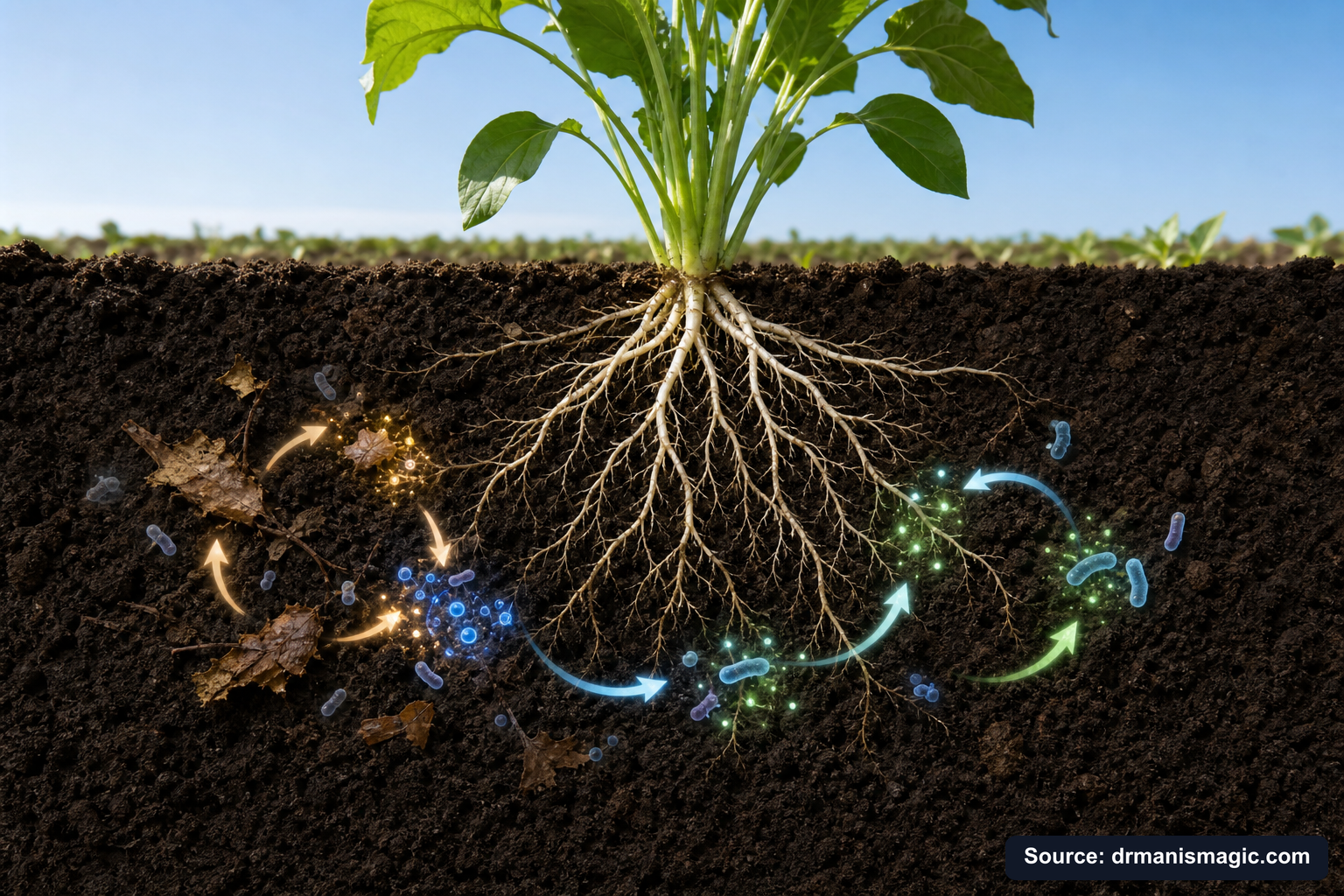
Certain soil bacteria, called chitin-degrading bacteria, explode in population. They love chitin. They eat it. And as they multiply, they outcompete the very fungal pathogens that cause root rot — because those pathogens have cell walls made of chitin too. The beneficial bacteria that feed on chitin essentially wage a biological war on Pythium, Phytophthora, and Fusarium — and they win.
At the same time, chitin delivers calcium and magnesium to your soil. Calcium is critical. A large proportion of the woody structural mass of any plant is calcium. Strong cell walls. Strong stems. Firm fruit. Resistance to cracking and disease.
Kelp: Nature's Growth Hormone in a Marine Plant
Cold-processed kelp is one of the most biologically complex inputs you can put in your soil. It contains natural plant hormones called auxins and cytokinins that regulate root development, shoot elongation, and cell division. It contains natural alginates — carbohydrates that feed soil microbes and help bind soil particles into aggregates. It contains dozens of trace minerals, vitamins, and amino acids in forms that are immediately bioavailable.
The "cold-processed" part matters. Heat destroys many of the active compounds in kelp. Cold processing preserves them. You get the full biological punch — not a heat-sterilized mineral powder.
Kelp also improves drought tolerance. The natural compounds in kelp help regulate how plants open and close their leaf pores, reducing water loss during stress. For a plant in a hot South Texas summer or a dry apartment in January, that matters enormously.
Amino Acids: The Fastest, Gentlest Path to Nitrogen
Amino acids are the building blocks of protein. When you apply amino acid-based fertilizer to your soil, you are giving your plant nitrogen in its most ready-to-use form. Normally, nitrogen has to travel through multiple microbial conversion steps before roots can absorb it. Amino acid nitrogen skips several of those steps. The plant can absorb it directly, or with minimal microbial processing.
This is especially important for plants under stress — recovering from root damage, transplant shock, or a hard pruning. They need nutrition immediately. Amino acids deliver it gently, without the salt shock of a synthetic fertilizer, and without waiting weeks for microbial conversion to complete.
And critically: amino acids feed the soil microbes too. They do not bypass the biology. They support it from multiple angles simultaneously.
Volcanic Ash: Trace Minerals That Build Resilience from the Ground Up
Volcanic ash provides a broad-spectrum supply of silica and trace micronutrients — iron, zinc, manganese, copper, boron, molybdenum — in slowly weathering mineral form. Silica strengthens cell walls, making leaves and stems physically tougher and more resistant to insect pressure and disease. Plants with adequate silica stand up straighter, hold fruit better, and recover faster from stress.
Trace minerals are the overlooked nutrients. You can have perfect nitrogen, phosphorus, and potassium, and still watch your plant fail — because of a single missing micronutrient. The Law of the Minimum applies: one deficiency limits everything else, regardless of how much of every other nutrient is present. Volcanic ash fills those gaps quietly, continuously, over a long growing season.
How Do Fertilizer Types Compare — and Which One Actually Works With Soil Biology?
Quick Answer: Fast-release synthetic fertilizers bypass soil biology, carry high salt loads, and can harm roots and microbes. Slow-release synthetics reduce burn risk but often use plastic coatings that persist in soil. Organic and biostimulant-based fertilizers feed the soil ecosystem first, release nutrients slowly and steadily, and actively support the microbial system plants depend on.
Here is a side-by-side comparison so you can see it clearly.
| Fertilizer Type | What It Feeds | Release Speed | Salt Index / Root Risk | Microbial Impact | PFAS / Contaminant Risk | Best Use Case |
|---|---|---|---|---|---|---|
| Fast-release synthetic (e.g., soluble NPK) | Plant directly, bypasses biology | Immediate | High — osmotic stress, root burn | Kills beneficial bacteria and fungi | Low (but plastic prill risk in slow-release versions) | Emergency short-term greening — not recommended long-term |
| Slow-release synthetic (coated prill) | Plant directly, bypasses biology | Weeks to months | Medium — reduced but not eliminated | Less acute damage, but still suppresses biology | Plastic coating residue in soil | Convenience-focused, not biology-friendly |
| Compost / aged manure | Soil microbes first, then plant | Slow, variable | Low | Generally supportive | Medium — manure can carry hormones; some compost contains biosludge | Soil building, organic gardens, in-ground beds |
| Biosolids / sewage sludge-derived | Soil and plant | Slow | Low to medium | Adds organic matter, but contaminant risk is significant | HIGH — documented PFAS contamination risk | Not recommended for food gardens or containers |
| Fish emulsion | Soil microbes first, then plant | Moderate | Low | Positive | Low | Effective but strong odor — not ideal for indoor or patio use |
| Crab / chitin + kelp + amino acids (organic granular) | Soil microbes first, then plant; also direct amino acid uptake | Slow and steady | Very low — no salt burn risk | Actively feeds and supports beneficial microbes | Zero — no biosludge, no PFAS, no synthetics | All plants, containers, lawns, gardens, trees, year-round |
| Mycorrhizal inoculants (live fungi) | Extends root zone, delivers water and nutrients | Ongoing once established | None | Directly adds beneficial biology | None | New plantings, transplants, containers, any plant needing root support |
What Are PFAS and Biosludge — and Why Do They Matter in Your Garden?
Quick Answer: PFAS are synthetic chemicals that do not break down in soil, water, or the human body. Biosludge — processed municipal wastewater solids — is commonly used as a filler in fertilizers, including some labeled "organic." It can carry high concentrations of PFAS. If your fertilizer does not explicitly state it is biosludge-free, you may be spreading forever chemicals on your food garden, lawn, or children's play area.
This one does not get talked about enough.
PFAS stands for per- and polyfluoroalkyl substances. They are a class of thousands of synthetic chemicals used in nonstick coatings, stain-resistant fabrics, firefighting foam, and industrial processes. They are called "forever chemicals" because they do not break down. Not in sunlight. Not in water. Not in your body.
They accumulate. In soil. In groundwater. In plant tissue. In you.
Biosludge — also called sewage sludge, biosolids, or "recycled organics" on fertilizer labels — is the solid material left over after treating municipal wastewater. It contains whatever went down the drains of every home, hospital, and factory in a given city. That includes PFAS. Pennsylvania, Maine, and Michigan have all published extension guidance on PFAS contamination from biosolids used in agriculture and home gardening.
Here is the problem. Many fertilizers — including some marketed as organic — use biosludge as a filler. The label may say "derived from organic sources" without ever telling you what those sources are.
If you are growing food, playing on your lawn barefoot, or letting your children dig in the garden, this is not an abstract concern. It is a real one.
Dr. Mani's Magic Crab, Kelp & Amino Acids contains no biosludge, no PFAS, no synthetic salts, and no mystery fillers. The inputs are exactly what the name says: crab shells, cold-processed kelp, volcanic ash, and amino acids from clean animal protein sources. That is the entire list. No sewage. No plastic coatings. No forever chemicals.
That is also why it does not smell bad. Fish emulsion and biosludge-based fertilizers go anaerobic — they essentially start rotting — which is why they produce that unmistakable odor. Clean, properly sourced organic inputs do not have that problem. Your patio stays pleasant. Your kitchen stays pleasant. Your garden stays safe.
What Are the Three Plant Pillars and Why Do They Work for Any Plant?
Quick Answer: The Three Plant Pillars are the foundational system Dr. Mani Skaria developed after 40 years of plant science and testing on over 250,000 trees. Pillar One is mineral-based soil that stays open and drains freely. Pillar Two is live microbials — bacteria, fungi, and mycorrhizae. Pillar Three is organic fertilizer with biostimulants. Together, they give any plant the conditions it evolved to thrive in.
Dr. Mani Skaria did not discover the Three Plant Pillars in a laboratory. He discovered them the hard way — in a nursery, watching trees that should have thrived slowly fail under conventional growing methods.
He watched trees potted in bark-heavy organic mixes slowly suffocate as the bark decomposed and compacted, stealing oxygen from the root zone. He watched synthetic fertilizers create a brief flush of green followed by long, slow decline as the soil biology collapsed. He watched root rot claim tree after tree that was otherwise healthy — until he traced every case back to the same root causes: poor oxygen, dead soil, and the wrong inputs.
So he built a system from first principles. From the ground up. Literally.
Pillar One: Mineral-Based Soil. Most potting mixes are made from pine bark, sawdust, and other decomposing organic materials. They feel light and fluffy at first. But within months, they break down. They compact. They hold water instead of draining it. They steal oxygen as they decompose. Real mineral-based soil — sandy loam from the Rio Grande Valley, rich in silica that does not break down — stays open, drains freely, and lets roots breathe indefinitely. It is a permanent investment, not a consumable.
Pillar Two: Live Microbials. Bacteria, fungi, and mycorrhizae are not optional extras. They are the operational core of your soil's nutrient system. Without them, nutrients stay locked. Pathogens go unchecked. Roots lose their extended reach. With them, every other input you add works two to three times as effectively.
Pillar Three: Organic Fertilizer and Biostimulants. Slow-release, biology-friendly nutrition that feeds the microbes first and the plant second — continuously, gently, and without salt damage. Chitin for immune activation. Kelp for growth hormones and trace minerals. Amino acids for direct, rapid nitrogen delivery. Volcanic ash for the micronutrients that prevent hidden deficiencies.
Miss any one of these three pillars, and your plant is vulnerable. Root rot. Yellowing leaves. Weak fruiting. Pest pressure. The slow decline that makes good gardeners feel like failures.
Put all three in place, and something changes. The plant stops being fragile. It stops being dependent on you for every meal. It starts doing what plants were designed to do — grow, thrive, and reward you for the time you put in.
We have used this system on over 250,000 citrus trees at US Citrus Nursery in South Texas. We have used it on houseplants, tropical trees, ornamentals, lawn grass, and flowering plants. The result is always the same. When the biology is right, the plant follows. Explore the full Three Plant Pillars system to see how the pillars work together.
Three Plant Pillars at a Glance
| Pillar | What It Provides | What Happens Without It | Dr. Mani's Magic Solution |
|---|---|---|---|
| Pillar 1: Mineral-Based Soil | Drainage, oxygen, permanent structure, no decomposition | Compaction, root suffocation, root rot, anaerobic conditions | Super Soil (silica-rich sandy loam from South Texas) |
| Pillar 2: Live Microbials | Nutrient cycling, pathogen suppression, root extension, soil structure | Locked nutrients, disease vulnerability, poor root development, soil collapse | Plant Super Boost (live bacteria, fungi, and mycorrhizae) |
| Pillar 3: Organic Fertilizer and Biostimulants | Complete slow-release nutrition, immune activation, growth hormones, trace minerals | Deficiencies, yellowing, weak fruiting, salt damage, microbial die-off | Crab, Kelp & Amino Acids (7-4-4, no biosludge, no PFAS, no synthetic salts) |
Why Does Time Matter More Than Money When It Comes to Feeding Your Plants the Wrong Way?
Quick Answer: Money is replaceable. Time is not. When you use the wrong inputs, your plants may look acceptable for a season or two — then stall, decline, and never reach their potential. The real cost of the conventional approach is not what you spend on the products. It is the months and years of growth you lose while the soil biology quietly collapses underneath you.
Here is something Dr. Mani hears more than almost anything else.
People tell him they want to see fruit on a tree they planted with their own hands. They want to walk into their backyard, pick something off a branch, and taste it. That desire — to grow something, to nurture something, to see it bear fruit — is one of the most human things there is. It is not a hobby. It is something deeper. It is wired into us.
And here is the tragedy of the conventional approach.
You plant a tree. You use the products from the big box store — the salt-based fertilizer, the bark-heavy potting mix, maybe a splash of liquid synthetic every few weeks. The tree looks okay for a while. Maybe even pretty good. Then, somewhere around year two or three, it starts to plateau. The new growth slows. The leaves are a little pale. The fruit set is thin. You add more fertilizer. Nothing changes. You add different fertilizer. Nothing changes.
What happened? The soil biology collapsed. The salt built up. The microbes died. The roots stopped expanding. The tree is running on empty, and no amount of conventional input is going to fill that tank — because the engine that processes the inputs is gone.
You lost time. Not just money. Time you cannot get back.
That is the real cost of the old way. Not the price of the bag. The years of growth that never happened. The fruit you never tasted. The lawn that never got quite right. The garden that always underperformed.
The second-best time to build the right foundation is today. And when you do — when the soil structure is right, when the microbes are alive and thriving, when the nutrition is slow and clean and complete — the plant does not just survive. It accelerates. It does what it was always capable of doing, as soon as you stopped getting in the way of the system nature already built.
For a complete walkthrough of how to apply all three pillars from the start, see the Free Plant Care Field Guide — written by the same team that has grown over 250,000 trees and counting.
See also: Why Most Fertilizers Are Actually Salt in Disguise
Putting It All Together: What Thriving Plants Actually Need
Here is the simple version of everything above.
Plants are not machines that you feed chemicals and expect output. They are living systems, deeply connected to other living systems in the soil. The microbes are not a bonus feature. They are the foundation. They built the nutrient cycles that every plant on earth depends on. They have been doing this for hundreds of millions of years, without a bag of synthetic fertilizer in sight.
When you work with that system — when you give the microbes a home they can thrive in, feed them with clean organic inputs, and protect them from salt damage and oxygen stress — the plants take care of the rest. Roots expand. Nutrients flow. Diseases get suppressed. Fruit sets. Leaves turn that deep, saturated green that tells you, without any test or instrument, that the plant is well.
That is what the Three Plant Pillars were built to create. Not a complicated regimen. Not a shelf full of products that may or may not be compatible. Just three things, working together, the way nature designed them to work. Mineral soil that breathes. Live microbes that feed and protect. Clean organic nutrition that builds — slowly, steadily, without burning anything down.
We have tested this system on over 250,000 trees. We have watched trees that were failing turn around within a single growing season. We have watched lawns that were thinning out thicken back up. We have watched houseplants come back from the edge. We have watched gardeners who had given up on their own ability to grow anything discover that their brown thumb was never the problem. The inputs were.
If you are ready to see what your plants are actually capable of — without the guesswork, without the salt damage, and without starting over every season — explore the full Dr. Mani's Magic line, backed by a 30-day money-back guarantee, at drmanismagic.com. Real people. Real science. Real soil biology. And results you can taste.
Frequently Asked Questions
Most gardeners never get the full picture about what plants actually need to thrive. These questions come up again and again from real growers who are tired of wasting money and time on things that just don't work. Get the answers here, grounded in over 30 years of hands-on testing across more than 250,000 trees at our South Texas nursery.
What do plants depend on microorganisms for?
Plants depend on soil microorganisms for almost everything. Bacteria break down organic matter and release nitrogen. Fungi called mycorrhizae stretch through the soil and pull in water and nutrients that roots could never reach alone. Other microbes dissolve locked-up phosphorus and fight off root diseases. Without these tiny helpers, your plant is flying blind. This is the heart of Dr. Mani's Magic Plant Super Boost and the second of the Three Plant Pillars.
What are the basic needs of a plant?
Plants need sunlight, water, air, and nutrients. Simple enough, right? But here is what nobody tells you. Most of those nutrients stay locked in the soil unless microbes unlock them first. And roots need oxygen to breathe, which means your soil structure matters just as much as what you pour on top. That is why Dr. Mani built the Three Plant Pillars around mineral-based soil, live microbes, and organic fertilizer working together.
How do microbes affect plants?
Good microbes make plants stronger, faster, and more resistant to disease. They feed roots slowly and steadily, like a natural time-release system. Bad microbes, like the pathogens that cause root rot, move in when the good ones are gone. Salt-based synthetic fertilizers wipe out the good microbes and leave the door wide open for the bad ones. That cycle is exactly what Dr. Mani spent decades trying to break.
What microorganisms help plants grow?
The big players are bacteria, mycorrhizal fungi, and nitrogen-fixing microbes. Bacteria break down organic matter and release nutrients. Mycorrhizae act like a second root system, reaching far beyond where roots can go. Nitrogen-fixing bacteria pull food straight from the air. Dr. Mani's Plant Super Boost puts all of these live microorganisms directly into your soil, stabilized so they arrive alive and ready to work the moment you water them in.
What are microorganisms in plants and soil?
Microorganisms are living creatures too small to see without a microscope. Billions of them live in healthy soil, especially in the thin zone right around your roots called the rhizosphere. They eat, reproduce, and produce compounds that feed your plant, protect it from disease, and build soil structure over time. Most store-bought potting mixes and synthetic fertilizers destroy this living ecosystem. Dr. Mani's Super Soil and Plant Super Boost are built to protect and rebuild it.
What happens when plants lose their soil microbes?
When microbes die off, nutrients get locked up in the soil and your plant cannot reach them. Roots become weak and vulnerable to rot. You add more fertilizer, but it just sits there or burns the roots. The plant slowly loses ground no matter what you do. This is the trap that salt-based fertilizers create. Dr. Mani saw this pattern in growers across the country and built the Three Plant Pillars specifically to break it for good.
Why do plants depend on more than just fertilizer?
Fertilizer alone is like putting premium gas in a car with a broken engine. The fuel is there but nothing works. Plants need the right soil structure so roots can breathe, live microbes to unlock and deliver nutrients, and clean organic food that feeds the soil without burning it. That is the Three Plant Pillars in one sentence. Proven on over 250,000 trees and now available for your lawn, garden, houseplants, and fruit trees at drmanismagic.com.
About the Author
Ron Skaria, MD
Ron Skaria, MD, is the co-founder of Dr. Mani's Magic and the son of Dr. Mani. He trained as a medical doctor at Baylor College of Medicine, did his residency at UT Health Science Center - San Antonio and fellowship training at Texas Tech University. He now works full time on the family farm at US Citrus and US Citrus Nursery in Hargill, Texas, building Dr. Mani's Magic alongside his dad. He wrote the Brown Thumb Field Guide to put his father's 48 years of plant science into plain words any gardener can use. His belief is simple. You never had a brown thumb. You just never had the right help.


