


The Root Burn Cycle Nobody Talks About (And Why It's Killing Your Plants) | Dr. Mani's Magic
The Root Burn Cycle Nobody Talks About: Why Your Plant Is Dying Even When You're Doing Everything Right
You did everything the bag told you to do.
You measured the fertilizer. You watered it in. You stood back and waited for that deep, lush green to come rushing back. But a week later, the tips are brown. The leaves are curling. The plant looks more stressed than before you fed it. You touch the soil and it is still moist. So it cannot be drought. You just fed it, so it cannot be hunger. What in the world is happening?
Here is what nobody tells you. The problem did not start when you saw the brown tips. It started underground, weeks or even months earlier, in a place you cannot see. It started in the root zone. And once this hidden cycle kicks off, every well-meaning thing you do next can actually make it worse. We have grown over 250,000 trees at our South Texas nursery. We have watched this exact pattern kill beautiful plants that had every advantage. We call it the Root Burn Cycle. And once you understand it, you will never look at a bag of fertilizer the same way again.

Plant Super Boost
Key Takeaways
- The root burn cycle is a feedback loop, not a single event. Salts, damaged roots, low oxygen, dead microbes, and root disease all feed each other underground.
- Your plant can wilt and yellow even when the soil is wet. That is called physiological drought, and salt stress causes it.
- Salt-based synthetic fertilizers kill the beneficial microbes your roots depend on to absorb nutrients and fight disease.
- Once feeder roots are damaged, opportunistic pathogens like Pythium and Phytophthora move in fast.
- Adding more fertilizer to a stressed plant almost always makes the cycle worse, not better.
- Organic, low-salt nutrition like amino acid-based fertilizers feeds the microbes first, which then feed the plant slowly and safely.
- Recovery is possible, but it requires stopping the cycle at the root level, not just treating the leaves.
What Exactly Is the Root Burn Cycle?
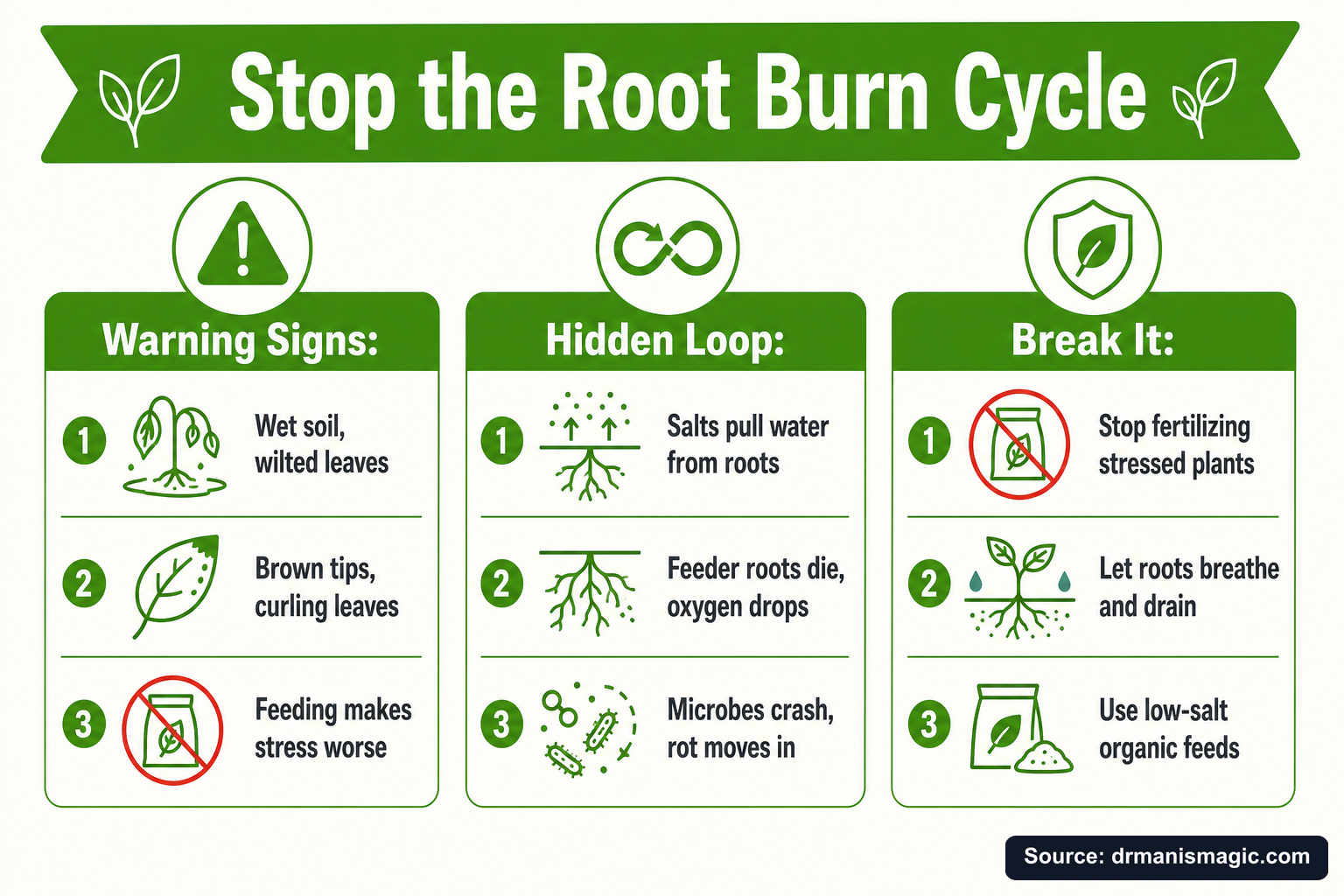
The root burn cycle is a hidden underground feedback loop where high salt from fertilizer creates osmotic stress, damages feeder roots, starves roots of oxygen, kills beneficial microbes, and invites root disease. Each stage makes the next worse. The plant looks hungry or thirsty even when fed and watered.
The root burn cycle is not just fertilizer burn. Fertilizer burn is one moment. A spill. An accident. The root burn cycle is a slow, self-reinforcing collapse that unfolds in six connected stages.
Here is how it works, step by step.
Stage 1: You add a salt-based fertilizer. Most fertilizers sold in big box stores are salt-based. The label might say "plant food" or "premium formula," but the chemistry underneath is salt. Lots of it.
Stage 2: The salt raises the concentration of the soil solution. When salt concentration in the soil gets higher than the concentration inside the root cells, water flows the wrong direction. Instead of flowing into the roots, it flows out. According to Penn State Extension, this osmotic imbalance is exactly how fertilizer burn damages plant tissue. Your plant is sitting in moist soil and literally dying of thirst. Scientists call this physiological drought.
Stage 3: The feeder roots get injured. Feeder roots are tiny, hair-thin root tips. They do almost all of the actual work of absorbing water and nutrients. Salt exposure burns them. They shrivel. They die back. And once they are gone, the plant has almost no way to recover what it lost, even if conditions improve.
Stage 4: Oxygen disappears from the root zone. Damaged roots cannot maintain the pore space in the soil around them. Water sits. The soil gets compacted. Oxygen gets squeezed out. Roots need oxygen to function, just like you do. When oxygen drops, root function collapses further.
Stage 5: The microbes die or go dormant. The beneficial bacteria and fungi in your soil are the real nutrient delivery system. They break down organic matter, unlock minerals, cycle nitrogen, and protect roots from disease. Salt kills them. Low oxygen suffocates them. When the microbe population crashes, the plant loses its entire support system underground.
Stage 6: Root pathogens move in. Pythium and Phytophthora are two of the most common root rot pathogens. They thrive in exactly these conditions: warm temperatures, low oxygen, damaged roots, and a dead microbial defense force. They spread fast. They rot roots from the inside. And the plant above the soil now looks yellow, wilted, and starved, so the gardener does the one thing that guarantees the cycle continues.
They add more fertilizer.
That is the Root Burn Cycle. And almost nobody talks about it.
Why Does Your Plant Wilt Even When the Soil Is Wet?
When salt concentration in the soil is higher than inside the root cells, water is pulled out of the roots instead of into them. The plant experiences drought-like symptoms even in moist soil. Oxygen-depleted roots from compaction or overwatering make it worse by shutting down the root's ability to absorb anything at all.
This is the symptom that confuses almost every gardener. The soil is wet. You just watered. But the leaves are drooping and the tips are going brown. So you check the soil again, feel moisture, and assume it must be a nutrient problem. You feed it. And the plant gets worse.
What you are seeing is osmotic stress in action.
Picture your root cells like tiny water balloons. Water moves from areas of low concentration to areas of high concentration through the root membrane. When everything is healthy, the concentration inside the root is higher than outside, so water flows in. That is how roots drink.
Now pour a high-salt fertilizer into that soil. Suddenly the concentration outside the root is higher. The direction of flow reverses. Water flows out of the root cells. The root literally dehydrates in wet soil. This is not a metaphor. This is basic chemistry, and it explains why your plant can look like it is dying of thirst on a rainy day.
Add compaction or overwatering on top of that, and you get a second problem. Roots also need oxygen to power the active transport of nutrients into the cell. When soil pores fill with water and oxygen drops, the roots cannot move nutrients even if those nutrients are sitting right there. University of Minnesota Extension notes that soil biological processes and root health are deeply linked to oxygen availability and organic matter management. Take away the oxygen, and the whole system shuts down.
The result looks identical to drought stress, nutrient deficiency, or overwatering. Which is why so many gardeners spend months chasing the wrong problem.
How Do Salt-Based Fertilizers Damage Roots and Soil Microbes?
Salt-based synthetic fertilizers raise the salt index of the soil solution. This damages fine feeder roots through osmotic stress and directly kills or drives away beneficial soil bacteria and fungi. Without those microbes, nutrients get locked up, disease pressure rises, and the plant enters a cycle of increasing dependence on more synthetic inputs.
Here is something the fertilizer aisle at a big box store will never show you.
Most synthetic fertilizers are made from salts. Ammonium nitrate. Potassium chloride. Monoammonium phosphate. These are all salt compounds. They dissolve fast in water, which is why they seem to work so quickly. That fast green-up after a feeding feels like proof they are working.
But speed has a price.
That salt does not disappear after the plant uses some of it. It accumulates. In containers, it builds up in layers. You can sometimes see a white crust forming on the soil surface or around the pot. That crust is salt. The soil underneath it is slowly becoming hostile to life.
And the microbes feel it first.
Your soil is supposed to be alive. Teeming with bacteria that fix nitrogen from the air. Fungi that extend the reach of roots by hundreds of times. Organisms that dissolve bound-up minerals and deliver them right to the root surface. When salt concentration rises, many of these organisms die. Others go dormant. The ones that survive are often the wrong ones, the pathogens that love a weakened, oxygen-poor environment.
At our nursery in South Texas, we watched this happen over and over before Dr. Mani cracked the code. Trees fed with conventional synthetic fertilizers would green up fast, then plateau. Then decline. Slowly at first, then all at once. The soil under them smelled off. The roots were brown and mushy. The microbial life was gone.
The fix was not a better synthetic fertilizer. The fix was stopping the salt cycle entirely.
See also: How Salt-Based Feeding Quietly Destroys Root Systems
What Is Physiological Drought and How Does It Fool Gardeners?
Physiological drought happens when a plant cannot absorb water even though water is present in the soil. Salt-induced osmotic stress and oxygen-depleted roots are the two main causes. The plant shows wilting, leaf curl, and tip burn, which are identical to the symptoms of underwatering, leading gardeners to water or feed more and deepen the problem.
Physiological drought is the great impersonator of gardening.
It looks like drought. It feels like drought. The leaves curl and go crispy at the edges. New growth wilts in the afternoon sun. If you stuck a meter in the soil, it would read moist. But the plant is in crisis, and adding water will not save it.
In fact, adding more water to a salt-stressed, oxygen-poor root zone often makes things worse. More water means less oxygen. Less oxygen means more root damage. More root damage means more entry points for Pythium and Phytophthora. And now you are not just dealing with salt stress. You are dealing with active root rot spreading through what is left of the feeder root system.
This is how gardeners lose plants they were certain they were taking good care of.
The soil was wet. The plant was fed. What else could they have done?
The answer is: start underground, not at the leaf. The root zone tells the whole story. But most gardening advice stops at the surface, which is exactly why this cycle stays hidden for so long.
How Do You Tell the Difference Between Salt Burn, Root Rot, Overwatering, and True Nutrient Deficiency?
These four problems share symptoms but have different causes and different fixes. Salt burn shows up as brown leaf tips with green centers, often after fertilizing. Root rot smells like decay and shows brown, mushy roots. Overwatering causes yellowing with wet soil. True nutrient deficiency shows patterned yellowing tied to specific leaf positions. The diagnostic table below helps you sort them out.
This is the question we get asked more than any other. And the honest answer is that these problems often overlap. But there are clues.
| Problem | Leaf Symptoms | Root Appearance | Soil Condition | Key Clue |
|---|---|---|---|---|
| Salt Burn / Fertilizer Burn | Brown tips and edges, green centers, crispy texture | Brown, dry, shriveled fine roots | Dry or normal; white crust on surface or pot rim | Symptoms appeared after fertilizing or in hot, dry weather |
| Root Rot (Pythium / Phytophthora) | Yellowing, wilting, brown patches spreading inward | Brown to black, mushy, foul smell | Wet, poorly draining, compacted | Soil smells sour or like decay; roots fall apart when touched |
| Overwatering (Oxygen Stress) | Yellow leaves, drooping, uniform throughout plant | Light brown, soft, no fine root hairs | Constantly wet, heavy, no air pockets | Soil never dries between waterings; heavy potting mix |
| True Nutrient Deficiency | Patterned yellowing: older leaves (nitrogen, potassium) or new leaves (iron, boron) | Often white and healthy if other conditions are right | Normal moisture | Pattern follows specific leaf age; no recent fertilizing; healthy drainage |
| Compaction / Poor Drainage | Slow growth, pale color, wilting in afternoon | Shallow, circling, no penetration below top layer | Hard, dense, water pools on surface | Soil feels like clay or packed sawdust; no drainage holes working |
| pH Lockout | Interveinal yellowing on new leaves despite feeding | May look normal | Normal moisture | Symptoms do not improve with more fertilizer; often in high-pH or highly acidic soils |
| Heat Scorch | Bleached or brown patches on sun-facing leaves only | Normal | Normal or dry | Damage appears only on the side of the plant facing direct afternoon sun |
The single most important thing to know: if you see brown tips after fertilizing, stop feeding immediately. Do not add more. The answer is almost never more fertilizer when the plant is already stressed.
Why Do Your Roots Need Live Microbes to Stay Healthy?
Beneficial soil bacteria and fungi do far more than help with nutrients. They build soil structure, protect roots from pathogens like Pythium, convert organic matter into plant-available forms, and form symbiotic relationships with roots that extend their reach dramatically. Without live microbes, even the best fertilizer sits locked up and useless.
Here is the part most fertilizer companies hope you never figure out.
Your plant does not eat fertilizer directly the way you eat food. The real nutrient delivery system is alive. It lives in the soil. And it has been there, working for free, for millions of years.
Beneficial bacteria in healthy soil fix nitrogen right out of the air. They pull it from the atmosphere, convert it into a form the plant can use, and deliver it straight to the root zone. Mycorrhizal fungi extend root reach by forming networks hundreds of times wider than the physical root. They trade minerals for sugars with the plant in a perfect exchange that benefits both. Other microbes dissolve bound-up phosphorus and iron. Others produce natural antibiotics that suppress Pythium and Phytophthora before they can take hold.
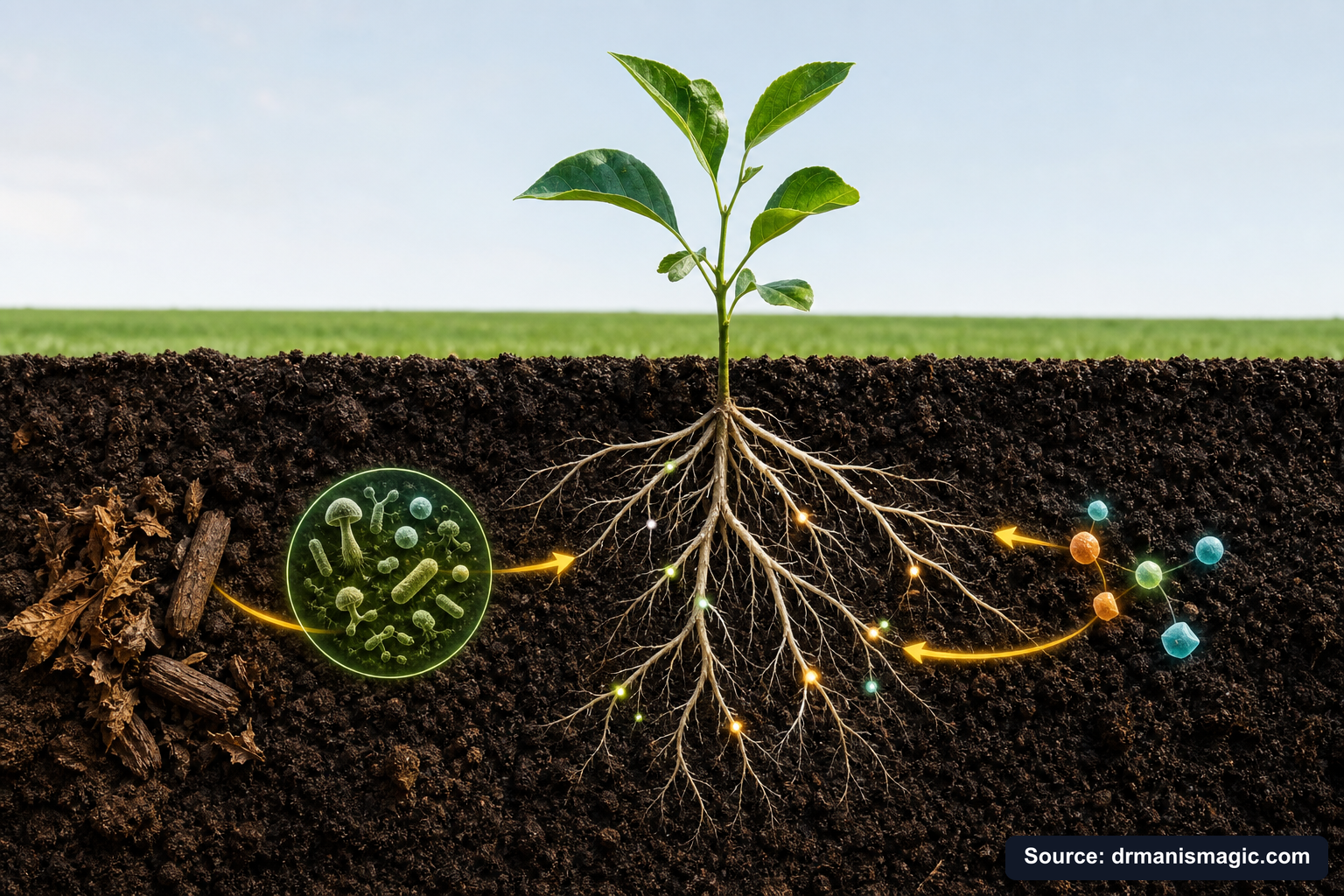
This is not a theory. This is the system plants evolved in over hundreds of millions of years. They built their entire biology around it.
When you pour salt-based fertilizer into the soil, you are not just feeding the plant. You are poisoning the crew that actually does most of the work.
And here is the part that changes how you think about organic fertilizer forever. Organic fertilizer does not just skip the microbes. It feeds them first. When you apply something like a crab, kelp, and amino acid fertilizer, the microbes in the soil eat it. They break it down. They convert it into exactly the forms the plant roots can absorb. Then, when those microbes die naturally, they release all of that stored nutrition directly into the root zone. Every dead microbe becomes a slow trickle of plant-available nutrition. It is a self-replenishing, time-release system that runs on biology, not chemistry. And it mirrors exactly how nutrients flow in nature.
This is why we built the Three Plant Pillars around live microbes as a non-negotiable foundation. No microbes means no resilience. No resilience means the first stressor, a heat wave, a heavy rain, a slightly heavy hand with the fertilizer, starts the root burn cycle all over again.
You Never Had a Brown Thumb.
You were handed the wrong tools. This free guide hands you the right ones.
You watered it. You fed it. It died anyway.
It was never you. It was the dirt, the salt food, and the bad advice.
This guide shows you what really went wrong, and how to fix it for good.
- Why your plants really died, and why it was never your fault
- The salt hiding in your plant food that quietly burns the roots
- The hidden killer in almost every bag of store soil
- The tiny helpers that grow a whole forest for free
- The rescue trick that brings a half dead plant back to life

Synthetic vs. Slow-Release vs. Organic Fertilizer: Which One Actually Helps Roots?
Synthetic fast-release fertilizers deliver a salt spike that stresses roots and kills microbes. Slow-release synthetics are better but still salt-based and often coated in plastic. Organic fertilizers like amino acid and kelp blends feed the microbial system first, release nutrients gradually at the plant's own pace, and build long-term root health instead of depleting it.
Let us put these three approaches side by side so you can see exactly what you are choosing.
| Feature | Synthetic Fast-Release | Synthetic Slow-Release (Coated) | Organic (Amino Acid / Chitin / Kelp) |
|---|---|---|---|
| Salt Index | Very high | Moderate to high | Low |
| Root Burn Risk | High, especially in containers | Lower but present | Very low |
| Impact on Microbes | Kills or suppresses beneficial bacteria and fungi | Still harmful to microbes over time | Feeds and supports microbial populations |
| Nutrient Release | Immediate spike, then crash | Gradual, but still chemically driven | Slow, biology-driven, self-regulating |
| PFAS / Biosludge Risk | Some products contain biosludge fillers with PFAS | Some contain biosludge; plastic coating stays in soil | Clean inputs: Zero PFAS, Zero Biosludge (when sourced properly) |
| Plastic Residue | No coating | Yes, plastic prills remain in soil | None |
| Container Use | High salt buildup risk | Moderate risk | Safe for regular monthly use with almost no overfeeding risk |
| Long-Term Soil Health | Degrades over time | Neutral to slightly degrading | Improves with each application |
Notice the last row. Organic nutrition does not just avoid doing damage. It actively builds soil health with every application. That is a fundamentally different relationship with your soil than anything a salt-based product can offer.
See also: Why Most Fertilizers Are Actually Salt in Disguise
What Are Amino Acids, Chitin, and Kelp Actually Doing for Your Roots?
Amino acids provide nitrogen in a plant-ready form that bypasses the osmotic stress of salt-based inputs. Chitin from crab shells triggers the plant's natural immune response and feeds beneficial microbes. Kelp delivers growth hormones called auxins, plus dozens of trace minerals that strengthen cell walls and improve stress tolerance. Together they rebuild the root environment salt-based fertilizers damage.
These three ingredients are not marketing buzzwords. Each one does a specific, documented job underground.
Amino acids are the building blocks of protein. When amino acid nitrogen reaches the root zone, the plant can absorb it almost directly. There is no salt spike. No osmotic shock. The plant regulates how much it takes in based on what it actually needs. That self-regulation is something synthetic nitrogen cannot offer. You cannot overfeed amino acid nitrogen the way you can overfeed ammonium nitrate.
Chitin comes from crab shells. It is the same compound that makes up the outer shells of insects and fungi. When chitin is present in the soil, the plant senses it and activates its immune system. It produces enzymes called chitinases that break down the cell walls of fungal pathogens, including the early stages of Pythium and Phytophthora. Meanwhile, the microbes in the soil eat the chitin and multiply. It is a two-for-one: you are building plant immunity and feeding the microbial army at the same time.
Kelp is one of the most nutrient-dense organisms on the planet. Cold-processed kelp delivers natural plant growth hormones called auxins and cytokinins. These hormones signal the plant to grow new root tips, which is exactly what a recovering root system needs most. Kelp also contains dozens of trace minerals, carbohydrates that microbes feed on, and compounds that improve the plant's tolerance to heat, drought, and cold stress.
Volcanic ash rounds out the picture with silica and a broad spectrum of micronutrients. Silica strengthens cell walls, which makes roots more resistant to physical damage and pathogen entry. Think of it as reinforcing the walls of a building before a storm hits.
When these four inputs work together in a single granular fertilizer, you are not just feeding the plant. You are rebuilding the entire underground ecosystem the salt cycle destroyed. Our Crab, Kelp & Amino Acids (7-4-4) was formulated with exactly this in mind: zero synthetic salts, zero biosludge, zero PFAS, and a complete spectrum of nutrition that works with your soil's biology rather than against it.
What About PFAS and Biosludge in Fertilizer? Should You Be Worried?
Some fertilizers, both synthetic and organic, use biosludge as a filler. Biosludge is treated municipal waste that can contain PFAS, which are man-made "forever chemicals" linked to health concerns. If you grow food, flowers, or plants in spaces your family uses, this matters. Clean inputs with no biosludge and no PFAS are the safer choice, especially for vegetable gardens, fruit trees, and containers near children or pets.
This is the part of the fertilizer conversation that almost nobody brings up. And it should be the first thing on the label.
Biosludge is treated municipal wastewater waste. It is sometimes used as a cheap filler in both synthetic and so-called organic fertilizers. The problem is that biosludge can carry PFAS, per- and polyfluoroalkyl substances, which are synthetic chemicals that do not break down in the environment or in the body. They accumulate. Scientists call them forever chemicals for a reason.
If you are growing fruit you plan to eat, vegetables your kids will pick straight off the vine, or herbs you will put in your food, this is not a small concern. It is the reason Dr. Mani refused to use biosludge fillers in any product bearing his name.
Zero PFAS. Zero biosludge. Zero synthetic salts. That is the standard we hold every batch to, because we use these products on our own trees, in our own nursery, in the same South Texas soil where our family works every day.
When you pick up a bag of fertilizer, it is worth asking: what else is in here besides the NPK numbers on the front?
How Do You Recover From the Root Burn Cycle? A Step-by-Step Protocol
Recovery starts with stopping the damage, not adding more inputs. Remove salt buildup, restore oxygen to the root zone, rebuild microbial populations, and return to gentle, biology-friendly nutrition. Most plants show improvement within four to six weeks when the cycle is broken and the right foundation is restored.
If your plant is in the root burn cycle right now, here is what to do. Follow these steps in order.
- Stop all synthetic fertilizing immediately. Do not add more salt to a salt-stressed root zone. Even if the leaves look hungry, feeding now will make things worse.
- Check drainage first. If water sits in the pot or around the base of the plant, the root zone is losing oxygen. Improve drainage before anything else. If the plant is in a container, check that the drain holes are open and working. If the soil is heavy, compacted, or smells sour, consider repotting into a mineral-based soil with good structure and long-term aeration. See also: Why Most Potting Mix Collapses Within 6-12 Months
- Leach salt from containers when drainage is adequate. For potted plants with working drainage, water deeply and slowly until water runs clear from the bottom. This pushes accumulated salts down and out. Do not do this if drainage is poor, as it will only waterlog the roots further.
- Remove any visible salt crust. Scrape white crystalline buildup from the soil surface and pot rims. This is concentrated salt that will dissolve back into the root zone every time you water.
- Do not fertilize the stressed plant until roots recover. Wait until you see new leaf growth or new root tips. That is the signal the plant has stabilized.
- Reintroduce beneficial microbes. A liquid drench of live bacteria, fungi, and mycorrhizae helps repopulate the root zone fast. Microbes suppress lingering Pythium and Phytophthora while rebuilding the nutrient delivery system. The Plant Super Boost liquid microbial formula was designed exactly for this kind of root zone reset.
- Return to low-salt, biology-friendly nutrition. Once the plant shows recovery signs, start a gentle organic fertilizer program. Granular amino acid and kelp-based fertilizers applied at normal rates are safe for ongoing monthly use with almost no risk of re-triggering the cycle.
Most plants, if caught before root rot has completely taken over, respond to this protocol within four to six weeks. You will see the new growth first. Then the color returns. Then the plant starts looking like itself again.
How Does the Three Plant Pillars Framework Prevent the Root Burn Cycle From Starting?
The Three Plant Pillars, mineral-based soil, live microbes, and organic fertilizer, address the three root causes of the root burn cycle before they can combine. Mineral soil provides permanent oxygen and drainage. Live microbes defend roots and cycle nutrients. Organic fertilizer feeds biology without salt spikes. Together they create conditions where the cycle cannot get started.
After 30 years of growing at our nursery and testing every input imaginable on over 250,000 trees, Dr. Mani Skaria distilled everything that worked into three non-negotiable foundations. We call them the Three Plant Pillars. They are not a marketing concept. They are the answer to every stage of the root burn cycle.
Pillar One: Mineral-Based Soil. Most potting mixes are made from pine bark, wood chips, and other organic matter that breaks down. As it decomposes, it compacts. It seals off oxygen. It creates the exact low-oxygen, poor-drainage environment where root rot and salt accumulation take hold. Mineral-based soil made from inert silica-rich sandy loam does not decompose. It does not compact. It holds its structure permanently, which means permanent drainage and permanent oxygen flow to the roots. That eliminates the oxygen-stress stage of the root burn cycle entirely.
Pillar Two: Live Microbials. Beneficial bacteria, fungi, and mycorrhizae form a living shield around the root zone. They outcompete pathogens like Pythium and Phytophthora for root surface space. They cycle nutrients continuously. They produce compounds that suppress disease. And they extend the plant's root reach far beyond what the physical roots can cover alone. When the microbial population is healthy and dense, the root burn cycle has no entry point.
Pillar Three: Organic Fertilizer. Salt-free, biology-friendly nutrition that feeds the microbes first and the plant second, in a slow, self-regulating trickle that mirrors the way nutrients move in nature. No salt spikes. No osmotic shocks. No microbe massacres. Just steady, clean nutrition that builds on itself with every application.
When all three pillars are in place, something remarkable happens. The plant stops being fragile. It stops being one bad week away from a decline spiral. It becomes, as Dr. Mani says, nearly bulletproof. Not because we did something exotic. But because we stopped fighting nature and started working with it.
You can learn more about how to put all three pillars together for your plants, whether you are growing grass, houseplants, fruit trees, flowers, or a full garden, through our Free Plant Care Field Guide. It is the same system we use every day in South Texas, written in plain language so anyone can follow it.
How Much Time Are You Losing to the Wrong System?
Every season spent in the root burn cycle is a season without healthy roots, real growth, or harvests. Salt-based inputs slow the biological clock underground even when the plant looks okay on the surface. Switching to a root-first system built on live microbes and organic nutrition is the fastest path to a plant that actually produces the results you planted it for.
Here is something nobody in the fertilizer industry wants you to think about.
You can always get more money. You cannot get more time.
The number one thing people tell us when they call our nursery is that they want to see their trees bear fruit while they still have time to enjoy it. Not someday. Not eventually. Now. And the cruel irony of the root burn cycle is that it steals exactly that. You spend a season trying this product. Another season recovering from that one. The plant goes up, plateaus, then slowly slides backward. You blame yourself. You think you have a brown thumb. But the truth is you were never given the right information to begin with.
The big chemical companies and big box stores profit when you stay confused. They sell you the fertilizer that stresses the roots, then the fungicide for the root rot that follows, then the soil amendment to fix the compaction that came after. Every problem creates the next purchase. That is not a gardening system. That is a subscription to failure.
The Three Plant Pillars break that cycle. Not slowly. When the right soil, the right microbes, and the right nutrition are all working together, plants respond within weeks. Real growth. Real color. Real fruit. Built on a foundation that keeps working long after you walk away from the garden.
The best time to break the root burn cycle was the first season you started gardening. The second best time is right now.
If you want to see exactly how the Three Plant Pillars work for any plant you are growing, from a single houseplant to a full backyard orchard, explore our complete Three Plant Pillars system and see what your plants were meant to look like all along. Every product comes with a 30-day money-back guarantee, because we are confident in what 250,000 tested trees taught us, and we want you to be too.
Frequently Asked Questions
If your plant keeps struggling even after you feed and water it, you are not alone. These are the questions we hear most from gardeners who are doing everything right but still watching their plants go downhill. The answers below will change how you think about fertilizer, roots, and soil forever.
What is the root burn cycle and why does it matter?
The root burn cycle is a hidden underground chain reaction. Salt-based fertilizer raises the salt level in your soil. That salt pulls water out of your roots instead of letting water in. Your roots shrivel. Oxygen disappears. Good microbes die. Then root disease moves in. Each stage makes the next one worse. We watched this pattern destroy beautiful plants across 250,000 trees at our South Texas nursery. It does not look like one bad day. It looks like slow, mysterious decline.
Why does my plant look thirsty even when the soil is wet?
This is called physiological drought. When salt concentration in the soil gets higher than inside your root cells, water flows out of the roots instead of in. Your plant is surrounded by moisture but cannot drink any of it. The roots are essentially locked out. Adding more water does not fix it. The salt has to go first. This is one of the most confusing and heartbreaking things a gardener can experience.
Can I save a plant that is already stuck in the root burn cycle?
Yes, but you have to stop making it worse first. That means no more salt-based fertilizer on a stressed plant. Flush the soil with clean water to help push salts out. Then rebuild from the ground up using the Three Plant Pillars. Start with mineral-based soil that drains well, add live microbes to bring the root zone back to life, and switch to organic slow-release nutrition. Recovery takes time, but the right foundation makes it possible.
How do synthetic fertilizers kill the good microbes in my soil?
Salt-based synthetic fertilizers are basically hostile to microbial life. The high salt concentration in the soil solution creates conditions that bacteria and fungi cannot survive. These are the same microbes that unlock nutrients, fight root disease, and help your roots absorb everything they need. Once they are gone, your plant is defenseless. It is like firing your entire immune system. Dr. Mani spent decades watching chemical companies ignore this, and it is exactly why he built Plant Super Boost around live, stable microbes instead.
What makes organic fertilizer safer for roots than synthetic fertilizer?
Organic fertilizers like Dr. Mani's Crab, Kelp, and Amino Acids formula release nutrients slowly. They do not dump a salt bomb into your soil all at once. Instead, they feed the microbes, and the microbes feed your plant in a steady, natural rhythm. There is no osmotic spike. No root burn. No microbial massacre. Your feeder roots stay intact, your soil stays alive, and your plant builds real strength instead of a short green flash followed by a crash.
Why does the type of soil I use matter so much for preventing root burn?
Most potting mixes are made from pine bark and wood that breaks down over time. As it rots, it compacts, squeezes out oxygen, and holds excess moisture around your roots. That wet, airless environment is exactly where root disease thrives after salt damage. Dr. Mani's Super Soil uses mineral-based sandy loam from South Texas that does not decompose. It drains fast, stays loose, and keeps oxygen moving through the root zone. Healthy oxygen levels are one of the best defenses against the root burn cycle.
How do I know if my plant has root burn and not just a watering problem?
The signs look almost identical, which is what makes root burn so sneaky. Brown leaf tips, yellowing, wilting, and slow growth can all point to either problem. The key clue is this: if your soil is moist and you recently fertilized, but the plant still looks stressed, root burn is the likely cause. A watering problem improves when you correct the water. Root burn does not. It keeps getting worse until you address the salt, the oxygen, and the microbes all at once.
About the Author
Ron Skaria, MD
Ron Skaria, MD, is the co-founder of Dr. Mani's Magic and the son of Dr. Mani. He trained as a medical doctor and now works full time on the family farm in Hargill, Texas, building Dr. Mani's Magic alongside his dad. He wrote the Brown Thumb Field Guide to put his father's 48 years of plant science into plain words any gardener can use. His belief is simple. You never had a brown thumb. You just never had the right help.


