


Why Sawdust-Based Potting Mix Is Designed to Rot Your Roots | Dr. Mani's Magic
Why Sawdust-Based Soil Is Designed to Rot: The Hidden Oxygen Problem Killing Your Container Plants
You repot your tree. You water it carefully. You even buy the expensive fertilizer. For a few months, everything looks great. Then, slowly, something changes. The leaves go pale. Growth stops. You water more, thinking it must be thirsty. But the soil stays wet for days. A sour smell drifts up from the pot. You dig your finger in and find dark, mushy roots where there used to be firm, white ones. You blame yourself. You think you overwatered. You think you have a brown thumb.
But here is the thing nobody told you. You did not kill that plant. The soil did. More specifically, the soil was always going to do this. It was engineered to decompose. And when it decomposed, it took your plant's oxygen with it. That smell you noticed? That is not just bad odor. That is the smell of a root zone slowly suffocating. The soggy soil that would not dry out? That is not overwatering. That is collapsed pore structure. The soil you trusted had been quietly rotting from the inside out since the day you opened the bag.
After growing more than 250,000 trees at our South Texas nursery, we have seen this pattern hundreds of times. A beautiful tree goes into a bag of fluffy store-bought mix. Eighteen months later, the grower calls us confused. The mix shrank away from the pot walls. The roots are brown. The leaves are yellow. And the soil, once light and airy, now feels like wet clay. This article is going to show you exactly why that happens, what is really in that bag you bought, and what the science of oxygen and soil structure actually tells us about growing plants that last.
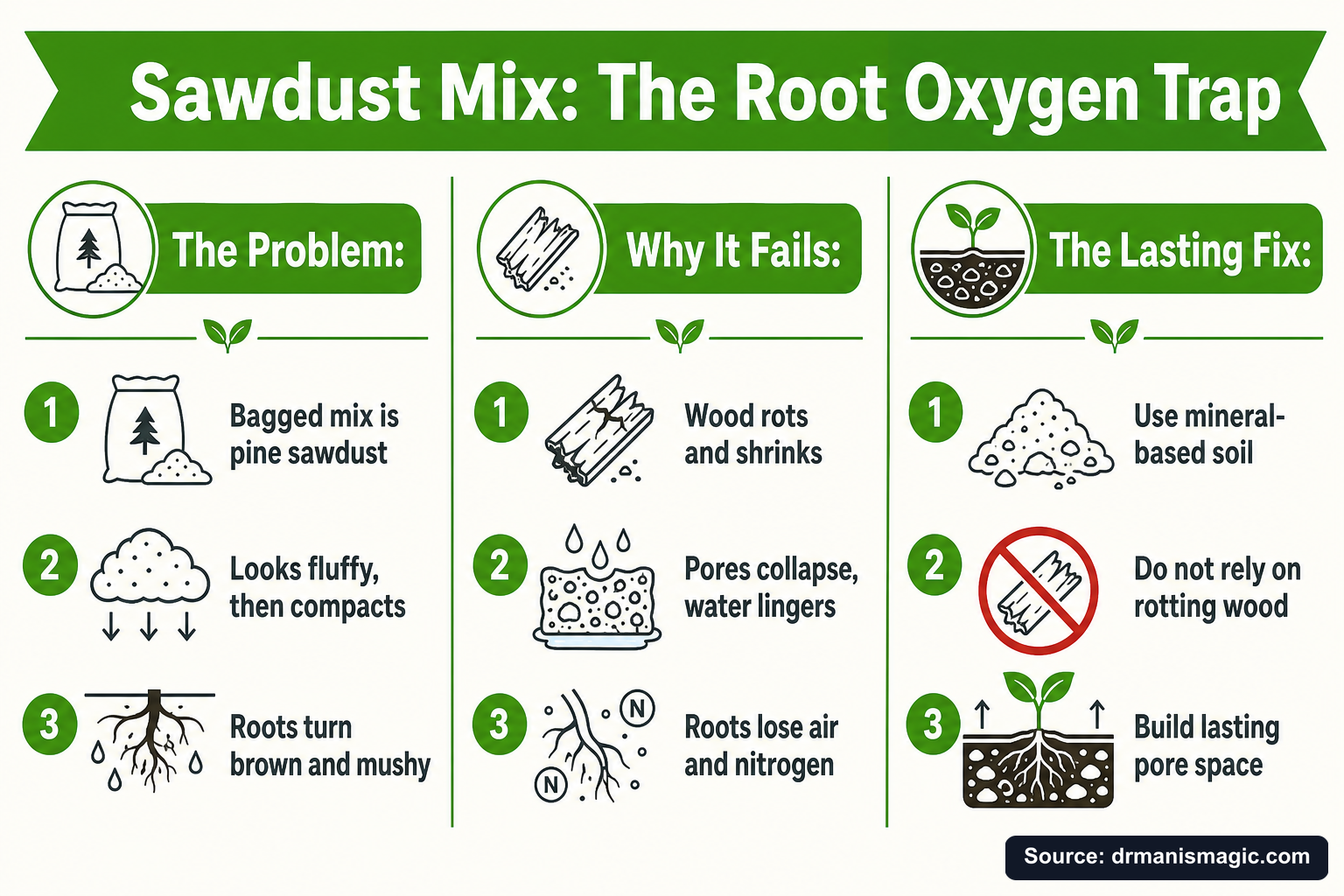
Key Takeaways
- Most potting mix is made from pine bark sawdust, a carbon-rich organic waste product from the timber industry that is biologically designed to break down.
- As sawdust decomposes, it shrinks, collapses pore space, and steals both oxygen and nitrogen from your root zone.
- Roots need oxygen just as much as they need water. When pore space disappears, roots suffocate and rot, even if you are watering perfectly.
- The perched water table inside a container makes oxygen loss happen faster and more severely than in open ground.
- Mineral-based soils built from silica and inorganic particles do not decompose, do not steal oxygen, and do not collapse over time.
- The fix is not better watering technique. The fix is separating structure from fertility and using durable materials to build lasting pore architecture.
- The Three Plant Pillars framework, developed and proven at US Citrus Nursery, starts with mineral-based soil as the non-negotiable foundation for any plant.
What Is Actually Inside a Bag of Potting Mix?
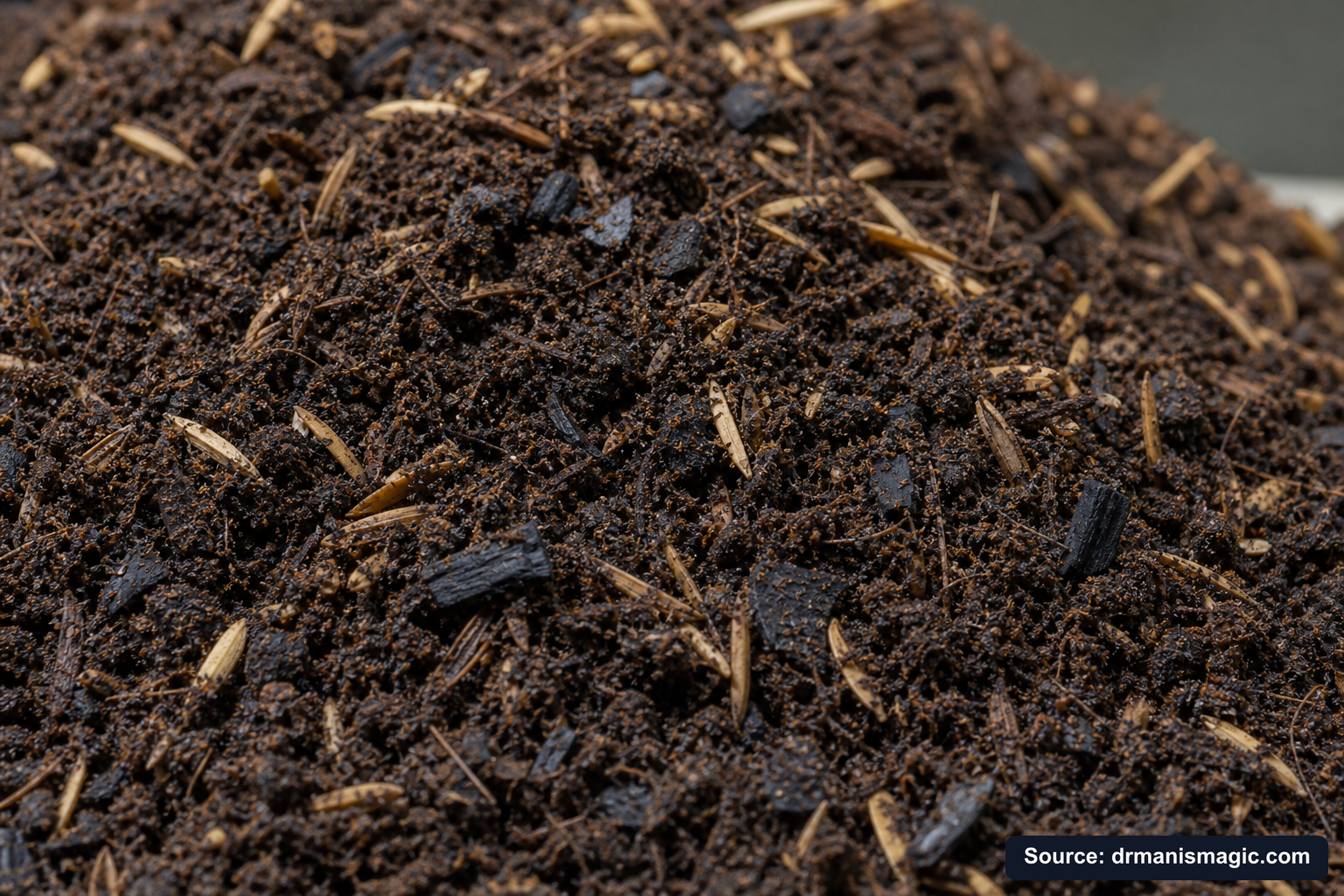
Quick Answer: Most bagged potting mix is made primarily from pine bark sawdust, a cheap waste product of the timber industry. It is not soil. It is finely shredded wood treated with surfactants to hold moisture. It works for a short time, then decomposes, compacts, and eventually collapses the root zone it was supposed to protect.
Have you ever noticed that your bag says "potting mix" and not "potting soil"? That is not an accident. It is not soil. It is not even close to soil. Real soil is ground-up rock. It is mineral. It is silica-based. It has been forming for thousands of years. What you get in that shiny bag from the big box store is mostly pine bark. Ground-up, shredded, compressed pine bark from the timber mills of the American Southeast, where pine forests are vast and sawdust is a cheap, abundant byproduct that costs almost nothing to collect.
Here is how the economics work. Timber companies produce enormous mountains of pine bark waste. Potting mix manufacturers buy it cheap. They grind it fine, pile it in giant mounds, let it partially decompose for a year or two to knock down some of the harshest chemicals, then bag it up and sell it to you as a premium growing medium. The profit margins are excellent. The shelf life is good. It looks and feels pleasant in your hands. And for the first few months in your pot, it actually works. That is the cruelest part of the whole story.
But before we go further, let us talk about what pine actually is at a chemical level. Pine wood is packed with compounds called terpenes and terpenoids. You already know some of them by name. Pine-Sol, the cleaning product, is named after them. Turpentine, the paint solvent, comes from distilled pine resin. These are powerful, biologically active compounds. They evolved in the tree to repel insects and resist decay. They are not gentle on living root tissue. They are not friendly to the beneficial microbes your plant depends on. That aging process in the giant decomposing pile? It is meant to break these chemicals down enough to make the product usable. But "less toxic than fresh pine bark" is a low bar to clear when you are talking about where your plant's roots will live for the next three years.
Then there is the moisture problem. Raw wood repels water. You have seen this yourself if you ever tried to wet a dry piece of lumber. Water just beads off. Sawdust behaves the same way. So manufacturers add surfactants, chemicals that help the wood fibers hold and absorb water instead of shedding it. This works beautifully when the bag is new. The mix feels moist, fluffy, and responsive. But those surfactants wash out. Every time you water, a little more of the chemical coating leaches away. After several months of regular watering, the wood fibers start to revert to their natural hydrophobic state. Old potting mix that has dried out completely becomes almost impossible to re-wet. You pour water on it and it runs straight down the sides of the pot and out the drain hole, barely touching the root zone at all. Meanwhile the center of the pot stays bone dry. Your plant is thirsty and drowning at the same time. No wonder people argue about overwatering on the internet.
Why Does Sawdust Steal Nitrogen From Your Plants?
Quick Answer: Sawdust has an extremely high carbon-to-nitrogen ratio, around 1000 parts carbon for every 1 part nitrogen. When microbes break it down, they consume huge amounts of nitrogen from the surrounding soil to do the job. That nitrogen comes directly from your plant's root zone. Your plant starves for nitrogen even when you are fertilizing, because the decomposing wood is eating your fertilizer first.
This is one of the most invisible problems in container gardening and almost nobody talks about it. Oregon State University Extension has documented it clearly: woody materials like sawdust can cause nitrogen deficiency for a surprisingly long time after they are introduced to a growing environment. The University of Georgia Extension goes further, contrasting sawdust's carbon-to-nitrogen ratio of roughly 1000 to 1 against pine bark's ratio of roughly 300 to 1, and explaining exactly why sawdust breaks down faster and causes more severe nitrogen tie-up once moisture and microbial activity are present.
Here is the plain-English version of what that means. Soil microbes are hungry. Their job is to break down organic matter. To do that work, they need nitrogen. Sawdust gives them enormous amounts of carbon to eat but almost no nitrogen to fuel the digestion. So they take the nitrogen from wherever they can find it. In your pot, that means they take it from the fertilizer you just applied. They take it from the nutrients already dissolved in the soil water. They pull it right out of the root zone before your plant ever gets a chance to absorb it. Your tree goes yellow. You think you are not fertilizing enough. You add more fertilizer. The microbes eat that too. You are running on a treadmill, and the sawdust is the machine keeping you on it.
This is not a conspiracy. It is basic soil chemistry. But it is chemistry that the companies selling you bags of pine bark sawdust have very little incentive to explain, because the solution involves not buying their product. See also: Why Most Fertilizers Are Actually Salt in Disguise for more on how the nutrient cycle gets disrupted at the root zone level.
What Is a Perched Water Table and Why Does It Matter in a Pot?
Quick Answer: A perched water table is a zone of permanently saturated soil that forms at the bottom of every container, regardless of how much drainage material you put there. It exists because water tension in fine-pored media holds moisture in place. In a pot full of decomposed sawdust, this saturated zone grows larger over time, pushing roots out of oxygen entirely.
Pull up a chair, because this is the physics most gardening content completely ignores, and it is the reason why "just add drainage holes" is not enough. Rutgers University Extension explains it this way: roots in a saturated container medium exist without air until enough water is used to create air spaces. Their research shows that oxygen stress becomes likely when air-filled porosity drops below about 10 percent of the total soil volume.
Think about what that means in practical terms. Every container, no matter how many holes are in the bottom, has a zone near its base where water does not drain away. It sits there, held in place by the surface tension of the water itself interacting with the fine particles of the growing medium. This zone is called the perched water table. In a tall pot, this zone is relatively small compared to the total volume. In a shallow pot, it can take up the entire lower half. In a pot filled with fine, decomposed sawdust, it can be enormous because fine particles hold water much more tightly than coarse ones do.
Now here is where decomposition makes everything worse. Fresh pine bark has relatively large particles with spaces between them. Those spaces hold air. Water can drain through them. Roots can grow into them and breathe. But as the wood breaks down, those particles get smaller and smaller. The big chunks collapse into fine fragments. Fine fragments pack together. Pore space disappears. The perched water table grows. What was once a well-draining medium becomes a sponge that holds water against roots for days at a time. Cornell University greenhouse media guidance confirms that aerobic root respiration requires continuous oxygen diffusion into pores and carbon dioxide diffusion out. When pores fill with water, that exchange stops. Roots begin to suffocate.
And here is the cruel irony. The plant that was thriving in its first year of a new potting mix is now sitting in what is effectively a slow-motion drowning chamber. The grower has not changed anything. Same watering schedule, same fertilizer, same location. But the medium changed. It decomposed. And now normal watering is too much, because the soil that used to drain in an hour now takes three days.
How Fast Does Potting Mix Actually Break Down?
Quick Answer: Meaningful decomposition in a typical sawdust-heavy potting mix begins within weeks of planting, accelerates as moisture and microbial activity increase, and produces noticeable structural collapse within 6 to 18 months. After two years, most standard potting mixes have lost a significant fraction of their original volume and nearly all of their original pore architecture.
Six months. That is roughly how long you have before a standard potting mix starts performing meaningfully worse than it did when it was new. This is not our opinion. This is the consistent pattern we observed growing more than 250,000 trees at our South Texas nursery, and it lines up with the soil science research on carbon-based organic media.
Here is the sequence. You open a fresh bag. The mix is fluffy, light, almost spongy. You can feel the air in it. You plant your tree or your flower or your houseplant and water it well. The water drains within minutes. The roots grow quickly because there is plenty of oxygen and the structure is open. Life is good. Then, quietly and invisibly, the biology begins. Microbes start eating the wood. Moisture and warmth speed them up. The fine particles multiply as the coarser ones break apart. Volume shrinks. You can see this in the gap that appears between the soil surface and the rim of the pot. That gap is not just settling. That is decomposed material that is gone. It became microbial biomass, gases, and water. It left the pot as carbon dioxide. Your potting mix is literally evaporating, and it is taking your root zone architecture with it.
By 18 months, a typical sawdust-heavy mix in a container plant has lost much of its original air-filled porosity. By two years, many growers report the symptoms that brought them to us: soil that stays wet for days, a sour or fermented smell from the pot, fine particles washing out of the drain holes, and roots that are brown instead of white when they inspect them. The plant looks like it is struggling despite correct care, because it is. The structure it needed to survive has been eaten away by biology.
And the big box stores? They know this cycle. They benefit from it. Annual plants, short-cycle vegetables, and fast-selling seasonal flowers all get replaced before the potting mix has a chance to fully collapse. The stores are not selling you a long-term growing system. They are selling you a system that requires regular replacement. That is a very different thing.
You Never Had a Brown Thumb.
You were handed the wrong tools. This free guide hands you the right ones.
You watered it. You fed it. It died anyway.
It was never you. It was the dirt, the salt food, and the bad advice.
This guide shows you what really went wrong, and how to fix it for good.
- Why your plants really died, and why it was never your fault
- The salt hiding in your plant food that quietly burns the roots
- The hidden killer in almost every bag of store soil
- The tiny helpers that grow a whole forest for free
- The rescue trick that brings a half dead plant back to life

Sawdust vs Pine Bark vs Mineral Soil: What Is the Real Difference?
Quick Answer: Sawdust is the most problematic wood-based ingredient because of its extremely fine particle size and very high carbon-to-nitrogen ratio, which causes the fastest decomposition and most severe nitrogen tie-up. Coarser pine bark performs better but still decomposes. Mineral-based silica soils do not decompose at all and maintain their pore structure permanently.
Not all wood products are the same. This is a critical distinction that almost every gardening article gets wrong by treating sawdust, bark fines, wood chips, and bark mulch as interchangeable. They are not. The differences are significant and directly affect how long your growing medium will support healthy roots.
| Ingredient | Particle Size | Carbon-to-Nitrogen Ratio | Decomposition Speed | Nitrogen Tie-Up Risk | Long-Term Pore Structure |
|---|---|---|---|---|---|
| Sawdust / Bark Fines | Very fine | ~1000:1 | Very fast once wet | Severe | Collapses within months |
| Pine Bark (medium) | Medium chunks | ~300:1 | Moderate (1-3 years) | Moderate | Degrades over 1-2 years |
| Aged Bark / Wood Chips | Coarse | ~150:1 | Slow | Low to moderate | Holds several years |
| Perlite | Coarse, porous | None (inorganic) | Does not decompose | None | Good, but lightweight and floats |
| Pumice / Lava Rock | Coarse, porous | None (inorganic) | Does not decompose | None | Excellent, durable |
| Silica Sand / Sandy Loam | Fine to medium | None (inorganic) | Does not decompose | None | Permanent, maintains drainage |
| Mineral-Based Sandy Loam (Super Soil) | Balanced mix | None (inorganic base) | Does not decompose | None | Permanent, optimal for roots |
The pattern is clear. The finer and more carbon-rich the ingredient, the faster it breaks down and the more damage it does on the way out. Sawdust is the worst-performing ingredient in this category, which makes it remarkable that it became the dominant base for the potting mix industry. The answer, again, is economics. Fine sawdust is cheap, plentiful, and lightweight for shipping. Those qualities serve the manufacturer, not your plant.
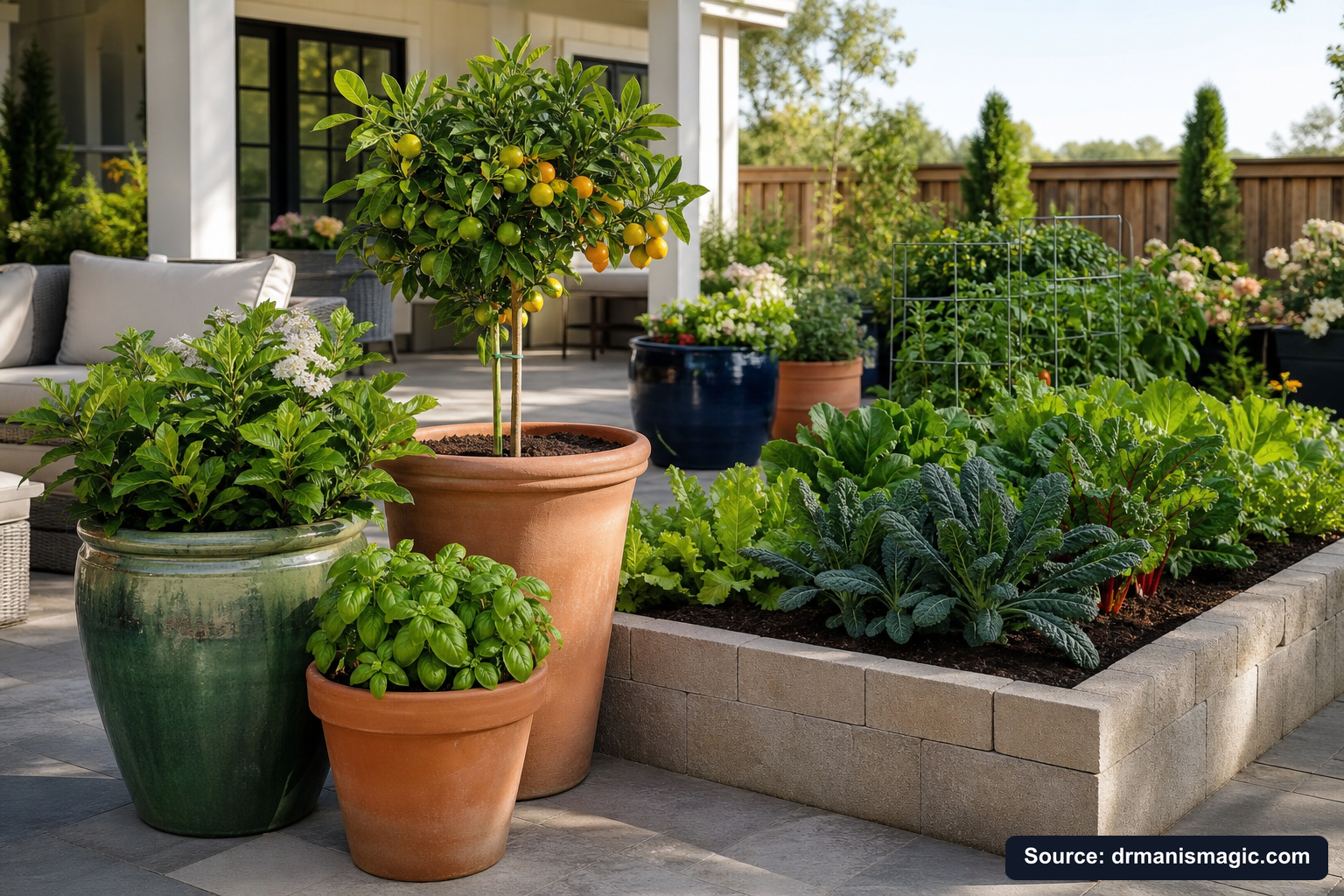
The ancient practice of bonsai figured this out centuries ago. Traditional bonsai masters use akadama clay, pumice, and lava rock as their primary growing media. These are all inorganic, mineral-based materials that do not decompose. The bonsai world has known for generations that long-lived container plants need durable mineral structure, not organic filler that rots away. We came to the same conclusion at our South Texas nursery after years of watching carbon-based mixes fail our citrus trees, and it led directly to the mineral-based soil philosophy behind the Three Plant Pillars framework.
What Are the Signs That Your Potting Mix Has Already Collapsed?
Quick Answer: Key signs of collapsed potting mix include soil shrinking away from the pot wall, a sour or fermented smell, soil that stays wet for more than two days after watering, brown or slimy roots, fine dark particles washing from drain holes, fungus gnats, yellowing leaves despite fertilizing, and dry pockets that repel water in the center of the pot.
Your plant cannot talk. But the pot is telling you everything if you know what to look for. Here is a quick diagnostic checklist organized by what you can see, smell, and feel.
| What You Notice | What It Means | Root Zone Status |
|---|---|---|
| Soil pulled away from pot wall | Volume lost to decomposition | Structure collapsing |
| Sour, fermented, or sewage smell | Anaerobic bacterial activity in saturated zone | Oxygen depleted below |
| Soil stays wet 2+ days after watering | Pore collapse, perched water table grown | Roots in standing water |
| Water runs straight through without absorbing | Hydrophobic dry zone (surfactants washed out) | Root zone drought despite watering |
| Fungus gnats | Consistently moist, decomposing organic matter | Wet, low-oxygen environment |
| Brown, slimy roots | Root rot from oxygen deprivation and pathogen invasion | Active root death |
| Yellowing leaves despite fertilizing | Nitrogen tie-up from decomposing carbon | Nutrients locked out |
| Fine dark particles at drain holes | Decomposed organic matter washing out | Further volume loss ongoing |
If you are seeing two or more of these signs, your potting mix has likely already collapsed past the point where it can recover on its own. The good news is the plant can recover. The mix cannot. Here is a simple recovery checklist to get roots back to health.
- Remove the plant gently and inspect the root ball. Trim away any roots that are brown, soft, or slimy with clean scissors.
- Rinse the roots with clean water to remove any decomposed material clinging to them.
- Let the root ball air out in open shade for 30 to 60 minutes. Oxygen is medicine for stressed roots.
- Clean the container completely. Remove all old potting mix. Rinse with clean water. Do not reuse collapsed media.
- Repot into a mineral-based, well-draining mix that will not decompose. Silica-rich sandy loam with stable organic amendments like coco coir and rice hulls is ideal.
- Water gently for the first two weeks. The recovering root system does not need heavy moisture while it rebuilds.
- Reintroduce beneficial microbes through a liquid microbial inoculant to help the root zone rebuild its protective ecosystem. See also: The Hidden Reason Synthetic Fertilizers Cause Root Rot for why this step matters.
Why Do Roots Need Oxygen and What Happens Without It?
Quick Answer: Roots use oxygen for cellular respiration, the process that gives them energy to grow, absorb water, and take up nutrients. Without oxygen, root cells begin to die within hours. Pathogens like Pythium and Phytophthora, the fungi behind most root rot, move in and colonize the weakened tissue. The plant above ground shows stress days or weeks after the damage below ground has already begun.
Here is a fact that surprises almost every new gardener. Your plant breathes carbon dioxide through its leaves. But its roots breathe oxygen through the soil. Both processes happen at the same time, in the same plant, and both are equally necessary for survival. Cut off either one and the plant dies. Most people understand the leaf side of this equation. Almost nobody thinks about the root side.
Roots need a continuous supply of oxygen for a process called aerobic respiration. This is how root cells generate the energy they need to do their jobs. Absorbing water takes energy. Taking up nutrients from the soil takes energy. Growing new root tips takes energy. Without oxygen, the cellular machinery that produces that energy shuts down. Root cells begin to die. The protective mucilage that coats healthy roots breaks down. The chemical signals that keep pathogens at bay stop broadcasting. And then the opportunistic fungi move in.
Pythium, Phytophthora, Fusarium. These are the names on the root rot lineup card. They are always present in the environment. Under normal conditions with healthy, oxygen-rich roots, the plant's own biology and the beneficial microbes in a good root zone keep them from causing damage. But in a low-oxygen, waterlogged environment full of decomposing organic matter? They thrive. They spread through the root system rapidly. By the time you see yellowing leaves or wilting above ground, the root system below may have already lost a significant portion of its functional tissue.
This is the core mechanism that we built the Three Plant Pillars around. Pillar One is mineral-based soil, specifically because mineral soil does not decompose, does not consume oxygen, and does not collapse pore structure over time. The silica particles in real sandy loam soil from the Rio Grande Valley are essentially permanent. They were formed over geological timescales. They will not break down in your lifetime, let alone in your pot. Your roots can breathe in them indefinitely. That is the promise that a bag of pine bark sawdust simply cannot make.
Potting Mix vs Mineral-Based Soil: The Head-to-Head Comparison
Quick Answer: Standard potting mix starts strong but structurally collapses within 6 to 18 months as it decomposes, stealing oxygen and nitrogen from roots. Mineral-based soil built on silica-rich sandy loam does not decompose, maintains pore structure permanently, and provides a stable foundation for roots, beneficial microbes, and long-term plant health.
Let us put the two approaches side by side so the difference is impossible to ignore.
| Property | Standard Potting Mix (Sawdust/Bark Based) | Mineral-Based Soil (Silica/Sandy Loam) |
|---|---|---|
| Primary ingredient | Pine bark sawdust (carbon-based, organic) | Silica sand / sandy loam (inorganic, mineral) |
| Decomposes over time? | Yes, continuously | No, permanent structure |
| Oxygen availability at roots | Declines as pores collapse | Stable, maintained long-term |
| Nitrogen tie-up risk | High (C:N ratio ~300-1000:1) | None |
| Useful life in a container | 6 to 18 months | Permanent (does not need replacement) |
| Water behavior when dry | Becomes hydrophobic, repels water | Rewets consistently and evenly |
| Volume stability | Shrinks as organic matter breaks down | Stable, no shrinkage |
| Root rot risk | High in year 2 and beyond | Low when drainage is maintained |
| Beneficial microbe support | Poor long-term (harsh pine chemistry, low oxygen) | Excellent (stable, neutral environment) |
| Cost over 5 years | High (requires frequent replacement) | Low (one-time investment) |
Look at the cost over time row. This is where the math becomes impossible to argue with. When you buy a bag of potting mix, you are not buying a permanent home for your plant. You are renting a temporary structure that will need to be replaced, probably more than once in the life of a perennial plant. Every repotting stresses the root system. Every repotting costs you time and money. Every repotting is another opportunity for something to go wrong. A mineral-based growing medium that does not decompose eliminates all of that. You plant once. You plant right. Your plant grows in that same stable, oxygen-rich environment for years.
We tested this at our South Texas nursery with our citrus trees, our houseplants, and our tropical trees. The results were so consistent that we built our entire product line around this principle. That led to Super Soil, our mineral-based, steam-sterilized sandy loam blend that includes coco coir, rice hulls, and biochar for a balanced structure that drains beautifully, holds just enough moisture, and never collapses. Zero synthetic salts. Zero PFAS. Zero biosludge. Made in the USA from South Texas sandy loam that has been supporting plant life in one of the most demanding climates in America for generations.
What Is the Right Long-Term Soil Mix for Container Plants?
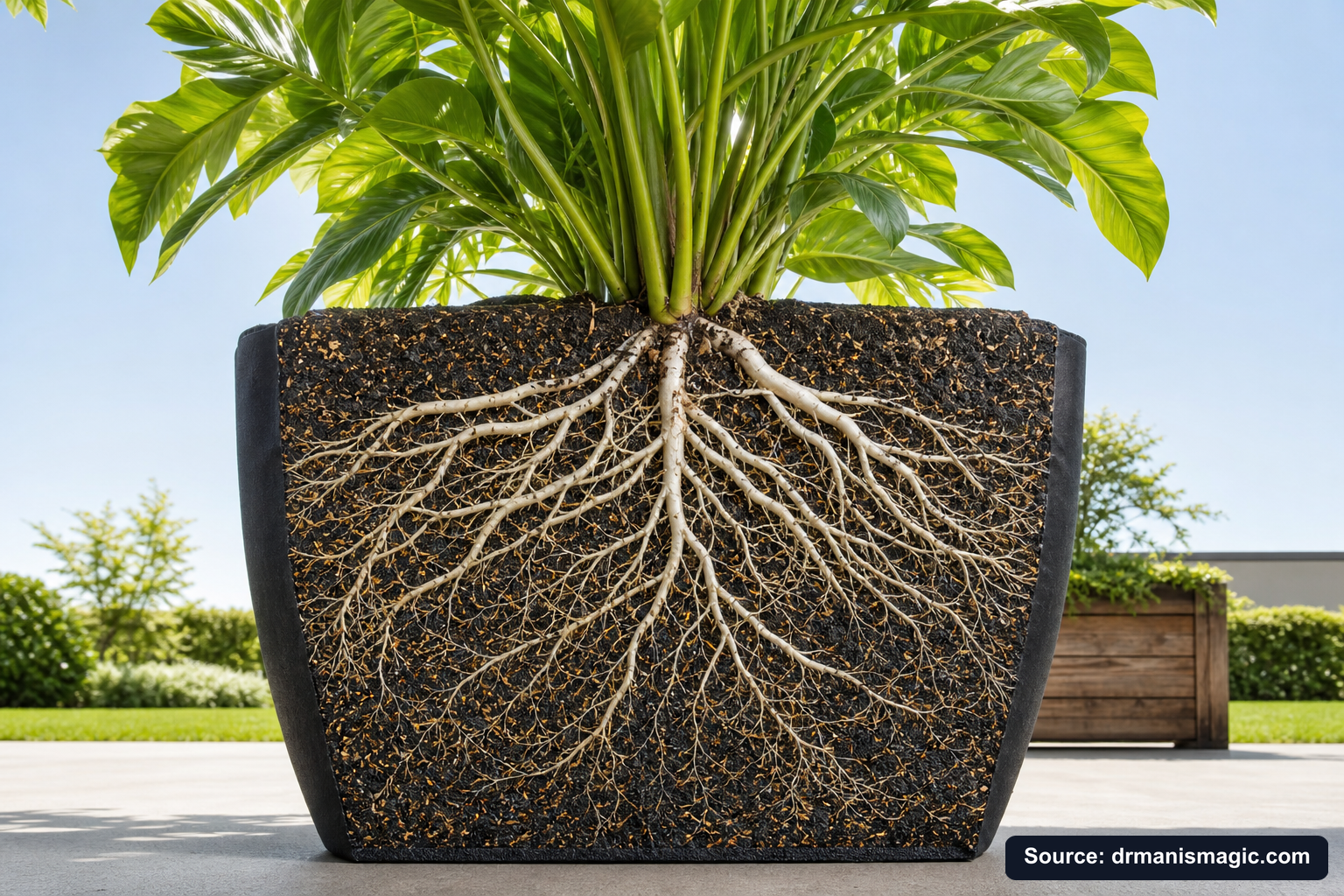
Quick Answer: The right long-term container mix separates structure from fertility. Use a durable mineral or stable organic skeleton to maintain oxygen pathways permanently, then manage nutrients separately through organic fertilizer. Fine sawdust as the bulk ingredient is the single worst choice for any plant you intend to keep alive for more than one growing season.
This is the principle that bonsai masters, serious orchid growers, and citrus nurseries all eventually arrive at from different directions. Separate structure from fertility. Do not ask one ingredient to do both jobs, because a material that rots away to feed microbes will eventually stop being a structure entirely.
Think of it this way. You would not build the foundation of your house from wood that you expected to rot. You would use concrete, brick, or stone. Permanent, inorganic materials that maintain their shape and load-bearing function indefinitely. Then you would furnish the inside of the house with things that can be changed and updated. The foundation is not the furniture. In a container plant, the mineral skeleton of the growing medium is the foundation. The nutrients from organic fertilizer are the furniture. They serve different roles, and they should come from different sources.
The practical formula is this. Start with an inorganic or very stable organic skeleton that makes up the majority of the mix. Silica-rich sandy loam, pumice, lava rock, coarse aged bark, and coco coir are all reasonable options depending on your plant type and climate. These materials maintain pore space over time. Then add fertility separately through a slow-release organic fertilizer that feeds the plant without disrupting the soil structure or killing the beneficial microbes that make the root zone function. That is the second and third pillar of the Three Plant Pillars framework, and it is why the system works when individual products fail.
Once the roots can breathe, once the microbes are present and thriving, and once the nutrients arrive in the right form at the right pace, plants respond in ways that look almost unfair compared to what the same plant was doing in a bag of decomposing sawdust. Faster growth. Darker leaves. Stronger stems. And fruit, if that is what you are growing, that actually sets and ripens instead of dropping off early from stress. We have watched this transformation happen on our own trees at US Citrus Nursery hundreds of times. It is not magic. It is just oxygen.
You can get money back. You cannot get time back. The grower who plants a citrus tree in collapsing potting mix and spends three years watching it struggle before finally making the switch has lost those three years of growth permanently. The grower who starts with the right foundation gets those three years of compounding root development and canopy growth working in their favor from day one. That difference, multiplied over the life of a long-lived tree, is enormous. It is the difference between seeing fruit on your tree in a few seasons versus wondering for a decade why nothing ever seems to really take off. Start with the foundation. Everything else follows from there.
To learn how the Three Plant Pillars work together as a complete system, including mineral-based soil, live microbials, and organic fertilizer, the Free Plant Care Field Guide walks you through everything step by step with no guesswork and no jargon. It is the same system we use on every tree we grow in South Texas, and we put it together so you do not have to spend years figuring it out the hard way.
Frequently Asked Questions
If your plants keep stalling, yellowing, or dying no matter what you do, the soil in the bag is almost always the hidden problem. These are the questions Dr. Mani hears most from growers who finally figured out why their plants were failing. The answers might surprise you.
Is sawdust bad for soil?
Yes, when it is used as the main ingredient in a potting mix, sawdust is genuinely bad for your plant's root zone. As it breaks down, it steals nitrogen and collapses the air pockets roots need to breathe. At our South Texas nursery, we watched this happen to tree after tree. That is exactly why Dr. Mani built Super Soil around mineral-based sandy loam instead. Mineral material does not decompose, does not steal nitrogen, and does not collapse. Your roots stay safe for years, not months.
What plants is sawdust good for?
Sawdust can work as a surface mulch for acid-loving plants like blueberries when it is fully composted first. But it is never a safe base for container plants, citrus trees, or tropical trees. We proved this across more than 250,000 trees at US Citrus Nursery. The moment you put a tree in a sawdust-based mix and seal it inside a pot, you have started a slow countdown to root rot. The container traps the decomposition. There is nowhere for the sour, oxygen-starved air to escape.
What do farmers use sawdust for?
Farmers use sawdust for animal bedding, composting, and odor control in barns. Those are smart uses because the sawdust is spread out in open air, not sealed in a container around living roots. The problem comes when the potting mix industry borrows that same cheap material and bags it up as premium growing medium. It is a waste product dressed up in a shiny bag. Dr. Mani saw this for what it was and refused to build his soil around it.
Can grass grow through sawdust?
Grass will not thrive in raw sawdust. As the wood breaks down, it pulls nitrogen straight out of the ground around it. That is nitrogen your grass seeds desperately need to sprout and push roots down. You end up with thin, pale, struggling turf. The same oxygen and nitrogen robbery that kills container trees also quietly wrecks lawns. A mineral-based soil foundation, paired with live microbes and organic fertilizer, gives grass the stable base it needs to grow thick and green without that hidden drain on its nutrients.
Does sawdust make good compost?
Sawdust can be a useful carbon source inside a compost pile when it is balanced with nitrogen-rich materials and given enough time to break down properly. But composted sawdust is very different from raw sawdust stuffed into a potting bag. Most store-bought mixes skip the full composting process. They partially decompose the pine bark, bag it, and sell it. That means the breakdown is still happening inside your pot, around your roots, stealing oxygen the whole time. Finished compost is not the enemy. Unfinished organic material sealed in a container is.
How long does it take for sawdust to decompose in soil?
In open ground, sawdust can take one to two years to fully break down. Inside a sealed container, the process changes. The pot traps heat and moisture, which speeds up decomposition. Pore space collapses faster. The soil shrinks away from the pot walls. Roots lose oxygen within months, not years. That is why growers call us confused after just one growing season. The mix looked perfect in the bag. By the time the roots turned brown, the damage was already done. Mineral-based soil sidesteps this entirely because it never decomposes in the first place.
What do lumber mills do with sawdust?
Lumber mills sell sawdust as fuel, animal bedding, and raw material for particleboard. They also sell it to potting mix manufacturers for almost nothing, because it is a byproduct they need to get rid of. That low cost is exactly why it ends up in your bag of premium potting mix. The timber industry solves its waste problem. The potting mix company cuts its production cost. And you end up with a product that was never designed to keep roots alive long-term. Dr. Mani saw this supply chain clearly and built Super Soil around silica-rich sandy loam from the Rio Grande Valley instead, a material that costs more to source but never rots, never compacts, and never steals oxygen from your plant.
About the Author
Dr. Mani Skaria, PhD
Dr. Mani Skaria, PhD, is a plant pathologist and the scientific founder of Dr. Mani's Magic. He earned his doctorate at Purdue University and spent 48 years studying how plants, soil, and living microbes work together, including his years as Professor Emeritus at Texas A&M and as a member of the USDA NAREEE Advisory Board. He invented micro-budding, a method for growing healthier, stronger trees, and has grown more than 250,000 trees on the family farm in Hargill, Texas - US Citrus Nursery. His life's work takes real lab science and practical experience and turns it into simple, safe, organic plant care anyone can use at home.


