


Why Organic Nutrition Is Slower but Safer for Your Plants | Dr. Mani's Magic
Why Organic Nutrition Is Slower but Safer: The Soil Biology Truth Nobody Told You
Picture this. You've just sprinkled a bright blue synthetic fertilizer around your favorite potted tree. The instructions said it would work fast. So you water it in, step back, and wait. A week later, the tips of the leaves are brown. Crispy. Almost like someone held a lighter to them. You did everything the bag said. So what happened?
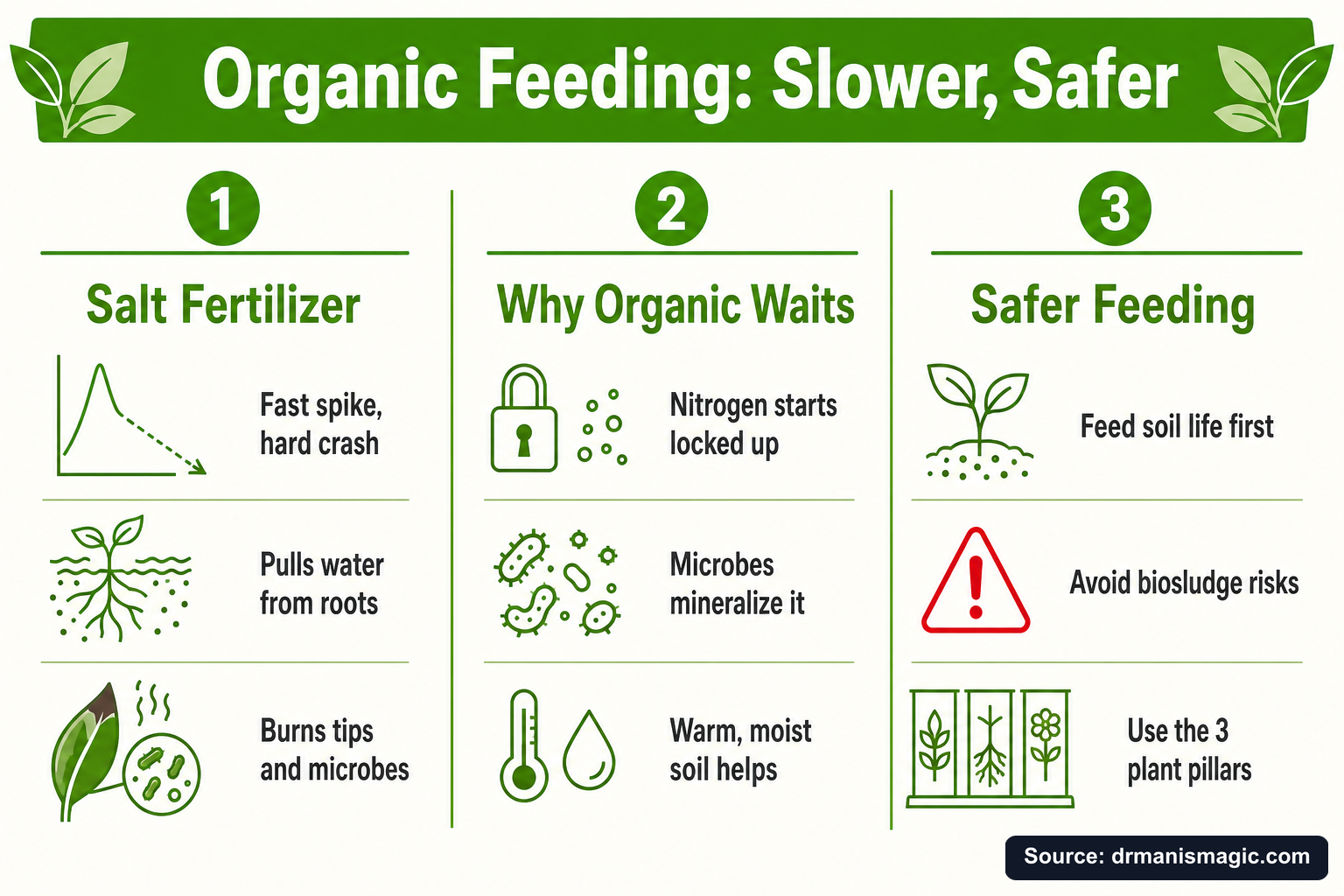
Here's what the bag didn't tell you. That bright blue powder is mostly salt. Salt dissolved in water pulls moisture away from roots. Your plant didn't get a meal. It got a burn. The roots tried to drink and instead got dehydrated. Farmers and plant scientists call it osmotic stress. We call it the moment gardeners lose confidence in themselves and start believing they have a brown thumb. But it's not your fault. You were handed the wrong tool and told it was the right one.
After growing over 250,000 trees at our South Texas nursery, we learned something that changed everything. The fastest way to grow a healthy plant is actually the slower way. Not because slow is better by accident. But because slow is exactly how nature designed it. And once you understand why, you'll never look at a bag of fertilizer the same way again. Keep reading. This is the part most garden centers hope you never figure out.

Plant Super Boost
Key Takeaways
- Organic fertilizers are slower because soil microbes must convert organic materials into plant-available nutrients before roots can absorb them.
- Most synthetic fertilizers are salt-based, and excess salt pulls water away from roots, burns root tissue, and kills the beneficial microbes your plant depends on.
- Organic fertilizer does not just avoid harming microbes. It actually feeds them first, and those microbes then feed your plant in a steady, natural trickle.
- Some "organic" fertilizers use biosludge, municipal waste, and contain PFAS "forever chemicals." Clean sourcing matters.
- Chitin from crab shells, hormones from kelp, and amino acid nitrogen all work together as a complete, biology-friendly nutrition system.
- The Three Plant Pillars — mineral soil, live microbes, and organic fertilizer — work as a system. Remove one and the whole thing weakens.
- The real cost of the wrong fertilizer is not just money. It is time. And you can never get time back.
Why Does Organic Fertilizer Take Longer to Show Results?
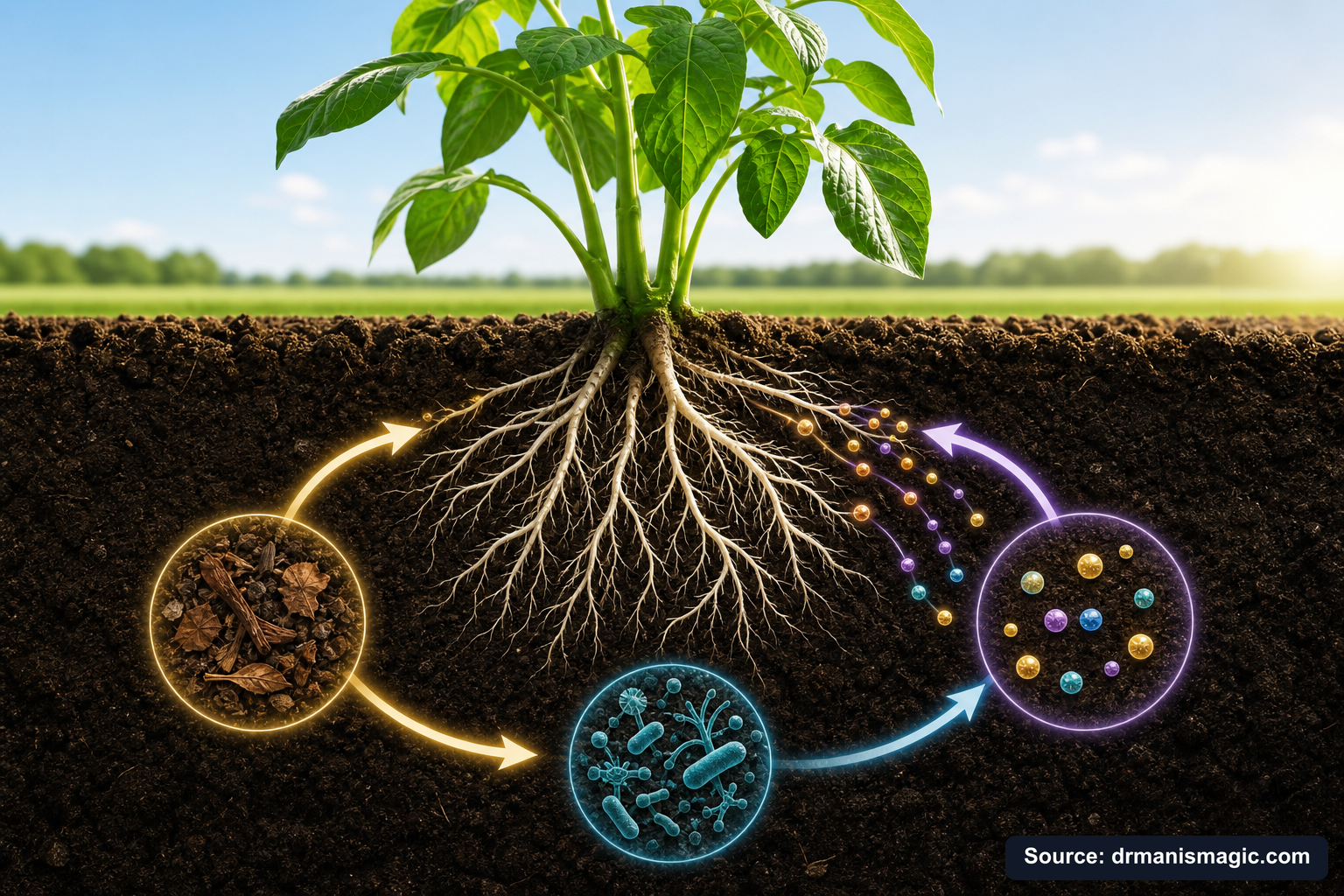
Quick Answer: Organic fertilizer takes longer because most of its nitrogen is locked inside proteins, amino acids, and carbon-based materials. Soil microbes must first break those materials down into simple mineral ions like ammonium and nitrate before your plant can absorb them. That process takes time, and it depends on soil temperature, moisture, and oxygen levels.
Think of it like this. Imagine you receive a gift card. You cannot spend it until you walk into a store and exchange it. Organic nitrogen is the gift card. The microbes in your soil are the store. Until that exchange happens, your plant cannot use the nutrition.
University of Georgia Extension explains this process as mineralization — the microbial conversion of organic nitrogen into inorganic ammonium and nitrate that plant roots can actually take up. Penn State Extension and Oregon State Extension both confirm that this microbial activity is controlled by three things: soil temperature, moisture, and oxygen. Cool, dry, or compacted soil slows the microbes down. Warm, moist, well-aerated soil speeds them up. (Penn State Extension: Nitrogen in Soils)
That is why organic fertilizer seems "lazy" in winter. The microbes slow down in the cold. They wake back up in spring, and your plant starts getting fed again. No spike. No crash. Just a steady, living rhythm.
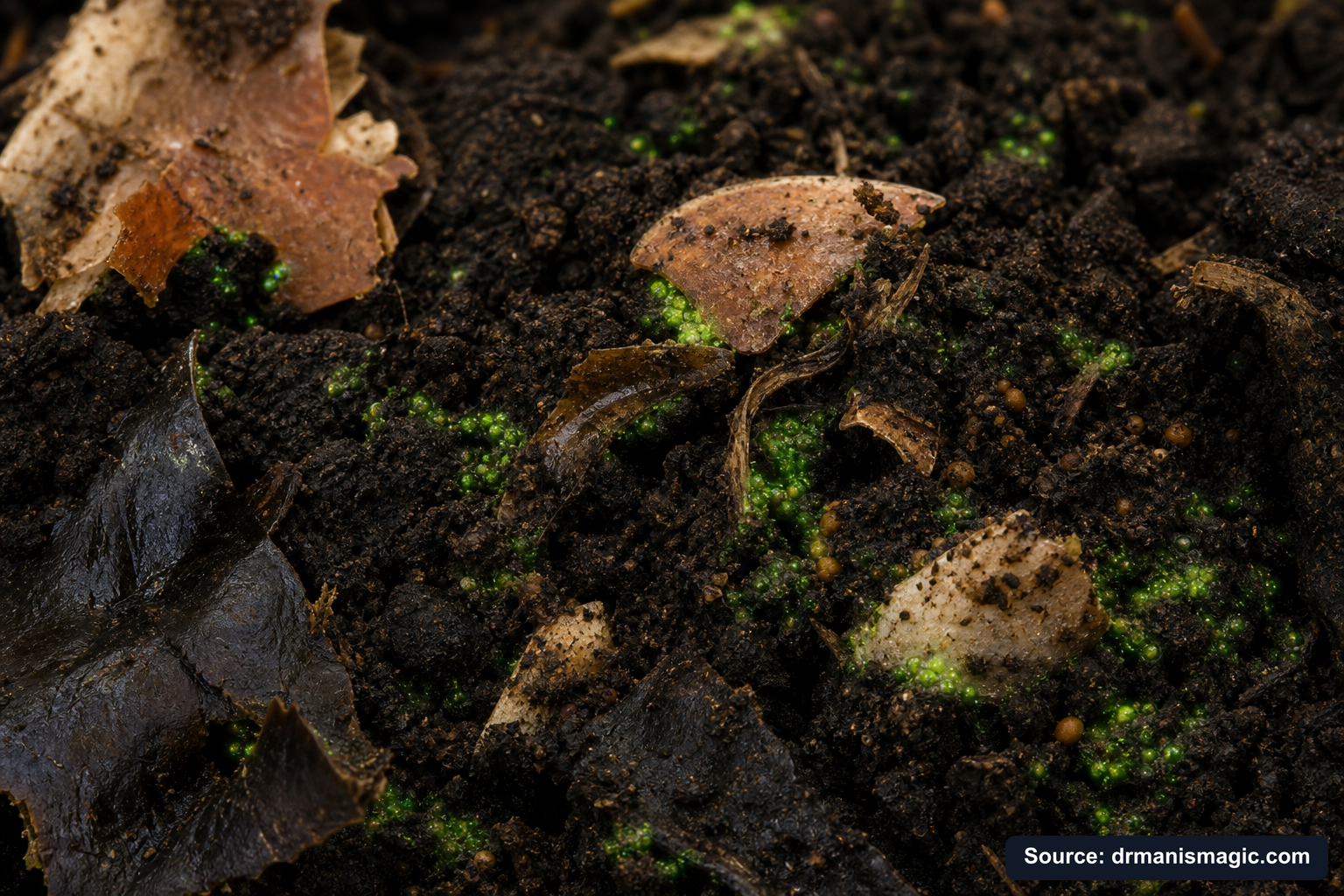
Here is the part most people miss. Organic fertilizer does not just avoid killing the microbes. It feeds them first. The microbes eat the organic material. They digest it. They convert it. Then, when those microbes eventually die, they release all that stored nutrition directly into the root zone in a simple, easy-to-absorb form. It is a living, self-replenishing delivery system. Nature invented it millions of years before humans invented fertilizer bags.
See also: Why Most Fertilizers Are Actually Salt in Disguise
What Does Salt-Based Fertilizer Actually Do to Your Roots?
Quick Answer: Salt-based fertilizers dissolve quickly and deliver an immediate nutrient spike, but excessive salts around roots create osmotic stress. The salt pulls water out of root cells instead of letting them drink. This can burn root tips, reduce water uptake, and leave your plant wilting even in wet soil — a condition called physiological drought.
Here is a simple way to picture osmotic stress. Take a cucumber and pack salt around it. Leave it for an hour. Come back and it will be wet and shriveled. The salt pulled the water right out of it. The same thing happens to tender root tips when salt concentrations get too high in the soil.
Maryland Extension, Colorado State Extension, and Michigan State Extension all describe this mechanism. When soluble salt levels climb too high, roots experience what scientists call physiological drought. The plant is surrounded by water but cannot drink it. The soil looks moist. The pot feels heavy. But the leaves still wilt. Brown tips appear. The gardener waters more. The problem gets worse.
It does not stop there. Salt also decimates your soil's microbial life. The bacteria and fungi that unlock nutrients, protect roots from pathogens like Pythium and Phytophthora, and build long-term soil health — they cannot survive in a high-salt environment. One heavy dose of a soluble synthetic fertilizer can wipe out the microscopic workforce your plant took months to build. (University of Georgia Extension: Soil Fertility and Fertilizers)
After that, the plant is defenseless. Root rot organisms move in. Growth stalls. The gardener buys more fertilizer, applies more, and the cycle continues. This is not a coincidence. This is the system.
See also: The Hidden Reason Synthetic Fertilizers Cause Root Rot
Organic vs Synthetic vs Slow-Release: Which Fertilizer Is Actually Right for Your Plant?
Quick Answer: Organic fertilizers are slowest but safest, with almost no burn risk and positive effects on soil microbes. Fast soluble synthetics are quickest but carry the highest burn and leaching risk. Synthetic slow-release products are middle-ground but often coated with plastic, and some organic options contain biosludge and PFAS. Clean organic sources like crab, kelp, and amino acids offer the best combination of safety, biology support, and complete nutrition.
| Fertilizer Type | Release Speed | Burn Risk | Microbial Impact | PFAS / Biosludge Risk | Best Use Case |
|---|---|---|---|---|---|
| Fast Soluble Synthetic (e.g. bright blue granules) | Immediate | High | Kills microbes via salt | Low (but salt damage is high) | Emergency green-up only; not for long-term use |
| Synthetic Slow-Release (plastic-coated prills) | Weeks to months | Moderate | Moderate harm from residual salt | Low PFAS; plastic shell residue in soil | Lawns where speed matters and biology is secondary |
| Biosolid-Based "Organic" (municipal sludge) | Slow | Low | Generally positive, but variable | High — PFAS confirmed in many products | Not recommended for food gardens, containers, or children's play areas |
| Natural Organic Meals (feather, blood, bone) | Slow to moderate | Low to moderate if over-applied | Positive — feeds microbes | Low if sourced cleanly | In-ground gardens and orchard trees |
| Crab, Kelp & Amino Acids (clean organic) | Slow and steady | Very low | Strongly positive — feeds and supports microbes | Zero PFAS, Zero Biosludge | All plants: containers, lawns, trees, gardens, houseplants |
| Compost | Very slow | Very low | Strongly positive | Depends on source | Soil building; best combined with a complete fertilizer |
The takeaway here is not that synthetic fertilizers are evil. The takeaway is that they are a tool designed for speed, not for biology. And if your goal is a living, thriving soil that keeps feeding your plant month after month, speed is not the point. Consistency is.
What Is Biosludge and Why Should You Care About PFAS in Fertilizer?
Quick Answer: Biosludge is treated municipal waste — essentially processed sewage — used as a filler in some fertilizers, including some labeled "organic." It often contains PFAS, a class of synthetic chemicals that do not break down in soil or in the human body. These are sometimes called "forever chemicals." They can accumulate in food crops and are linked to serious health concerns.
Here is something that does not appear on most fertilizer bags. Some of the most popular lawn and garden fertilizers on the market are bulked up with treated human waste. It goes by several names: biosludge, biosolids, municipal sludge. It is the processed material from wastewater treatment plants.
Now here is the part that should make you stop and think. PFAS — per- and polyfluoroalkyl substances — are a group of chemicals used in everything from non-stick cookware to firefighting foam. They end up in wastewater. They survive sewage treatment. They concentrate in biosolids. And when those biosolids go into your garden, those chemicals go into your soil.
PFAS do not break down. That is why they are called forever chemicals. Research from multiple university extension programs has flagged biosolid-derived fertilizers as a significant PFAS risk for food gardens and lawns where children and pets play.
Think about what that means. You are trying to grow food for your family. You are trying to create a space where your kids can run barefoot. And the fertilizer you are using might be introducing chemicals that do not leave. Ever.
Dr. Mani's Magic Crab, Kelp & Amino Acids contains zero biosludge, zero synthetic salts, and zero PFAS. That is not a marketing claim. It is a sourcing decision. You should know exactly what you are putting on the soil where your family lives.
You Never Had a Brown Thumb.
You were handed the wrong tools. This free guide hands you the right ones.
You watered it. You fed it. It died anyway.
It was never you. It was the dirt, the salt food, and the bad advice.
This guide shows you what really went wrong, and how to fix it for good.
- Why your plants really died, and why it was never your fault
- The salt hiding in your plant food that quietly burns the roots
- The hidden killer in almost every bag of store soil
- The tiny helpers that grow a whole forest for free
- The rescue trick that brings a half dead plant back to life

What Makes Crab Shells, Kelp, and Amino Acids So Powerful for Plants?
Quick Answer: Crab shells bring chitin, calcium, and magnesium. Chitin activates natural pest and disease resistance in the root zone. Kelp carries natural plant growth hormones called auxins, plus trace minerals and carbohydrates that stimulate root development. Amino acids provide a direct, easily absorbed form of nitrogen that supports both the plant and the microbes. Together they form a complete, clean nutrition system.
Let's walk through each one, because this is where the magic gets interesting.
Crab Shells and Chitin
Crab shells are not just a calcium source. They are loaded with a compound called chitin. Chitin is the same material that makes up the outer shells of insects and the cell walls of certain fungi. When chitin enters the soil, something remarkable happens. The microbes that feed on it happen to be the same microbes that suppress root-attacking fungi like Pythium and Phytophthora. You are essentially training your soil's army to fight the exact enemies that cause root rot. No sprays. No chemicals. Just biology doing what biology does.
Chitin also delivers calcium and magnesium. Calcium builds the woody structure of your plant. A large portion of every branch, trunk, and stem is calcium. Magnesium sits at the center of every chlorophyll molecule. Without it, your plant cannot photosynthesize. Without photosynthesis, nothing else matters.
Cold-Processed Kelp and Plant Hormones
Kelp is not just a seaweed. It is one of the most nutrient-dense organisms on the planet. Cold-processed kelp (the processing temperature matters — heat destroys the good stuff) carries natural plant growth hormones called auxins and cytokinins. These are the same hormones that tell roots to grow, tell buds to form, and tell fruit to set.
Kelp also brings a broad spectrum of trace minerals that land-based soils often lack. It brings carbohydrates that feed soil microbes directly. It is a biostimulant in the truest sense — it does not just feed the plant, it signals the plant to grow more aggressively.
Amino Acids as a Direct Nitrogen Source
Most nitrogen in organic fertilizers has to be converted by microbes before the plant can use it. Amino acids skip part of that line. They are already partially processed building blocks of protein. Plants can absorb certain amino acids directly through their roots. This gives organic fertilizer a gentle "fast lane" — not as fast as salt-based synthetics, but faster than raw organic materials, and with none of the burn risk.
Amino acid nitrogen also feeds microbes efficiently. The microbes eat it, multiply, and the whole living system gets stronger. More microbes means more nutrient cycling, more disease suppression, more root protection. Everything builds on itself.
Volcanic Ash and Trace Minerals
Volcanic ash brings something that most fertilizers completely ignore: silica and a broad range of trace micronutrients. Silica strengthens cell walls. Stronger cell walls mean more drought resistance, more physical protection from insects, and better overall plant resilience. Think of it as building the plant's skeleton alongside everything else. Trace minerals like iron, zinc, manganese, copper, boron, and molybdenum each play specific roles in enzyme function, chlorophyll production, and fruit development. Miss one and the whole system slows down. This is what plant scientists call the Law of the Minimum.
How Does Salt Damage Compare to Overwatering and True Root Rot?
Quick Answer: Salt damage, overwatering, and true root rot can all look similar from the outside — wilting, brown tips, yellowing leaves — but they have different root causes. Salt damage affects root cells through osmotic stress. Overwatering smothers roots by cutting off oxygen. True root rot involves fungal pathogens like Pythium or Phytophthora attacking weakened roots. Often all three happen together because salt and poor drainage create the perfect conditions for root rot to take hold.
| Symptom | Salt Damage | Overwatering (Oxygen Deprivation) | True Root Rot (Pythium / Phytophthora) |
|---|---|---|---|
| Leaf tips and edges | Brown, crispy, scorched edges | Yellow, soft, sometimes mushy | Yellow to brown; wilting despite wet soil |
| Root appearance | Brown, shriveled tips; surface roots look burnt | Soft, waterlogged, light tan to beige | Brown to black, slimy, foul odor |
| Soil condition | White crusty salt deposits on surface or pot rim | Stays wet for many days; no drainage | Often waterlogged and compacted |
| Plant response to watering | Worsens with more fertilizer; flush with plain water helps | Worsens with more water | Does not improve; continues declining |
| Primary cause | High salt index fertilizer; over-application of synthetics | Compacted organic potting mix; poor drainage; overwatering | Fungal pathogen; often triggered by oxygen deprivation from compacted soil |
| Microbial environment | Microbes suppressed or killed by salt | Anaerobic; beneficial microbes suffocate | Beneficial microbes absent; pathogens dominate |
Notice something in that table. All three problems share a common thread. The microbes are gone. Or dying. Or never there to begin with. This is why the Three Plant Pillars exist as a system. Mineral soil prevents compaction and oxygen loss. Live microbes suppress pathogens and cycle nutrients. Organic fertilizer feeds the microbes and the plant without introducing salt stress. Remove any one pillar and the other two get weaker. Keep all three in place and the whole system becomes remarkably resilient.
If you suspect your plant is already struggling, here is a simple recovery checklist:
- Stop all synthetic fertilizer immediately. Give the salt a chance to flush out.
- Water deeply with plain, unchlorinated water to leach excess salts through the drainage holes.
- Check the soil structure. If it smells musty, stays wet for more than four days, or has compacted into a hard mass, the potting mix has likely broken down and is starving roots of oxygen.
- Repot into mineral-based soil with proper drainage if the root zone is compacted or anaerobic. See also: Super Soil.
- Introduce live beneficial microbes to recolonize the root zone and start suppressing any remaining fungal pathogens. See also: Plant Super Boost.
- Begin a gentle organic fertilizer program once the plant shows new leaf growth, confirming root recovery.
- Be patient. Recovery is slower than damage. But it is real, and it lasts.
See also: How Salt-Based Feeding Quietly Destroys Root Systems
Does Slower Organic Nutrition Actually Work on Lawns, Flowers, Trees, and Houseplants?
Quick Answer: Yes. Organic nutrition works across all plant types because every plant depends on the same microbial soil ecosystem to access nutrients. The mechanism is identical whether you are growing lawn grass, roses, fruit trees, vegetable gardens, or indoor houseplants. Slower greening in the first two to three weeks is normal. What follows is a steadier, deeper, longer-lasting color and growth response compared to salt-based synthetic feeding.
We tested this across 250,000 citrus trees. We tested it in our grove. We tested it on houseplants, tropicals, and ornamentals. The results were consistent. The plants fed with clean organic inputs did not green up overnight. But after thirty days, they were darker green, more robust, and far less likely to show the stress symptoms we saw with synthetic programs.
Lawn owners often ask why their grass greens up slowly with organic fertilizer. Here is the honest answer. The microbes in your lawn need a few weeks to multiply and start mineralizing the organic nitrogen. In cool soil below 50°F, that process nearly stops. This is normal and temporary. Once soil temperatures rise and microbial activity ramps up, the lawn responds with deep, consistent color that does not fade between applications the way salt-spike greening does.
For container plants and houseplants, organic fertilizer is even more important than it is in-ground. Salts have nowhere to go in a container. They accumulate. Every application of a salt-based product builds the salt concentration a little higher. After a few months, you see it as white crust on the soil surface or around the pot rim. That is salt. And those roots are living in it.
For fruit trees, the slow-release nature of organic nutrition aligns with how trees actually grow. They do not need a huge nitrogen spike in spring and then nothing. They need a steady, consistent supply that supports vegetative growth, flower formation, fruit set, and fruit development across an entire growing season. That is exactly what microbe-mediated organic release provides.
The Three Plant Pillars framework was built on this exact insight. It was not built for citrus alone. It was built for any plant, in any container, in any garden, anywhere in the country.
Is Organic Fertilizer Always Safe? Can You Still Burn Plants With It?
Quick Answer: Organic fertilizer is much safer than salt-based synthetics, but it is not impossible to misuse. Very high applications of concentrated organic meals near seeds or tender roots can cause burn. The bigger risk with organic fertilizers is sourcing: some contain biosludge, sewage sludge, or high salt fillers that eliminate the safety advantage entirely. Choose clean, well-sourced organic inputs and follow application guidance.
We want to be honest with you here. The word "organic" does not automatically mean safe. It means carbon-based. Manure is organic. Sewage sludge is technically organic. Neither is something you want near your vegetable garden in high concentrations.
Utah State and Maryland Extension both note that concentrated organic nitrogen sources, like blood meal or feather meal applied in large amounts close to seeds or young roots, can cause localized burn. The mechanism is different from salt burn, but the damage is real. The rule is still the same as with any fertilizer: more is not better. Consistent and correct is better.
What makes clean organic fertilizers like crab, kelp, and amino acid blends so safe in practice is the salt index. The salt index is a measure of how much a fertilizer raises soil salt concentration relative to the same weight of sodium nitrate. Organic materials made from crab shells, kelp, and amino acids have a very low salt index. They can be applied regularly without accumulating dangerous salt levels. That is especially important in containers, raised beds, and any situation where drainage is limited.
The bottom line: organic nutrition is significantly safer than salt-based synthetic fertilizers when sourced cleanly and applied sensibly. But verify your source. Make sure there is no biosludge. Make sure there are no PFAS. And make sure the product was built to work with your soil's living biology, not in spite of it.
Why Is Time the Real Cost of Getting Fertilizer Wrong?
Quick Answer: Money lost on bad fertilizer can be replaced. The months and years your plant spent struggling, stunted, or dying cannot. Every season spent fighting salt damage, root rot, and microbial collapse is a season your tree did not grow toward the harvest you were hoping to see. Starting with the right foundation from the beginning is not just smarter. It is the only way to get back that time.
The number one thing people tell Dr. Mani when they call us is this: "I just want to see fruit on my tree while I'm still around to enjoy it." Not someday. Now. Or at least soon. They planted that tree with a vision. They can smell the fruit. They can picture their grandkids picking it. And then month after month, nothing. Or worse, the tree starts going backward.
You can get money back. You cannot get time back.
When you feed your plants the wrong way — even for just one season — you are not just wasting a bag of fertilizer. You are burning down the microbial ecosystem that took months to build. You are stressing roots that needed to be deepening. You are triggering a recovery process that takes longer than the damage did. Every cycle of salt-damage-and-recovery costs you a growing season. Two seasons. Three.
That is why Dr. Mani built the Three Plant Pillars as a first-principles foundation. Not a collection of tips. Not a product stack. A system that gets every variable right from the start so the plant can do what it was designed to do: grow, bloom, and produce. Fast. Because when the soil structure is right, the microbes are alive, and the nutrition is clean and steady, plants do not just survive. They thrive like they were always supposed to.
And that is not a theory. It is 30 years and 250,000 trees of proof.
If any part of this article made you stop and think about what you have been putting on your plants, that is exactly the right feeling to follow. The good news is that switching to biology-friendly nutrition is not complicated. You do not need a dozen products. You do not need a chemistry degree. You need a clean, complete organic fertilizer that feeds your microbes and your plant at the same time, from sources you can trust.
When you are ready to see what that looks like in practice, you can start by exploring our Free Plant Care Field Guide — a plain-English, step-by-step resource built from the same Three Plant Pillars philosophy that guides everything we do at Dr. Mani's Magic. Your plants have been waiting for this. So have you.
Frequently Asked Questions
Most gardeners have been told the same story for decades. Fast fertilizer equals fast results. But after growing over 250,000 trees in South Texas, Dr. Mani found out that story has a very unhappy ending. These questions get to the truth about why slower organic feeding is actually the smarter, safer path for your plants, your soil, and your family.
Is organic fertilizer actually safer for my plants and my family?
Yes, and here is why. Synthetic fertilizers are salt-based. Salt pulls moisture away from roots and kills the beneficial microbes your plant depends on. Organic fertilizer feeds those microbes first, and the microbes then feed your plant in a slow, steady trickle. No burning. No toxic residue. No warning labels. You can walk barefoot in your yard, let your kids play in the garden, and let your dog run free without worrying what they are touching.
Why does organic fertilizer take longer to work?
Organic nitrogen is locked inside proteins and carbon-based materials. Soil microbes must break those materials down into simple forms before your plant roots can absorb them. Think of it like a gift card. You cannot spend it until you walk into the store. The microbes are the store. That process takes a little time, but the result is a steady, natural feed that builds long-term health instead of creating a short spike followed by a crash.
Does slow feeding mean I will not see results for a long time?
Not at all. When all Three Plant Pillars are in place together, meaning mineral-based soil for drainage and root breathing, live microbes for nutrient unlocking, and organic fertilizer for clean slow-release feeding, most gardeners see real improvement within the first month. The system works fast because every piece supports the others. It is not slow because nature is lazy. It is steady because nature is smart.
Can synthetic fertilizers actually damage my soil long term?
Yes. Salt-based synthetic fertilizers wipe out beneficial bacteria and fungi every time you use them. Those microbes are the living engine of your soil. Once they are gone, your plant becomes dependent on the next dose of synthetic fertilizer to survive. It is a cycle that benefits the fertilizer company, not your garden. Over months and years, the soil gets weaker, not stronger. That is why so many gardeners feel like they are losing ground no matter how much they spend.
Are all organic fertilizers clean and safe to use around food plants?
No, and this matters a lot. Some products labeled organic are made from biosludge or municipal waste and can contain PFAS, which are called forever chemicals. That is not what you want near vegetables or fruit trees. Dr. Mani's Magic Crab, Kelp, and Amino Acids fertilizer uses clean, traceable inputs. Crab shell chitin, cold-pressed kelp, and amino acid nitrogen work together as a complete biology-friendly nutrition system with no toxic shortcuts and no foul smell.
What is the real cost of using the wrong fertilizer?
The money you waste on cheap fertilizer stings. But the real cost is time. After a few months of synthetic feeding, your soil starts to collapse. Microbes die off. Roots weaken. Growth stalls, then goes backwards. You cannot undo those lost months or years. Dr. Mani hears from gardeners every week who spent years fighting their plants before they found the Three Plant Pillars. The number one thing people tell him is they just want to see their tree bear fruit while they still can. Do not let the wrong fertilizer steal that from you.
Is the organic approach just a marketing trend, or is there real proof behind it?
Dr. Mani spent 35 years as a plant scientist and tested this system on over 250,000 citrus trees at US Citrus Nursery in South Texas before bringing it to home gardeners. This is not a trend. The Three Plant Pillars, mineral soil, live microbes, and organic fertilizer, are built on how nature actually grows plants. Big chemical companies have been selling synthetic shortcuts since the 1950s. Dr. Mani's Magic exists to give you the real foundation they never wanted you to have.
About the Author
Dr. Mani Skaria, PhD
Dr. Mani Skaria, PhD, is a plant pathologist and the scientific founder of Dr. Mani's Magic. He earned his doctorate at Purdue University and spent 48 years studying how plants, soil, and living microbes work together, including his years as Professor Emeritus at Texas A&M and as a member of the USDA NAREEE Advisory Board. He invented micro-budding, a method for growing healthier, stronger trees, and has grown more than 250,000 trees on the family farm in Hargill, Texas - US Citrus Nursery. His life's work takes real lab science and practical experience and turns it into simple, safe, organic plant care anyone can use at home.


