


Why Kelp Works Best in Living Soil Systems | Dr. Mani's Magic
Why Kelp Works Best in Living Systems: Microbes, Roots, Hormones, and Low-Salt Plant Nutrition
Picture this. You're standing in your backyard on a warm Saturday morning. Coffee in hand. The air smells like fresh earth after last night's rain. You look at your fruit tree. Your garden beds. Your lawn. And something feels off.
The leaves aren't quite right. A little pale. A little tired. You fed that tree. You watered it. You did everything the bag said to do. But the plant looks like it's just... surviving. Not thriving. Not the lush, green, fruit-heavy tree you pictured when you planted it. And here's what nobody told you: the problem might not be what you're missing. It might be what you're adding. Specifically, the salt hiding inside that fertilizer bag.
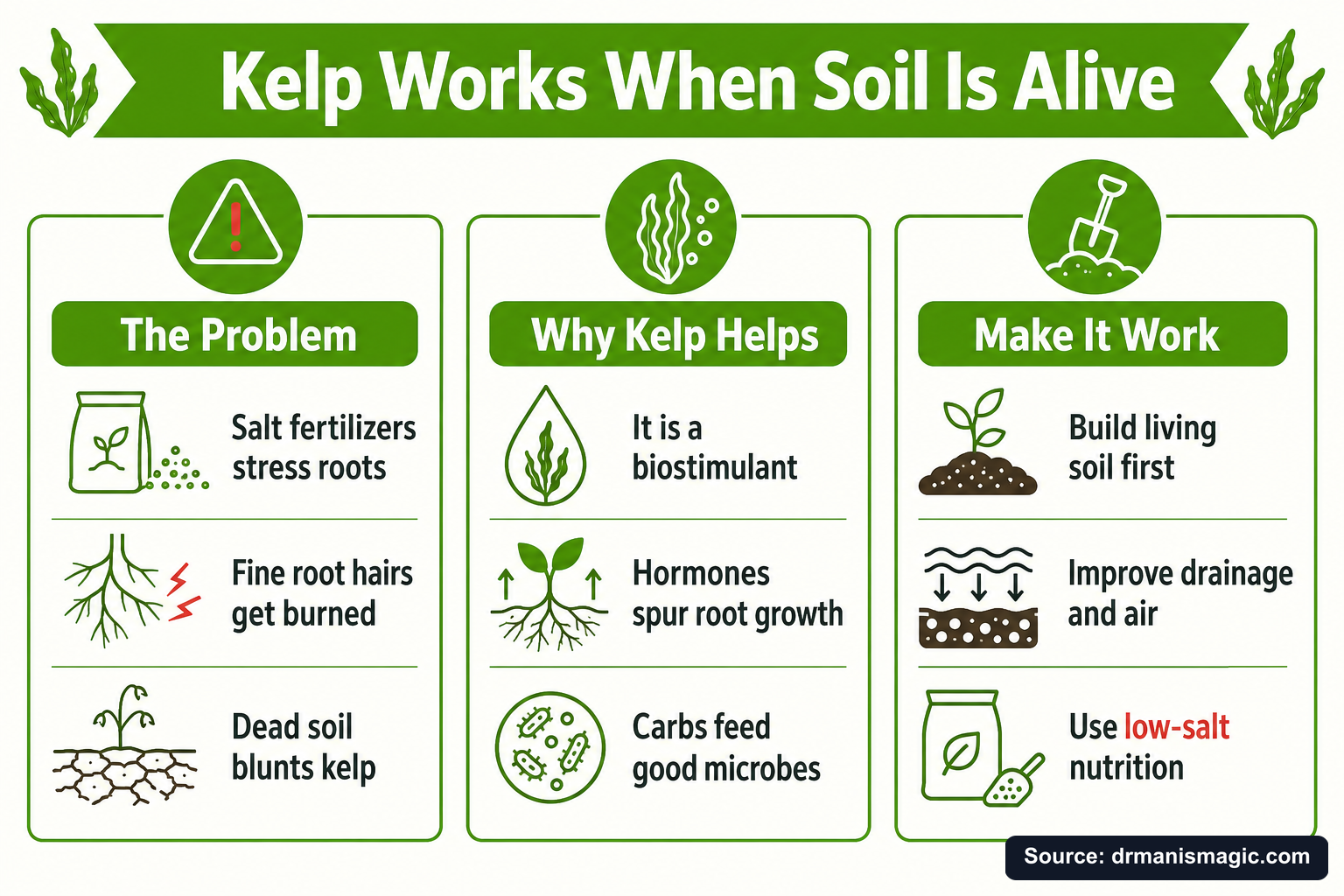
Here's where kelp comes in. Not as a miracle fix. Not as a replacement for real plant nutrition. But as something far more interesting. Kelp is what scientists call a biostimulant. Think of it less like plant food and more like a signal flare that wakes up the living system already inside your soil. But here's the catch that changes everything: kelp only works when that living system is actually alive. And most gardeners, without knowing it, have been quietly killing it. Let's fix that right now.

Organic Fertilizer | Crab, Kelp & Amino Acids
Key Takeaways
- Kelp is a biostimulant, not a high-NPK fertilizer. Its biggest job is signaling and supporting root biology, not directly feeding plants.
- Kelp works best in living soil because it needs active microbes, healthy roots, and good drainage to do its job.
- Salt-based synthetic fertilizers damage the very root zone that kelp is trying to support. University extension research from Colorado State, Utah State, and Minnesota all confirm salt damage to roots and soil microbes.
- Kelp contains natural plant hormones called auxins and cytokinins that help roots grow and help plants handle stress.
- Chitin from crab shells activates natural disease resistance in plants and feeds beneficial soil organisms.
- Amino acids deliver a clean, plant-ready form of nitrogen that feeds microbes and plants without the salt spike.
- The Three Plant Pillars, developed at US Citrus Nursery after growing 250,000+ trees, are the foundation that makes kelp actually work.
What Is Kelp, and Is It Actually a Fertilizer?
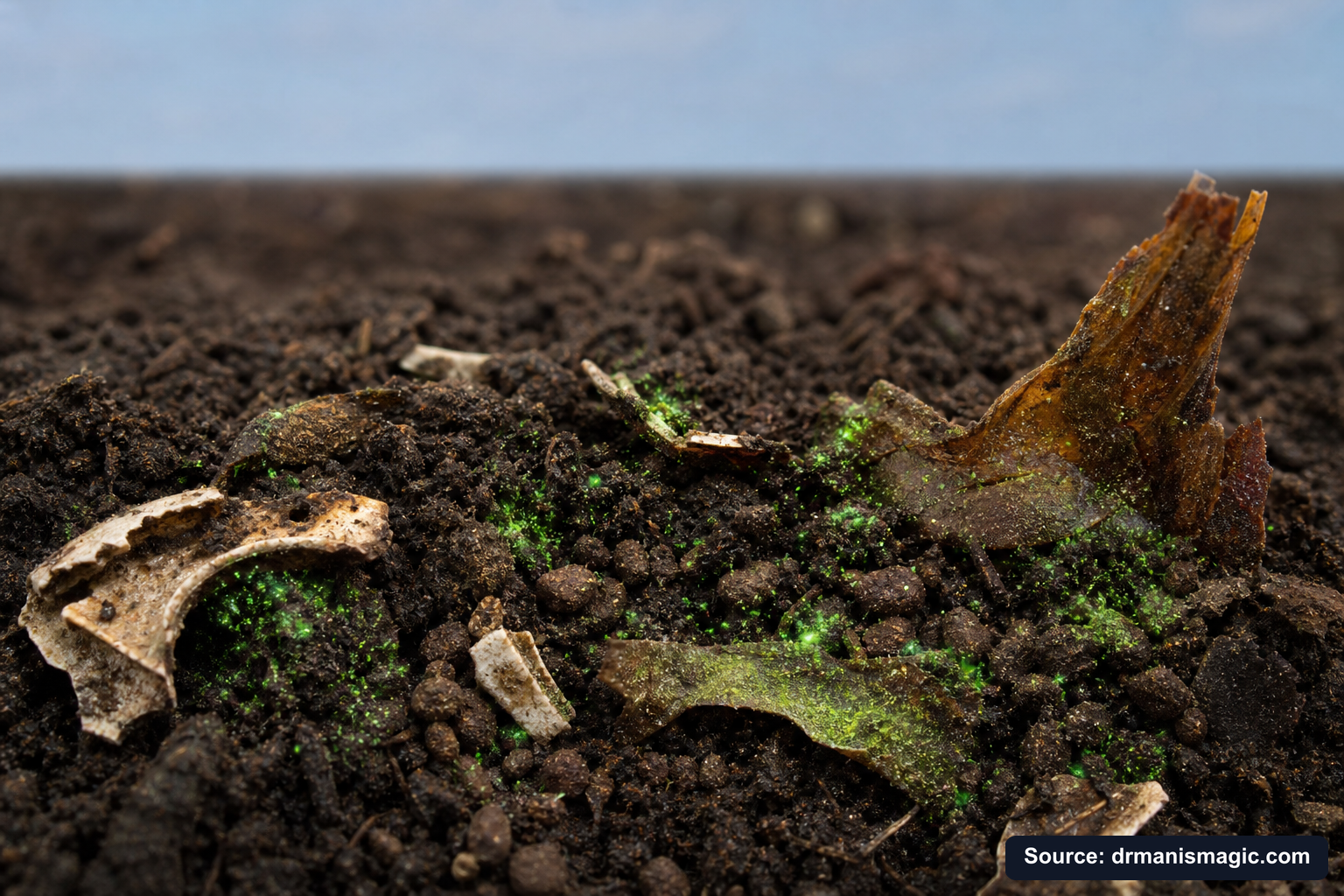
Quick Answer: Kelp is not a traditional fertilizer. It is a biostimulant. Its NPK numbers are very low. Its real power comes from plant hormones, trace minerals, carbohydrates, and compounds that wake up soil microbes and help roots grow better, handle stress, and absorb nutrients more efficiently.
Most people pick up a bag of kelp meal or a bottle of liquid seaweed and check the NPK numbers first. They see something like 1-0-2 and put it back on the shelf. That's a mistake. Because those numbers are almost beside the point.
Kelp is a type of large brown seaweed that grows in cold ocean water. When it's harvested and processed correctly, it carries something your garden soil cannot make on its own: a dense library of biological signals. Natural plant hormones. Complex carbohydrates that soil microbes love to eat. Trace minerals from the ocean. Compounds that help roots branch and stretch and soak up nutrients at a higher rate.
University researchers describe seaweed extracts as improving nutrient-use efficiency, root architecture, stress tolerance, and microbial activity in soil. That is very different from what a bag of synthetic nitrogen does. Synthetic fertilizers dump a fast dose of soluble salts into the root zone. Kelp, by contrast, whispers to the biology already living in your soil and asks it to work harder.
That distinction matters more than almost anything else in this article. So let's dig into the biology.
Why Does Kelp Need Living Soil to Work?
Quick Answer: Kelp feeds and signals into the rhizosphere, the living world around your roots. If that world is dead or damaged from salt, compaction, or overwatering, kelp has nothing to amplify. Living soil with active microbes is the system kelp is built to work inside.
Kelp is a biological amplifier. That phrase is important. An amplifier does not create the signal. It makes an existing signal stronger. Kelp cannot build a living root system from nothing. It cannot replace dead microbes. It cannot drain waterlogged soil or fix compacted clay by itself.
What it can do is take a root zone that already has oxygen flowing through it, has active bacteria and fungi working the soil, and has organic matter for those microbes to eat, and make that whole system hum louder.
The University of Minnesota Extension explains that soil organisms drive nutrient cycling, nutrient retention, disease suppression, and much of the plant-available nitrogen and phosphorus that plants actually use. Penn State Extension research echoes the same idea: your soil is not a passive growing medium. It is a living community. Bacteria, fungi, mycorrhizae, protozoa, nematodes. All of them working together to break things down, build things up, and shuttle nutrition into plant roots.
Kelp plugs directly into that community. Its carbohydrates feed the bacteria. Its hormones signal root cells to grow more hair-like extensions that touch more of the microbial web. Its trace minerals fill gaps that synthetic programs often leave empty. When the community is thriving, kelp multiplies the benefit. When the community is wiped out, kelp has almost nowhere to land.
This is why two gardeners can use the same kelp product and get completely different results. One has living soil. One has been pouring salt-based fertilizer on their beds for three years. Same product. Completely different outcomes.
What Do Salt-Based Fertilizers Actually Do to Your Root Zone?
Quick Answer: Salt-based synthetic fertilizers raise the salt concentration around roots, pull water out of root cells through osmotic stress, burn fine root hairs, and kill the beneficial microbes that your plants depend on. This is called physiological drought. Your plant sits in moist soil and still cannot drink.
This is the part that nobody at the big box store will tell you. And it is the part that changes everything.
When you pour a synthetic fertilizer on your soil, you are adding salts. Every major synthetic fertilizer is salt-based. Ammonium nitrate. Potassium chloride. Monoammonium phosphate. All salts. And salts in the root zone do something that feels deeply counterintuitive: they pull water away from the roots instead of toward them.
This is called osmotic stress. The scientific term is physiological drought. Your plant is sitting in perfectly moist soil, and it is still dying of thirst because the salt concentration outside the roots is higher than inside. Water flows toward concentration. The roots lose moisture instead of gaining it. You can see this as wilting, browning leaf tips, and root burn even when you are watering faithfully.
Colorado State University Extension, Utah State University, University of Maryland, University of Minnesota, and Kansas State University Extension have all published research and extension guides warning about soluble salt damage to roots. They document how salt restricts water uptake, burns roots, inhibits seed germination, stunts growth, and injures turf, flowers, trees, and vegetables. This is not a fringe idea. It is textbook plant science.
And here is the part that connects directly back to kelp. Those same salts that burn your roots kill the microbes that kelp is designed to feed. You cannot have it both ways. You cannot pour salt on your soil every month and then expect kelp to go in and wake up a thriving microbial community. The community was the first casualty.
After growing more than 250,000 trees at our South Texas nursery at US Citrus Nursery, we watched this pattern play out again and again. Trees that had been hit with synthetic salt fertilizers looked okay on the surface for a season or two. Then the root zone quietly collapsed. The microbes were gone. The fine feeder roots were burned. The tree was on life support.
See also: The Hidden Reason Synthetic Fertilizers Cause Root Rot
What Plant Hormones Does Kelp Contain and Why Do They Matter?
Quick Answer: Kelp contains natural plant growth hormones called auxins and cytokinins. Auxins help roots grow longer and branch outward. Cytokinins stimulate cell division and help plants handle stress. These hormones signal plants to grow more efficiently without any synthetic chemistry.
Walk into a garden center and you will see rooting hormones sold in small packets or dip powders. They work because the chemistry inside them triggers root cell division. Kelp does something very similar, naturally.
Auxins are the hormones that tell root cells to elongate. More root length means more surface area. More surface area means more contact with the microbial web in your soil. More contact with that web means more nutrient uptake. The whole chain reaction starts with that one hormonal signal.
Cytokinins do something different. They tell cells to divide. This matters especially at the root tip, where new growth happens. Cytokinins from kelp help roots push into new territory in the soil, finding pockets of moisture and nutrition that roots without this signal would never reach.
There is also evidence that these hormones help plants handle stress. Heat stress. Drought stress. Transplant shock. When a plant is under pressure, its growth almost always stops first. The hormones in kelp can help the plant stay in growth mode even when conditions get tough.
Now imagine pairing those hormones with a root zone full of living bacteria and fungi. The hormones signal the roots to grow. The microbes are right there to welcome those new roots with nitrogen, phosphorus, and trace minerals. That is the living system working exactly as nature designed it.
How Do Soil Microbes Turn Organic Fertilizer Into Plant Food?
Quick Answer: Microbes eat organic fertilizer first. They break it down and convert it into forms plants can absorb. When those microbes die, they release that stored nutrition directly into the root zone. This creates a natural slow-release cycle that keeps feeding your plant long after you apply the fertilizer.
This mechanism is the one most gardening advice completely skips over. And it is the most important thing to understand about why organic fertilizer paired with kelp and living microbes works so much better than synthetic salts.
Here is exactly what happens when you put a good organic fertilizer on living soil.
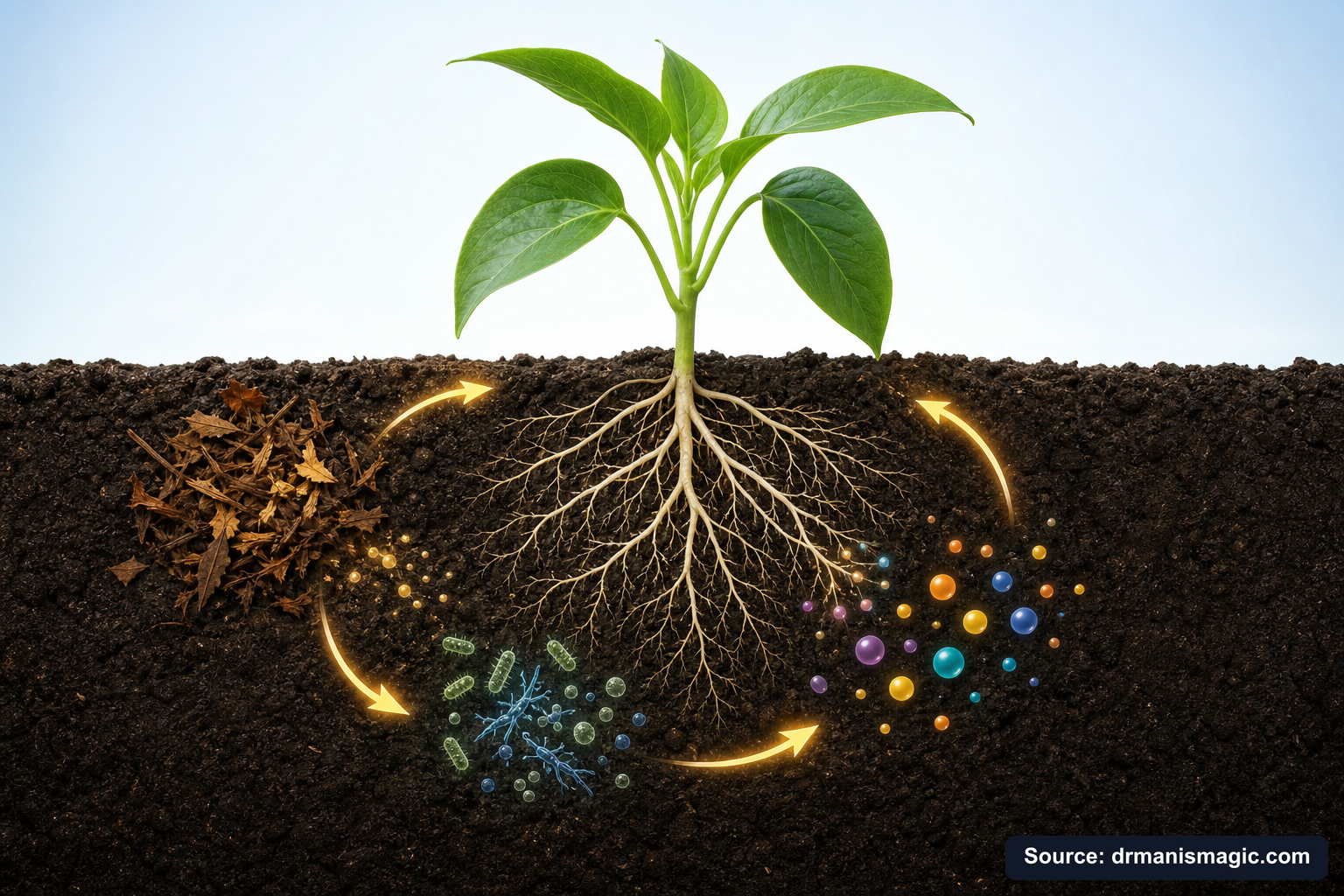
First, the bacteria and fungi in the soil smell the organic material. They swarm it. They start eating. As they eat, they break the complex proteins and carbohydrates down into simpler compounds. Ammonium. Phosphate. Minerals. Things the plant root can actually take up through its cell walls.
Second, the plant's roots pick up those simpler compounds. The plant is essentially getting pre-digested nutrition, broken down to exactly the size it needs to absorb. This is why organic nitrogen from amino acids is so much more efficient than synthetic nitrogen. The work of breaking it down has already been started by the microbes.
Third, when those microbes eventually die, their bodies become nutrition too. Every dead microbe cell releases its stored nutrients back into the root zone. This is the slow-release mechanism that no synthetic fertilizer can fully replicate. It is a living, cycling system that keeps releasing nutrition in small steady doses, exactly the way nature designed it.
Compare that to a synthetic fertilizer. The salt dissolves instantly. It floods the root zone with a spike of soluble nutrients. The plant can only absorb so much at once. The rest either runs off into the water table or sits in the soil building salt concentration. No microbe involvement. No cycling. No slow release. Just a spike, then a crash, then you have to buy another bag.
This is the cycle the big chemical companies built their business on. Your plants get a quick green-up. You feel like it's working. Then two weeks later it fades and you reach for the bag again. Meanwhile, the salt is accumulating and the microbes are dying, one application at a time.
See also: Why Most Fertilizers Are Actually Salt in Disguise
What Is Chitin and Why Does Crab Shell Belong in Your Garden?
Quick Answer: Chitin is a tough natural fiber found in crab shells, insect exoskeletons, and fungal cell walls. When added to soil, chitin feeds a specific group of bacteria that also happen to eat the cell walls of harmful fungi and pests. This naturally builds plant disease resistance without any synthetic chemistry.
Crab shells sound like an unusual ingredient for a fertilizer. But the science behind them is genuinely fascinating.
Chitin is one of the most abundant natural polymers on Earth. It is the structural fiber that makes up crab and shrimp shells, insect bodies, and the cell walls of many harmful soil fungi. When chitin enters living soil, something remarkable happens. The bacteria in that soil that love to eat chitin start multiplying fast. They are thriving. And those same bacteria have enzymes called chitinases that break down chitin wherever they find it.
Here is the brilliant part. Harmful root fungi like Pythium and Phytophthora, the organisms that cause root rot, have chitin in their cell walls. When chitinase-producing bacteria are abundant in your soil, they attack those fungal cell walls too. Your living soil becomes actively hostile to root rot pathogens.
No synthetic spray needed. No chemical fungicide. Just chitin in the soil feeding the bacteria that naturally defend your roots.
Chitin also brings calcium and magnesium directly to the root zone. Calcium is the primary structural mineral in woody plant tissue. Magnesium sits at the center of every chlorophyll molecule. Without magnesium, your plant cannot photosynthesize. Without calcium, cell walls are weak and fruit quality drops. Crab shell delivers both in a slow-release form the microbes help unlock.
This is why Crab, Kelp & Amino Acids brings these three ingredients together. Kelp signals the biology. Crab shell feeds and protects it. Amino acids fuel it cleanly. All three working together in living soil.
You Never Had a Brown Thumb.
You were handed the wrong tools. This free guide hands you the right ones.
You watered it. You fed it. It died anyway.
It was never you. It was the dirt, the salt food, and the bad advice.
This guide shows you what really went wrong, and how to fix it for good.
- Why your plants really died, and why it was never your fault
- The salt hiding in your plant food that quietly burns the roots
- The hidden killer in almost every bag of store soil
- The tiny helpers that grow a whole forest for free
- The rescue trick that brings a half dead plant back to life

What Are Amino Acid Fertilizers and Why Are They Better Than Synthetic Nitrogen?
Quick Answer: Amino acids are the building blocks of protein. As a nitrogen source, they skip several steps in the normal nutrient breakdown process, arriving at the root in a form that is easy to absorb and gentle on soil microbes. No salt spike. No osmotic stress. Just clean, efficient nutrition.
Nitrogen is the nutrient plants need most. It drives leaf growth, chlorophyll production, and the protein machinery inside every plant cell. The question is not whether you need nitrogen. The question is what form you deliver it in.
Synthetic nitrogen fertilizers deliver ammonium nitrate or urea in soluble salt form. Fast, cheap, and immediately available. But that speed comes with the salt spike we already talked about. Osmotic stress. Microbial die-off. Root burn. Nutrient lockup when salt concentrations get too high.
Amino acid nitrogen works differently. Amino acids are already partially broken down proteins. The microbes in living soil can convert them quickly and efficiently. Some amino acids can even be absorbed directly through root cell walls without microbial processing at all. The plant gets nitrogen in a form that feels natural because it is natural. No salt index spike. No osmotic shock. No burned root hairs.
The Law of the Minimum in plant science says that if any one essential nutrient is deficient, the plant's overall growth is limited to that level, no matter how much of everything else you add. Amino acids help cover nitrogen, the most commonly deficient nutrient, in the cleanest, most bioavailable way we know of.
And because amino acid nitrogen does not come with a high salt index, it does not damage the microbes that are doing all the other work. The whole system stays intact. That is the key difference.
Kelp vs. Synthetic Fertilizer: What Actually Happens in Your Soil
Quick Answer: Kelp supports root growth, microbial life, and stress tolerance without adding salt. Synthetic fertilizers spike nutrients fast, add salt that burns roots and kills microbes, and require repeated applications to maintain results. One builds a living system. The other bypasses it and slowly destroys it.
Let's put these two approaches side by side so you can see exactly what you are choosing between.
| Feature | Kelp Biostimulant (Organic) | Synthetic Salt Fertilizer | Organic Fertilizer with Chitin and Amino Acids |
|---|---|---|---|
| Primary mechanism | Hormones, microbial stimulation, trace minerals | Soluble salt nutrient dump | Slow microbial breakdown into plant-available nutrition |
| Salt index | Very low | High | Low |
| Effect on soil microbes | Feeds and stimulates microbial activity | Kills microbes through osmotic stress | Feeds microbes; supports microbial diversity |
| Root impact | Promotes root branching and root hair growth | Burns fine root hairs; causes physiological drought | Supports healthy root development |
| Nutrient release speed | Gradual, biology-dependent | Immediate spike, then crash | Slow and steady, mirrors nature |
| PFAS or biosludge risk | None when clean-sourced | Possible in some products | Zero PFAS, Zero Biosludge when clean-sourced |
| Long-term soil health | Improves it | Degrades it over time | Builds it steadily |
| Works in sterile or salty soil? | Poorly. Needs living biology to amplify | Short-term yes, long-term no | Better than synthetic but works best with living microbes |
The pattern is clear. Kelp and organic inputs work with biology. Synthetic salts work around it, and eventually against it.
And here is the time truth that most people miss. You can recover money. You cannot recover time. Every season you spend pushing salt-based inputs into your soil is a season the microbial community shrinks. Every season the microbes decline, your roots get less support. Every season the roots suffer, the plant grows slower. After a few years of this, you are not just behind. You are rebuilding from near zero. That is the real cost of the old way. Not the bag of fertilizer. The seasons.
How Do You Know If Salt Damage Has Already Hit Your Plants?
Quick Answer: Salt damage often looks like root rot or overwatering but the soil may not be wet. Key signs include brown or crispy leaf tips, wilting in moist soil, stunted new growth, and roots that look brown and mushy at the tips. The table below helps you tell the difference.
This is one of the most confusing problems in gardening because salt damage, overwatering, and true root rot can all look almost identical above ground. Your leaves wilt. Your plant looks tired. You water more. Things get worse. Here is how to start telling them apart.
| Symptom | Salt Damage / Osmotic Stress | Overwatering | True Root Rot (Pythium / Phytophthora) |
|---|---|---|---|
| Soil moisture when wilting occurs | Moist or normal | Wet, soggy | Often wet but can occur in any moisture level |
| Leaf tip appearance | Brown, crispy tips on outer edges | Yellowing, soft, limp | Yellowing, drooping, often from base upward |
| Root color and texture | Brown, dried, shrunken at tips | Pale, waterlogged, soft | Black, mushy, foul smell |
| Soil smell | Normal or slightly chemical | Slightly sour or flat | Rotten, sulfur-like odor |
| Response to watering | No improvement or worsens | Worsens with more water | Worsens regardless of water level |
| History | Recent synthetic fertilizer application | Frequent watering, poor drainage | Warm soil, standing water, damaged roots |
| First action to take | Flush soil with clean water; stop synthetic inputs | Improve drainage; reduce watering frequency | Remove affected roots; improve drainage; add beneficial microbes |
If salt damage has already hit your plants, here is a simple recovery checklist to follow.
- Stop all synthetic salt-based fertilizer immediately.
- Flush the root zone with clean water two or three times over a week to leach excess salts downward.
- Check drainage. If water sits in the pot or bed for more than a few minutes, the structure needs to improve before anything else will work.
- Add living microbes back to the root zone to begin rebuilding the microbial community.
- Apply a clean organic fertilizer with kelp and amino acids at a lower rate than recommended for the first month to avoid overwhelming stressed roots.
- Give the plant four to six weeks to stabilize before expecting new growth. Recovery is real but it takes time.
- Consider improving soil structure long term. Mineral-based soil that does not compact is the foundation that makes everything else easier.
See also: How Salt-Based Feeding Quietly Destroys Root Systems
What About PFAS and Biosludge in Fertilizers?
Quick Answer: Some fertilizers, both synthetic and organic, use municipal waste byproducts as fillers. These can contain PFAS "forever chemicals" that accumulate in soil, plants, and people. Clean organic fertilizers made without biosludge or synthetic salts do not carry this risk.
This is the part of the fertilizer conversation almost nobody wants to have. But you deserve to know it.
PFAS stands for per- and polyfluoroalkyl substances. They are called forever chemicals because they do not break down. They accumulate. In soil. In groundwater. In plant tissue. And eventually in the bodies of people who eat from that soil or walk barefoot through that lawn.
Some fertilizers use what the industry calls biosludge. This is treated municipal wastewater waste. Human sewage byproduct. It gets processed and dried and used as a filler in certain fertilizer products, sometimes without being clearly labeled. The PFAS problem enters through this stream because many PFAS compounds pass right through municipal water treatment and end up concentrated in the solid waste.
Think about what that means. You are trying to grow food for your family. Vegetables from your garden. Fruit from your trees. And the fertilizer you are putting on that soil may be introducing forever chemicals that no amount of washing will remove.
This is not a fringe concern. It is an active area of EPA and university research. And it is one of the reasons clean inputs matter so much.
Our Crab, Kelp & Amino Acids formula contains Zero PFAS, Zero Biosludge, and Zero Synthetic Salts. No fillers. No municipal waste. No forever chemicals. Just crab shells, cold-processed kelp, volcanic ash, and amino acids. Clean enough to put on your vegetable garden. Clean enough for barefoot kids and curious dogs.
Where Do the Three Plant Pillars Fit Into All of This?
Quick Answer: The Three Plant Pillars are the foundation that makes kelp and organic nutrition actually work. Mineral-based soil provides oxygen and drainage. Live microbes build the biological web. Organic fertilizer with kelp feeds and signals the whole system. Miss any one pillar and the others underperform.
Dr. Mani Skaria spent 40 years studying plant pathology at the Texas A&M Citrus Center. He watched thousands of trees thrive and fail. He tested products from every direction. And eventually, the pattern became impossible to ignore.
Healthy plants needed three things in place at the same time. Not two out of three. All three.
First, the soil structure has to allow oxygen to reach the roots. Most potting mixes fail here within six to twelve months. They are made from pine bark and wood fiber that decomposes. As it breaks down, it compacts. Compaction pushes oxygen out. Roots without oxygen cannot absorb nutrients no matter how much fertilizer you add. Mineral-based soil made from sandy loam does not decompose. It holds its structure permanently. Roots can breathe. Water drains. The whole system starts from a solid base.
Second, living microbes have to be present and active. Without bacteria, fungi, and mycorrhizae in the root zone, nutrient cycling stops. Kelp has nothing to amplify. Organic fertilizer breaks down slowly without microbial help. The Plant Super Boost product at Dr. Mani's Magic delivers live bacteria, fungi, and mycorrhizae directly to the root zone in a liquid form you drench monthly. Easy. Fast. And it smells like healthy earth, not rotting fish, because the microbes are stabilized, not fermenting.
Third, the plant needs clean, slow-release organic nutrition that feeds the microbes and then the plant, in that order. Kelp, crab shell, amino acids, and volcanic trace minerals all work together to fill that role without salt, without PFAS, without biosludge.
All three pillars together. That is when the magic happens. You can learn more about building that foundation through our Three Plant Pillars system.
We proved this on 250,000 trees in South Texas. On citrus trees in containers. On tropical houseplants. On grass and garden beds. The same principles apply everywhere there is a root, a microbe, and a plant trying to grow.
How and When Should You Apply Kelp for Best Results?
Quick Answer: Apply kelp-containing organic fertilizer monthly for containers and potted plants, or three times per year for in-ground plants. Use it as a soil drench or incorporate granules into the root zone. Foliar spraying works for stress events. Always pair it with living microbes and good drainage for full effect.
Kelp is not a set-it-and-forget-it product. It works best as a regular part of a living-soil maintenance program.
For potted plants, trees in containers, houseplants, and raised beds, monthly feeding is ideal. Containers concentrate salts faster than in-ground beds and have less buffering capacity from surrounding soil biology. Regular small doses of clean organic fertilizer with kelp keep the microbial community fed and the plant nutrition steady.
For in-ground lawns, garden beds, fruit trees, and ornamentals, three applications per year is a strong starting point. Think of it like the old Valentine's Day, Memorial Day, and Labor Day timing that traditional fertilizer schedules use, but with one important difference. You are not spiking with salts. You are feeding a living system that keeps cycling nutrition between applications.
Foliar spraying, misting the leaves directly with a diluted liquid kelp solution, works especially well during stress events. Transplant shock. Extreme heat. Cold snaps. Drought. The hormones in kelp absorb through leaf tissue and help the plant stay in growth mode when it would otherwise shut down.
The most important thing is this: kelp applied to living soil in a functioning Three Plant Pillars system will outperform kelp applied to compacted, salty, microbe-poor soil every single time. Fix the foundation first. Then let kelp do what it does best.
You can explore our Free Plant Care Field Guide for specific timing and application guidance across different plant types.
The Payoff Is Real. And It Is Worth Starting Today.
Here is something Dr. Mani hears from gardeners all the time. More than any other request. More than questions about pruning or watering schedules or pest control. People want to see fruit on their own tree. They want to harvest something they grew. To taste it. To share it at the table with their family. To feel that deep, quiet satisfaction of having nurtured something from the ground up.
That is not a small thing. That is primal. It is written into us. We were made to tend a garden. And the tragedy is that most gardeners are being quietly robbed of that experience by salt-based chemistry that looks like progress and acts like a slow poison on the living system their plants depend on.
Kelp is not magic on its own. But kelp in living soil, paired with real microbes and clean organic nutrition, with roots that can breathe and drainage that works, becomes something close to magic. It is nature's own amplifier doing what it has always done in healthy ecosystems. Signaling. Cycling. Supporting. Growing.
You cannot get back the seasons you spent on the wrong approach. But you can start the right one today. And with the Three Plant Pillars as your foundation, the plants you grow from here forward will not just survive. They will thrive in a way that finally feels like the garden you always pictured.
If you are ready to make that shift, start with our Crab, Kelp & Amino Acids and see what clean organic nutrition does in a living root zone. We back it with a 30-day money-back guarantee. Real people. Real support. No bots. Just growers who have been doing this for decades, rooting for you to succeed.
Frequently Asked Questions
Kelp sounds simple. But most gardeners use it wrong and wonder why nothing changes. These questions cut straight to what matters: why kelp only works inside a living system, and how the Three Plant Pillars make that living system possible. Dr. Mani figured this out growing over 250,000 trees in South Texas. Now you get the shortcut.
Why does kelp work best in living soil?
Kelp is a biostimulant. That means it sends signals to the biology already living in your soil. But if that biology is dead or damaged, there is nothing to signal. Salt-based fertilizers quietly kill the bacteria and fungi your roots depend on. When you build living soil first using the Three Plant Pillars, kelp has a living audience to wake up. That is when the real growth starts.
What does kelp actually do for plants?
Kelp is not a heavy feeder. Its NPK numbers are tiny. What it does carry are natural plant hormones called auxins and cytokinins. These hormones tell roots to branch out and stretch deeper. They also help plants handle heat, drought, and stress without falling apart. Think of kelp less like food and more like a coach that helps your plant perform at its best.
Why does salt-based fertilizer ruin how kelp works?
Synthetic fertilizers are salt-based. Salt pulls water away from roots and kills the beneficial microbes living around them. Kelp needs those microbes alive and active to do its job. When you pour salt fertilizer into the root zone, you wipe out the very system kelp is trying to support. That is why Dr. Mani uses only organic, slow-release fertilizer made from crab, kelp, and amino acids. No salt. No damage. Just clean fuel.
How do crab shells and kelp work together in the soil?
Crab shells contain chitin. Chitin is a natural compound that triggers your plant's built-in defense system. It also feeds beneficial soil organisms that fight off disease. Kelp adds plant hormones and trace minerals from the ocean. Together they create a one-two punch. The crab feeds the soil army. The kelp signals the roots to grow faster and stronger. That combination is baked into Dr. Mani's Magic organic fertilizer.
What role do amino acids play alongside kelp?
Amino acids deliver nitrogen in a form plants can use right away without any salt spike. They also feed the microbes living around your roots. Microbes love amino acids. When those microbes are well fed, they unlock more nutrients from the soil and pass them straight to your plant. Amino acids are the quiet worker in Dr. Mani's fertilizer blend. Kelp gets the spotlight, but amino acids keep the whole system humming.
Can kelp help plants that are already struggling?
It can help, but only if you fix the foundation first. Pale leaves and slow growth usually mean the soil is wrong, the microbes are gone, or the fertilizer has been burning the roots. Kelp alone will not fix those problems. Start with mineral-based soil for drainage, add live microbes with Plant Super Boost, then feed with organic fertilizer. Once those Three Plant Pillars are in place, kelp does exactly what it is supposed to do.
Is kelp safe to use around children, pets, and edible plants?
Yes. Kelp is a natural sea vegetable. It carries no synthetic chemicals, no harsh salts, and no plastic-coated slow-release toxins. Dr. Mani's Magic fertilizer uses kelp alongside crab and amino acids so you can feed your fruit trees, vegetables, and flowers without worrying about what your kids or dogs are walking through. That peace of mind is the whole point. You should be able to enjoy your garden, not fear it.
About the Author
Dr. Mani Skaria, PhD
Dr. Mani Skaria, PhD, is a plant pathologist and the scientific founder of Dr. Mani's Magic. He earned his doctorate at Purdue University and spent 48 years studying how plants, soil, and living microbes work together, including his years as Professor Emeritus at Texas A&M and as a member of the USDA NAREEE Advisory Board. He invented micro-budding, a method for growing healthier, stronger trees, and has grown more than 250,000 trees on the family farm in Hargill, Texas - US Citrus Nursery. His life's work takes real lab science and practical experience and turns it into simple, safe, organic plant care anyone can use at home.


