


Why Heavy Soil Grows Stronger Plants Than Fluffy Potting Mix | Dr. Mani's Magic
Why Heavy Soil Grows Stronger Plants (And Why Everything You Were Told About Potting Mix Is Wrong)
Picture this. You're standing in the garden center, staring at a wall of fluffy, lightweight potting mix bags. The bags have photos of giant tomatoes and lush flowers on them. They promise "premium aeration" and "superior drainage." You grab one. It weighs almost nothing. You think, "Perfect. Light and fluffy. Roots will love this."
Three months later, your tree is yellowing. Six months later, the leaves are dropping. A year later, you're Googling "why is my citrus dying" at midnight, wondering what you did wrong. You watered it. You fed it. You did everything right. But the plant is slowly suffocating. And here's the thing nobody told you: the problem started the moment you filled that pot with fluffy, featherlight, looks-perfect-on-the-shelf potting mix. That bag of "premium soil" was not soil at all. It was, essentially, other dead plants. And dead plants decompose. And decomposition steals the one thing your roots cannot live without: oxygen.
We've grown over 250,000 trees at our South Texas nursery. We've watched plants thrive and we've watched them quietly die. And the single most misunderstood lesson we've learned is this: the best soil for long-lived plants is not the lightest or the fluffiest. It's the most structurally durable. It's mineral-heavy, gritty, and built to last. That's what this article is about. Let's dig in.

Organic Fertilizer | Crab, Kelp & Amino Acids
Key Takeaways
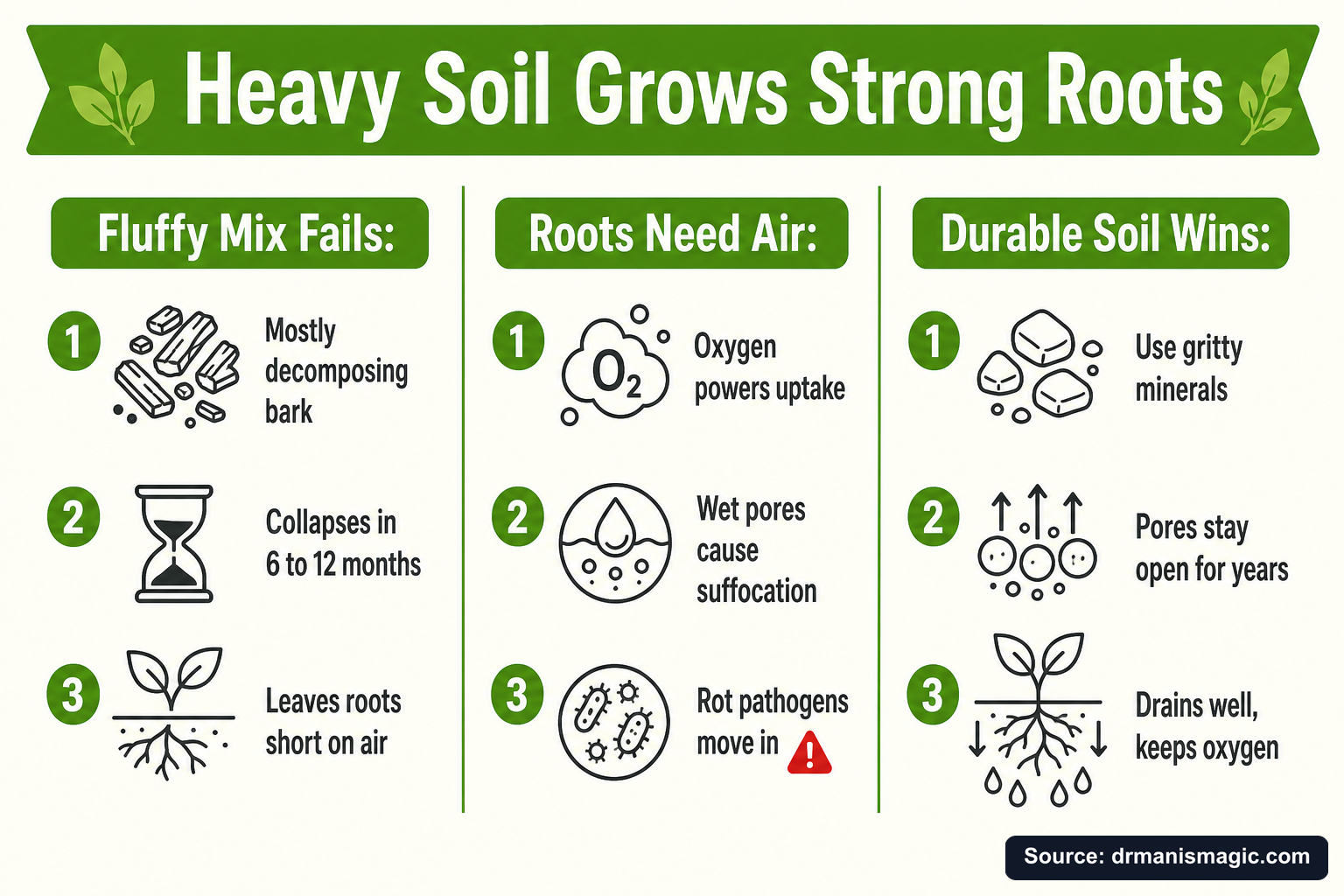
- Most bagged potting mix is made from pine bark sawdust, an organic carbon material that decomposes and steals oxygen from roots.
- Roots need oxygen, not just water and nutrients. No oxygen equals root rot, yellowing leaves, and plant decline.
- "Heavy" mineral-based soil is not the same as compacted clay. Granular, silica-based mineral media holds its structure for years.
- Potting mix typically collapses structurally within 6 to 12 months, which is why perennial container plants often stall and decline.
- The Three Plant Pillars, mineral-based soil, live microbes, and organic fertilizer, form the foundation Dr. Mani's Magic has tested on 250,000+ trees.
- Good heavy soil preserves air-filled pore space, drains well, and does not break down or steal oxygen from your root zone.
- Bonsai masters, citrus growers, and ancient farmers have all understood the power of mineral-heavy, gritty media for centuries. Science now confirms why it works.
What Does "Heavy Soil" Actually Mean for Container Plants?
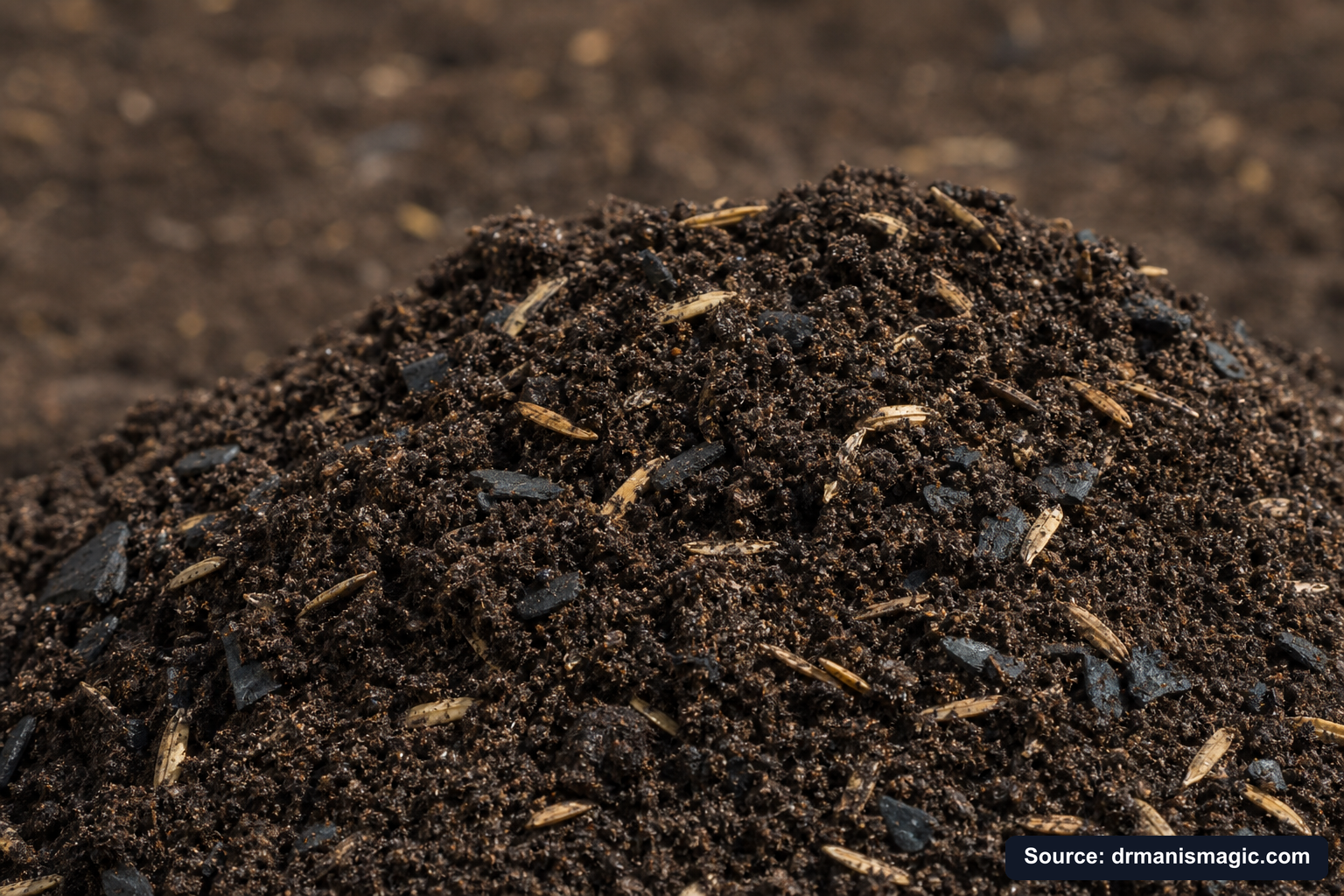
Quick Answer: "Heavy soil" in the context of container plants does not mean compacted, waterlogged clay. It means a mineral-rich, granular growing medium with durable particles like sand, pumice, lava rock, or silica-based loam that hold their shape for years, preserve oxygen-filled pore spaces, and resist the structural collapse that kills long-lived plants.
There are two completely different things that people call "heavy soil," and mixing them up is costing plant owners years of wasted time.
Bad heavy soil is compacted clay or topsoil shoveled straight into a container. It has tiny, sticky particles that pack together, seal off air pockets, and trap water. Roots drown in it. Pathogens love it. Nothing good grows in it long-term in a pot.
Good heavy soil is something entirely different. It is a granular, mineral-based medium made of silica-rich particles: sand, pumice, lava rock, perlite, coarse mineral loam. These particles do not decompose. They do not pack together into sludge. They hold their shape for years. And between those particles, they create a stable network of pores, some large enough to hold oxygen, some small enough to hold water. That structure is the whole game.
When we say "heavy soil grows stronger plants," we are talking about the second kind. We are talking about mineral structure, not dead weight. The confusion between these two ideas has sent generations of gardeners in the wrong direction.
| Soil Type | What It's Made Of | Does It Decompose? | Oxygen in Pores? | Good for Long-Term Containers? |
|---|---|---|---|---|
| Standard Potting Mix | Pine bark sawdust, peat, compost | Yes, within 6-18 months | Decreases over time as structure collapses | No |
| Compacted Clay / Topsoil in Pot | Fine clay particles, silt | Minimal, but packs tight | Very poor, seals off air | No |
| Mineral-Heavy Granular Media | Silica sand, pumice, lava rock, mineral loam | No, silica does not decompose | Excellent, stable pore structure | Yes |
| Dr. Mani's Magic Super Soil | Steam-sterilized sandy loam, coco coir, rice hulls, biochar | Minimal, engineered for permanence | Excellent, engineered for drainage and aeration | Yes, designed as a permanent medium |
Why Do Roots Need Oxygen to Survive?
Quick Answer: Roots breathe oxygen just like you do. They use it to drive cellular respiration, the process that powers nutrient and water uptake. When soil pore space fills with water or collapses from decomposition, oxygen disappears, root cells die, and pathogens like Phytophthora move in fast. No oxygen means no healthy roots.
Here is the fact that surprises almost everyone: your plant breathes carbon dioxide through its leaves, but its roots breathe oxygen through the soil.
Yes. Roots need oxygen. Not CO2. Oxygen.
According to UC IPM at the University of California, roots require oxygen for growth and for nutrient and water uptake. When soil becomes waterlogged or compacted, oxygen disappears from the pore spaces. Roots begin to suffocate. And once roots are damaged, fungal pathogens like Phytophthora and Pythium, the organisms responsible for root rot, move in and finish the job.
This is why "overwatering" is actually a soil structure problem, not just a watering problem. If your soil holds its pore structure, water drains through and oxygen refills those pores quickly. If your soil has collapsed into a dense, fine-textured sludge, water sits. Oxygen cannot get back in. And your roots begin to rot.
UC Davis research on container plant management links excess water and poor drainage directly to oxygen deprivation and increased susceptibility to root rot pathogens. The solution is not just "water less." The solution is soil with durable, stable pore structure that drains freely and stays oxygenated.
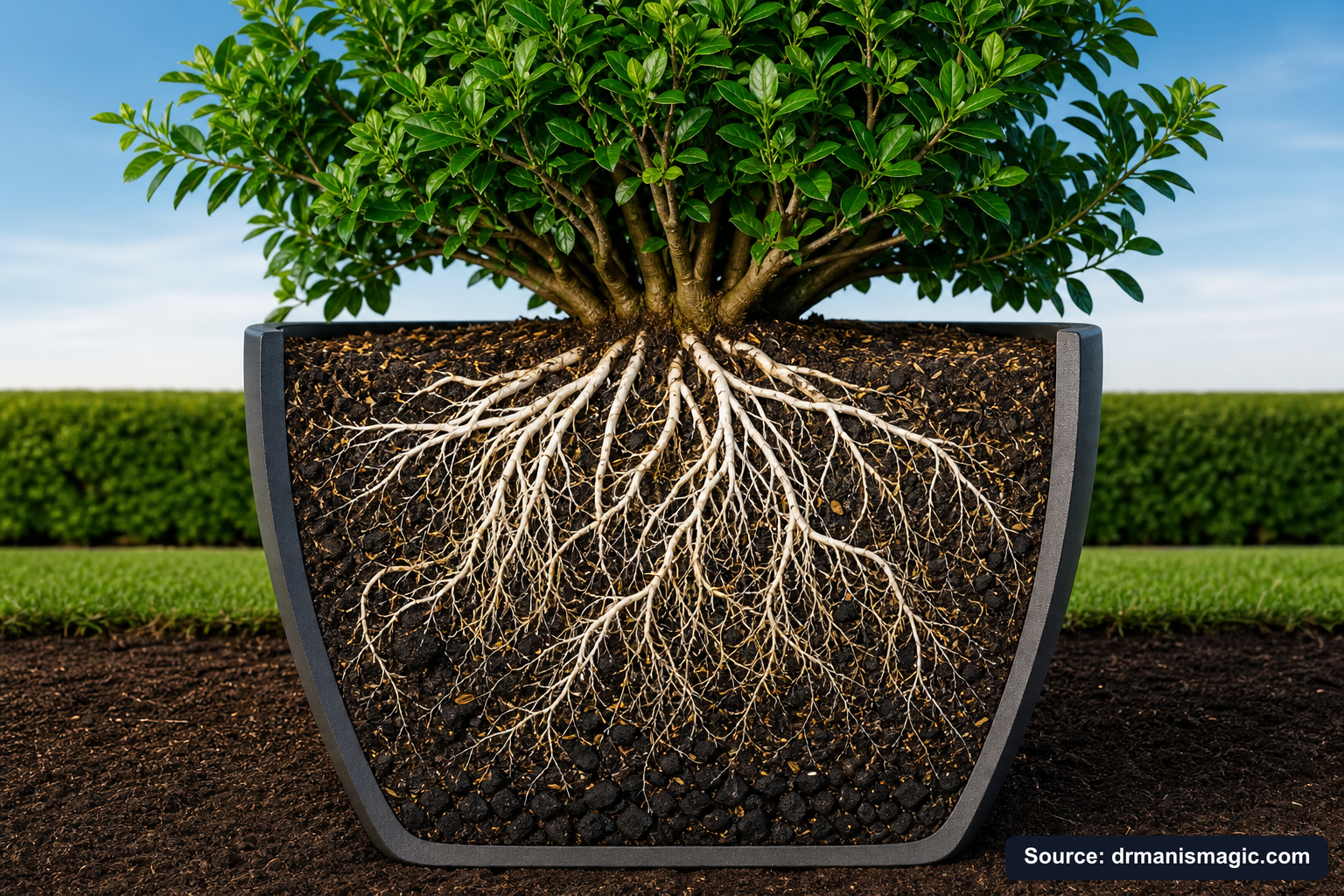
That is exactly what mineral-heavy soil provides. Those hard, gritty particles do not collapse. The pores between them stay open. Oxygen keeps flowing. Roots keep breathing.
Why Does Potting Mix Collapse and Suffocate Roots?
Quick Answer: Standard potting mix is mostly pine bark sawdust, an organic carbon material. All organic matter decomposes over time. As it breaks down, the particles shrink, pore spaces disappear, and the decomposition process itself consumes the oxygen your roots need. Most potting mixes lose their structure within 6 to 12 months, which is when long-lived plants begin to stall and decline.
Let's talk about what is actually inside that bag of potting mix you bought at the garden center.
It is mostly pine bark. Ground up, partially composted pine bark. In other words, you are planting your tree in other dead trees. That phrase sounds funny until you understand what it means for your roots. Dead plant material decomposes. That is what it does. And when it decomposes inside your container, two bad things happen simultaneously.
First, the structure collapses. Those fluffy, light particles break down into finer and finer fragments. The large pores that held oxygen disappear. The medium gets denser. Water stops draining freely. The root zone starts to look and behave more like mud than soil.
Second, the decomposition process itself consumes oxygen. Microorganisms breaking down organic matter are competing directly with your roots for the same oxygen supply. In a container with a collapsing potting mix, the roots lose that competition. Every time.
And there is another layer to the pine bark problem that almost nobody talks about. Pine trees produce powerful chemical compounds called terpenes and terpenoids. You already know some of them by different names: Pine-Sol. Turpentine. These are not gentle, root-friendly compounds. They are, in fact, antimicrobial and allelopathic, meaning they actively suppress the beneficial soil microbes your plant depends on.
To reduce the harshness of these chemicals, manufacturers let pine bark sit in enormous outdoor piles for months or years before using it. During that time, it decomposes. Yes, the very process that makes it less chemically hostile also begins destroying the structural integrity that made it useful in the first place. And then manufacturers add surfactants, synthetic chemicals that make the hydrophobic wood particles hold water. Those surfactants wash away over time, leaving a medium that repels water and becomes nearly impossible to re-wet once it dries out completely.
So the timeline of a standard potting mix in a container looks like this: fresh out of the bag, it works reasonably well. Three to six months in, it starts compacting. Six to twelve months in, it is losing its pore structure. Eighteen months in, it is dense, hydrophobic in spots, oxygen-poor, and chemically depleted. And your beautiful perennial plant, your citrus tree, your fig, your olive, your patio maple, is sitting in it, slowly suffocating.
Big box stores do not have a problem with this timeline. They sell annuals. Plants meant to last one season. Their entire business model is built on replacement. When your plant declines, you come back and buy another one. That is not a conspiracy theory. That is just how their economics work. The problem is that perennial plants, trees and shrubs meant to live for decades, deserve a growing medium engineered for the long game.
What Is the Science Behind Soil Pore Space and Oxygen?
Quick Answer: Healthy container media needs two types of pore space: large macropores that drain freely and hold oxygen after watering, and smaller micropores that retain plant-available water. When organic media decomposes, macropores collapse first, eliminating the oxygen supply. Mineral particles like silica sand and pumice maintain both pore types for years without degrading.
Think of your soil as a city of tiny tunnels and rooms.
The big tunnels are macropores. After you water, gravity pulls the water down and out through these big tunnels. Air rushes back in behind the water. That air carries oxygen to your roots. These big tunnels are the oxygen highway.
The small rooms are micropores. They hold onto water by capillary tension, the same force that makes water climb a paper towel. Your roots drink from these small rooms between waterings.
A healthy growing medium has both. Big tunnels for oxygen. Small rooms for water. The balance between these two is what plant scientists call air-filled porosity and water-holding capacity. Research from Rutgers University's New Jersey Agricultural Experiment Station and Oregon State University's nursery media programs confirms that container success depends almost entirely on these physical properties, not on fertility alone.
Now watch what happens to potting mix over time. The organic particles break down into smaller fragments. The big tunnels shrink and disappear. The oxygen highway closes. Water pools in the collapsed medium with nowhere to drain. The roots sit in stagnant, oxygen-poor, wet conditions. Root rot follows.
Mineral particles, silica sand, pumice, lava rock, do not break down. The big tunnels stay open. The oxygen highway stays clear. After three years, the pore structure of a well-engineered mineral-based medium looks almost identical to how it looked on day one. That is the entire secret to why mineral-heavy soil grows stronger plants over time.
Potting Mix vs. Mineral-Based Soil: The Full Comparison
Quick Answer: Potting mix is a short-term, carbon-based medium optimized for cheap production and easy transport. Mineral-based soil is a long-term, silica-based medium optimized for structural stability, oxygen availability, and root health in perennial container plants. They are not interchangeable for trees, shrubs, or any plant you want to keep alive for more than one season.
Let's put these two side by side where it counts.
| Category | Standard Potting Mix | Mineral-Based Soil (e.g., Sandy Loam / Super Soil) |
|---|---|---|
| Primary material | Pine bark, peat moss, compost (organic carbon) | Silica sand, mineral loam, pumice, lava rock (inorganic silica) |
| Does it decompose? | Yes, actively, within months | No, silica does not decompose |
| Structural lifespan in a container | 6 to 18 months before collapse | Many years, essentially permanent |
| Oxygen availability over time | Decreasing, as pores collapse | Stable, macropores remain open |
| Root rot risk | High, especially after 6 months | Low, with proper watering |
| Water behavior when dry | Becomes hydrophobic, repels water | Rewets easily and consistently |
| Impact on beneficial microbes | Pine terpenes suppress microbes; anaerobic conditions kill them | Neutral to supportive, microbes can colonize mineral surfaces |
| Best for | Annual flowers, seed starting, short-cycle plants | Citrus, figs, olives, bonsai, fruit trees, perennial container plants |
| Cost over 5 years | High, requires repeated repotting and replacement | Low, one investment that lasts |
The bottom line is simple. If you are growing a plant you want to keep for more than one season, standard potting mix is working against you from the moment it goes in the container. It is engineered for the nursery supply chain, not for your tree's long-term health.
See also: The Hidden Reason Synthetic Fertilizers Cause Root Rot
You Never Had a Brown Thumb.
You were handed the wrong tools. This free guide hands you the right ones.
You watered it. You fed it. It died anyway.
It was never you. It was the dirt, the salt food, and the bad advice.
This guide shows you what really went wrong, and how to fix it for good.
- Why your plants really died, and why it was never your fault
- The salt hiding in your plant food that quietly burns the roots
- The hidden killer in almost every bag of store soil
- The tiny helpers that grow a whole forest for free
- The rescue trick that brings a half dead plant back to life

Why Do Bonsai Masters and Ancient Growers Use Gritty, Mineral-Heavy Media?
Quick Answer: Bonsai practitioners have used mineral-heavy media like Akadama clay, pumice, and lava rock for centuries because gritty, granular substrates preserve root oxygen, prevent rot, allow precise water control, and build the dense, fine root structures that produce the strongest plants. This is not a trend. It is thousands of years of observed evidence.
Here is a fun truth. The gardeners who have consistently grown the oldest, most resilient container plants on earth, bonsai masters in Japan and China, figured out the heavy mineral soil secret centuries before modern plant scientists could explain why it worked.
Traditional bonsai media contains almost no organic matter. It is built from volcanic pumice, calcined clay like Akadama, and lava rock. The mix is gritty, heavy, and drains almost instantly. It looks like the kind of thing you would find at the bottom of a mountain stream. And trees grown in it live for hundreds of years.
In the ancient Mediterranean, olive and fig growers planted their trees in rocky, mineral-rich hillside soils. The trees rooted deep into cracked limestone and volcanic stone. Those trees still bear fruit today, thousands of years later.
Go further back. Look at where the strongest wild trees grow. Not in soft, fluffy forest duff. In the gaps between rocks. In cliff faces. In gravelly riverbanks. In mineral-rich, well-draining, oxygen-rich substrates that force roots to work hard, anchor deep, and breathe freely.
This is not a coincidence. It is nature's proof of concept. Strong plants grow in mineral-heavy, structurally stable, oxygen-rich substrates. The idea that "light and fluffy" equals "good for roots" is a modern marketing invention, not a horticultural truth.
At our South Texas nursery, after growing and selling over 250,000 citrus trees, we arrived at the same conclusion the bonsai masters reached centuries ago. Mineral structure wins. Every time. For every plant meant to live longer than a single season.
How Do You Know If Your Soil Has Collapsed? (Root Health Diagnostic)
Quick Answer: Signs of collapsed, oxygen-poor soil include water pooling on the surface instead of draining, a sour or sulfur smell from the pot, yellowing leaves that do not respond to fertilizer, brown or slimy roots when you lift the plant, and soil that repels water after drying out. If you see two or more of these signs, your growing medium has likely failed structurally.
Your soil will not send you a text message when it fails. But it does send signals. Here is how to read them.
| Symptom You Can See or Smell | What It Means | Root-Cause Problem |
|---|---|---|
| Water pools on surface and drains slowly | Macropores have collapsed, drainage path is blocked | Structural failure of organic media |
| Sour, swampy, or sulfur smell from pot | Anaerobic (no-oxygen) conditions, fermentation happening in root zone | Oxygen starvation |
| Yellow leaves that do not respond to fertilizer | Roots cannot uptake nutrients without adequate oxygen | Root damage from oxygen deprivation |
| Brown, mushy, or slimy roots | Active root rot, pathogen invasion of damaged root tissue | Root cell death from oxygen starvation |
| Soil repels water, beads up, won't absorb | Surfactants have washed out of pine bark, medium is now hydrophobic | End-of-life potting mix behavior |
| Plant looks fine in spring, declines in summer | Warm temperatures accelerate decomposition and oxygen demand | Accelerated structural collapse |
| Plant has been in same potting mix for over 18 months | Medium is statistically past its structural lifespan | Time-based organic decomposition |
If you are seeing two or more of these symptoms, your plant is not failing because of your thumb color. It is failing because the medium it is sitting in has structurally collapsed and is no longer providing what roots need most: oxygen.
What Is the Three Plant Pillars Framework and Why Does Soil Come First?
Quick Answer: The Three Plant Pillars, developed by Dr. Mani Skaria at US Citrus Nursery and proven across 250,000+ trees, are: mineral-based soil, live microbials, and organic fertilizer. Soil comes first because without oxygen-preserving, structurally stable soil, microbes cannot survive and nutrients cannot reach roots. Every other input depends on getting the foundation right.
Dr. Mani Skaria spent 40 years as a Professor of Plant Pathology at the Texas A&M Citrus Center. He traveled the world testing gardening products. He ran the Clean Citrus Program for the entire state of Texas. He grew and sold over 250,000 trees at US Citrus Nursery in South Texas. And after all of that, he arrived at a simple, three-part framework he calls the Three Plant Pillars.
Pillar One: Mineral-Based Soil. This is the foundation. Not pine bark. Not peat. Not compost. Mineral-based, silica-rich soil that does not decompose, does not steal oxygen, and holds its structure for years. In nature, plants grow in dirt. Dirt is ground-up rock. Rock is silica. Silica does not decompose. That is the model nature already perfected. We just had to stop overriding it with pine bark.
Pillar Two: Live Microbials. Bacteria, fungi, and mycorrhizae. The invisible army that unlocks nutrients, protects roots from pathogens, and recreates the living soil ecosystem that plants evolved in over millions of years. Without these microbes, your plant is essentially defenseless. With them, the root zone becomes a self-sustaining, self-defending ecosystem. No microbes equals no resilience. It is that simple.
Pillar Three: Organic Fertilizer. Not salt-based synthetic chemicals that burn roots and massacre the very microbes you just put in the soil. Slow-release, organic nutrients from sources like crab meal, kelp, and amino acids. Nutrients that feed plants gently, work in harmony with the microbial community, and build long-term soil health instead of depleting it.
Miss any one of these pillars and you will run into problems. Root rot. Yellow leaves. Weak fruiting. Pest and disease issues. A plant that never quite thrives no matter what you try. Get all three in place and your plant becomes, as Dr. Mani likes to say, practically bulletproof.
The soil pillar comes first because it is the infrastructure everything else depends on. You cannot have thriving microbes in a collapsed, anaerobic, chemically hostile potting mix. You cannot have effective nutrient uptake when roots are suffocating. The foundation must come before everything else. It always does.
See also: Why Most Fertilizers Are Actually Salt in Disguise
How Do You Fix Collapsed Soil and Rescue a Struggling Container Plant?
Quick Answer: The most effective fix for a plant suffering from collapsed, oxygen-poor potting mix is to repot into a mineral-based, structurally stable medium as soon as possible. Trim damaged roots, introduce live beneficial microbes at planting time, and hold off on fertilizer until the root system has had time to recover. Here is the step-by-step process.
You cannot fertilize your way out of a soil structure problem. You cannot water your way out of it either. If the foundation is failing, you need to rebuild it. Here is how.
- Remove the plant gently from its container. Shake off as much of the old potting mix as possible. Look at the roots. Healthy roots are white or light tan and firm. Rotten roots are brown, black, or gray and feel mushy or slimy.
- Trim all dead, rotted, or mushy roots with clean scissors or pruning shears. Cut back to healthy tissue. This step is not optional. Leaving dead root material in the new medium gives pathogens a place to hide and spread.
- Let the roots air-dry briefly, 30 to 60 minutes, before repotting. This slows pathogen activity and gives cut surfaces time to begin callusing.
- Fill the new container with a mineral-based, structurally stable growing medium. Look for a medium built on silica-based mineral loam, coarse sand, pumice, or lava rock rather than pine bark or peat. Super Soil by Dr. Mani's Magic is built on steam-sterilized sandy loam from South Texas, with coco coir, rice hulls, and biochar added for water balance and microbial support. It is engineered as a permanent medium so you do not have to repot again next year.
- Introduce live beneficial microbes at planting. Drench the new medium with a live microbial inoculant containing bacteria, fungi, and mycorrhizae. This repopulates the root zone with the protective microbial community that was absent or destroyed in the old, collapsed medium. Plant Super Boost is a liquid inoculant that goes right into the watering can, once a month.
- Water gently and hold off on fertilizer for two to four weeks after repotting. Give the roots time to establish in the new medium before adding the nutrient load of fertilizer. The mineral soil and microbes are doing the heavy lifting right now. Let them work.
- Resume regular organic fertilizing once new growth appears. New growth is the plant's signal that roots are active and healthy. At that point, a slow-release organic fertilizer like Crab, Kelp & Amino Acids feeds the plant and the microbial community together without the salt burn that synthetic fertilizers cause.
This process works for citrus, figs, olives, maples, blueberries, bonsai, houseplants, and virtually any long-lived container plant. The key insight is always the same: fix the foundation first. Everything else follows from there.
How Does This Apply to Every Plant You Own, Not Just Citrus?
Quick Answer: The oxygen, drainage, and structural stability principles of mineral-based soil apply to every container plant, every garden bed, and every potted houseplant. Any plant with roots needs oxygen in the root zone. The Three Plant Pillars framework works for lawns, orchards, flower gardens, indoor tropicals, and vegetable beds because it is built on universal plant biology, not just citrus science.
We talk about citrus a lot because that is where we built our proof. Dr. Mani spent four decades with citrus trees. Our nursery has grown and sold over a quarter million of them. Citrus is our laboratory.
But roots are roots. A Meyer lemon root and a fiddle leaf fig root and a rose root and a blueberry root all need the same three things: oxygen, water, and microbial support. They all suffer the same way when those things are missing. Brown roots. Yellow leaves. Slow decline. And they all respond the same way when those things are restored.
We have seen the Three Plant Pillars work on:
- Indoor tropical houseplants that had been slowly declining for years in old potting mix
- Backyard vegetable gardens that produced less every season as the soil compacted
- Container figs and olives on patios that stalled and never produced fruit
- Lawn grass that stayed thin and yellowed no matter how much synthetic fertilizer was applied
- Bonsai trees that developed the fine, dense root structures only mineral media can produce
The framework is universal because it is based on plant biology, not on marketing categories. Whether you are growing a pot of basil on a windowsill or a citrus grove on five acres, the roots underneath have the same needs. Give them oxygen-preserving mineral structure, living microbial support, and gentle organic nutrition, and they will reward you with the kind of growth that makes people stop and ask what you are doing differently.
You can get the complete roadmap with the Free Plant Care Field Guide, which walks through how to apply the Three Plant Pillars to any plant, any container, any garden.
The One Thing That Will Cost You More Than Money
Here is something Dr. Mani hears more than almost anything else from people who come to him after years of struggling with container plants. They do not say "I wasted money." They say a version of this: "I just want to see fruit on my tree while I still can."
That hits differently than a complaint about a dead plant. Because it is not really about the plant. It is about time. We can earn more money. We cannot earn more time. Every year a tree spends slowly suffocating in collapsed potting mix is a year it does not spend growing toward the harvest you planted it for. Every season a garden underperforms because the soil foundation is wrong is a season you will never get back.
The old way of doing things, buying fluffy potting mix, adding synthetic fertilizer, watching things stall, buying more products, watching things stall again, is not just expensive. It is a time-consuming loop that goes nowhere. Nature has rules. You can work with them or against them, but you cannot buy your way around them.
The good news is that the right foundation changes the timeline dramatically. When the soil holds its structure and oxygen flows freely to the roots, when live microbes colonize the root zone and unlock nutrients, when organic fertilizer feeds the plant and the soil community together, plants respond fast. They do not just survive. They grow with the kind of vigor that makes you feel like you finally cracked the code. Because you did.
If you want to see what mineral-based soil, live microbes, and organic nutrition can do for your plants, the full Three Plant Pillars system is available at Dr. Mani's Magic, tested and proven on over 250,000 trees, made in the USA, and backed by a 30-day money-back guarantee. No synthetic salts. No PFAS. No biosludge. Just the foundation your plants have always needed.
Start with the soil. Everything else grows from there.
Frequently Asked Questions
You have questions about soil, and that makes sense. Most gardeners have been told the wrong thing for decades. These answers are based on what Dr. Mani learned growing over 250,000 trees in South Texas. Get this right and everything else gets easier.
Which soil helps plants grow best in containers?
Mineral-based soil wins every time. Most bagged potting mixes are made from pine bark and wood chips. Those materials rot. When they rot, they steal oxygen from your roots. Dr. Mani's Magic Super Soil uses silica-rich sandy loam from South Texas. It does not break down. It holds its shape for years. Roots breathe, grow deep, and stay strong. That is the difference between a plant that thrives and one that slowly dies.
What can you add to soil to help plants grow faster?
The fastest growth comes from live microbes, not just compost or organic matter. Microbes unlock nutrients already in your soil and protect roots from disease. Dr. Mani's Magic Plant Super Boost is packed with live bacteria, fungi, and mycorrhizae. Just mix it with water and pour it on. These tiny helpers go to work immediately. We tested this on over 250,000 citrus trees. The results were not subtle. Plants grew faster and fought off problems on their own.
What are the three most important things plants need to grow?
Dr. Mani calls them the Three Plant Pillars. First, mineral-based soil that holds structure and lets roots breathe. Second, live microbes that protect roots and unlock nutrients. Third, organic fertilizer that feeds plants slowly without burning them. Most gardeners only think about fertilizer. That is like building a house and only buying furniture. Get all three pillars right and your plants become nearly bulletproof.
How does bad soil hurt plant growth?
Bad soil suffocates roots. When potting mix breaks down into sludge, it blocks the tiny air pockets roots need to breathe. Water sits instead of draining. Roots rot. Nutrients get locked away. The plant looks fine at first. Then it yellows. Then it stalls. Then it dies. The scary part is it happens slowly, so you blame yourself instead of the soil. It is not your fault. The soil was the problem from day one.
What soil texture is best for plants growing in pots?
Gritty and granular beats fluffy every time for long-lived container plants. You want particles that hold their shape, like silica sand, pumice, or mineral loam. These create stable air pockets between the grains. Roots push through easily. Water drains fast. Oxygen stays in the root zone. Fluffy potting mix feels nice in your hands at the store. But it collapses within months. Dr. Mani's Super Soil is gritty by design, and that is exactly why it works.
What is the best potting soil for most plants?
Most plants do best in a mineral-based soil that drains well and does not break down over time. Dr. Mani's Magic Super Soil was built for exactly that. It uses steam-sterilized sandy loam from the Rio Grande Valley, mixed with coco coir, rice hulls, and biochar. It works for citrus trees, houseplants, tropical trees, vegetables, and flowers. We did not guess at this formula. We tested it on over 250,000 trees before we ever sold a single bag.
Why do plants in containers stall or decline after the first year?
The potting mix collapses. Most bagged soils lose their structure within six to twelve months. The organic material breaks down into a dense, airless sludge. Roots run out of oxygen. Nutrients get locked up. The plant stops growing and starts struggling. You add more fertilizer and it does not help. That is because the problem is not nutrition, it is structure. Switch to a mineral-based soil that holds its shape permanently and that cycle stops for good.
About the Author
Dr. Mani Skaria, PhD
Dr. Mani Skaria, PhD, is a plant pathologist and the scientific founder of Dr. Mani's Magic. He earned his doctorate at Purdue University and spent 48 years studying how plants, soil, and living microbes work together, including his years as Professor Emeritus at Texas A&M and as a member of the USDA NAREEE Advisory Board. He invented micro-budding, a method for growing healthier, stronger trees, and has grown more than 250,000 trees on the family farm in Hargill, Texas - US Citrus Nursery. His life's work takes real lab science and practical experience and turns it into simple, safe, organic plant care anyone can use at home.


