


The Role of Peat in Temporary Water Retention for Container Plants | Dr. Mani's Magic
Peat Holds Water — But It Is Slowly Suffocating Your Roots
Picture this. You repot your favorite container tree. You use a fresh bag of potting mix — the kind with peat moss, because the bag said "moisture control." You water it. The top of the soil feels damp. The plant looks okay for a few weeks. You feel good about yourself.
Then something starts to go wrong. Slowly. A few yellow leaves. Then more. The soil starts to smell faintly like a wet basement. You water less. Then more. You can't figure out what it wants. Six months later, you pull the pot apart and find roots that are brown, slimy, and half-rotten — sitting in soil that looks like dark mud. The drainage holes were open the whole time. You did everything right. So what happened?
Here is what happened. The peat in that mix did exactly what it was designed to do. It held water. But holding water is not the same as building healthy soil. And nobody told you that peat is a temporary tool — not a long-term foundation. That is the gap this article is going to close. Because understanding the role of peat in temporary water retention might be the single most important thing you learn about container gardening this year.

Plant Super Boost
Key Takeaways
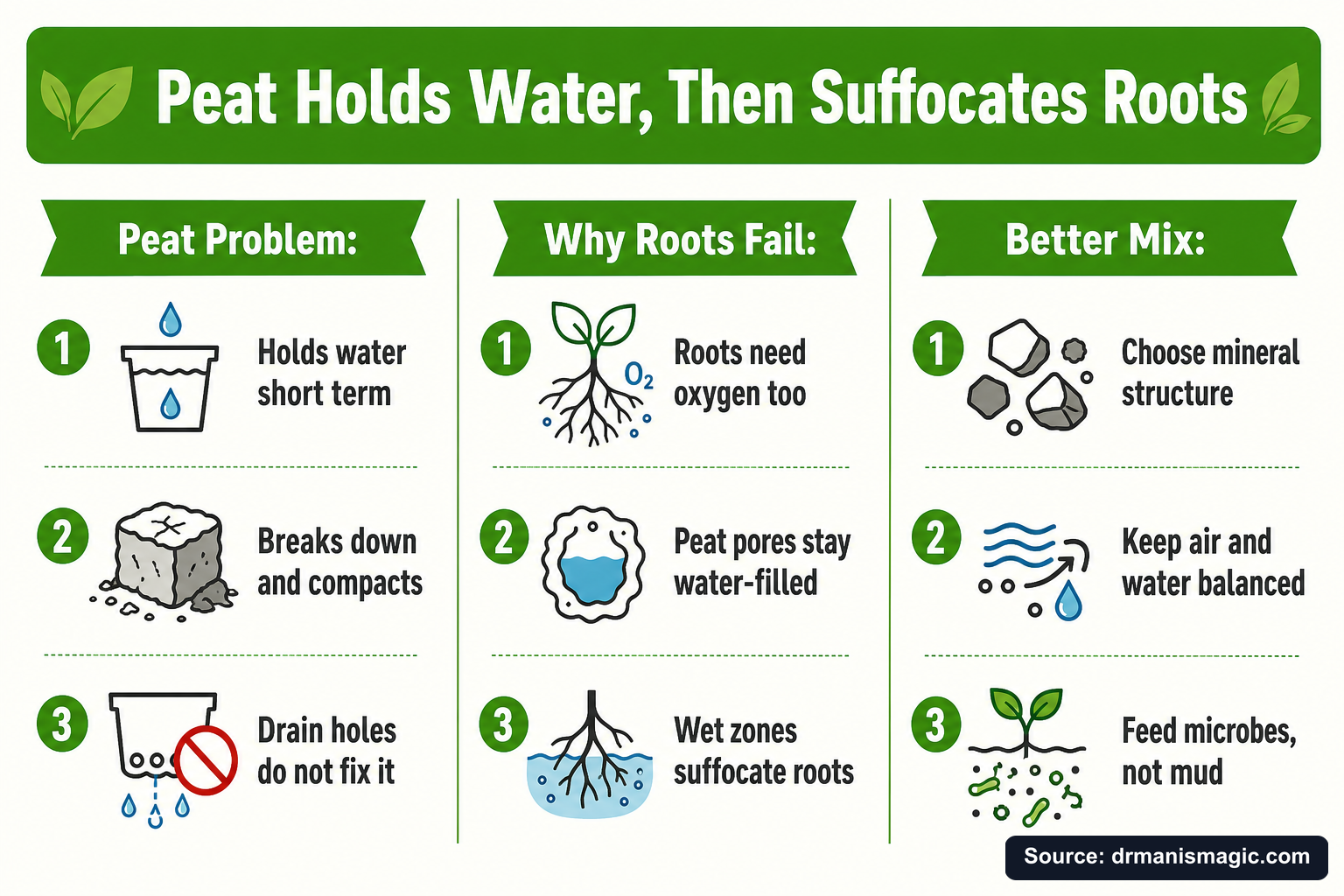
- Peat moss holds water well in the short term, but it is not a structural material — it compresses, decomposes, and eventually seals off oxygen to roots.
- Roots need oxygen just as much as they need water. When peat packs down, air disappears and roots suffocate.
- A drainage hole at the bottom of a pot does not prevent a "perched water table" — a zone of trapped, oxygen-starved water sitting right above the drain.
- Peat-heavy mixes can become hydrophobic when they dry out, actually repelling water instead of absorbing it.
- For perennial container plants — citrus, tropical trees, woody shrubs, or any plant staying in the same pot for years — mineral-based structure outlasts and outperforms peat every time.
- The Three Plant Pillars (mineral soil, live microbes, organic fertilizer) fix the root cause of peat's long-term failure, not just the symptoms.
- Balancing water retention with air porosity is not complicated once you understand the physics — and this article will show you exactly how.
What Is the Role of Peat in Temporary Water Retention, Really?
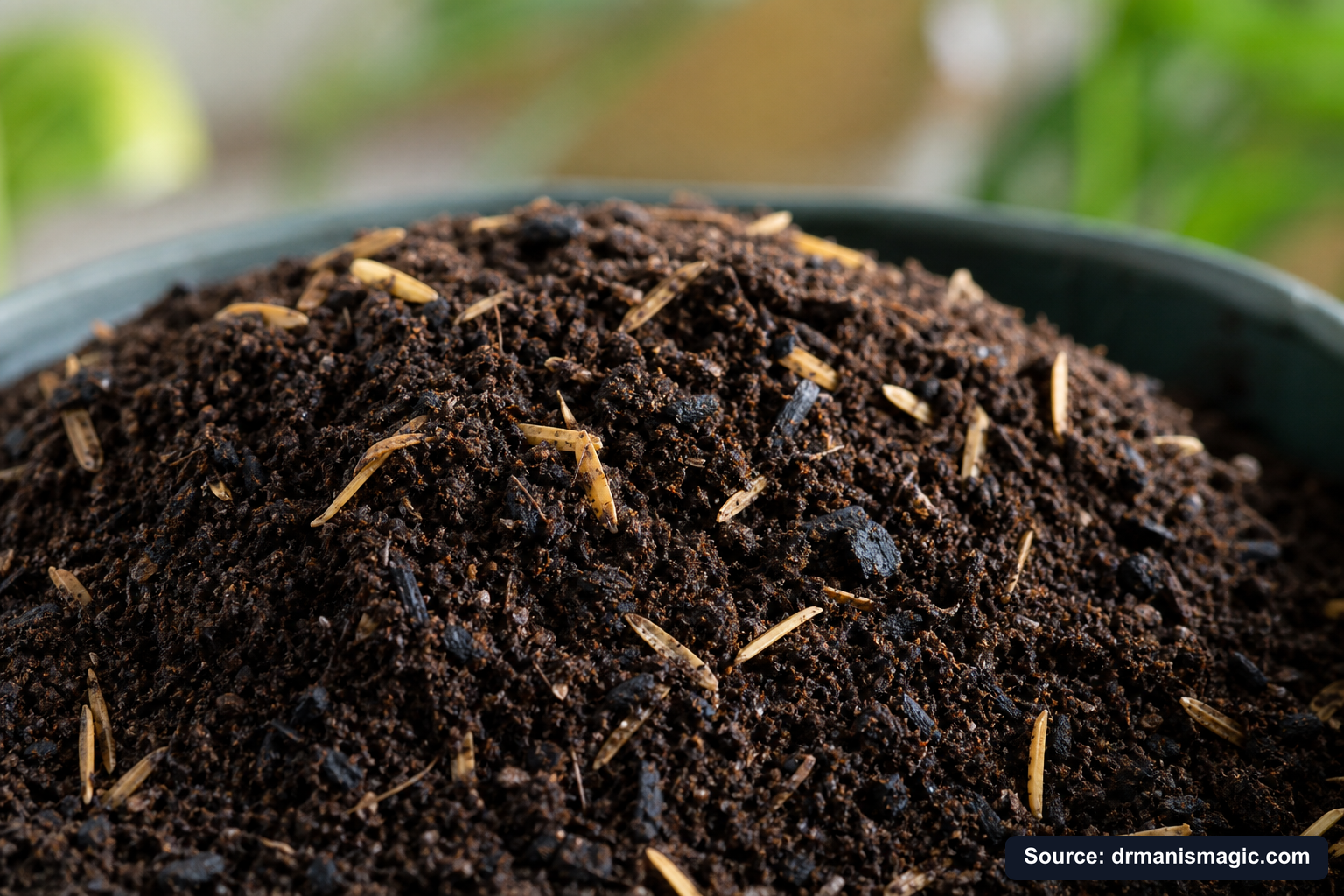
Quick Answer: Peat moss acts like a sponge inside a container. Its tiny pores hold onto water molecules and release them slowly to roots. This is genuinely useful — but only short term. Over weeks and months, peat compresses, decomposes, and either turns into airless mud or dries into a hard, water-repelling brick. It was never meant to be a forever material.
Peat comes from ancient bogs. Over thousands of years, partially decomposed plant material — mostly sphagnum moss — piles up in waterlogged, low-oxygen environments. The result is a spongy, acidic, carbon-rich material that holds many times its weight in water.
That sounds amazing for plants. And in the right context, it is. Nurseries and seed-starting operations use peat because it is light, consistent, and cheap. For a tomato seedling that will be in a tray for six weeks, peat is perfectly fine. It does its job and gets replaced before it fails.
But here is the truth that almost nobody says out loud: peat is a temporary water-buffering material. It is not a soil. It does not have the structure or stability to function as a long-term growing medium on its own. The moment you put a perennial plant — a lemon tree, a fig, a fiddle-leaf fig, a bonsai — into a peat-heavy mix and expect it to thrive for years, you are building your house on sand. Wet sand. Sand that is slowly turning into concrete.
Rutgers University's cooperative extension research on container media shows the ideal growing medium should have roughly 60 to 75 percent total porosity, 10 to 20 percent air capacity, and over 30 percent available water. Peat alone cannot maintain those numbers over time. It starts near the right range and then drifts badly as it breaks down. (Rutgers NJAES Container Media Guide)
Why Do Roots Need Oxygen — And What Does That Have to Do With Peat?
Quick Answer: Roots breathe. They pull oxygen from air pockets in the soil and use it to drive cellular respiration — the process that powers nutrient uptake. When peat compresses and fills those air pockets with water, roots cannot breathe. They die from the inside out, turning brown and slimy long before you see a yellow leaf above the soil.
Here is something that surprises almost every gardener the first time they hear it. Your plant's leaves use carbon dioxide. But your plant's roots use oxygen. The roots and the leaves are doing completely different jobs, and they need completely different gases.
Soil is not just stuff that holds your plant upright. Healthy soil is about 50 percent solid material and 50 percent pore space. That pore space should be split between water-filled pores and air-filled pores. The air-filled pores are how oxygen gets to the roots.
Peat's pores are tiny — called micropores. Micropores hold water through capillary action, and they hold it tight. They do not release it easily to air. When your mix is mostly peat, most of the pore space is water-filled most of the time. The air pores shrink. Oxygen disappears.
Decomposition makes this worse. Peat is an organic, carbon-based material. All organic materials eventually break down. And the breakdown process itself consumes oxygen — the same oxygen your roots are trying to breathe. So peat is pulling oxygen out of the soil in two ways at once: by filling pores with water, and by consuming oxygen as it decomposes.
This is why Dr. Mani Skaria — plant pathologist, Professor Emeritus, and founder of the Clean Citrus Program in Texas — built his soil system around a mineral base. Minerals are silica-based. Silica does not decompose. It does not consume oxygen. It holds its structure for decades. After growing more than 250,000 trees at the US Citrus Nursery in South Texas, the lesson was clear: organic-heavy mixes fail over time, and mineral structure is what roots need to truly thrive.
What Is a Perched Water Table, and Why Does Your Drainage Hole Not Fix It?
Quick Answer: A perched water table is a layer of saturated, oxygen-starved soil that forms above the bottom of any container — even one with drainage holes. Fine-textured media like peat holds water through capillary tension, which is stronger than gravity in a shallow container. Water does not drain out. It just sits there, suffocating roots, while the top of the pot feels perfectly dry.
This is the part that confuses almost everyone. You put drainage holes in the pot. You tilt the pot. Water comes out when you water. So how can the bottom of the pot still be soaking wet?
Here is the physics. In a container, water moves down through the soil until capillary tension in the pore spaces equals the downward pull of gravity. At that point, water stops moving. The zone where water stops is called the perched water table. In a fine-textured, peat-heavy mix, this zone can be several inches deep — sitting right at the bottom of your pot, right where the roots are most concentrated.
Adding rocks or gravel to the bottom of the pot actually makes this worse. It raises the interface between fine and coarse material, which raises the perched water table higher into the root zone. The University of Illinois Extension has documented this effect clearly, showing that layering coarse material under fine media increases saturation in the fine layer above. (University of Illinois Extension — Gravel at the Bottom of Pots)
The fix is not rocks at the bottom. The fix is a mix with enough large pores — macropores — throughout the entire volume of the pot. Macropores drain freely by gravity. They stay air-filled after watering. They keep oxygen available to roots. This is why coarse components like bark, pumice, perlite, lava rock, and mineral sand matter so much. They create macropores. Peat alone cannot do that.
What Happens to Peat Over Time in a Container?
Quick Answer: Peat degrades in stages. First it compresses under the weight of watering and gravity. Then it begins to break down chemically, consuming oxygen as it decomposes. Finally, once it dries out, it can become hydrophobic — meaning it actively repels water instead of absorbing it. A mix that felt perfect at month one can become root-choking mud or a dry, water-repelling brick by month six.
Think about what happens to a brand new bag of potting mix versus one that has been in a pot for a year. When it is new, it is fluffy. Light. Full of air. You push your finger in and it gives way easily. It feels alive.
Six months later, it is dense. Dark. Heavy. It pulls away from the edges of the pot when it dries. You pour water on it and the water beads up and runs down the edges without soaking in. Sound familiar?
That is hydrophobicity — and it is a natural result of peat drying out. Fresh peat is hydrophilic, meaning it loves water. But once it dries completely, the surface chemistry of the peat particles changes. It becomes water-repelling. Manufacturers add surfactants — wetting agents — to fresh potting mixes to counteract this. Over time, those surfactants wash away. And then you are left with a pot full of material that sheds water like a raincoat.
This is also why the overwatering vs. underwatering debate in online gardening groups is so confusing. The plant can be suffering from both at the same time. The bottom of the pot is saturated and oxygen-starved. The top is dry and hydrophobic. Neither zone is healthy. The roots in the middle are doing their best to survive in a shrinking corridor of usable space.
Big box stores benefit from this cycle. They sell you the plant. They sell you the potting mix. Six months later, you come back for another plant and more potting mix. The system is not designed for your plant's long-term health. It is designed for repeat purchases. We have seen this pattern play out across hundreds of thousands of trees, and it never changes unless you change the foundation.
Peat vs. Mineral Soil: What Is the Real Difference for Container Plants?
Quick Answer: Peat is organic, carbon-based, and temporary. It holds water but degrades, compresses, and eventually suffocates roots. Mineral soil is silica-based, inorganic, and permanent. It holds its structure indefinitely, maintains air porosity, and never steals oxygen through decomposition. For any plant staying in a container longer than one season, mineral structure wins every time.
Here is a side-by-side look at how these two approaches compare where it actually matters:
| Property | Peat-Heavy Potting Mix | Mineral-Based Soil (e.g., Super Soil) |
|---|---|---|
| Base material | Pine bark, peat, coir (carbon-based organics) | Silica-rich sandy loam (inorganic mineral) |
| Decomposition over time | Yes — compresses and breaks down within months | No — silica does not decompose |
| Oxygen availability at roots | Declines rapidly as pores fill and collapse | Maintained long-term through stable pore structure |
| Perched water table risk | High — fine particles hold water by capillary tension | Low — coarse mineral particles drain freely |
| Hydrophobicity when dry | Common after surfactants wash out | Minimal — mineral particles rewet easily |
| Lifespan in container | 3 to 12 months before significant performance loss | Permanent — does not need replacement |
| Root rot risk | High in perennial containers | Low when properly formulated |
| Best use case | Annual vegetables, seed starting, short-cycle crops | Citrus, tropical trees, houseplants, perennial containers |
The bonsai community figured this out centuries ago. Traditional Japanese bonsai substrate is almost entirely mineral — akadama, pumice, and lava rock. Almost zero organic matter. The trees live for decades, sometimes centuries, in the same containers. They do not need to be repotted because the media breaks down. The mineral structure holds. The roots breathe. The trees thrive.
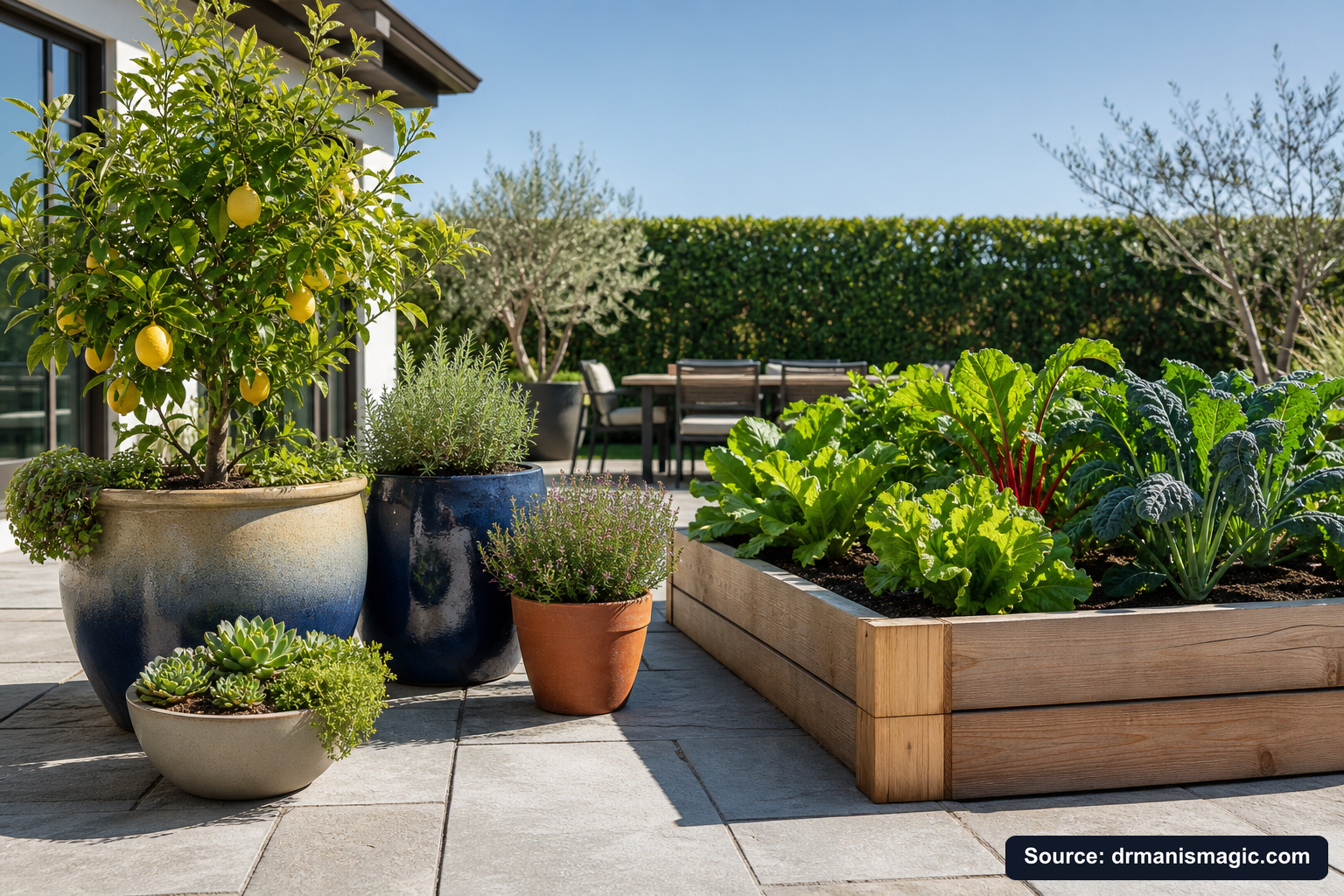
This is not a new idea. It is an old one that the modern potting mix industry quietly buried because pine bark sawdust is cheaper and lighter to ship than mineral soil. We are planting our trees in other dead trees and calling it gardening. There is a better way.
You Never Had a Brown Thumb.
You were handed the wrong tools. This free guide hands you the right ones.
You watered it. You fed it. It died anyway.
It was never you. It was the dirt, the salt food, and the bad advice.
This guide shows you what really went wrong, and how to fix it for good.
- Why your plants really died, and why it was never your fault
- The salt hiding in your plant food that quietly burns the roots
- The hidden killer in almost every bag of store soil
- The tiny helpers that grow a whole forest for free
- The rescue trick that brings a half dead plant back to life

Which Plants Tolerate More Peat — and Which Ones Suffer Most?
Quick Answer: Annual vegetables and short-cycle crops can handle peat-heavy mixes because they are replaced before the media degrades. Citrus, tropical trees, woody shrubs, bonsai, and long-term houseplants suffer the most — they stay in the same pot for years and experience the full collapse of peat structure. Succulents need the fastest dry-down and do worst of all in high-peat mixes.
Not every plant is equally hurt by peat. The damage is tied to how long the plant stays in the same container. Here is a quick framework:
| Plant Type | Time in Container | Peat Tolerance | Recommended Media Strategy |
|---|---|---|---|
| Annual vegetables (tomatoes, peppers, herbs) | One season | High — replaced before media fails | Peat-based mix acceptable; add perlite for drainage |
| Moisture-loving perennials (ferns, peace lily) | Years | Moderate — need frequent repotting | Peat with significant bark and perlite addition |
| Citrus and tropical fruit trees | Many years | Low — peat collapse causes serious root damage | Mineral-based soil with coarse bark and minimal peat |
| Woody patio plants and shrubs | Many years | Low | Primarily mineral with coarse organic fraction |
| Succulents and cacti | Years | Very low — need rapid dry-down | Mostly mineral: pumice, lava rock, coarse sand |
| Bonsai | Decades | None — fully mineral substrate required | Akadama, pumice, lava rock blend |
The most heartbreaking cases we see are citrus trees that were doing great for the first few months and then mysteriously started declining. The owner watered correctly. They fertilized. They gave it sunshine. But nobody told them that the potting mix was collapsing underneath the surface. By month eight, the roots were sitting in an anaerobic, oxygen-starved swamp — and the tree was sending every distress signal it had. Yellowing leaves. Dropping fruit. Slow growth. The tree was not failing. The foundation was failing.
You cannot get that time back. That is the part that hurts most. Not the money spent on the plant, or the bags of potting mix, or the fertilizer. The time. Months of growth that should have happened and did not. The fruit you were hoping to see. The tree you were hoping to pass down. Time spent watching a plant struggle instead of watching it thrive.
What Can Replace Peat's Water-Holding Role Without Sacrificing Oxygen?
Quick Answer: Coconut coir holds water similarly to peat but is more renewable and rewets more easily when dry. Pine bark provides both water retention and large macropores for air. Pumice, perlite, lava rock, and coarse sand create the macropore structure that keeps oxygen available. The best long-term mixes combine a stable mineral base with a small fraction of water-buffering organic material.
Peat does one thing genuinely well: it buffers moisture. It slows down the dry-out cycle between waterings. For roots, that buffering is useful — as long as there is also enough air space to keep oxygen flowing. The goal is not to eliminate water retention. It is to separate the water-holding job from the structural job and give each to a material that does it well long-term.
Here is how the main alternatives compare to peat for water retention, air porosity, and longevity:
- Coconut coir: Similar water retention to peat, more renewable, rewets easily when dry, slightly higher pH. Good peat substitute in most mixes. This is one of the components in Super Soil, alongside biochar and rice hulls — all chosen because they contribute without decomposing into root-suffocating sludge.
- Pine bark (coarse): Holds some water, creates large macropores, breaks down slowly but more predictably than peat. Better for perennial containers than fine pine bark or sawdust.
- Perlite: Volcanic glass, inorganic, creates excellent macropores, holds almost no water. Perfect for improving drainage and air porosity in any mix.
- Pumice: Volcanic rock with both micro and macropores, holds some water but also allows air flow. Excellent long-term mineral amendment.
- Lava rock: Very porous, extremely durable, excellent drainage. Common in bonsai and succulent mixes.
- Biochar: Carbon-based but highly stable — does not decompose like peat. Acts as a home for beneficial microbes and holds water and nutrients at a microscopic level without blocking air.
- Rice hulls: Made of silica, resist decomposition, improve aeration, can be used as a top dressing to suppress weeds. A natural spacer that lasts far longer than peat.
- Coarse sand: Inorganic, creates macropores, no water retention, improves drainage significantly. Must be coarse — fine sand can actually make drainage worse by filling air pores.
The Three Plant Pillars approach starts with getting the mineral foundation right. Once oxygen is flowing freely to the roots, everything else in the system works better — the microbes thrive, the nutrients get absorbed, and the plant has the foundation it needs to grow the way nature intended.
How Do You Diagnose Root Problems Caused by Peat Breakdown?
Quick Answer: The first signs of peat-related root trouble appear above the soil — yellowing leaves, slow new growth, and dropping foliage — while the soil looks fine on the surface. The real damage is happening below, where compressed and waterlogged peat has created oxygen-starved conditions that allow root-rotting pathogens to take hold.
Here is a simple diagnostic framework. If your container plant has been in the same peat-based mix for more than six months and you notice any combination of the following, peat breakdown is likely contributing:
| Symptom | What It Suggests | Root Cause |
|---|---|---|
| Yellowing leaves from the bottom up | Nutrient lockout or root damage | Roots cannot absorb what is there when oxygen is gone |
| Soil surface dry but plant wilting | Hydrophobic peat or root rot | Water not reaching roots OR roots too damaged to uptake |
| Water runs off the surface without soaking in | Hydrophobic peat | Surfactants washed away, peat repelling water |
| Musty or sour smell from the pot | Anaerobic conditions in the root zone | Waterlogged peat creating low-oxygen environment |
| Brown, slimy roots when unpotted | Active root rot | Pathogenic fungi attacking oxygen-starved roots |
| No new growth despite fertilizing | Root system too compromised to uptake nutrients | Soil structure failure — not a fertilizer problem |
See also: The Hidden Reason Synthetic Fertilizers Cause Root Rot — because adding more fertilizer to a peat-collapsed mix is like pouring gas on a smoldering fire. The roots cannot use what they cannot reach.
How Do You Recover a Plant From a Collapsed Peat Mix?
Quick Answer: Recovery starts with removing the plant from the failed media, trimming damaged roots, and moving it into a well-structured, mineral-based mix that restores oxygen to the root zone. Adding live beneficial microbes after the move dramatically improves recovery speed by repopulating the rhizosphere with organisms that protect and rebuild root tissue.
If you have already identified the problem, here is a recovery checklist to walk through step by step:
- Unpot the plant gently. Shake or rinse away as much of the old potting mix as possible. Do not be alarmed by what you find. Knowledge is power. You are fixing the problem now.
- Inspect the roots. Healthy roots are white or tan and firm. Rotten roots are brown, dark, or slimy and smell sour. Trim the rotten sections with clean, sharp scissors or pruning shears. Cut back to healthy tissue.
- Let the roots air-dry briefly. Ten to fifteen minutes of exposure to air before repotting allows cut surfaces to begin callusing and reduces the chance of continued pathogen spread.
- Choose a mineral-based, well-draining mix. You want a mix that maintains its structure for years — not one that will collapse again in six months. The mineral base is what keeps pore space open long-term.
- Repot into the right size container. Bigger is not always better. Excess soil volume holds excess water. Choose a pot that fits the root ball with just a few inches of clearance on all sides.
- Drench with live beneficial microbes. This is not optional for a stressed plant. Beneficial bacteria and fungi in the root zone protect damaged roots, help them recover faster, and begin rebuilding the microbial ecosystem that makes plants resilient. See: Plant Super Boost — a liquid blend of live bacteria, fungi, and mycorrhizae developed specifically for this purpose.
- Hold off on heavy fertilizing for two to four weeks. Give the root system time to stabilize before pushing new growth. When you do fertilize, choose a slow-release organic form that works with the microbes — not a salt-based product that will burn recovering roots and wipe out the beneficial organisms you just added.
Most plants recover faster than you expect when you get the foundation right. We have seen trees that looked nearly dead push new growth within weeks of being moved into proper mineral-based soil with live microbial support. The plant was not the problem. The environment was. Fix the environment and the plant will do the rest.
What Does Long-Term Container Success Actually Look Like?
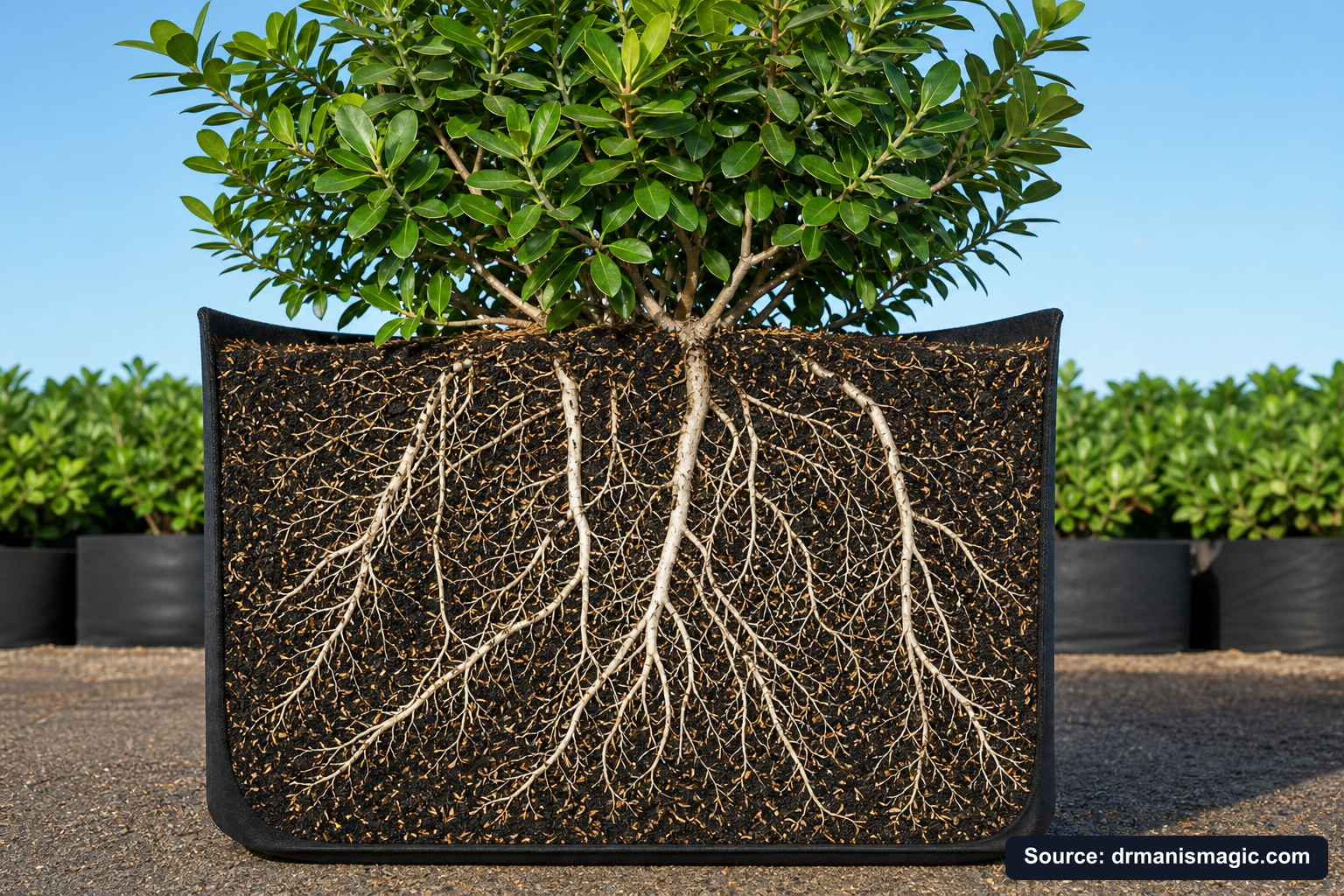
Quick Answer: Long-term container success means building a growing environment the plant can live in for years — not months. That requires mineral-based soil structure that never collapses, live microbes that protect and feed the root zone, and organic nutrition that fuels growth without burning the system. These are the Three Plant Pillars, proven across 250,000+ trees in South Texas.
Here is the thing about time that nobody in the gardening industry wants to talk about. You can get money back. You can buy another plant. But you cannot get back the months and years you waited for a tree to grow, only to watch it circle the drain because its foundation was wrong from the start.
The number one thing people tell Dr. Mani they want is to see their own tree produce fruit while they are still around to enjoy it. That is a primal, human, God-given desire. We were put on this earth to tend a garden. That drive has never left us. But going down the wrong path — the sawdust-in-a-bag path, the salt-fertilizer path, the "maybe it needs more water" path — burns months of growth. Then years. And the window does not wait.
The Three Plant Pillars are not a complicated system. They are a first-principles answer to what plants have always needed: a stable mineral foundation for roots to breathe, a living microbial ecosystem to protect and feed the root zone, and slow-release organic nutrition that works with nature instead of against it. These three things together make the plant nearly bulletproof. Miss any one of them and you are fighting uphill every single season.
After 30 years of growing at the US Citrus Nursery in Hargill, Texas — through Texas summers, through cold snaps, through every mistake imaginable — this is the system that works. Not because it is clever. Because it is aligned with how plants actually grow.
If you are ready to stop guessing and start growing on a foundation that lasts, download the Free Plant Care Field Guide from Dr. Mani's Magic. It walks you through the Three Plant Pillars in plain language, with everything you need to get started — no jargon, no guesswork, no more dead plants. Your tree is waiting. Your window is open. Let's not waste another season.
Frequently Asked Questions
Peat moss sounds like a great idea. The bag says "moisture control." The price is right. But after working with over 250,000 citrus and tropical trees at US Citrus Nursery, Dr. Mani learned the hard truth about peat that most gardeners find out too late. These questions will show you exactly what peat does, what it cannot do, and what actually keeps roots alive and thriving long term.
Does peat moss actually retain water well?
Yes, peat holds water very well in the short term. It can soak up around 20 times its own weight in moisture and release it slowly to roots. That sounds great. But here is the catch. Over time, peat breaks down, compresses, and turns into a soggy, airless sludge. Roots need oxygen just as much as they need water. When peat packs down, oxygen disappears and roots start to rot. Water retention without air flow is not a feature. It is a slow death sentence for your plant.
Does peat help with drainage?
Fresh peat can improve drainage in heavy clay soils, and that is true. But in a container, the story changes completely. Peat compresses over weeks and months. Once it packs down, water stops moving through it the way it should. You end up with what scientists call a perched water table, a zone of trapped, oxygen-starved water sitting right above your drainage hole. The hole is open. The water just will not leave. That is not drainage. That is a root rot trap hiding in plain sight.
What type of soil holds water best for healthy plants?
Clay soil holds the most water by raw volume, but that is not the same as being good for plants. Clay suffocates roots. The best growing medium balances water retention with air flow. Dr. Mani's Super Soil uses mineral-based sandy loam from South Texas, the same Rio Grande Valley silica-rich sand that does not break down or compact. It holds enough moisture for roots to drink while staying open and airy so roots can breathe. That balance is what 250,000 trees taught us works.
Why are so many gardeners moving away from peat?
Two big reasons. First, peat bogs are ancient carbon sinks. Mining them releases carbon stored over thousands of years and wrecks rare wildlife habitats. Second, peat has real practical problems. It contains almost no nutrients on its own. When it dries out completely, it turns hydrophobic and actually repels water instead of absorbing it. You end up pouring water on a pot and watching it bead off the surface like rain on a waxed car. Sustainable alternatives like coco coir, biochar, and mineral-based soil do the job better and do not cost the planet.
Does peat improve the water-holding capacity of sandy soil?
It does, but only temporarily. Peat can hold 70 to 80 percent of its weight in water, which makes it useful as a short-term amendment for sandy soils. The problem is that peat decomposes. In a few seasons, it breaks down and you are back where you started, except now your soil has compacted a little more and your microbe population has taken a hit. Dr. Mani's Three Plant Pillars solve this at the root level. Mineral soil gives you permanent structure. Live microbes from Plant Super Boost build a living ecosystem that manages moisture naturally.
Does peat-free compost hold water differently?
Yes, and that surprises a lot of gardeners who switch. Peat-free mixes use ingredients like coco coir, rice hulls, and biochar, and each one holds water and releases it at a different rate. Coco coir stays moist without going soggy. Rice hulls create air pockets so roots breathe. Biochar acts like a tiny sponge hotel for microbes and nutrients. Super Soil combines all of these with mineral-based sandy loam, so you get moisture retention, air flow, and a living soil ecosystem working together instead of fighting each other.
What is the long-term solution if peat keeps failing my container plants?
Stop patching the problem and fix the foundation. That is what the Three Plant Pillars are all about. Pillar one is mineral-based soil that never compacts or rots. Pillar two is live microbes that turn your soil into a self-sustaining ecosystem. Pillar three is organic fertilizer that feeds your plants without burning roots or wiping out the beneficial bacteria peat already struggles to support. We proved this system across 250,000 trees at US Citrus Nursery. It works for citrus, tropicals, houseplants, flowers, and gardens. Stop gambling on peat. Build the right foundation once and watch everything change.
About the Author
Dr. Mani Skaria, PhD
Dr. Mani Skaria, PhD, is a plant pathologist and the scientific founder of Dr. Mani's Magic. He earned his doctorate at Purdue University and spent 48 years studying how plants, soil, and living microbes work together, including his years as Professor Emeritus at Texas A&M and as a member of the USDA NAREEE Advisory Board. He invented micro-budding, a method for growing healthier, stronger trees, and has grown more than 250,000 trees on the family farm in Hargill, Texas - US Citrus Nursery. His life's work takes real lab science and practical experience and turns it into simple, safe, organic plant care anyone can use at home.


