


Natural Growth Signals Found Only in Sea Plants Explained | Dr. Mani's Magic
The Natural Growth Signals Found Only in Sea Plants (And Why Your Garden Has Never Heard of Them)
Picture this. You walk out to your backyard on a Saturday morning. Coffee in hand. The sun is just coming up. And you stop in front of your favorite tree or garden bed and stare at it the way you have for months now. Waiting. Hoping. Wondering why it just... sits there. Alive, sure. But not thriving. Not growing the way you imagined when you first planted it.
You have done everything the bag said to do. You watered it. You sprinkled on the fertilizer from the big orange store. You gave it sunshine. But something is missing. Some invisible spark that turns a struggling plant into one that makes your neighbors stop and ask, "What are you doing differently?" That spark has a name. And it comes from the ocean.
Deep underwater, sea plants called kelp and seaweed have been solving complex problems for millions of years. They survive crushing pressure, freezing cold, wild temperature swings, and salt levels that would kill almost anything else. To do that, they packed themselves full of a remarkable toolkit of natural compounds. Compounds that, when you apply them to any plant in your yard, your garden, your containers, or your lawn, send signals that wake up growth in ways that ordinary fertilizer simply cannot touch. After growing more than 250,000 trees at our South Texas nursery, we learned that this marine toolkit is one of the most powerful and least understood tools in all of gardening. Here is the full story.

Organic Fertilizer | Crab, Kelp & Amino Acids
Key Takeaways
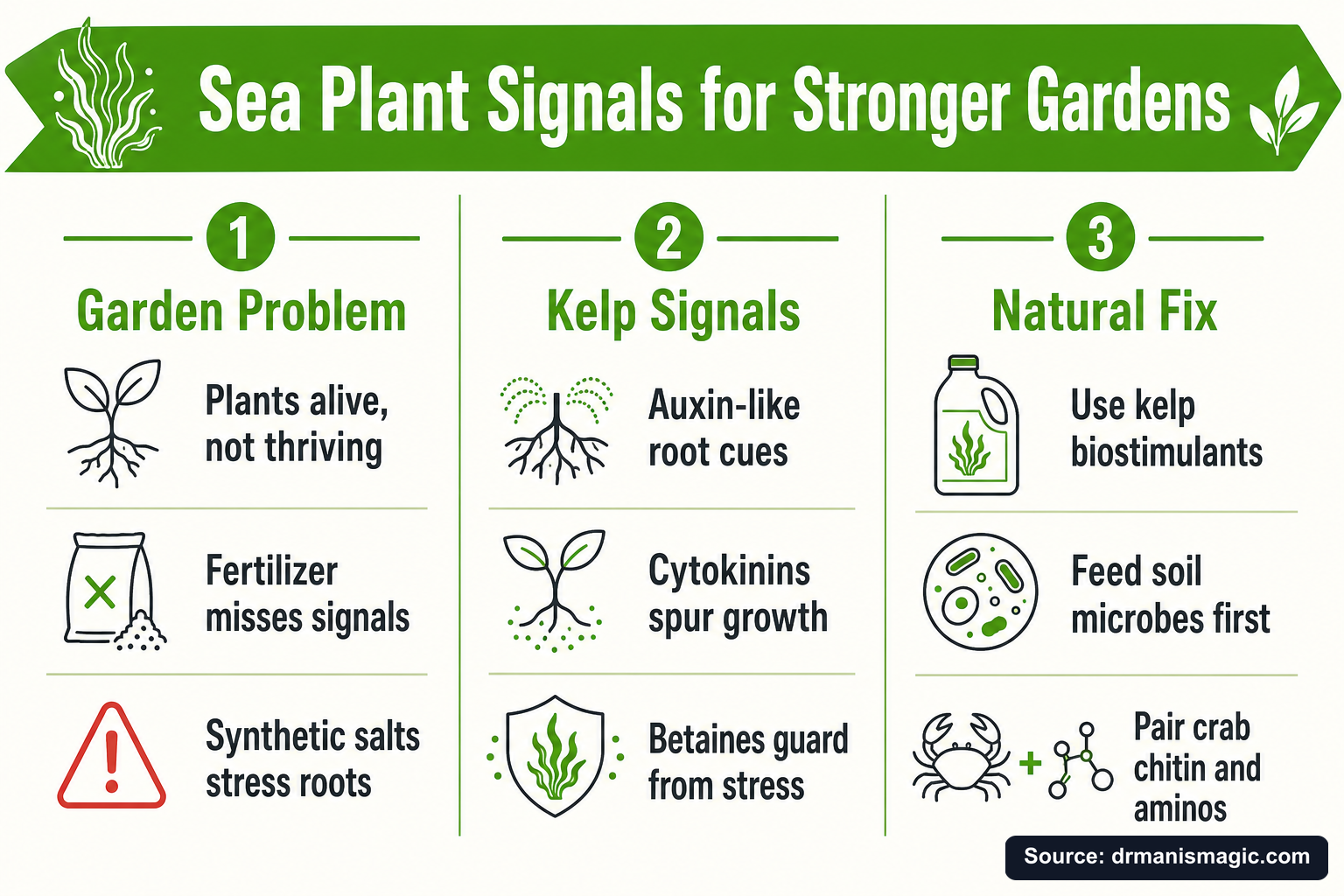
- Kelp and seaweed are not fertilizers in the traditional sense. They are biostimulants that send growth signals your plant's roots already understand.
- The natural compounds in sea plants include hormone-like activity, amino acids, marine polysaccharides, osmoprotectants, and trace minerals that land-based fertilizers almost never provide together in one place.
- Salt-based synthetic fertilizers kill the very microbes that translate these signals for your plant, making the whole system fall apart.
- Kelp helps most during transplant shock, drought stress, heat stress, root recovery, seedling establishment, and flowering transitions.
- Chitin from crab shells works alongside kelp to trigger your plant's natural immune system from the inside out.
- Clean organic inputs like kelp, crab, and amino acids feed the soil microbes first, and those microbes then slowly release nutrition straight to the roots, mimicking how nature feeds plants every single day.
- Zero PFAS, zero biosludge, zero synthetic salts means your family, your pets, and your soil microbes are all safe.
What Are the Natural Growth Signals Found Only in Sea Plants?
Quick Answer: Sea plants like kelp contain a unique mix of hormone-like compounds, marine polysaccharides, osmoprotectants, amino acids, and trace minerals that influence how land plants root, grow, handle stress, and absorb nutrients. No land-based fertilizer naturally contains all of these signals together in the same package.
Sea plants are not like the plants in your backyard. They evolved in one of the harshest environments on Earth. The ocean is cold, salty, dark, and wildly unpredictable. To survive it, kelp and other brown seaweeds built an internal chemistry that is nothing short of extraordinary.
When scientists began studying commercial kelp extracts, they found something remarkable. These extracts did not just supply nitrogen, phosphorus, and potassium like a regular fertilizer. They influenced how plants behaved at a biological level. Roots grew faster. Seeds germinated sooner. Plants handled heat and drought better. Flowers opened with more vigor. And the soil microbes around the roots became more active and more diverse.
So what exactly is in there? The honest answer is a cocktail of compounds that work together, not a single magic molecule. Here is what the research shows is inside brown seaweeds like the kelp species used in quality extracts, according to work reviewed by University of Wisconsin Extension.
- Auxin-like activity — These are compounds that behave like auxins, one of the main plant hormones responsible for root growth and cell elongation. Sea plants do not have a monopoly on auxins, but they carry a unique marine form of this activity that land fertilizers do not replicate.
- Cytokinin-like compounds — Cytokinins signal cells to divide. More cell division means faster growth. Kelp extracts have been found to carry or stimulate cytokinin activity.
- Betaines and osmoprotectants — These are stress-shield molecules. They help plants manage salt stress, heat, and drought by protecting their cells from damage. This is the ocean's own stress survival chemistry being handed directly to your plant.
- Marine polysaccharides — Complex carbohydrates like alginic acid and fucoidan that feed soil microbes and help build soil structure around the roots.
- Natural amino acids — Ready-to-use building blocks for plant proteins, available immediately without requiring a long breakdown process.
- Trace minerals from the sea — Iodine, boron, manganese, iron, and dozens of other trace elements that ocean water concentrates over millennia and land soils often run short on.
- Vitamins and phenolic compounds — Support enzyme activity, antioxidant function, and overall plant resilience.
None of these compounds alone is the secret. The secret is that they show up together, in one natural matrix, working in sync. That is the marine difference. That is why plants respond to kelp in a way they simply do not respond to a bag of synthetic granules.
Why Do Salt-Based Fertilizers Block These Signals From Working?
Quick Answer: Salt-based synthetic fertilizers raise the salt concentration around plant roots, which forces roots to work against osmotic pressure instead of absorbing water and nutrients. High salt also kills the soil microbes that are responsible for translating natural biological signals into plant-usable nutrition. When microbes die, the whole communication system breaks down.
Here is what most fertilizer companies will never tell you. The granules in that blue bag or that shaker bottle from the big box store are essentially salt. That is how they are made. They are synthesized through high-energy industrial processes that produce water-soluble salt compounds. And salt, when it builds up around plant roots, does something cruel.
It triggers osmotic stress. That is a big phrase with a simple meaning. Your plant's roots absorb water by pulling it in from the surrounding soil. They do this because the concentration of dissolved material inside the root is higher than in the soil. Water flows from low concentration to high concentration, right into the root. But when you dump salt into the soil, the concentration outside the root suddenly rises. Now the gradient flips. Instead of water flowing in, it wants to flow out. Your plant is literally being pulled dry from the outside, even if you just watered it. University of Maryland Extension describes this as physiological drought, and it is exactly as bad as it sounds. The plant looks thirsty and stressed even when there is plenty of water present.
Now add the microbe problem on top of that. Your soil is supposed to be alive. Trillions of bacteria and fungi live in healthy soil. They break down organic matter. They convert raw nutrients into plant-ready forms. They protect roots from pathogens like Pythium and Phytophthora, the two main culprits behind root rot. When you pour salt into that community, it burns them. Not metaphorically. The high salt index of synthetic fertilizers literally dehydrates microbial cells and kills them. And once your microbes are gone, those natural growth signals from kelp have no biological system to amplify them. The signals arrive with nowhere to land.
See also: How Salt-Based Feeding Quietly Destroys Root Systems
How Does Organic Fertilizer Actually Feed Your Plant (The Real Mechanism)?
Quick Answer: Organic fertilizer does not feed your plant directly. It feeds the soil microbes first. The microbes eat the organic material, convert it into plant-ready nutrition, and then slowly release it straight to the roots as they work and eventually die. It is a living, self-regulating slow-release system that mirrors exactly how nature has always fed plants.
This is the part that changed everything for us at US Citrus Nursery, and it is the part that nobody explains clearly. Grab a cup of coffee, because this is worth understanding.
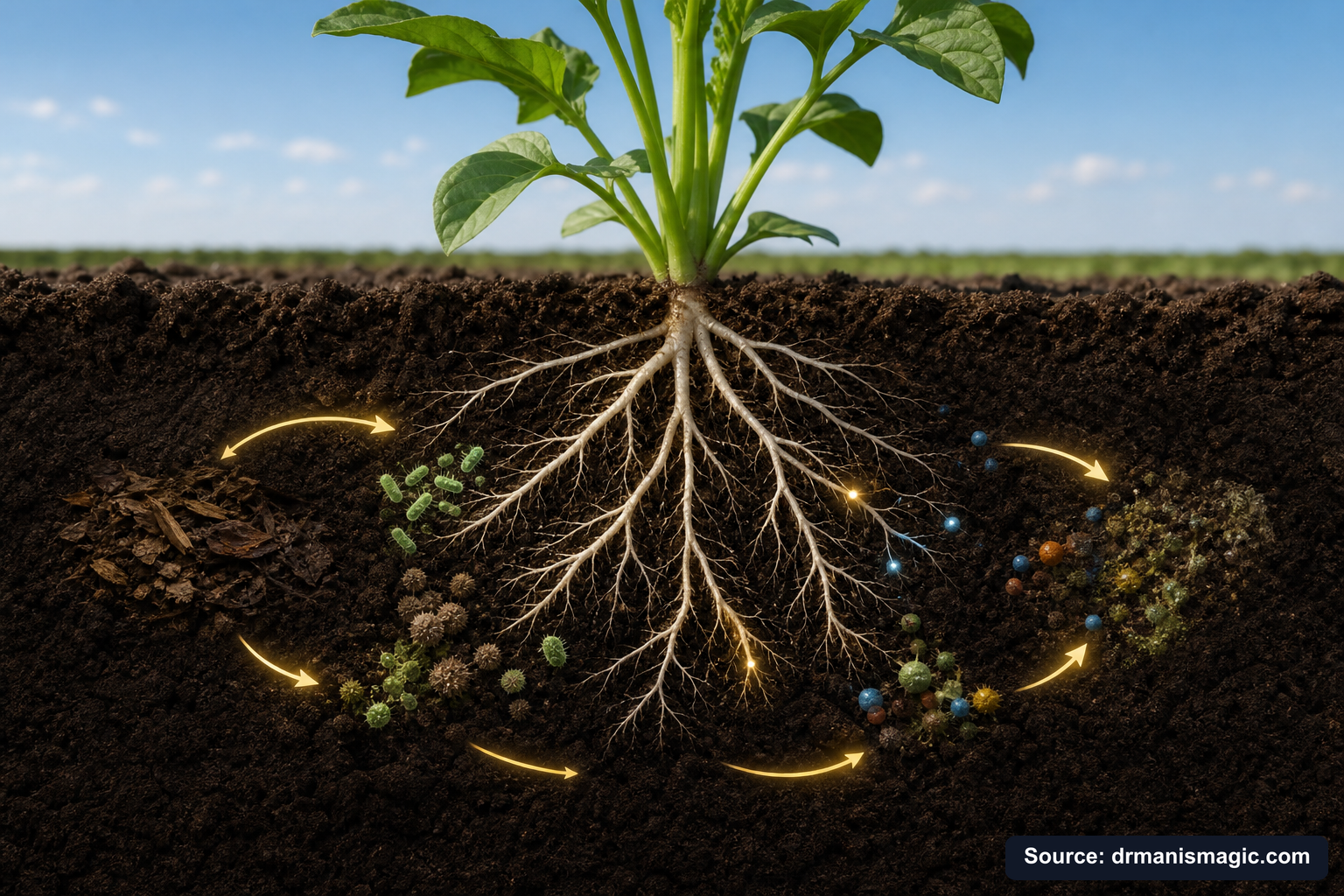
When you sprinkle an organic granular fertilizer like our Crab, Kelp & Amino Acids onto your soil, your plant does not immediately gulp it down. The granules sit there. The soil microbes find them. And then the microbes eat them. The bacteria and fungi in the root zone break down the crab shell, the kelp, and the amino acids, converting all of that nutrition into simpler forms the plant's roots can pull in through their tiny hair-like tips.
But here is where it gets even better. When those microbes eventually die, which is part of their natural life cycle, all the nutrition they were holding inside their bodies gets released right there in the root zone. Slowly. Steadily. Exactly where the plant needs it.
Think of it like a savings account instead of a spending spree. Synthetic fertilizer is a flash of cash that the plant burns through fast, followed by nothing. Then you have to feed again, and again, and the salt keeps building. Organic fertilizer is a steady deposit that keeps paying out for weeks and months, all while building the soil richer than it was before.
This is why Dr. Mani Skaria, founder of US Citrus Nursery and Professor Emeritus of Plant Pathology at the Texas A&M Citrus Center, built the entire Dr. Mani's Magic system around organic slow-release nutrition. After forty years of research and more than 250,000 trees, the evidence was impossible to ignore. The plants that thrived were always the ones fed this way.
What Does Chitin From Crab Shells Do for Your Plants?
Quick Answer: Chitin is the structural compound found in crab and shrimp shells. When it breaks down in the soil, it triggers your plant's natural immune response, boosts beneficial microbe populations, and stimulates root development. It also feeds a class of microbes that naturally suppress soil-borne fungal pathogens like Pythium and Phytophthora.
Most people think of crab shells as waste. We think of them as one of the most powerful plant inputs you can find in nature.
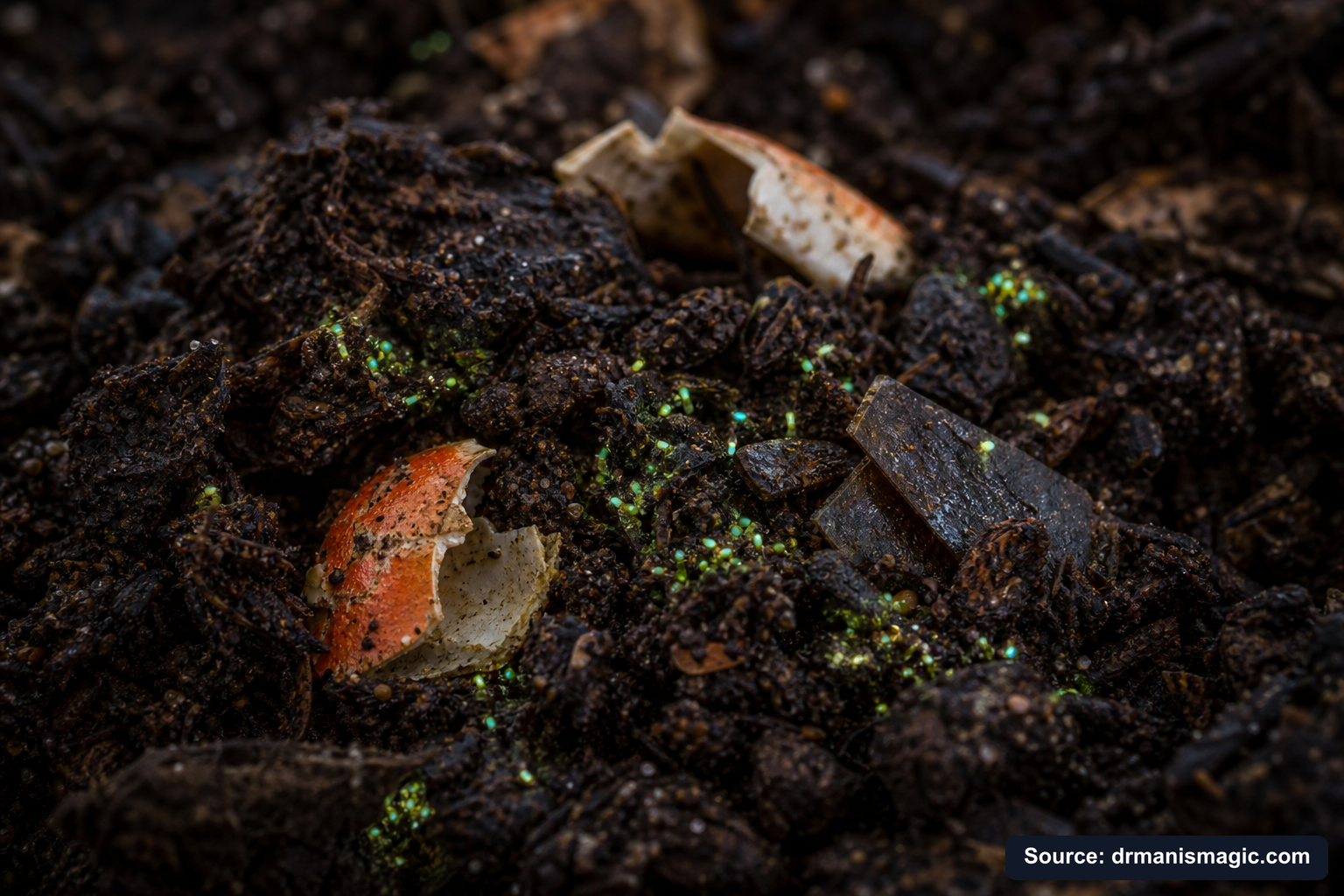
Chitin is the tough structural material that makes up crab and shrimp shells. When chitin enters your soil, something fascinating happens. The microbes that break chitin down are the same microbes that attack the cell walls of harmful fungi. Think about that for a moment. By feeding your soil chitin, you are selectively feeding the beneficial microbes that suppress the pathogens responsible for root rot. It is a natural biological control system, built right into the input.
At the same time, chitin contains calcium and magnesium, two nutrients that plants use in huge quantities for strong cell walls, fruit firmness, and woody stem development. Calcium is, by weight, the most abundant mineral in the structural tissue of plants. A large portion of every branch, every trunk, and every root tip is built with it.
And chitin also acts as a mild elicitor of plant immunity. When a plant senses chitin breaking down in its root zone, it reads that as a signal that something with a cell wall is present in the soil. It responds by quietly boosting its own defenses, building thicker cell walls, and producing more of its own protective compounds. It is like a low-grade fire drill that keeps your plant ready without causing any stress.
When Does Kelp Help the Most? A Plant Owner's Timing Guide
Quick Answer: Kelp biostimulants deliver the most dramatic results during transplant shock, seedling establishment, root recovery after repotting, heat stress, drought stress, and the transition into flowering. These are the moments when plants need growth signals most and are most responsive to the hormonal and protective compounds in kelp.
Kelp is not a "spray it on and forget it" product. It has timing. And knowing when to lean on it makes the difference between a modest response and a dramatic one.
Here is a practical guide to the moments when sea plant compounds do the most work.
| Situation | How Kelp Helps | Key Compound at Work |
|---|---|---|
| Transplant shock | Reduces root stress, speeds new root formation | Auxin-like activity, betaines |
| Seedling establishment | Faster germination, stronger early root systems | Cytokinin-like compounds, amino acids |
| Heat stress | Protects cell membranes from heat damage | Osmoprotectants, betaines |
| Drought stress | Helps plant regulate water use and reduce wilt | Betaines, marine polysaccharides |
| Salt stress (road salt, over-fertilization) | Counteracts osmotic pressure, protects roots | Osmoprotectants, betaines |
| Flowering transition | Supports hormone balance needed to trigger blooms | Cytokinin and auxin-like activity |
| Recovery after pruning or repotting | Speeds cell division and wound healing | Cytokinin-like compounds |
| Root rot recovery | Stimulates new root tips, supports microbial recolonization | Marine polysaccharides, amino acids |
Every single plant type benefits from this list. Lawns under summer heat stress. Tomatoes going through transplant shock. Orchids after repotting. Citrus trees pushing through a South Texas summer. Houseplants recovering from a bad watering stretch. The kelp signal language is universal. Plants evolved to respond to it regardless of what species they are.
You Never Had a Brown Thumb.
You were handed the wrong tools. This free guide hands you the right ones.
You watered it. You fed it. It died anyway.
It was never you. It was the dirt, the salt food, and the bad advice.
This guide shows you what really went wrong, and how to fix it for good.
- Why your plants really died, and why it was never your fault
- The salt hiding in your plant food that quietly burns the roots
- The hidden killer in almost every bag of store soil
- The tiny helpers that grow a whole forest for free
- The rescue trick that brings a half dead plant back to life

How Do You Recognize Salt Damage vs. Overwatering vs. True Root Rot?
Quick Answer: Salt damage causes brown leaf tips and edges on otherwise healthy tissue, usually appearing first on fast-growing new leaves or tips. Overwatering causes yellowing and soft stems but roots may still be intact. True root rot shows mushy, dark, foul-smelling roots that crumble when touched, caused by pathogens like Pythium or Phytophthora once roots are weakened by salt or oxygen starvation.
These three problems look similar on the outside. But they have different root causes, literally and figuratively. Getting the diagnosis right is the first step to recovery.
| Symptom | Salt Damage (Fertilizer Burn) | Overwatering | True Root Rot (Pythium / Phytophthora) |
|---|---|---|---|
| Leaf color | Brown tips and margins, rest of leaf stays green at first | Yellowing, especially lower leaves | Yellow then brown, whole plant wilts |
| Leaf texture | Crispy and dry at edges | Soft and limp, sometimes mushy | Limp, wilted even with wet soil |
| Root appearance | Brown, dry, possibly shriveled at tips | White to tan, possibly beginning to soften | Black or dark brown, mushy, breaks apart, foul smell |
| Soil condition | White crust on surface (salt deposits) | Constantly wet, poor drainage | Wet, compacted, low oxygen |
| Recovery speed | Weeks with flushing and clean inputs | Days to weeks if watering corrected | Slow, requires root pruning and microbial support |
| Main cause | High salt index from synthetic fertilizer | Waterlogged soil, poor drainage, oxygen loss | Pythium, Phytophthora pathogens in anaerobic roots |
Here is the important connection. Salt damage is not just cosmetic. Salt weakens roots. Weakened roots lose oxygen. Low-oxygen roots attract Pythium and Phytophthora. And once those pathogens move in, salt damage becomes full root rot. This is why the salt story and the biostimulant story are the same story. Clean up the inputs, restore the microbes, and the whole chain of damage stops.
See also: The Hidden Reason Synthetic Fertilizers Cause Root Rot
What Is the Difference Between Seaweed as a Fertilizer vs. Seaweed as a Biostimulant?
Quick Answer: As a fertilizer, seaweed provides modest amounts of nitrogen, phosphorus, and potassium. As a biostimulant, it does something far more important: it activates biological pathways inside the plant that improve rooting, stress tolerance, nutrient uptake, microbial interactions, and flowering. The biostimulant role is where the real value lives.
This is a distinction worth understanding clearly because it changes how you think about every product on the shelf.
If you look at the NPK number on a kelp extract, it is going to look small. Maybe a 1-0-4 or similar. By conventional fertilizer thinking, that looks weak. Not worth much. But that framing misses the point entirely.
Kelp is not primarily trying to supply nutrients. It is trying to influence biological processes. The difference is like comparing a vitamin to a meal. A meal gives you calories. A vitamin activates enzymes, regulates hormones, and keeps your body running the processes that use those calories properly. Kelp is the vitamin. A complete organic fertilizer like our Crab, Kelp & Amino Acids (7-4-4) is the meal. Together, they work in a way that neither one does alone.
This is why at US Citrus Nursery, Dr. Mani Skaria built kelp into the fertilizer blend itself rather than selling it as a standalone product. The marine biostimulant signals work best when they are already present in the root zone, delivered consistently alongside the other nutrients the plant needs. The effect is compounding. You are not just feeding the plant. You are signaling it to grow better, defend itself better, and absorb nutrition more efficiently all at the same time.
What About PFAS, Biosludge, and Why Clean Inputs Matter for Your Family?
Quick Answer: Some fertilizers, both synthetic and organic, use biosludge fillers made from treated municipal waste. Biosludge is one of the primary carriers of PFAS "forever chemicals" in the food and garden chain. Dr. Mani's Magic Crab, Kelp & Amino Acids contains zero biosludge, zero PFAS, and zero synthetic salts, making it safe for edible gardens, barefoot lawns, children, and pets.
This is the part of the fertilizer story that most companies hope you never ask about.
Biosludge is the polite industry term for treated municipal waste. Human sewage. It gets processed and dried and sold as a low-cost filler in both synthetic and some organic fertilizers. And it carries PFAS, the class of industrial compounds known as "forever chemicals" because your body and your soil cannot break them down. They accumulate. And once they are in your garden, they do not leave.
Think about what is actually at stake here. You want to walk barefoot on your grass. You want your kids and your dog out in the yard. You want to pull a tomato off the vine and eat it right there in the garden. All of that becomes a question mark the moment you introduce biosludge-based inputs into your soil.
Dr. Mani Skaria built his entire product philosophy around the idea that your garden should be safe for your family, not just productive. There is no point in growing beautiful fruit if you are not comfortable eating it. Every ingredient in the Dr. Mani's Magic line is American-sourced, clean, and traceable. No biosludge. No PFAS. No synthetic salts. No plastic-coated slow-release shells leaching microplastics into your soil. Just crab shells, cold-processed kelp, volcanic ash, and amino acids working together the way nature intended.
And yes, there is a 30-day money-back guarantee. If you are not happy with what you see in your plants within a month, you get your money back. No arguing. No fine print.
What Are the Three Plant Pillars and Where Does Kelp Fit In?
Quick Answer: The Three Plant Pillars are the framework Dr. Mani Skaria developed after decades of growing over 250,000 trees at US Citrus Nursery in South Texas. Pillar One is mineral-based soil that never compacts. Pillar Two is live soil microbes. Pillar Three is organic fertilizer with biostimulants. Kelp is the core biostimulant engine inside Pillar Three, working alongside crab chitin and amino acids.
Every thriving plant on Earth has three things working in its favor. Good soil structure that lets roots breathe. A living community of microbes in the root zone. And a steady, clean supply of nutrition that feeds the whole system without burning it. Take away any one of these three, and the plant struggles. Put all three in place, and the plant becomes almost bulletproof.
Dr. Mani spent years watching plants fail in his nursery before the pattern became clear. The ones that died had compacted soil, dead microbes, or salt-damaged roots from synthetic fertilizer. The ones that thrived had all three pillars working together. He called it the Three Plant Pillars, and it became the foundation of everything at Dr. Mani's Magic.
Kelp lives inside Pillar Three. But it does not work in isolation. It works because Pillar One has given the roots room to breathe and grow. It works because Pillar Two has populated the root zone with the living microbes that respond to kelp's polysaccharide signals and amplify the hormone-like activity into real plant growth. Pull out either of those first two pillars and the kelp signals fall on deaf ears.
This is why buying a bottle of kelp extract and spraying it on a plant stuck in dead potting mix with no microbes does not produce dramatic results. The signal is there, but the receiving system is broken. Build the Three Plant Pillars first. Then every input you apply, including the marine growth signals from kelp, lands in a system that is ready to use them. See how the Three Plant Pillars work together as a complete system here.
A Recovery Checklist: How to Restore a Plant That Has Been on Synthetic Fertilizers
Quick Answer: Recovery from synthetic fertilizer damage takes weeks, not days, but the steps are straightforward. Flush the salt, restore the microbes, add clean organic nutrition, and give the root zone time to rebuild. Most plants show visible improvement within three to four weeks when all three pillars are in place.
If your plant has been living on salt-based synthetic fertilizer for months or years, the root zone needs a reset. Here is a simple checklist that works for any plant, whether it is a citrus tree in a container, a garden bed of tomatoes, a lawn, a row of shrubs, or a houseplant on your windowsill.
- Stop the salt. Put down the synthetic fertilizer immediately. Every additional application makes the recovery longer.
- Flush the root zone. Water deeply and thoroughly to push accumulated salt salts down and away from the root zone. For containers, water until it flows freely out of the drainage holes, then repeat twice more.
- Check for compaction and drainage. If water sits on the surface for more than a few minutes, the soil structure needs addressing. Salt-damaged soil in containers often needs a partial refresh with mineral-based soil to restore oxygen flow. See also: Why Most Fertilizers Are Actually Salt in Disguise
- Introduce live microbes. The microbial community in salt-damaged soil is depleted. A monthly drench with live bacteria, fungi, and mycorrhizae restores the biological engine in the root zone. Plant Super Boost is the simplest way to do this.
- Begin clean organic nutrition. Once microbes are present and the salt has been flushed, begin feeding with a slow-release organic fertilizer that includes kelp biostimulants and chitin. The microbes will begin converting it into plant-ready nutrition within a few weeks.
- Be patient with root recovery. New root tips form slowly. You will likely see the first signs of improvement in new leaf color and growth rather than roots, since the leaves respond to improved nutrition before roots are fully rebuilt.
- Maintain the system. Once the Three Plant Pillars are in place, the system is largely self-sustaining. Consistent monthly microbial applications and regular organic feeding keep the cycle going without the boom-and-bust cycle of synthetic fertilizers.
Which Plants Benefit From Sea Plant Growth Signals?
Quick Answer: Every plant benefits. Kelp biostimulants have shown measurable results in lawns, vegetables, fruit trees, ornamental shrubs, orchids, houseplants, container plants, seedlings, and mature trees under stress. The signal language of marine compounds is not species-specific. It is universal to plant life.
We get asked this question a lot. "Is this just for citrus?" The answer is no. Emphatically no.
We tested our system on 250,000 citrus trees because that is what we grow at US Citrus Nursery. But the Three Plant Pillars doctrine applies to every living plant. The science of how microbes feed roots, how salt damages them, and how marine biostimulants activate growth does not change based on whether you are growing a Meyer lemon tree, a Bermuda grass lawn, a fiddle-leaf fig in your living room, or a bed of dahlias in your front yard.
Kelp biostimulants have been studied and documented across an enormous range of plant types. Tomatoes germinate faster. Turfgrass recovers from summer heat more quickly. Fruit trees produce stronger flowering transitions. Orchids push new roots after repotting. Seedlings establish with less transplant shock. Houseplants that have been sitting stagnant for months suddenly begin pushing new growth.
The common thread is not the plant species. It is the biology. Healthy microbes, clean nutrition, and natural growth signals from the sea work together the same way for every plant that has roots in soil. That is the whole point of the Three Plant Pillars. It is a first-principles system, not a species-specific formula. You can download the free Plant Care Field Guide here to see how to apply these principles to your specific plants.
Why Time Is the Real Cost of Getting This Wrong
Money you can get back. Time, you cannot.
The number one thing people tell Dr. Mani when they call the nursery is that they want to see fruit on the tree they planted. They want to see flowers fill in a garden bed they have been nurturing for years. They want to look out at a lush, green lawn and feel the quiet satisfaction of something they built and tended actually working. Not eventually. While they still have the energy to enjoy it.
Every month spent on a salt-damaged root zone is a month the plant is not growing toward that moment. Every year of synthetic fertilizer cycling is a year the microbes stay suppressed, the roots stay shallow, and the growth stays frustratingly slow. And here is the cruel part. After a few months or a year or two of going down the synthetic fertilizer road, growth does not just stall. It often reverses. The salt accumulates. The microbes never return on their own. The plant that seemed fine starts to decline. You have not just wasted money. You have lost irreplaceable time.
The plants in our nursery that got the Three Plant Pillars from the beginning, mineral soil, live microbes, and clean organic nutrition with kelp biostimulants, grew faster and stayed healthier than any plant we had ever grown before. Not because of magic. Because we stopped fighting against nature and started working with it.
That is the real gift that the natural growth signals found in sea plants offer. Not just faster growth. Time back in your hands.
If you are ready to give your plants the marine biostimulants, clean chitin nutrition, and amino acid nitrogen that work with your soil instead of against it, our Crab, Kelp & Amino Acids is the place to start. It is the clean, complete, slow-release organic fertilizer we built for our own trees, tested on over 250,000 plants in South Texas, and made available to every plant owner in America. No biosludge. No PFAS. No synthetic salts. Just the natural signals your plants have been waiting for.
Frequently Asked Questions
You just read about the hidden power packed inside sea plants like kelp. Now the real questions start bubbling up. These are the questions we hear most from gardeners who are tired of guessing and ready to grow something they can actually be proud of. Let us clear things up fast.
What makes kelp different from regular fertilizer?
Regular fertilizer dumps salt-based nutrients on your plant and calls it a day. Kelp does something completely different. It sends biological signals that wake up your plant's roots, help it handle heat and drought, and feed the living microbes in your soil. At Dr. Mani's Magic, we call this the second and third Plant Pillars working together. We proved it across more than 250,000 trees. No synthetic fertilizer can replicate that.
What ocean plants are actually used in gardening products?
Kelp is the big one. Brown seaweeds like Ascophyllum nodosum are harvested from cold ocean waters and processed into extracts. Crab shell chitin from marine crustaceans is another powerful input. Our Crab, Kelp, and Amino Acids fertilizer combines both. Together they feed your soil microbes, trigger your plant's natural immune system, and deliver trace minerals your land-based soil almost never has on its own.
Can kelp and seaweed products help plants that are not citrus trees?
Absolutely. We tested our system on citrus first because that is where Dr. Mani spent 35 years. But the Three Plant Pillars work for any plant. Lawns, houseplants, vegetable gardens, flowers, tropical trees, fruit trees in containers. The biology is the same. Roots need oxygen, living microbes, and clean slow-release nutrition. Kelp and crab deliver all three signals no matter what you are growing.
Why do synthetic fertilizers cancel out the benefits of kelp?
Salt-based synthetic fertilizers wipe out the beneficial bacteria and fungi living in your soil. Those microbes are the translators. They take the signals from kelp and crab and deliver them straight to your roots. Kill the microbes and the signals go nowhere. It is like cutting the phone line and then wondering why nobody answered. That is exactly why our system pairs clean organic inputs with live microbes from Plant Super Boost.
Does more than 85 percent of plant life really come from the ocean?
That figure refers to the sheer volume of photosynthetic life in the ocean, mostly microscopic algae called phytoplankton. They produce more than half the oxygen on Earth. What matters for your garden is this: ocean plants evolved survival tools over millions of years that land plants never developed. When you apply those tools to your backyard, you are giving your plants a biological advantage they could never get from a bag of synthetic granules.
When should I apply a kelp-based fertilizer for the best results?
Kelp shines hardest during transplant shock, summer heat stress, drought, root recovery, and the transition into flowering. These are the moments when your plant is fighting hardest and needs biological backup the most. Our Crab, Kelp, and Amino Acids fertilizer is slow-release and organic, so it feeds your soil microbes first. Those microbes then drip nutrition to your roots steadily, the way nature intended, not in one harsh chemical flood.
Is kelp fertilizer safe for kids, pets, and the soil long term?
Yes. Our formula contains zero synthetic salts, zero PFAS, and zero biosludge. No scary warning labels. No waiting period before your kids run barefoot on the lawn. No worrying when your dog rolls in the garden bed. Dr. Mani built this product because he wanted gardening to feel joyful again, not like a hazmat operation. Clean inputs protect your family and build healthier soil with every single application.
About the Author
Dr. Mani Skaria, PhD
Dr. Mani Skaria, PhD, is a plant pathologist and the scientific founder of Dr. Mani's Magic. He earned his doctorate at Purdue University and spent 48 years studying how plants, soil, and living microbes work together, including his years as Professor Emeritus at Texas A&M and as a member of the USDA NAREEE Advisory Board. He invented micro-budding, a method for growing healthier, stronger trees, and has grown more than 250,000 trees on the family farm in Hargill, Texas - US Citrus Nursery. His life's work takes real lab science and practical experience and turns it into simple, safe, organic plant care anyone can use at home.


