


How Living Soil Replaces Guesswork With the Soil Food Web | Dr. Mani's Magic
How Living Soil Replaces Guesswork: The Soil Food Web Decision System
Picture this. You're standing in your backyard on a Saturday morning, coffee in hand, staring at a plant that should be thriving. You followed the instructions on the fertilizer bag. You watered on schedule. You even watched three YouTube videos. But the leaves are still yellow. The fruit is still small. And that low, sinking feeling is back — the one that whispers maybe you just don't have a green thumb.
Here's the thing nobody told you. The problem was never your thumb. It was never even the plant. The problem was the soil. Not whether it was wet or dry, not whether the pH was 6.2 or 6.8. The problem is that your soil is silent. Nothing is alive in it. And when nothing is alive in your soil, you are flying completely blind — guessing at fertilizer doses, guessing at watering schedules, guessing at what is wrong every single time something goes sideways.
But living soil? Living soil talks back. It buffers your mistakes. It cycles nutrients on its own. It suppresses disease without you lifting a finger. After 30 years of growing over 250,000 trees at the US Citrus Nursery in South Texas, Dr. Mani Skaria and his team cracked the code on exactly how this works — and why most gardeners never hear about it. What you are about to read will change how you see every plant you own, whether that's a potted lemon tree on your patio, a rose garden out front, a lawn your kids play on barefoot, or an orchard you've been dreaming about for years.

Organic Fertilizer | Crab, Kelp & Amino Acids
Key Takeaways
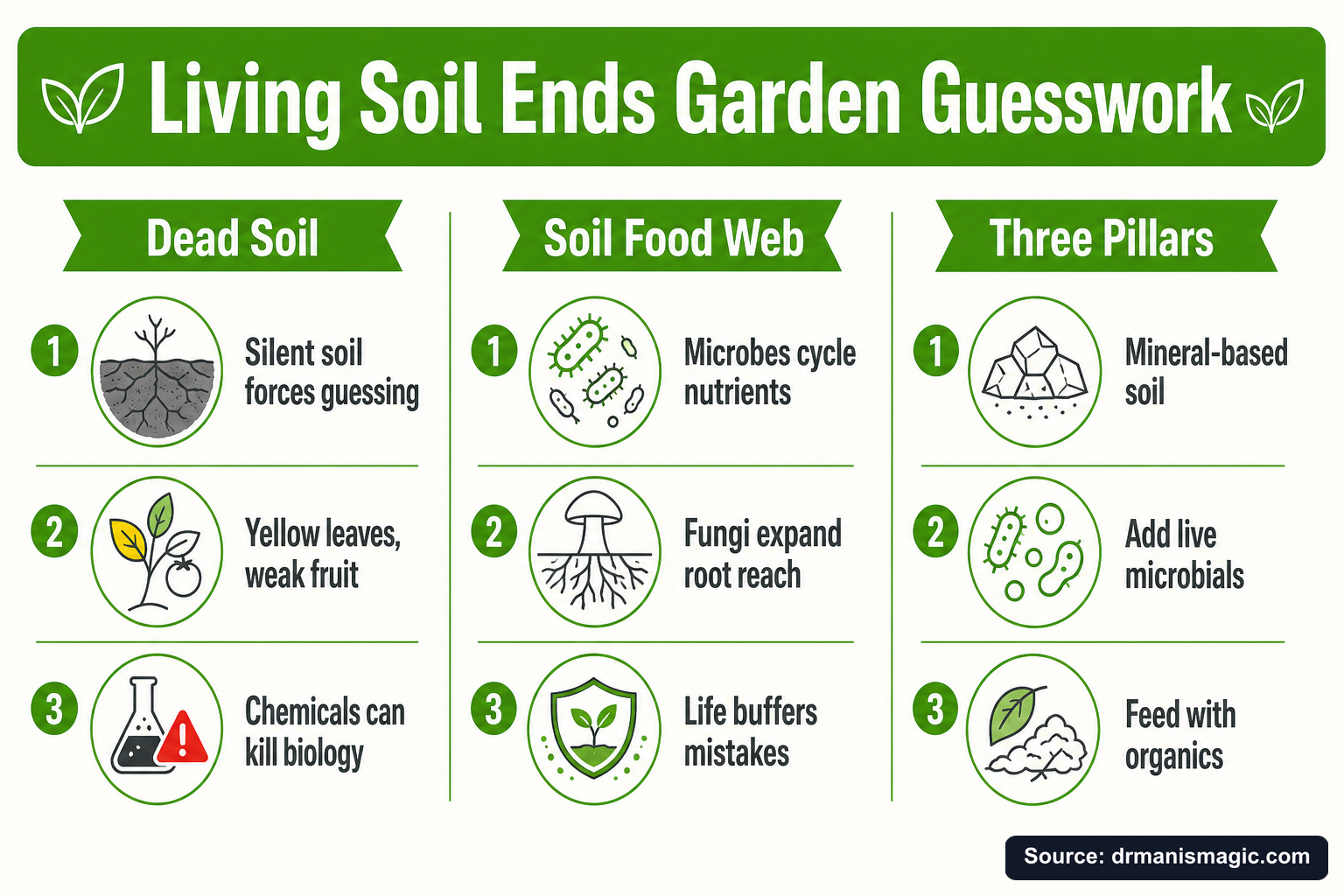
- Living soil is a biological feedback system, not just a growing medium — it tells your plants what they need and delivers it automatically.
- The soil food web includes bacteria, fungi, protozoa, and nematodes, each performing a specific job that replaces guesswork with biology.
- Mycorrhizal fungi can expand a plant's root surface by 100 to 1,000 times, giving roots access to water and nutrients they could never reach alone.
- Salt-based synthetic fertilizers, fungicides, herbicides, and pesticides damage or kill soil biology, turning living soil into a dead growing medium that requires constant inputs.
- Most store-bought microbial products either arrive dead (dried powder) or are dying in a smelly liquid — neither delivers the biology your plant actually needs.
- The Three Plant Pillars — mineral-based soil, live microbials, and organic fertilizer — are the proven foundation that makes guesswork unnecessary.
- Damaged or sterile soil can recover, but it takes the right steps in the right order, not just a single product poured on once.
What Is the Soil Food Web and Why Does It Replace Guesswork?
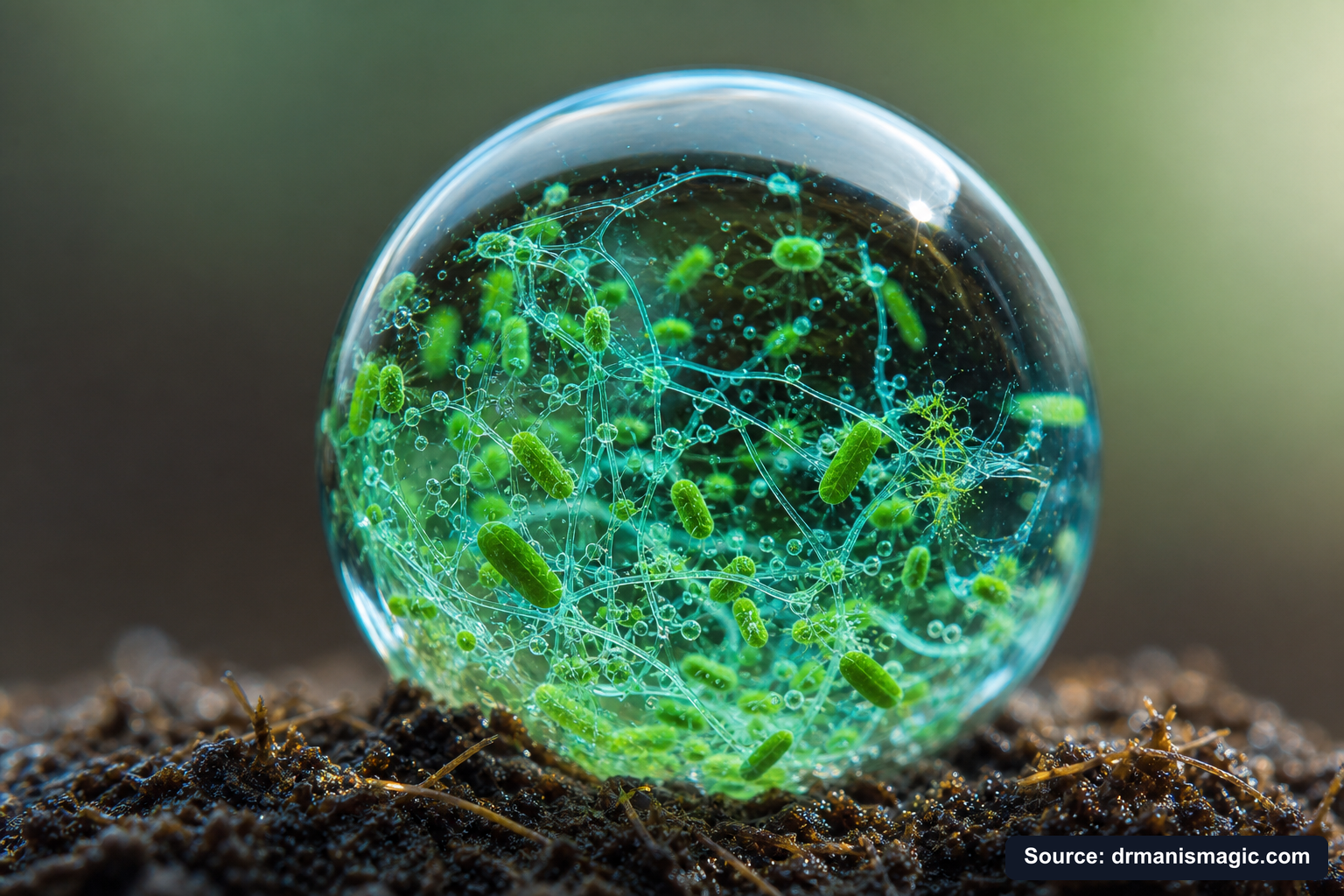
Quick Answer: The soil food web is a living network of bacteria, fungi, protozoa, nematodes, earthworms, and roots that cycles nutrients, suppresses disease, and regulates water — all automatically. When this network is healthy, your soil becomes a self-correcting feedback system that replaces the constant guessing most gardeners rely on.
The soil food web is not a metaphor. It is a real, measurable ecosystem happening right under your feet — or right inside your container pot — every single day. Bacteria break down organic matter. Fungi extend root systems. Protozoa eat bacteria and release nitrogen. Nematodes eat protozoa and cycle nutrients deeper. Earthworms shred residue and create passages for air and water. Roots feed the whole system sugars in exchange for minerals they cannot mine on their own.
Every single one of those jobs replaces a decision you would otherwise have to make. How much nitrogen does my plant need today? The bacteria and protozoa just handled it. Is there enough phosphorus near the roots? The mycorrhizal fungi just went and got it. Is that pathogen going to attack the roots? The beneficial bacteria just crowded it out.
According to the University of Minnesota Extension, soil biology supplies roughly 75% of the plant-available nitrogen and 65% of the available phosphorus in healthy, living soil. That is not a small number. That is the majority of what your plant needs, delivered by invisible workers you never have to schedule, pay, or direct.
When that system is broken — when the soil is sterile, compacted, salt-damaged, or soaked with fungicide — those workers disappear. And now every single one of those jobs falls back on you. You have to guess. You have to buy more products. You have to hope. That is the real cost of dead soil, and it is the root cause behind every brown thumb in America.
| Organism | Primary Job | What It Replaces for You |
|---|---|---|
| Beneficial bacteria | Break down organic matter, fix atmospheric nitrogen, solubilize minerals, suppress pathogens | Guessing nitrogen and mineral doses |
| Mycorrhizal fungi | Extend root surface by 100–1,000x, exchange plant sugars for phosphorus and water | Guessing phosphorus and watering needs |
| Protozoa | Graze on bacteria, release plant-available nitrogen directly in the root zone (rhizosphere) | Guessing nitrogen timing and amount |
| Beneficial nematodes | Graze on bacteria and protozoa, cycle nutrients deeper, suppress harmful nematodes and pests | Guessing pest and disease management |
| Earthworms | Shred organic residue, create channels for air and water movement, deposit castings | Guessing aeration and drainage fixes |
| Plant roots | Feed microbes sugar (exudates) in exchange for nutrients and protection | The engine that powers the whole system |
What Do Bacteria and Fungi Actually Do Inside Your Soil?
Quick Answer: Bacteria and fungi are the primary nutrient processors in living soil. Bacteria fix nitrogen from the air, break down organic matter, and fight pathogens. Fungi, especially mycorrhizal fungi, extend the root system, unlock phosphorus, and improve drought and disease resistance. Together they handle most of what fertilizer bags claim to do — except they do it for free, indefinitely.
Think of bacteria as the factory floor workers. There are thousands of species, and each one has a specialty. Some pull nitrogen straight out of the air and convert it into a form your plant roots can drink. Some dissolve mineral nutrients that are locked inside soil particles like a safe that only they know the combination to. Some produce natural antibiotics that kill pathogenic fungi before they ever reach your roots.
Fungi work differently. They grow long, thread-like structures called hyphae that spread out through the soil in every direction. Colorado State University Extension reports that mycorrhizal fungi can enlarge a plant's root absorbing area by 100 to 1,000 times. Read that again. One thousand times more surface area reaching out for water and phosphorus that your visible roots could never access on their own.
Pull a healthy weed out of the ground sometime and look at the roots closely. See that white fuzz clinging to them? That is mycorrhizae. That is why weeds grow so aggressively even in terrible conditions. They have a fungal army working for them. Your garden plants deserve the same army.
When Dr. Mani Skaria was running the Clean Citrus Program at the Texas A&M Citrus Center, he watched tree after tree struggle in managed growing conditions even with regular fertilizer applications. The missing piece was always the same: the biology was gone. The synthetic inputs had wiped it out. Once he restored the microbial community, the trees changed completely. Faster growth. Stronger roots. Fewer pest problems. Less guesswork.
What Are Protozoa and Nematodes Doing in Your Root Zone?
Quick Answer: Protozoa eat bacteria in the root zone and release plant-available nitrogen right where roots can grab it — this is called the grazing loop and it is one of the most efficient nutrient delivery systems in nature. Beneficial nematodes eat protozoa and other organisms, cycling nutrients even deeper and suppressing harmful pests. Most gardening advice skips these two entirely, which is why so many nutrient plans fall short.
Protozoa are tiny single-celled organisms that graze on bacteria the same way cows graze on grass. When they eat a bacterium, they absorb what they need and excrete the rest as ammonium — a direct, plant-ready form of nitrogen — right there in the rhizosphere, which is the narrow zone of soil immediately surrounding your roots.
This is not random. This is precision delivery. The plant feeds sugars to bacteria through its root tips. The bacteria multiply. Protozoa come in and graze. Nitrogen drops right where the root can absorb it instantly. No guessing. No measuring. No burning.
Beneficial nematodes are a step up the food chain. They eat bacteria, protozoa, fungi, and even other nematodes. Not all nematodes are bad — the harmful ones attack roots, but the beneficial ones are actually predators that keep the whole food web in balance. When you see a healthy soil food web with active nematode populations, it is a reliable sign that the whole system is working. When nematodes disappear, it usually means something toxic has entered the system.
Most living-soil articles online never mention protozoa or beneficial nematodes at all. They stop at bacteria and mycorrhizae. That leaves half the story untold — and it leaves your soil nutrient cycle running at a fraction of its potential.
How Does Living Soil Actually Suppress Disease Without Chemicals?
Quick Answer: Living soil suppresses disease through competitive exclusion — beneficial microbes crowd out pathogens, consume their food sources, and produce natural antibiotics that destroy harmful organisms before they reach your roots. This is not something a fungicide spray can replicate, because fungicides kill beneficial fungi along with harmful ones, making future disease problems worse.
Here is something that will make your stomach drop if you have ever sprayed a broad-spectrum fungicide on a struggling plant. That fungicide did not know the difference between the pathogen you were trying to kill and the mycorrhizal fungi that were protecting your plant. It killed both. So now your plant has less protection than it had before you sprayed. And the next time a pathogen shows up, there is nobody home to fight it.
In living soil, disease suppression is automatic. Beneficial bacteria produce compounds that are chemically hostile to pathogens. Fungi outcompete harmful species for space and food. Protozoa and nematodes eat organisms that would otherwise cause root problems. The whole community acts like an immune system for your plant's root zone.
This is why plants grown in biologically rich soil can handle stress that would destroy plants grown in sterile or chemically managed media. The immune system is already active and working. You do not have to guess whether to spray, when to spray, or what to spray with. The biology handles the threat before you even know it was there.
See also: The Hidden Reason Synthetic Fertilizers Cause Root Rot
What Destroys Living Soil and Why Does It Take So Long to Recover?
Quick Answer: Synthetic salt-based fertilizers, herbicides, broad-spectrum pesticides, and fungicides are the four biggest killers of soil biology. Salt dehydrates and kills bacteria and fungi. Herbicides disrupt microbial communities. Fungicides wipe out both harmful and beneficial fungi. Recovery takes time because rebuilding a diverse microbial community requires reintroducing biology, reestablishing food sources, and stopping the inputs that caused the damage.
Salt-based synthetic fertilizers are the most widespread killer of soil biology in America, and they have been since the 1950s when a marketing company rebranded imported synthetic fertilizer as a garden solution and convinced the entire country it was normal. The salts in these fertilizers draw water out of microbial cells the same way they draw water out of plant roots — through osmosis. The microbes dehydrate and die. The more you apply, the more the biology collapses. The more the biology collapses, the worse your plant performs. So you buy more fertilizer. The cycle tightens.
Herbicides like glyphosate do not just kill weeds. Research has documented widespread disruption of soil microbial communities following herbicide application. Fungicides meant to stop one pathogen take out entire populations of beneficial fungi, including mycorrhizae that took years to establish. Pesticides leach into the root zone and affect the microorganisms living there.
Recovery takes weeks to seasons — not days. The biology has to rebuild from whatever survivors remain, and it needs the right inputs to do so. Adding more synthetic fertilizer during recovery is like trying to heal a wound by putting salt in it.
| Input or Practice | What It Damages | Recovery Action |
|---|---|---|
| Salt-based synthetic fertilizers | Kills bacteria and fungi through osmotic shock, depletes biology over time | Switch to organic fertilizer, flush accumulated salts, reintroduce live microbes |
| Broad-spectrum fungicides | Eliminates mycorrhizal fungi and beneficial fungal populations alongside pathogens | Stop applications, reintroduce mycorrhizae and beneficial fungi through live inoculant |
| Herbicides (including glyphosate) | Disrupts microbial communities, reduces diversity, impairs nitrogen-fixers | Avoid repeat applications, add organic matter, reintroduce biology |
| Broad-spectrum pesticides | Reduces microbial diversity, harms protozoa and nematode populations | Transition to targeted organic pest control, restore biology |
| Compaction and over-tilling | Destroys fungal hyphae networks, reduces oxygen, collapses soil structure | Reduce tillage, add organic matter, restore aeration |
| Sterile or bark-heavy potting mix | No biology present at all; decomposes into root-suffocating sludge over time | Switch to mineral-based soil, add full-spectrum microbial inoculant |
You Never Had a Brown Thumb.
You were handed the wrong tools. This free guide hands you the right ones.
You watered it. You fed it. It died anyway.
It was never you. It was the dirt, the salt food, and the bad advice.
This guide shows you what really went wrong, and how to fix it for good.
- Why your plants really died, and why it was never your fault
- The salt hiding in your plant food that quietly burns the roots
- The hidden killer in almost every bag of store soil
- The tiny helpers that grow a whole forest for free
- The rescue trick that brings a half dead plant back to life

How Can You Tell If Your Soil Is Biologically Alive or Biologically Dead?
Quick Answer: Healthy, biologically active soil smells earthy and rich, drains well, holds together in loose clumps when squeezed, shows visible earthworm activity, and breaks down organic residues like mulch or fallen leaves within weeks. Dead or damaged soil smells sour or like nothing at all, compacts into a hard crust, drains poorly or pools water, and shows no residue breakdown over months.
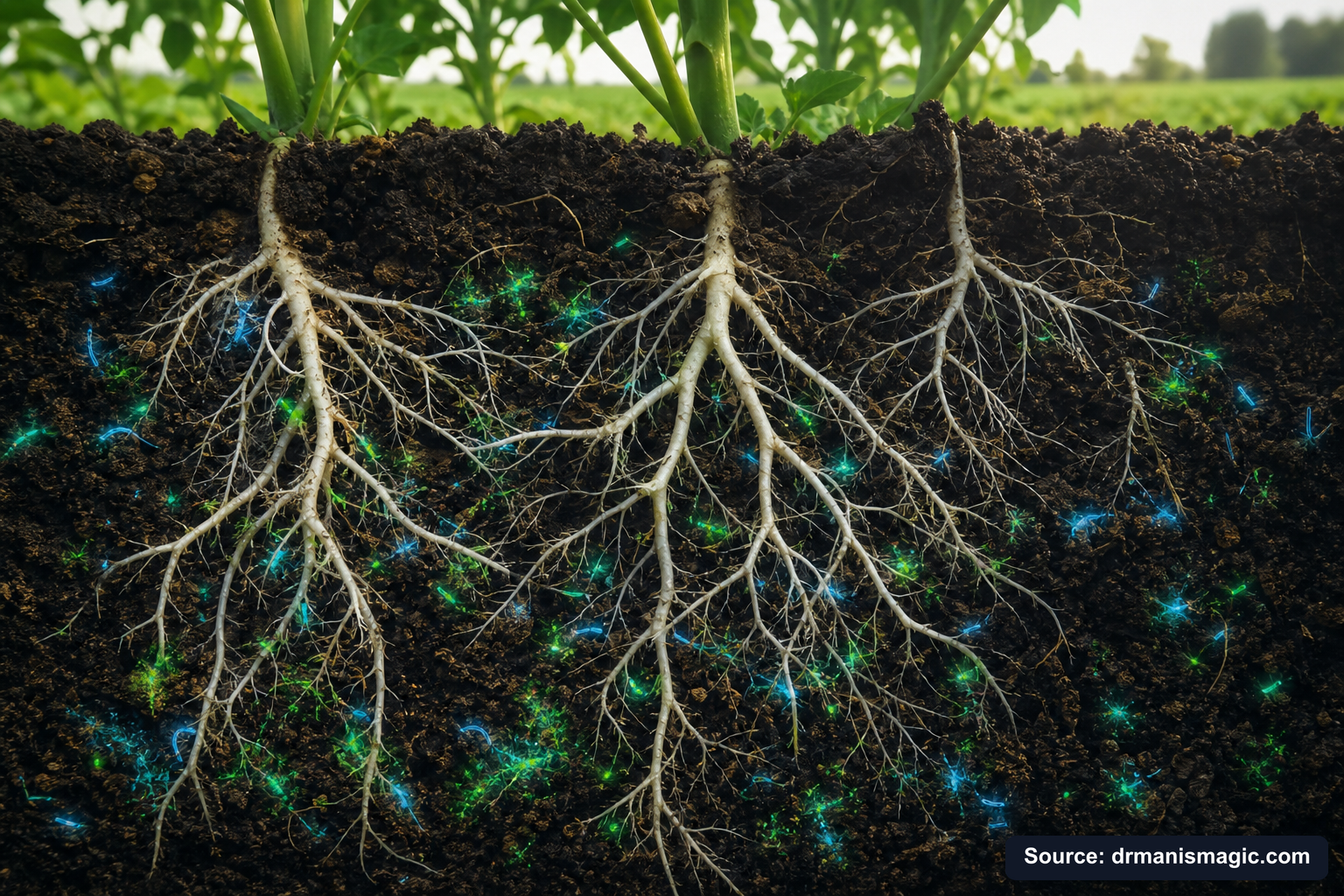
Your nose is one of the best soil biology detectors you own. Genuinely healthy soil smells like a forest after rain. That smell — petrichor, scientists call it — comes from a compound called geosmin produced by actinobacteria, a group of beneficial soil bacteria. If your soil smells earthy and rich when you dig into it, something is alive in there. If it smells sour, like sewage, or like absolutely nothing, that is a sign the biology is compromised.
Look at how water moves through it. Biologically active soil has structure. Microbial communities, especially mycorrhizal fungi, produce a sticky protein called glomalin that binds soil particles into aggregates — little clumps with air pockets between them. Water moves through those spaces easily. Nutrients move. Roots move. Oxygen moves. When biology disappears, the aggregates fall apart. The soil becomes a powder or a hard pan. Water either runs off the surface or pools and sits.
Here are a few quick diagnostics you can do in your backyard right now:
- Dig a small hole and look for earthworms. Even three or four earthworms in a shovel of soil is a positive sign. Zero earthworms in compacted, pale soil is a warning.
- Drop a handful of moist soil from about waist height onto a hard surface. Living soil with good structure will hold together loosely. Dead soil either crumbles into dust or stays in a hard clump that does not break apart.
- Put a teaspoon of soil in a glass of water. Healthy aggregated soil will slowly break apart. Dead soil often clouds the water immediately because there is no structure holding the particles together.
- Look at your plant's roots during repotting. White, firm, actively growing root tips surrounded by white fuzzy threads mean the biology is working. Brown, mushy, odorless roots with no white fuzz mean the root zone is compromised.
Why Do Most Microbial Products on Store Shelves Not Work?
Quick Answer: Most store-bought microbial products either contain dried, dormant spores that fail to reactivate in real soil conditions, or they are liquid products that have already gone anaerobic — meaning the microbes died in the bottle long before you poured them on your plant. A product that smells bad is almost always a product full of dead or dying microbes. Live microbes require specialized stabilization to survive shipping and storage.
Walk into any big box garden center and you will see shelves of microbial products. Bags of white powder. Brown liquid bottles. Labels packed with long scientific names and impressive CFU numbers. And most of them — after decades of testing at the US Citrus Nursery — simply do not work.
Here is what is actually happening inside those bottles and bags.
The powder products are microbes that were grown in a factory, then dried into spore form and packaged. The idea is that the spores will "wake up" when you add water and pour them into soil. The problem is that the drying process, the storage conditions, the heat during shipping, and the shock of rehydration kill most of the viable organisms before they ever reach a root. We have tested dozens of these batches at the nursery. The trees did not respond.
The liquid products that smell like sewage or make a fizzing sound when you open them? That fizzing is gas released by fermentation. The microbes in that bottle are dying. They have gone anaerobic — meaning the oxygen is gone and the beneficial aerobic organisms are being replaced by anaerobic decomposers. You might get some benefit from the humic acid or fulvic acid that was in the original organic material, but the biology is mostly gone.
Then there is a third category: lactobacillus-based products, like fermented rice water. Lactobacillus is extremely vigorous and does stay alive. But it crowds out the other beneficial microbes in your soil. It belongs in yogurt, not in your root zone.
See also: Why Dead Microbe Products Fail in Real Gardens
| Product Type | Viability When Used | Spectrum of Organisms | Smell | Does It Work? |
|---|---|---|---|---|
| Dry powder (lab-grown, dried spores) | Very low — most do not reactivate | Narrow, 3–10 species | Little to none | No — we tested dozens, saw no plant response |
| Dry powder rehydrated into liquid | Very low — same reactivation problem | Narrow | Little to none | No — same issue as above |
| Compost tea, fresh under 24 hours | Moderate — works if actively aerated and used immediately | Broad but incomplete | Earthy, then sour | Yes, but only if truly fresh — highly time-sensitive |
| Compost tea, older than 24 hours | Low — gone anaerobic | Partial | Strong, sewage-like | Minimal — biology mostly dead |
| Lactobacillus-based products | High — very vigorous | Narrow — one dominant species | Fermented, sour | No — crowds out beneficial organisms |
| Plant Super Boost (stabilized, full-spectrum) | High — stabilized through all-natural method | 2,000+ bacteria species, 400–500 fungi including mycorrhizae, plus protozoa and nematodes | Earthy — not anaerobic | Yes — visible under microscope, verified by lab analysis |
What Makes Plant Super Boost Different From Every Other Microbial Product?
Quick Answer: Plant Super Boost is harvested from hand-crafted compost — not grown in a factory — and stabilized through an all-natural proprietary technique that keeps the microbes genuinely alive without going anaerobic. This means you get the full biological power of fresh compost in a shelf-stable bottle that smells earthy, not foul, and contains over 2,000 bacterial species, 400 to 500 fungal species including mycorrhizae, plus protozoa and beneficial nematodes.
The story behind Plant Super Boost is one of those "you can't make this up" moments in agricultural history. A world-renowned compost expert — someone who had advised the farming practices of royal families and governments — discovered a natural method to stabilize the full spectrum of microbes from fresh compost without losing viability. Big chemical companies did not like what was happening when growers using his method started seeing results that made synthetic inputs look unnecessary. He was blacklisted. At one point, he feared for his life and stopped production entirely.
Years later, through what Dr. Mani's family describes as a providential meeting, this expert teamed up with US Citrus Nursery in South Texas. He joined the company. The Dr. Mani's Magic line was born. And the goal was simple: bypass the big box stores and bring the power of genuinely living biology directly to every American gardener — whether you are growing lemons in a container on your porch, flowers in a raised bed, or grass your kids run across barefoot.
Plant Super Boost does not smell bad because it is not going anaerobic. The microbes inside it are alive. You can take a single drop, put it under a microscope, and watch them move. Lab analyses confirm what your eyes can see. Zero PFAS. Zero biosludge. Zero synthetic salts. This is not a marketing claim — it is a measurable, verifiable reality.
You can even see it working. When you apply Plant Super Boost to a root zone that has been running on synthetic inputs, the roots visibly change within weeks. They go from sparse and brown to white, dense, and actively growing. That white fuzz you see on healthy weed roots? You start to see it on your own plants. Because now they have the same invisible army.
How Do the Three Plant Pillars Work Together to End Guesswork?
Quick Answer: The Three Plant Pillars — mineral-based soil, live microbials, and organic fertilizer — create a self-sustaining growing system where each element supports the others. Mineral soil provides drainage and oxygen for roots and microbes. Live microbials build the biological feedback network. Organic fertilizer feeds both the plant and the microbes without the salt damage that collapses the system. Together, they make guesswork unnecessary.
Dr. Mani spent 30 years watching plants fail and plants succeed. He narrowed every success down to three things working in harmony. Miss any one of them and you are back to guessing.
Pillar One: Mineral-Based Soil. Most potting mixes are made from pine bark and wood fiber. They look fine in the bag. But over six to twelve months, that organic material decomposes. It compacts. It steals oxygen from roots. It holds water in all the wrong ways. Roots suffocate. Root rot sets in. You buy a new bag of soil and start the cycle over.
Mineral-based soil does not decompose. The sandy loam from the Rio Grande Valley that anchors Super Soil is silica-rich and permanent. It drains well. It holds structure. It stays aerated. Roots can breathe and push deep. Microbes thrive because they have oxygen. This is the foundation everything else is built on.
Pillar Two: Live Microbials. This is the biological feedback system. This is the part that replaces guesswork. When the soil food web is active and diverse, nutrient delivery is automatic, disease suppression is automatic, and stress tolerance is built in. Without live microbials, you are managing a sterile growing medium that requires constant intervention.
Pillar Three: Organic Fertilizer. The Crab, Kelp and Amino Acids organic fertilizer feeds the plant with slow-release, earth-born nutrients that do not spike and crash. More importantly, it does not contain synthetic salts. That means it feeds the plant without killing the biology. The microbes can keep working. The feedback loop stays intact. Salt-based fertilizers break this loop every single time.
When all three pillars are in place, something shifts. The plant stops looking like a problem you have to manage and starts looking like something that genuinely wants to grow. Because it does. All it needed was the right conditions — the conditions that have existed in healthy natural soil for millions of years, before humans decided to replace biology with chemistry.
You can explore all three pillars together at the Three Plant Pillars bundle page.
Can Sterile or Damaged Soil Become Living Soil Again?
Quick Answer: Yes. Sterile or damaged soil can absolutely become living soil again, but it requires more than pouring one product on once. The biology must be reintroduced, the damage sources must be removed or reduced, and the soil environment must support microbial survival. Recovery happens over weeks to seasons, not overnight, and repeated applications of live biology are essential because the damaging pressures continue between applications.
This is the question most living-soil articles never answer clearly. They tell you living soil is great. They explain the biology. And then they leave you standing there wondering what to actually do about the dead gray sand in your pot or the compacted, herbicide-soaked lawn you inherited.
Here is a practical, step-by-step recovery process. It works for containers, raised beds, in-ground gardens, lawns, and orchards.
- Stop or reduce the inputs that are causing damage. If you are using salt-based synthetic fertilizers, herbicides, or broad-spectrum fungicides, those are the first things to address. You cannot rebuild a biological community while continuing to poison it. This does not have to be all-or-nothing overnight, but it needs to move in the right direction.
- Check your pH and salt levels. Extreme pH or high electrical conductivity from salt accumulation creates conditions where most beneficial microbes cannot survive. A simple soil test from your local extension service will tell you where you stand. For containers, flushing with clean water over several drainage cycles can reduce accumulated salts before you begin reintroducing biology.
- Restore oxygen and drainage. If your soil is compacted or your potting mix has collapsed into sludge, the microbes you introduce will not survive without oxygen. For containers, consider transitioning to a mineral-based soil. For in-ground beds, reduce tillage, add organic matter to improve structure, and stop walking on growing areas if compaction is the issue.
- Add stable organic matter. Compost, aged wood chips, or organic mulch provide food and habitat for the microbial community you are rebuilding. Do not skip this step. Microbes need something to eat.
- Reintroduce genuine live biology. This is where a full-spectrum live microbial product makes the difference between slow recovery and real recovery. Apply monthly. The biology needs repeated reinforcement because the pressures that damaged it — residual salts, competition from pathogens, environmental stress — do not disappear overnight. Every monthly application adds to what is already building.
- Keep living roots in the soil as much as possible. Roots feed the microbial community through their exudates. Bare soil with no roots loses biology faster. Even a cover crop or a temporary planting between seasons keeps the system active.
- Be patient and watch the indicators. Smell the soil after rain. Watch the roots during repotting. Look for earthworms. Watch how water moves. These biological indicators will tell you recovery is happening before any fertilizer response chart will.
See also: The Long-Term Damage Caused by Salt Accumulation in Soil
What Can You Do Right Now to Start Building Living Soil?
Quick Answer: The most impactful thing you can do right now is stop applying inputs that kill soil biology, start adding genuine live microbials monthly, and move toward organic fertilizer that feeds both your plant and the microbial community. These three shifts, grounded in the Three Plant Pillars framework Dr. Mani developed over 30 years and 250,000 trees, are the fastest path from guesswork to a self-managing, biologically active soil system.
Here is the honest truth about time. You can get money back. You can replace a dead plant. But you cannot get back the seasons you spent guessing. The number one thing people tell Dr. Mani they want is to see their own tree bearing fruit — to stand in their own backyard and pick something they grew with their own hands. That moment is possible. But it requires the right foundation underneath it, not another bag of blue fertilizer crystals.
The people who get there fastest are the ones who stop fighting nature and start working with it. They build the three pillars. They stop sterilizing their soil with salt-based inputs. They add live biology monthly and let it multiply. And within a season, they are not guessing anymore. The soil is telling them what the plant needs, and the plant is showing them it is getting it.
Your lawn, your garden, your houseplants, your fruit trees — they all want to grow. They have been trying to grow. They just need the invisible workforce that nature always intended to be there.
Dr. Mani's Magic was built for exactly this. Tested on over 250,000 trees. Made in the USA. Zero PFAS, zero biosludge, zero synthetic salts. Real people on the phone when you have a question. A 30-day money-back guarantee if you are not seeing results.
If you want to stop guessing and start growing, the Free Plant Care Field Guide is the best place to start — it walks you through the Three Plant Pillars step by step, in plain language, for any plant you own. No jargon. No guesswork. Just the foundation that makes everything else work.
Frequently Asked Questions
Most gardeners never get straight answers about living soil. They get confusing forum debates, chemical company spin, or advice that flat out does not work. These questions cut through all of that noise. Every answer below is grounded in what Dr. Mani learned growing over 250,000 trees in South Texas using the Three Plant Pillars.
What are the real pros and cons of living soil?
The biggest pro is that living soil thinks for your plant. Microbes cycle nutrients, fight disease, and buffer your mistakes automatically. That means less guesswork and fewer heartbreaks. The con? Most living soil products either arrive dead or smell like a swamp because the microbes have rotted. Dr. Mani's Magic Plant Super Boost solves that with stabilized live microbes that actually survive the trip to your door and do not stink.
Is living soil better than synthetic fertilizers and hydroponics?
For long-term plant health, yes. Synthetic fertilizers are salt-based. They burn your soil biology and create a cycle where your plant gets weaker over time, not stronger. Hydroponics gives you control but zero biological resilience. Living soil builds a self-sustaining system. Your roots get fed, protected, and expanded by biology working around the clock. That is something no bottle of synthetic nutrients can replicate.
How long does living soil last?
Healthy living soil can last for years, even decades, when you treat it right. The key is never letting it go bone dry and never hitting it with synthetic fertilizers or harsh pesticides that wipe out the microbial community. Dr. Mani's Magic Super Soil is mineral-based, so it does not break down or compact like pine bark potting mixes do. It stays open, airy, and alive season after season.
How often do I need to feed living soil?
A lot less than you think. When your soil has a thriving microbial community, it feeds your plant on its own schedule. Dr. Mani recommends applying Plant Super Boost and the Crab, Kelp, and Amino Acids organic fertilizer on a simple routine, not a complicated daily regimen. Think of it as fueling a fire that already burns, not starting one from scratch every single week.
Do I need to add nutrients to living soil?
Yes, but the right kind. Organic, slow-release nutrients from sources like crab, kelp, and amino acids feed the microbes first, and the microbes feed your plant. That is the natural order. Salt-based synthetic nutrients skip that step and go straight to the root, which sounds fast but kills the biology that makes your soil self-sustaining. Without biology, you are back to guessing every single week.
How many times can I reuse living soil?
With the right foundation, you can reuse it indefinitely. Standard potting mix breaks down in one season and turns into root-choking sludge. Dr. Mani's Magic Super Soil is built on silica-rich sandy loam from the Rio Grande Valley that does not decompose. You top it off with organic matter and recharge it with Plant Super Boost between growing cycles. Same soil, better results every time.
How do I know if my living soil is actually alive?
Healthy living soil smells like earth after rain, not chemicals, not rot. Your plants tell you too. Roots that are white and branching, leaves that hold their color, and steady growth without constant intervention are all signs the biology is working. If your soil smells bad or your plant stalls after a few months, the microbes are gone. That is when most gardeners blame themselves. It was never your fault. It was the soil.
About the Author
Ron Skaria, MD
Ron Skaria, MD, is the co-founder of Dr. Mani's Magic and the son of Dr. Mani. He trained as a medical doctor at Baylor College of Medicine, did his residency at UT Health Science Center - San Antonio and fellowship training at Texas Tech University. He now works full time on the family farm at US Citrus and US Citrus Nursery in Hargill, Texas, building Dr. Mani's Magic alongside his dad. He wrote the Brown Thumb Field Guide to put his father's 48 years of plant science into plain words any gardener can use. His belief is simple. You never had a brown thumb. You just never had the right help.


