


Biochar as Habitat, Not Fertilizer: What Your Roots Actually Need | Dr. Mani's Magic
Biochar Is Not Fertilizer: How It Works as Root Habitat
Picture this. You're out on your patio on a warm Saturday morning, coffee in hand, staring at your favorite container tree. The leaves look a little pale. The soil looks dense. You watered it two days ago, but somehow it already looks thirsty again. So you do what most people do. You reach for the fertilizer.
That instinct makes total sense. Plants need food, right? And biochar is supposed to be amazing for plants. So you figure, more is better. But here is the thing almost nobody tells you: biochar is not fertilizer. Not even close. Calling biochar a fertilizer is like calling a sponge a meal. Yes, the sponge can hold your soup. But the sponge is not what feeds you. This distinction is everything. And once you understand it, you will never look at your root zone the same way again.
At our South Texas nursery, after growing and testing more than 250,000 trees, we learned this the hard way. The root zone is not about stuffing nutrients into dirt. It is about building a physical world down there. A world with space. With air. With tiny living creatures doing invisible, miraculous work. Biochar is one of the best tools for building that world. But only if you understand what it actually is.
Key Takeaways
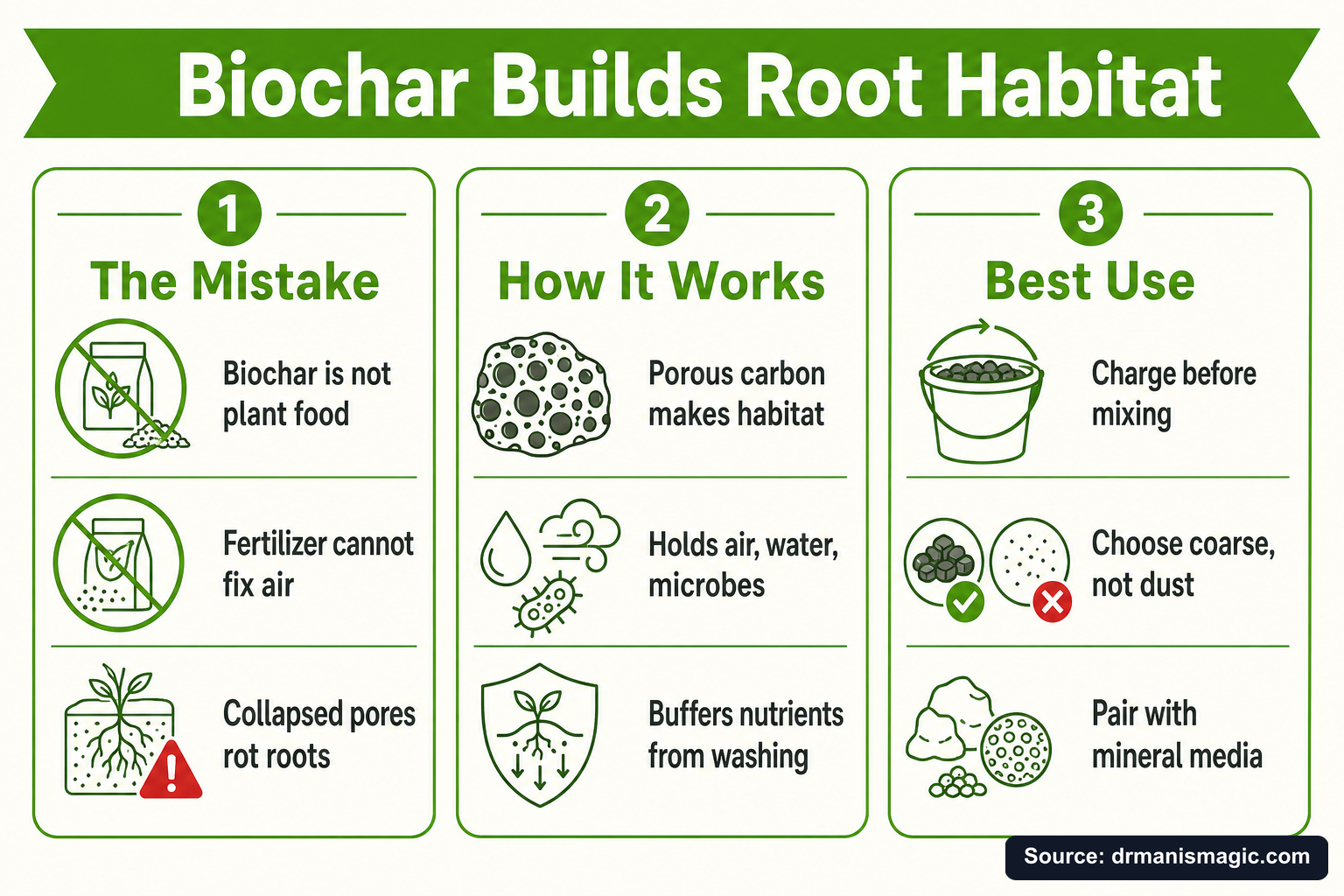
- Biochar is a porous carbon structure, not a fertilizer. Its job is to hold space, air, water, and microbes, not to directly feed plants.
- Roots need oxygen just as much as they need water. When pore space collapses, roots suffocate and rot begins.
- Biochar works best when "charged" first with compost, compost tea, or liquid microbes before going into your soil or mix.
- Particle size matters. Coarse biochar adds air space. Fine biochar dust can clog pores and make things worse.
- Organic potting mix decomposes and collapses over time, stealing the oxygen your roots need. Mineral-based media does not.
- Biochar is most useful as one piece of a complete root-zone system, alongside mineral structure, live microbes, and organic nutrition.
- The Three Plant Pillars, mineral-based soil, live microbials, and organic fertilizer, are the proven foundation. Biochar supports Pillar One.
What Is Biochar and Why Does Everyone Get It Wrong?
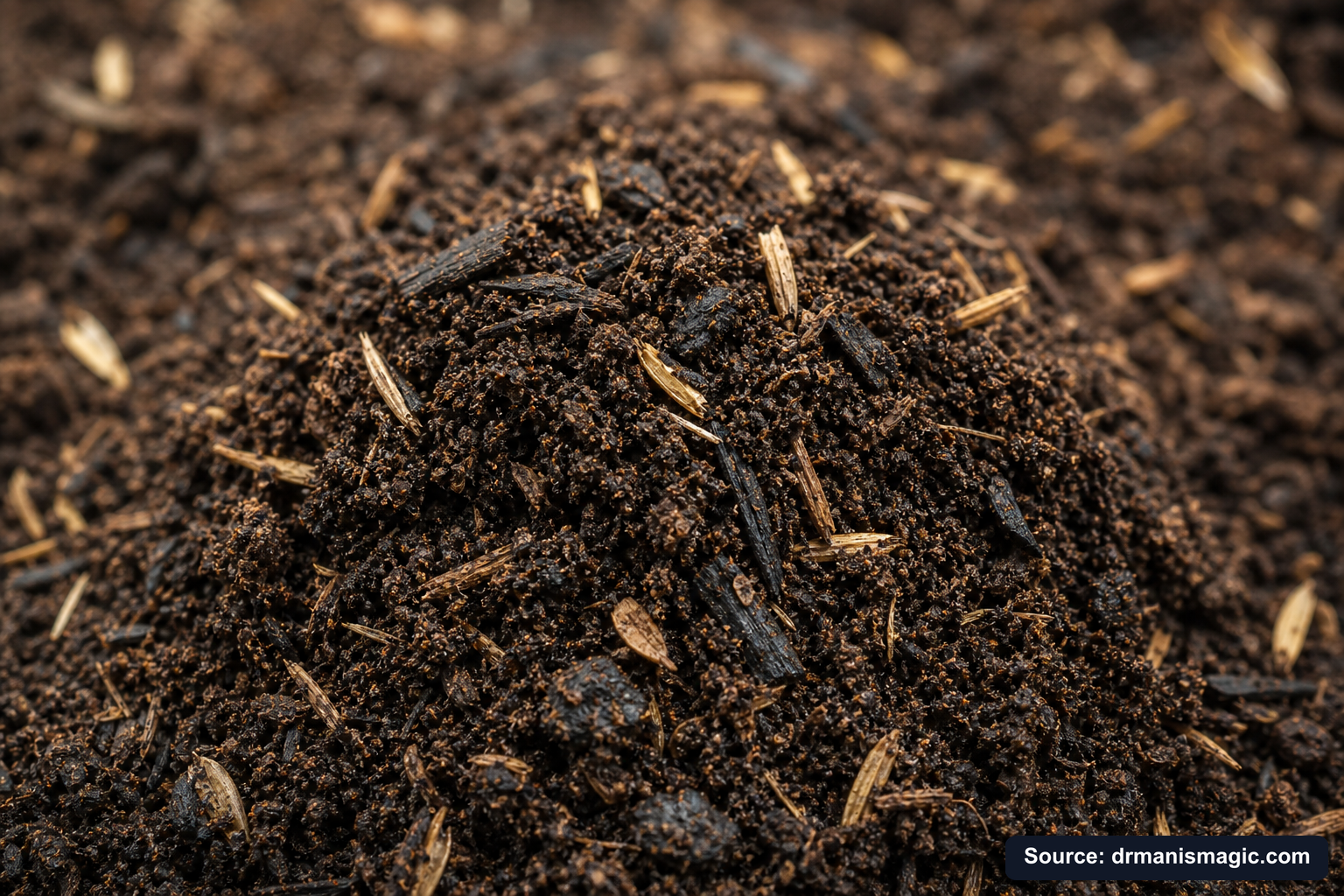
Quick Answer: Biochar is wood or plant material that has been burned without oxygen at high heat, leaving behind a porous carbon skeleton. It does not directly feed plants. Its real value is physical: it holds pore space, buffers water and nutrients, and shelters beneficial microbes inside its tiny tunnels and chambers.
Think about what happens when you burn a piece of wood all the way down to ash. You get a fine white powder. That ash does have minerals in it. Calcium, potassium, trace elements. That is the part people confuse with fertilizer.
But biochar is made differently. The wood or plant material is heated to very high temperatures with little to no oxygen. This process is called pyrolysis. The result is not ash. It is a black, hard, porous skeleton of carbon. The minerals are mostly gone or locked away. What is left is structure.
Pure structure.
Think of it like a tiny apartment building for your soil. Thousands of rooms. Tunnels. Chambers. Nooks and crannies so small you need a microscope to see them. According to Penn State Extension, biochar can have a surface area of hundreds of square meters per gram. That is more surface area in a teaspoon of biochar than in a football field of flat soil.
Those surfaces and chambers do three things that matter enormously in the root zone:
- They hold water without drowning roots.
- They adsorb nutrients so they do not wash away before roots can use them.
- They shelter beneficial microbes from predators, drying, and disruption.
None of those things are fertilizing. All of them are habitat building. That is the whole story.
The confusion usually starts because biochar made from high-ash feedstocks, like straw or manure, can release a small burst of minerals early on. Some biochar also raises soil pH slightly. These effects get labeled as "fertility." But they are side effects, not the main event. And they do not last. The pore structure? That lasts for hundreds of years.
Why Do Roots Need Oxygen More Than You Think?
Quick Answer: Roots breathe oxygen through a process called aerobic respiration. Without enough oxygen in the soil pore space, roots slow down, weaken, and eventually rot. This is why pore architecture, the physical spaces in your soil or potting mix, matters more than almost any nutrient you could add.
Here is something that surprises almost everyone. Your plant's leaves love carbon dioxide. They breathe it in and turn it into sugar. Beautiful. But the roots? The roots need oxygen. Just like you do. Just like every animal on this planet.
Roots use oxygen to do their work. They use it to drive the chemical reactions that pull water and nutrients from the soil. When oxygen levels in the root zone drop, those reactions slow down. The roots get weak. Then stressed. Then pathogens like Phytophthora and Pythium, which are the fungi responsible for root rot, move in and finish the job.
University of Florida IFAS Extension research confirms that oxygen availability in the root zone is one of the most important and most overlooked factors in container plant health. They describe air-filled porosity, the percentage of pore space that drains and fills with air after watering, as a critical design parameter for any container medium.
Here is the physics of it, in plain English. When you water a container, gravity pulls liquid down and out the drainage hole. The large pores drain first. Air rushes in behind the water to refill those large pores. That air is what feeds your roots oxygen after every watering. Small pores hold water by capillary force and do not drain. They stay wet. That is fine, as long as you also have plenty of large draining pores.
The problem with decomposing organic potting mix is that it starts with large pores and loses them over time. As the pine bark and sawdust break down, the particles get smaller and smaller. The large pores collapse. The mix turns to a dense, airless sludge. Roots suffocate. And then they rot.
Biochar's pores do not collapse. That is the whole point.
What Is the "Charosphere" and Why Should You Care?
Quick Answer: The charosphere is the zone of biological activity directly around and inside biochar particles in soil. Scientists have found that microbial communities inside biochar pores can be dramatically different and more diverse than those in the surrounding soil, making biochar a protected refuge for beneficial organisms your roots depend on.
Scientists gave it a name borrowed from the rhizosphere, which is the root zone itself. The charosphere is the living world inside and immediately around a biochar particle.
Research published in scientific literature on soil microbiology describes biochar's pores as refuges. Predators like protozoa and larger soil fauna cannot fit inside the smallest pores. So bacteria and fungi that colonize those interior chambers are protected. They thrive. They multiply. They build colonies that would otherwise get eaten or disrupted.
Cornell University researchers studying microbial colonization of biochar have noted that the interior surfaces of biochar particles host distinct microbial communities compared to the surrounding bulk soil. This is not just a curiosity. Those microbes do real work: they break down organic matter, release nutrients, suppress pathogens, and form partnerships with plant roots.
This is where biochar intersects with Pillar Two of our Three Plant Pillars framework. Live microbials are the engine of soil health. Biochar is the housing. You cannot separate the two if you want real results.
Now here is the catch. Brand-new, raw biochar fresh from the kiln is mostly empty. Those little apartment rooms are vacant. The microbes have not moved in yet. This is why raw biochar sometimes does nothing in the short term, and occasionally even pulls nutrients away from roots as it adsorbs them before microbes have had a chance to pre-fill those sites. This is the "raw biochar problem" that catches a lot of gardeners off guard.
The solution is charging.
Why Should Biochar Be Charged Before You Use It?
Quick Answer: Raw biochar has empty pores that can adsorb, or lock up, nutrients before plant roots can access them. Charging biochar means soaking or mixing it with compost, compost tea, liquid microbes, or diluted fertilizer first. This fills those pores with beneficial life and nutrition so the biochar adds to your root zone instead of temporarily competing with it.
Think of raw biochar as a brand-new sponge right out of the packaging. Bone dry. Pull it out and drop it in your sink. It immediately soaks up everything it touches. That is great for cleaning. Not so great if the "everything" it soaks up is the nitrogen your tree was about to absorb.
Charged biochar is that same sponge, pre-loaded with what you want. You fill it up with the good stuff first. Then it releases slowly as plants and microbes need it.
How to charge biochar at home:
- Put your dry biochar in a bucket or bin.
- Add a liquid microbial inoculant like Plant Super Boost, diluted per label directions.
- Stir well so all surfaces are coated.
- Let it sit for 24 to 48 hours, stirring once or twice.
- You can also add a small amount of compost or worm castings for extra biological loading.
- The biochar will darken and smell earthy. That is the sign of life moving in.
- Mix the charged biochar into your soil or potting mix right away, or store it damp until use.
This one step transforms biochar from a passive carbon skeleton into an active, living structure. Skipping it is one of the most common reasons people say "biochar did nothing for my plants."
How Does Biochar Compare to Perlite, Pumice, and Lava Rock?
Quick Answer: Perlite, pumice, lava rock, and biochar all serve a similar structural role: they add pore space and improve drainage. The key differences are biological activity, longevity, weight, and pH effect. Biochar is the only one that also provides microbial habitat. Pumice and lava are purely mineral. Perlite is lightweight but biologically inert and can float out of mixes over time.
This is a question worth unpacking with a real comparison table, because the differences are practical and important.
| Amendment | Pore Space | Microbial Habitat | Longevity | Weight | pH Effect | Water Retention |
|---|---|---|---|---|---|---|
| Biochar | Very High (macro + micro) | Excellent (interior refuges) | Centuries | Light | Raises slightly (varies) | Moderate to High |
| Pumice | High (macro dominant) | Low (surface only) | Centuries | Medium | Neutral | Low to Moderate |
| Lava Rock | High (macro dominant) | Low (surface only) | Centuries | Medium | Neutral | Low |
| Perlite | High (macro dominant) | Very Low | Decades (floats, degrades slowly) | Very Light | Neutral to slightly alkaline | Very Low |
| Coarse Sand | Moderate (macro) | Low | Permanent | Heavy | Neutral | Very Low |
| Pine Bark / Potting Mix | High initially, collapses fast | Moderate, then declining | 6 to 12 months | Light when dry | Acidic | Variable, becomes hydrophobic |
Notice what is at the bottom of that table. Pine bark and potting mix. High pore space at first. Collapses within months. Becomes water-repellent when dry. Lasts less than a year before turning into a dense, airless mat of decomposing carbon.
Every other option on that list outlasts potting mix by decades or centuries. Every single one.
This is not a coincidence. It is physics. Organic carbon decomposes. Silica does not. And biochar sits in a fascinating middle ground: it is carbon-based, but the pyrolysis process that creates it makes it highly resistant to further decomposition. Cornell researchers estimate biochar persists in soil for hundreds to thousands of years depending on conditions. That is the durability story no bag of potting mix can tell.
Can Biochar Help Prevent Root Rot?
Quick Answer: Biochar can help create conditions that are less favorable for root rot by maintaining air-filled pore space, supporting beneficial microbial communities, and moderating water retention. But it is not a cure. If your overall mix is too dense, too fine, or too organic, biochar alone will not save the roots. Pore architecture in the whole mix is what matters most.
Root rot is a physics problem first. It is a biological problem second.
Most people hear "root rot" and immediately think of a fungus. And yes, pathogens like Pythium and Phytophthora are usually the organisms doing the actual damage. But those organisms are opportunists. They attack roots that are already weak. And roots get weak when they cannot breathe.
So the question to ask is not "how do I kill the fungus?" The question is "why are my roots gasping for air in the first place?"
The answer is almost always the same. The pores are gone. The organic matter in the mix has broken down. The large spaces that used to drain and refill with air after watering have collapsed into tiny, water-holding capillaries. The roots are sitting in a waterlogged, oxygen-starved zone. The pathogens move in because that is what they do in those conditions.
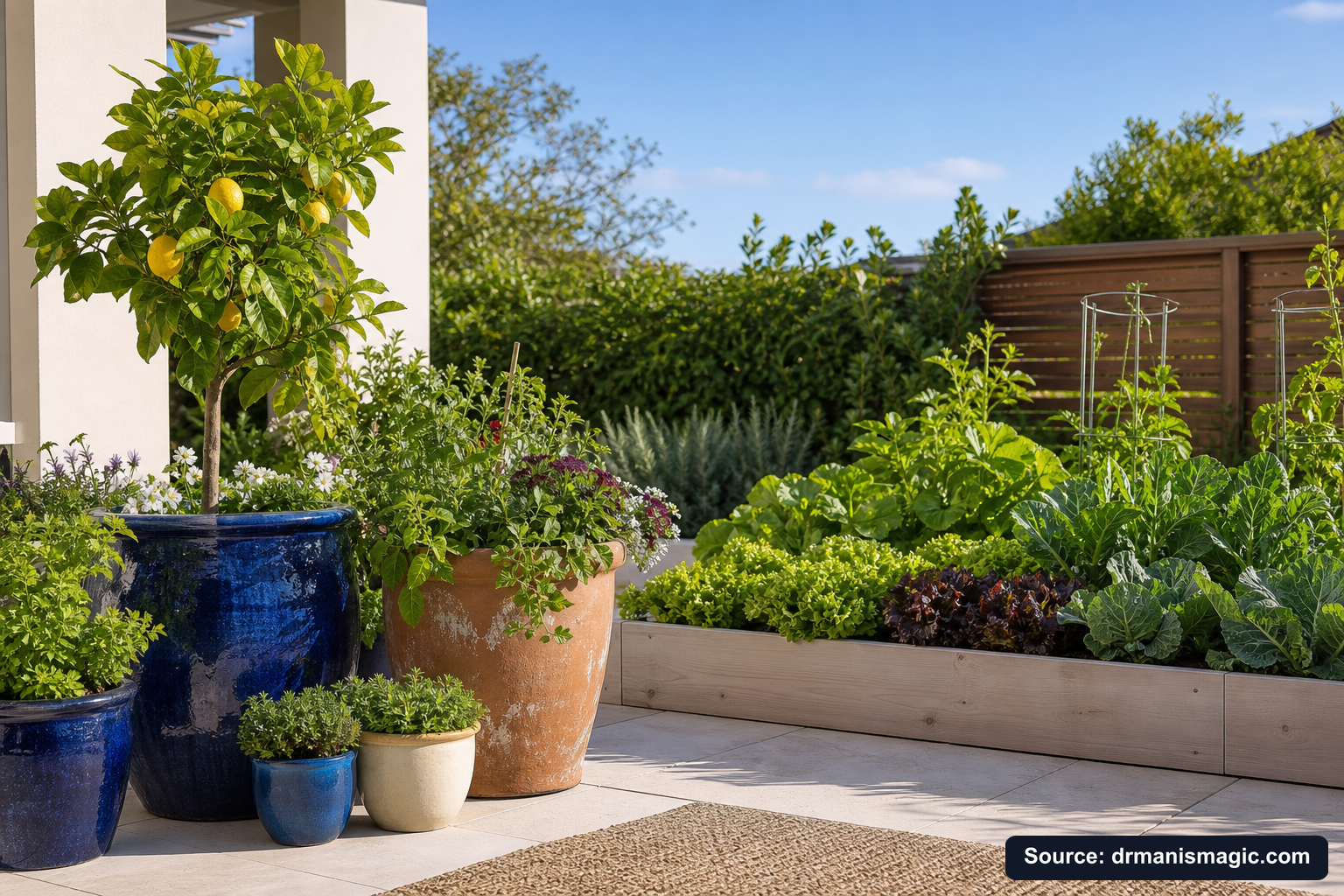
Biochar, when properly sized and incorporated into a well-designed mix, helps preserve those large pores. It is persistent. It does not collapse. It keeps physical channels open for drainage and gas exchange even as other components of the mix age. Beneficial microbes living inside biochar's pores also actively compete with and suppress pathogenic fungi, adding a biological layer of protection on top of the physical one.
But here is the honest caveat. If you add a small amount of coarse biochar to a mix that is otherwise 80% decomposing pine bark, you are not going to prevent root rot. The physics of the overall system still wins. Biochar is a powerful tool. It is not magic on its own.
See also: The Hidden Reason Synthetic Fertilizers Cause Root Rot
You Never Had a Brown Thumb.
You were handed the wrong tools. This free guide hands you the right ones.
You watered it. You fed it. It died anyway.
It was never you. It was the dirt, the salt food, and the bad advice.
This guide shows you what really went wrong, and how to fix it for good.
- Why your plants really died, and why it was never your fault
- The salt hiding in your plant food that quietly burns the roots
- The hidden killer in almost every bag of store soil
- The tiny helpers that grow a whole forest for free
- The rescue trick that brings a half dead plant back to life

What Is the Right Particle Size for Biochar in Containers?
Quick Answer: For container plants and potted trees, use coarse biochar particles in the 3 to 12 millimeter range. Fine biochar dust can actually clog pore spaces and make drainage worse. Coarse particles act like tiny lightweight aggregate, adding air space and drainage channels that last for years.
This is the detail that almost nobody talks about. And it matters enormously.
Biochar comes in all sizes. From fine powder to chunky pieces the size of gravel. And the size you use determines whether it helps or hurts your root zone.
Fine biochar powder, especially anything approaching dust, behaves differently from coarse biochar. Fine particles can fill in the gaps between larger soil particles and actually reduce air-filled porosity. You add it thinking you are improving drainage, and you end up with a denser mix. This is counterproductive.
Coarse biochar, on the other hand, acts like a lightweight aggregate. Think of it the way bonsai growers think about akadama, pumice, or lava rock. The goal in bonsai soil is a mineral-dominant, granular structure with large pore spaces that drain freely. Experienced bonsai practitioners have known for generations that roots thrive in open, granular, mineral-heavy media. Coarse biochar fits right into that philosophy.
For container trees, citrus, tropicals, and large houseplants, aim for a particle size in the 3 to 12 millimeter range. Sieve out the dust before mixing. That dust is not wasted; it can go into outdoor garden beds where the soil volume is large enough to absorb it without clogging.
How Does Organic Potting Mix Compare to Mineral-Based Soil for Long-Lived Container Plants?
Quick Answer: Organic potting mix breaks down within 6 to 12 months, losing pore space and oxygen-holding capacity. Mineral-based soil, built on silica-based particles like sandy loam, does not decompose. It holds its structure for years or permanently, making it the only rational choice for container plants you plan to keep for more than one season.
Let us talk about the biggest dirty secret in the nursery business.
Most plants you buy at a big box store are planted in potting mix. Potting mix is not soil. It is mostly pine bark sawdust. It is a waste product from the timber industry. It is cheap. It is light. It is easy to ship. And it is genuinely terrible for long-term container plant health.
You are literally planting your tree in other dead trees.
Let that sink in for a moment.
Pine bark has a fascinating and completely uninvited chemistry in the root zone. Pine trees produce compounds called terpenes and terpenoids. These are the chemicals that give pine its sharp, clean smell. You have encountered them before. Pine-Sol is made from them. Turpentine is made from them. They are excellent for cleaning floors and stripping varnish. They are not what you want surrounding your plant's roots.
To reduce that chemical harshness, manufacturers let the pine bark sit in massive piles and partially decompose before using it. That decomposition does mellow the chemicals. But it also begins the very process that will eventually collapse your root zone. And that decomposition does not stop when it goes into the bag. It keeps going in the pot. Month after month.
| Property | Organic Potting Mix (Pine Bark Based) | Mineral-Based Soil (Silica Sandy Loam) |
|---|---|---|
| Base Material | Pine bark, sawdust (carbon-based, organic) | Sandy loam, silica particles (inorganic) |
| Decomposition | Yes, ongoing. Collapses within 6-12 months | No. Permanent structure |
| Oxygen Availability | Decreasing over time as pores collapse | Stable, consistent long-term |
| Water Behavior | Becomes hydrophobic when dry, hard to re-wet | Consistent drainage and wetting |
| Root Rot Risk | High after 6 months | Low when properly formulated |
| Lifespan in Container | 6 to 12 months of good performance | Years to permanent |
| Repotting Frequency | Every 1 to 2 years minimum | Rarely, if ever, for the same reason |
| Microbial Support | Declining as oxygen decreases | Stable, supports diverse microbes |
| Big Box Store Preference | Yes. Cheap, lightweight, high turnover profit | No. Too expensive, too heavy, plant survives too long |
Read that last row again. Big box stores prefer potting mix not because it is better for your plant. They prefer it because it is cheap, light, and ensures your plant will eventually struggle, sending you back to buy another one. That is the business model. We are not angry about it. We just want you to see it clearly.
The mineral-based alternative, built on silica-rich sandy loam, does not decompose. It keeps its structure. It keeps its pore space. It keeps oxygen flowing to roots year after year. This is the foundation of Pillar One in the Three Plant Pillars system, and it is the reason our Super Soil is formulated around a permanent mineral base rather than carbon-heavy organic matter.
Where Does Biochar Fit Inside the Three Plant Pillars?
Quick Answer: Biochar primarily supports Pillar One, mineral foundation, by adding persistent pore structure that holds air, water, and nutrients. It also strengthens Pillar Two, microbial muscle, by providing protected habitat for beneficial bacteria and fungi. It is not a replacement for any Pillar but a powerful amplifier of all three when used correctly.
The Three Plant Pillars are not complicated. They are the three things every plant on earth needs in its root zone to truly thrive.
Pillar One: Mineral Foundation. Structure, drainage, oxygen, permanent pore space. No decomposition. No collapse.
Pillar Two: Microbial Muscle. Living bacteria, fungi, and mycorrhizae that unlock nutrients, fight disease, and make the soil a living ecosystem instead of dead filler.
Pillar Three: Organic Fertilizer. Slow-release, salt-free nutrition from natural sources that feeds plants gently and works with microbes instead of killing them.
Biochar is not a separate pillar. It is an amplifier. It strengthens Pillar One by adding durable pore architecture. It strengthens Pillar Two by giving beneficial microbes a protected home. And when it is charged with organic nutrients, it buffers Pillar Three inputs so they stay available longer.
This is why Dr. Mani included biochar in our Super Soil blend alongside sandy loam, coco coir, and rice hulls. Each ingredient plays a specific physical or biological role. Nothing is in there because it sounds good on a label. Everything earns its place by doing a real job in the root zone.
See also: Why Most Fertilizers Are Actually Salt in Disguise
How Much Biochar Should You Use in a Container Mix?
Quick Answer: For most container mixes, 5% to 15% coarse biochar by volume is a practical starting range. Higher rates are possible in well-designed mineral mixes but can raise pH and should be tested. Always use charged biochar. Always use coarse particles, not fine dust. More is not always better.
The most common mistake with biochar in containers is also the most forgivable one. People hear that biochar is amazing and they add a lot of it. They buy a bag, pour in a generous amount, and wait for magic.
Sometimes it works beautifully. Sometimes nothing happens. Sometimes the plants look worse for a few weeks before recovering. The difference is almost always particle size, charging status, and how the biochar interacts with the rest of the mix.
Here are practical guidelines for using biochar in containers:
- Start with 5% to 10% by volume for most container applications. This is enough to add meaningful pore space without overwhelming the mix or dramatically shifting pH.
- Use coarse particles only. Sieve out anything finer than about 3 millimeters. Dust goes to the garden beds, not the container.
- Always charge the biochar first. Raw biochar is empty. Filled biochar is alive. That difference is the whole game.
- Check your pH. Some biochars, especially those made from wood, can raise pH by half a point or more. If you are growing acid-loving plants like blueberries, test before committing to a large batch.
- Combine with mineral structure. Biochar alone is not a complete medium. It needs mineral particles alongside it to create a balanced air-water architecture.
- For established containers, top-dress with charged biochar and water it in, or mix it into the top few inches without disturbing the root ball.
What Does Raw vs. Charged Biochar Actually Look Like in Practice?
Quick Answer: Raw biochar is dry, jet black, and nearly weightless. It adsorbs nutrients quickly when wet, which can temporarily starve plant roots. Charged biochar smells earthy, feels heavier, and has visible microbial activity. In practice, charged biochar begins supporting the root zone immediately while raw biochar may take a full growing season to reach equilibrium on its own.
You can tell a lot by picking up a handful of biochar and paying attention.
Raw biochar feels almost weightless. It is jet black. It has no smell or a faint smoky odor. Drop it in water and it floats. It absorbs water very slowly at first because the pores are full of air, not yet colonized. This is the biochar that sometimes makes plants look worse before they look better, because it is pulling available nutrients into its pores before microbes and roots have a chance to use them.
Charged biochar feels different. It is heavier. It smells like earth, like the good soil you find under leaf litter in an old forest. It is darker if possible, almost glistening slightly. Drop it in water and it sinks faster. The pores are already full of life. This biochar goes to work immediately. The microbes are already there, already functioning, already doing the invisible work that makes your roots happy.
The difference between those two handfuls is the difference between a vacant building and a thriving neighborhood. Same structure. Completely different outcome.
A Root Recovery Checklist: When Your Container Plant Is Struggling
If your plant is showing pale leaves, slow growth, soggy-feeling soil, or roots that look brown and slimy when you pull them out, work through this list in order:
- Check the mix age. If it has been more than 12 months since the plant was potted in organic potting mix, the pore structure has likely collapsed. Repotting into a mineral-based medium is the fastest fix for the underlying cause.
- Check drainage. Make sure the drainage hole is not blocked. Lift the pot and look. A clogged hole turns any mix into a swimming pool.
- Remove the plant and inspect the roots. Healthy roots are white or cream colored and firm. Rotting roots are brown, black, mushy, and may smell sour. Trim away any dead roots with clean scissors.
- Repot into a mineral-based mix with charged biochar included. The mineral base provides permanent pore space. The biochar adds additional habitat and buffering. Together they give the recovering roots a fighting chance.
- Drench the root zone with live microbials. Beneficial bacteria and fungi will compete with lingering pathogens and begin rebuilding the biological environment the roots need. This is Pillar Two in action.
- Hold off on heavy fertilizing for two to four weeks. Give the recovering root system time to re-establish before loading it with nutrients. A light organic fertilizer application is fine. Salt-based synthetic fertilizers add osmotic stress to an already stressed system and should be avoided entirely.
- Watch for new growth. New root tips appear white and vigorous. New leaf growth above the soil is your confirmation that the root zone is recovering. Give it time. Biology works on its own schedule, but it works.
The Warm Truth About Biochar and Your Plants
You planted that tree because you wanted something real. Something alive. Maybe you wanted to reach out one morning, still in your pajamas, and pull a piece of fruit off a branch you grew yourself. That is one of the most human desires there is. We were built to tend living things. That drive is ancient and it is good.
But here is what the big box store and the bag of potting mix never told you. The clock is ticking on that mix. Six months in, maybe twelve, the pore space is gone. The oxygen is gone. The microbes are struggling. The roots are suffocating in slow motion. And you are buying another bag, starting over, losing time. Money you can replace. Time you cannot.
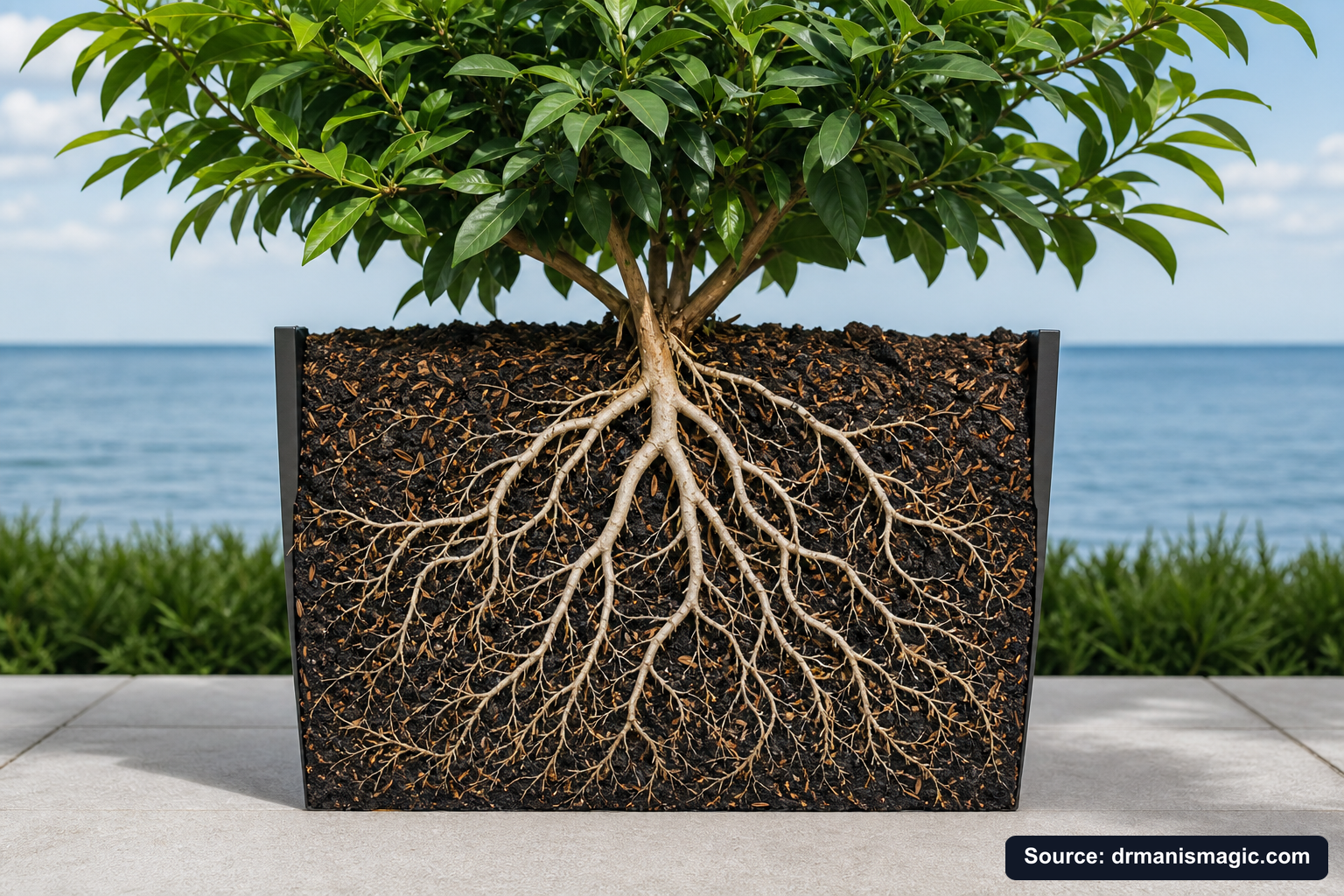
Biochar, used correctly, is one small piece of a smarter approach. It is not the magic ingredient. The magic is in understanding the whole system. Permanent mineral structure. Living microbes. Gentle organic nutrition. These three things, working together, give your plants a root zone that lasts. A foundation that does not collapse in six months. A home that gets better with age instead of worse.
Dr. Mani spent forty years learning this through hard experience with more than 250,000 trees in South Texas. The lesson is always the same. Build the foundation right. Give the roots oxygen, structure, and living allies. Everything else follows.
If you want to see exactly how we put these principles into a complete, tested system, the Free Plant Care Field Guide is a great place to start. It is the same foundation we use on every tree we grow, written in plain language, designed for real people with real plants and real lives. No jargon. No guesswork. Just the foundation your plants have been waiting for.
Frequently Asked Questions
Most gardeners have heard of biochar. But very few understand what it actually does underground. These questions come up again and again from real plant owners who want to stop guessing and start growing. If you have ever wondered whether biochar is safe, whether you can use too much, or how it fits into a real growing system, you are in the right place.
Is biochar the same as fertilizer?
No. Biochar does not feed your plants directly. Think of it like a tiny apartment building underground. It creates space, holds water, and gives beneficial microbes a safe place to live. That is its job. At Dr. Mani's Magic, we say biochar supports Pillar One of the Three Plant Pillars, which is mineral structure. It builds the physical world your roots need. Your organic fertilizer is what actually feeds the plant.
Can you put too much biochar in soil?
Yes, and it can backfire fast. Raw biochar acts like an empty sponge. Too much of it will pull nitrogen and nutrients away from your plant roots before they can use them. It can also push your soil pH too high. A safe starting point is five to ten percent of your total soil volume. Always charge your biochar first by mixing it with compost or liquid microbes before adding it to your soil.
Is biochar bad for the environment?
Low-quality biochar can be. If it is made from industrial waste, treated wood, or sewage sludge, it can carry heavy metals and toxins right into your garden. That is the last thing you want near your fruits, vegetables, or bare feet. At Dr. Mani's Magic, we only source clean, USA-made biochar. After testing on more than 250,000 trees at our South Texas nursery, we only use what we trust for our own plants.
Is biochar carcinogenic?
Poorly made biochar can contain polycyclic aromatic hydrocarbons, which are compounds linked to health risks when they enter the soil and move into food. This is exactly why the source and production method matter so much. Clean biochar made through proper pyrolysis from safe feedstocks does not carry this risk. Always know where your biochar comes from. If the label does not tell you, that is a red flag worth paying attention to.
Is biochar just burnt wood?
Not quite. Regular burnt wood turns to ash when oxygen is present. Biochar is made by heating wood or plant material at very high temperatures with almost no oxygen at all. That process is called pyrolysis. What is left behind is not ash. It is a hard, black, porous carbon skeleton with millions of tiny tunnels and chambers inside. Those chambers are what make biochar so valuable as a home for beneficial microbes and a buffer for water and nutrients.
Which is better, biochar or compost?
They do completely different jobs, so you do not have to choose. Compost feeds your soil with nutrients and organic matter. Biochar holds space and shelters the microbes that make those nutrients available to your roots. Together they work like a team. In fact, the best way to use biochar is to charge it with compost or a live microbial product like Dr. Mani's Magic Plant Super Boost before adding it to your soil. That way the biochar arrives ready to work, not hungry.
What are the dangers of biochar when handling it?
Fine biochar dust can irritate your lungs if you breathe it in during mixing. Always handle dry biochar in a well-ventilated area and consider wearing a simple dust mask. Once it is wet and mixed into soil, this risk goes away. Also, adding too much at once can temporarily stunt plant growth by locking up nutrients. Start with small amounts, charge it first, and work it into your soil as part of a complete system, not as a standalone fix.
About the Author
Ron Skaria, MD
Ron Skaria, MD, is the co-founder of Dr. Mani's Magic and the son of Dr. Mani. He trained as a medical doctor at Baylor College of Medicine, did his residency at UT Health Science Center - San Antonio and fellowship training at Texas Tech University. He now works full time on the family farm at US Citrus and US Citrus Nursery in Hargill, Texas, building Dr. Mani's Magic alongside his dad. He wrote the Brown Thumb Field Guide to put his father's 48 years of plant science into plain words any gardener can use. His belief is simple. You never had a brown thumb. You just never had the right help.


