


Why "Organic" Does Not Always Mean Clean: What Your Fertilizer Bag Is Not Telling You
Why "Organic" Does Not Always Mean Clean: What Your Fertilizer Bag Is Not Telling You
You are standing in the garden aisle. The bag in your hands says "Organic" in big, friendly letters. There is a leaf on the logo. Maybe a sunbeam. It feels safe. It feels right. You picture your tomatoes, your citrus tree, your rose bed, your lawn — all of it lush and thriving because you made the responsible choice.
So you bring it home. You apply it. And then... something feels off. The grass looks stressed. The leaves go pale. The soil smells strange. Or maybe nothing happens at all. You did everything right. You bought the organic bag. What went wrong?
Here is the thing nobody tells you at the garden center. "Organic" is a sourcing label. It tells you where the ingredient came from. It does not tell you whether that ingredient is clean, low-salt, free of contaminants, safe for your soil's living microbes, or actually going to help your plants. After growing more than 250,000 trees at our South Texas nursery and testing inputs for decades, we learned this lesson the hard way so you do not have to. The word "organic" on a bag can hide a lot of problems. Let us show you exactly what to look for — and what to avoid.

Plant Super Boost
Key Takeaways
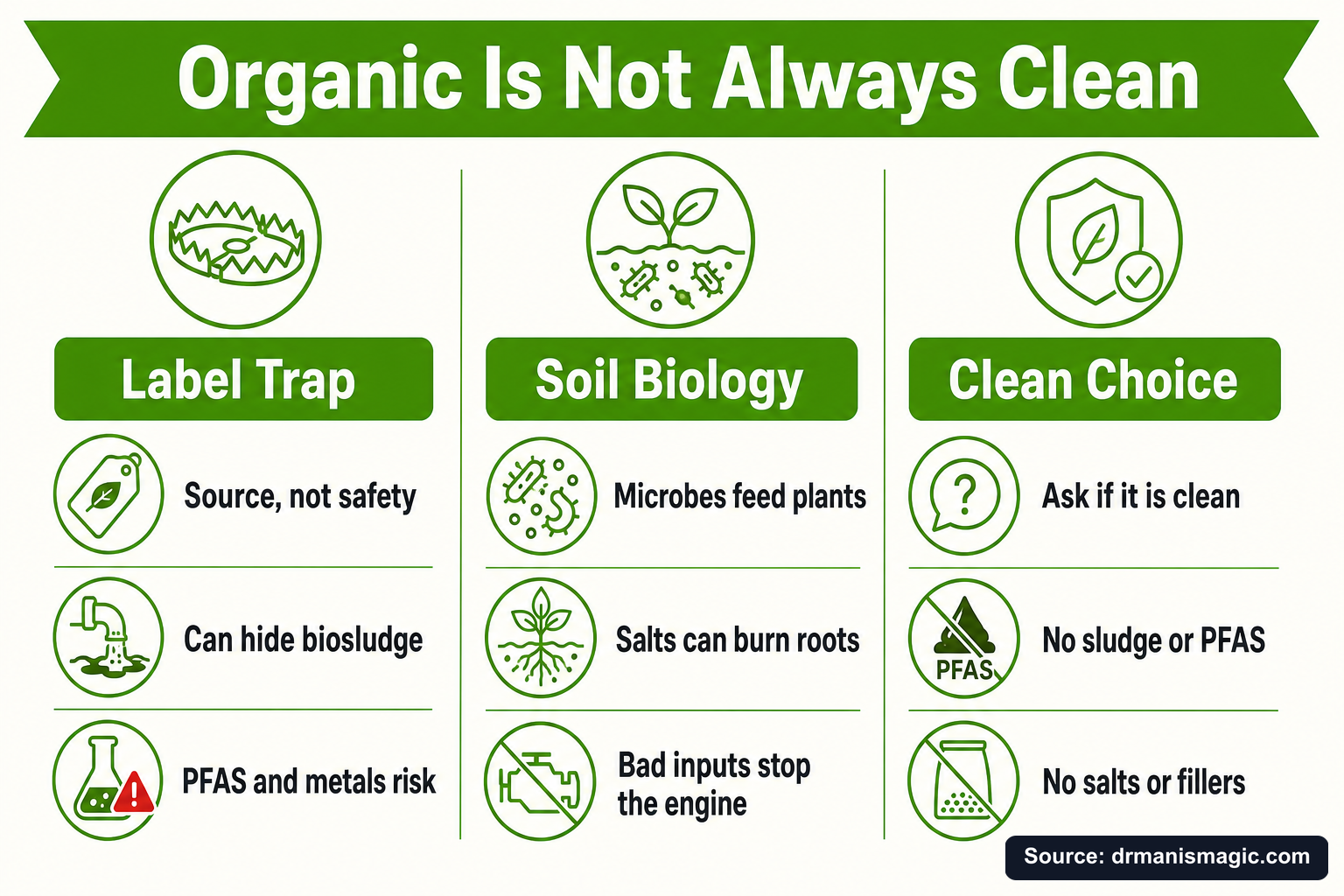
- "Organic" describes where an ingredient came from, not whether it is clean, low-salt, or safe for soil biology.
- Some organic fertilizers and composts contain PFAS "forever chemicals," heavy metals, or biosludge from treated municipal waste.
- Fertilizer burn is a salt and osmotic stress problem — and it can happen with certain organic inputs, not just synthetic ones.
- Soil microbes are the engine of clean fertility. They eat organic matter and convert it into plant-available nutrition. Kill the microbes and you shut down the engine.
- The University of Minnesota Extension notes that biological processes supply roughly 75% of plant-available nitrogen and 65% of available phosphorus in healthy soil.
- The Three Plant Pillars — mineral soil, live microbes, and clean organic fertilizer — work together as a system. Missing one breaks the whole thing.
- Clean inputs mean: no biosludge, no PFAS, no synthetic salts, and no hidden fillers. That is the standard to hold every bag to.
What Does "Organic" Actually Mean on a Fertilizer Label?
Quick Answer: On a fertilizer label, "organic" means the nutrients come from a once-living source — plants, animals, or minerals — rather than from a synthetic chemical factory. It does not mean the product is contaminant-free, low in salt, safe for soil microbes, or tested for PFAS or heavy metals. It is a sourcing claim, not a cleanliness guarantee.
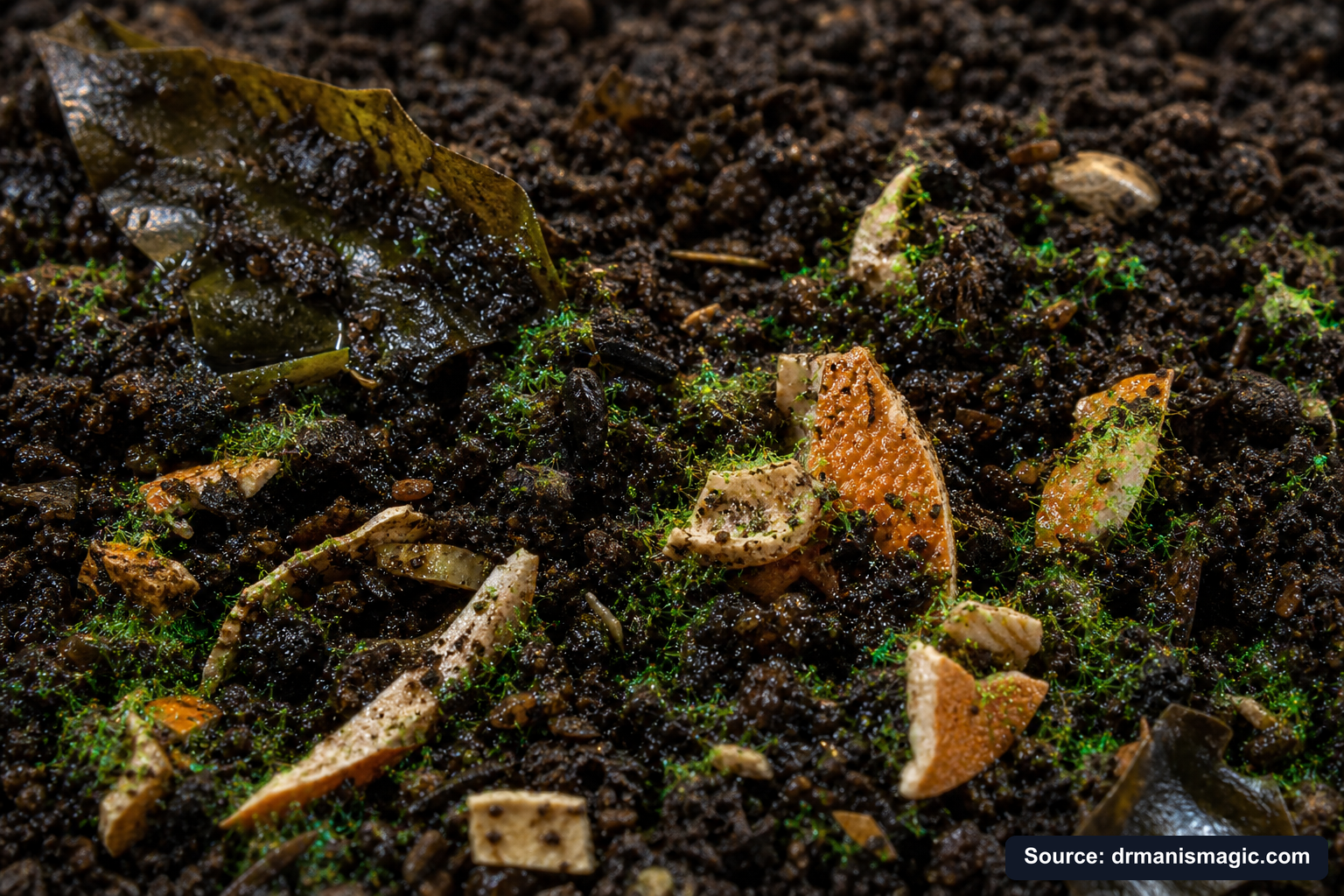
Organic just means it started as something alive. Crab shells are organic. Cold-pressed kelp is organic. So is composted chicken manure. So is treated municipal sewage sludge — yes, the stuff that flows through city pipes. All of them carry the same label. None of them are automatically clean.
Think of it this way. A candy bar can be made with organic cane sugar. That does not make it a health food. The word tells you about the source. It says nothing about what else came along for the ride.
This distinction matters enormously for your soil. Your soil is alive. It is home to billions of bacteria, fungi, and other microbes that do the real work of feeding your plants. University of Minnesota Extension research confirms that biological processes in healthy soil supply roughly 75% of plant-available nitrogen and 65% of available phosphorus. Those microbes are not optional. They are the engine. And some "organic" fertilizers hurt that engine just as badly as synthetic ones.
The stronger question to ask is not "Is this organic?" The better question is: "Is this clean?"
What Is Biosludge and Why Is It in Some Organic Fertilizers?
Quick Answer: Biosludge is the solid byproduct of treating municipal wastewater — essentially processed human waste. It is sometimes used as a cheap filler in fertilizer products, including some labeled organic. It can carry PFAS "forever chemicals," heavy metals, pharmaceutical residues, and pathogens. It does not belong anywhere near your garden, your edible plants, your lawn, or your children.
This is the part the garden center does not put on a sign.
Municipal biosolids — the polite name for treated sewage sludge — are sometimes dried, processed, and sold or blended into fertilizer and compost products. It is legal. It is common. And it is exactly the kind of input that can carry PFAS compounds, heavy metals like cadmium and lead, residual pharmaceuticals, and hormone-disrupting chemicals directly into your backyard soil.
PFAS stands for per- and polyfluoroalkyl substances. They are called "forever chemicals" because they do not break down. They accumulate in soil. They leach into groundwater. They show up in food crops grown in contaminated fields. The U.S. EPA has flagged PFAS as a serious and growing concern in agricultural soils, particularly where biosolid-derived fertilizers have been applied repeatedly.
Here is what makes this even more frustrating. You cannot smell PFAS. You cannot see heavy metals. You cannot taste pharmaceutical residues. The bag looks perfectly fine. The word "organic" sits right there on the front. And yet the inputs inside can quietly damage your soil biology, stress your roots, and contaminate the vegetables and fruit your family eats.
At Dr. Mani's Magic, our Crab, Kelp & Amino Acids fertilizer contains zero biosludge, zero PFAS, and zero synthetic salts. That is not a marketing phrase. It is a line in the sand.
Can Organic Fertilizer Actually Burn Your Plants?
Quick Answer: Yes. Fertilizer burn is caused by salt and osmotic stress, not by whether a product is labeled organic or synthetic. Certain organic inputs — especially poultry litter, some manures, and heavily processed organic concentrates — carry enough soluble salts to damage fine roots, stress plants, and kill soil microbes. Salt is the problem, not just the source category.
Most people think burn only comes from synthetic fertilizers. That is not the whole story.
Burn is an osmotic stress problem. When salt concentration around the roots gets too high, water actually moves out of the root cells instead of into them. The plant experiences what scientists call physiological drought — it is surrounded by moisture but cannot drink any of it. Roots shrivel. Leaves scorch. Growth stalls. In severe cases, pathogens like Pythium and Phytophthora move in on the weakened root zone and finish the job.
This can happen in containers especially fast. Salts accumulate in a small volume of soil with no rain to flush them out. A heavy application of a high-salt "organic" input — think concentrated poultry litter or poorly processed manure — can spike electrical conductivity (EC) in your pot to damaging levels within days.
The same risk applies to lawns, raised beds, and arid soils that do not get enough leaching rain. Salt builds. Roots suffer. And the gardener blames themselves for having a brown thumb.
You do not have a brown thumb. You were given the wrong inputs. See also: How Salt-Based Feeding Quietly Destroys Root Systems
Why Do Soil Microbes Matter More Than the Fertilizer You Apply?
Quick Answer: Soil microbes are the true engine of plant nutrition. They eat organic matter, break it down, and convert it into the exact forms of nitrogen, phosphorus, and other nutrients that plant roots can absorb. Without active microbes, even a well-labeled organic fertilizer sits unused in the soil. Feed the microbes first, and they feed your plants continuously.
Picture a tiny factory running underground, 24 hours a day, seven days a week, all year long. That is what a healthy microbial community does for your plants.
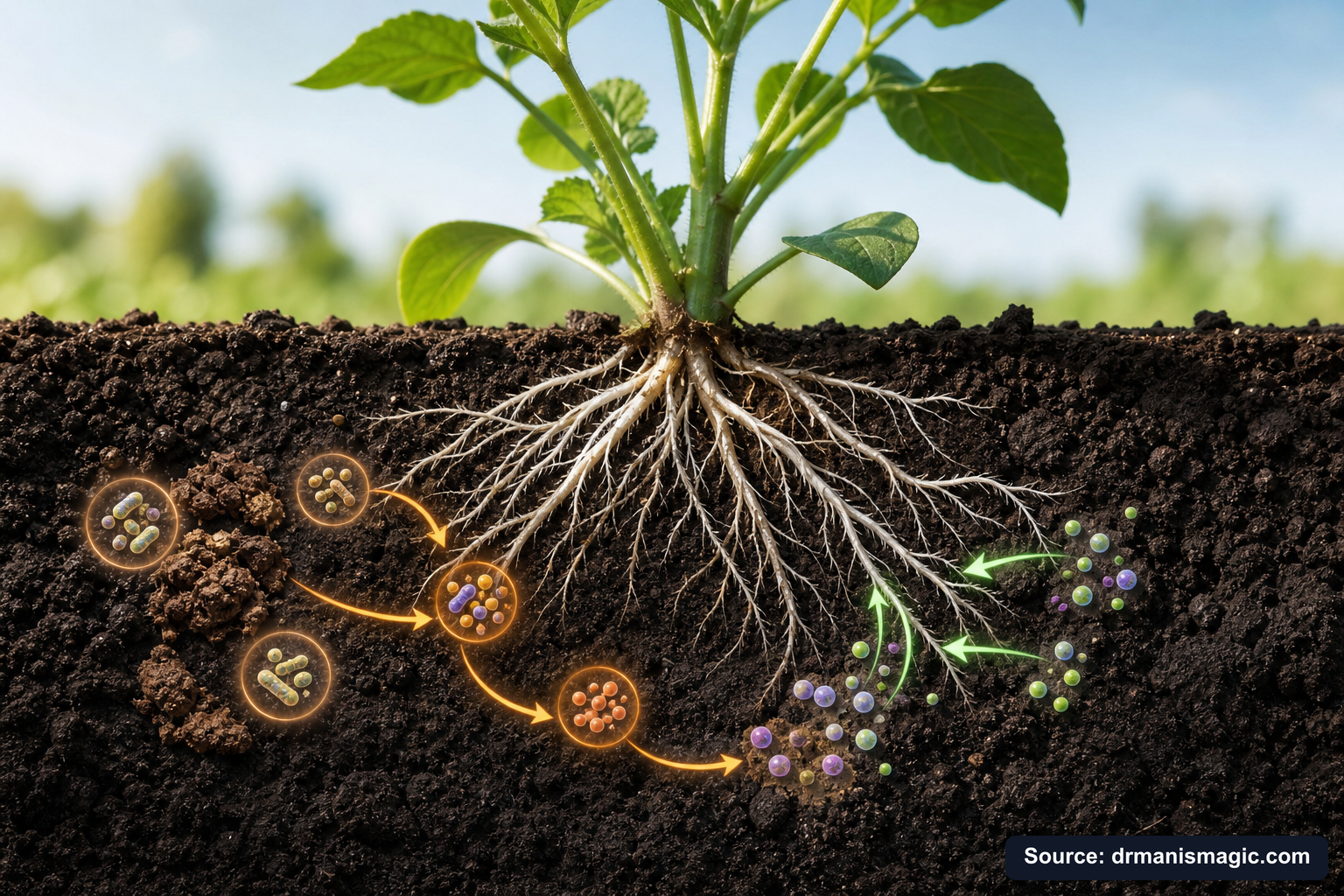
Here is how it works in plain language. You apply an organic fertilizer — something made from crab shells, kelp, feather meal, or amino acids. The microbes in your soil eat it. They digest it and convert it into simple, plant-available forms of nitrogen, phosphorus, and minerals. The plant roots absorb exactly what they need, exactly when they need it. Then, when those microbes die (which they do, naturally, as part of the cycle), their bodies release another wave of nutrition right into the root zone. It is a natural slow-release system. No timer. No plastic coating. Just biology working the way it has for hundreds of millions of years.
Now here is what happens when you apply a salt-based synthetic fertilizer instead. The salt damages and kills the very microbes running that underground factory. You get a fast surge of nutrition — the plant responds, you feel like a genius — but the factory is shutting down. The next application has to be bigger to get the same response. The cycle repeats. The soil gets more depleted. The roots get more dependent. Dr. Mani saw this pattern play out across thousands of trees at our nursery, and it never ends well for the plant.
This is why Pillar 2 of the Three Plant Pillars is microbial muscle. Not optional. Not a bonus. The foundation that makes everything else work.
What Is Osmotic Stress and How Does Salt Damage Roots at the Cellular Level?
Quick Answer: Osmotic stress happens when salt concentration outside the root cell is higher than inside. Water moves out of the cell to balance the difference, leaving the root dehydrated even in wet soil. This is called physiological drought. It weakens cell walls, invites root rot pathogens like Pythium and Phytophthora, and can permanently damage fine root tips in hours.
Roots breathe. They drink. They are alive at a cellular level, and salt is their enemy.
Every cell in a root has a membrane. Water moves through that membrane by osmosis — always from lower salt concentration to higher. In healthy soil, the concentration inside the root cell is higher than outside. Water flows in. The plant drinks. Everything works.
Now add a heavy dose of salt-based fertilizer. The salt concentration outside the root spikes. Suddenly the gradient reverses. Water flows out of the root, not in. The cell collapses a little. The root tip stops growing. Fine feeder roots — the ones doing most of the actual nutrient uptake — start to die back.
Wet, weakened roots are a welcome mat for Pythium and Phytophthora, the water mold pathogens responsible for the majority of root rot cases in container plants, citrus, lawns, and ornamentals. A plant dealing with salt injury looks almost identical to one with root rot. Yellowing leaves. Wilting despite wet soil. Slow decline. Most gardeners never connect it back to the fertilizer bag.
See also: The Hidden Reason Synthetic Fertilizers Cause Root Rot
Organic vs. Synthetic vs. Clean Organic: What Is the Real Difference?
Quick Answer: Synthetic fertilizers are salt-based and fast-acting but damage microbes and carry osmotic stress risk. Standard organic fertilizers improve on this but may still carry biosludge, PFAS, or moderate salt loads depending on the source. Clean organic fertilizers — made from verified, contaminant-free inputs like crab, kelp, and amino acids — feed the soil biology first, release nutrients slowly, and carry no synthetic salt risk or hidden contaminants.
Not all fertilizers are built the same. Here is a side-by-side look at the three main categories.
| Feature | Synthetic Fast-Release | Standard Organic (Unverified Source) | Clean Organic (Crab, Kelp, Amino Acids) |
|---|---|---|---|
| Nutrient release speed | Immediate — soluble salt flood | Moderate — depends on source and processing | Slow — microbe-mediated, steady trickle |
| Salt content / salt index | High — osmotic stress risk | Low to moderate — varies by feedstock | Very low — no synthetic salt load |
| Impact on soil microbes | Kills or suppresses microbial populations | Generally supportive but depends on source | Feeds microbes directly — builds the colony |
| PFAS / biosludge risk | Possible (some slow-release prills use plastic coatings) | Possible — especially if biosolid-derived | Zero — verified clean inputs only |
| Heavy metal risk | Possible with phosphate-sourced products | Possible with municipal compost or sludge | Minimal — traceable marine and plant sources |
| Container safety | Poor — salts accumulate fast in pots | Moderate — watch EC levels | Excellent — almost no overfeeding risk |
| Smell | Chemical or neutral | Often strong — manure, fish emulsion, anaerobic odors | Earthy — no sewage or rotting smell |
| Microbial lifecycle benefit | None — disrupts the cycle | Partial — depends on maturity and source | Full — feeds, supports, and multiplies microbes |
The column that matters most is the third one. That is the standard clean gardening inputs should be held to. Anything less is a compromise your soil will eventually pay for.
How Do You Tell Salt Damage Apart From Overwatering or True Root Rot?
Quick Answer: Salt damage, overwatering, and root rot look nearly identical above the soil line — yellowing leaves, wilting, and slow decline. The difference is in the root zone and the history. Salt damage leaves brown, dried-out root tips. Overwatering leaves soft, mushy roots. True root rot from Pythium or Phytophthora shows black, collapsing roots with a foul smell. The recovery approach is different for each.
Getting the diagnosis right is the difference between saving a plant and losing it.
| Symptom or Clue | Salt / Osmotic Stress | Overwatering | Root Rot (Pythium / Phytophthora) |
|---|---|---|---|
| Leaf appearance | Tips brown and crispy; edges scorch | Yellowing, soft, drooping | Yellowing, then rapid collapse |
| Root appearance | Brown, dry, shriveled tips | Soft, pale, waterlogged | Black, slimy, foul-smelling |
| Soil smell | Normal to slightly chemical | Stale, sour, low-oxygen | Rotting, sulfur-like, very foul |
| Watering history | Normal or even dry | Frequent, poor drainage | Often wet + compacted or bark-heavy soil |
| Fertilizer history | Recent salt-based or heavy application | Not directly related | Often worsened by prior salt stress |
| Spread speed | Slow to moderate | Slow | Fast — can collapse a plant in days |
| Recovery potential | Good if caught early and soil is flushed | Good if drainage is improved | Moderate — requires root pruning and biology reset |
If you suspect salt damage, here is a simple recovery checklist.
- Stop all fertilizing immediately. Do not add more salt to a stressed root zone.
- Flush the soil deeply. Water slowly and heavily to push accumulated salts down and out through drainage holes.
- Check drainage. If the soil is bark-heavy or compacted, it will not drain well. This is where mineral-based soil becomes critical. See: Super Soil.
- Reintroduce live microbes. A soil drench with active bacteria and fungi helps rebuild the root zone environment and suppress Pythium and Phytophthora. See: Plant Super Boost.
- Wait before feeding again. Give the root zone two to three weeks to stabilize before applying any fertilizer.
- Resume only with clean, low-salt organic nutrition. Amino acid nitrogen, chitin, and kelp-based inputs are gentle enough to use even on recovering plants.
- Watch the new growth. Healthy new leaves emerging with good color and turgor are the signal that the root zone is recovering.
You Never Had a Brown Thumb.
You were handed the wrong tools. This free guide hands you the right ones.
You watered it. You fed it. It died anyway.
It was never you. It was the dirt, the salt food, and the bad advice.
This guide shows you what really went wrong, and how to fix it for good.
- Why your plants really died, and why it was never your fault
- The salt hiding in your plant food that quietly burns the roots
- The hidden killer in almost every bag of store soil
- The tiny helpers that grow a whole forest for free
- The rescue trick that brings a half dead plant back to life

What Is Chitin and Why Does Crab Shell Matter for Plant Health?
Quick Answer: Chitin is a natural fiber found in crab and shrimp shells. When it enters the soil, microbes that eat chitin also produce enzymes that break down the cell walls of harmful fungi and root pathogens. This gives plants a natural, built-in defense system. It also provides calcium and magnesium, two nutrients critical for strong cell walls and woody growth.
There is something almost elegant about how crab shell works in soil.
Chitin is the structural material in the shells of crustaceans and the cell walls of harmful fungi. When you add chitin to your soil, a specific class of beneficial microbes called chitinase-producing bacteria multiply rapidly. They eat the chitin. But in doing so, they produce enzymes that also break down the outer walls of soil-borne fungal pathogens. The same biology that digests the crab shell fragment also attacks the disease organism trying to colonize your roots.
It is not a chemical pesticide. It does not come with a warning label. It does not require re-entry intervals or protective equipment. It is a biological cascade that nature designed over millions of years. And it works across every plant type — lawns, roses, fruit trees, houseplants, vegetable gardens. The chitin does not care what is growing above it. It just activates the defense system in the soil below.
Beyond the biological defense, crab shell brings calcium — the primary structural mineral in the woody tissue of plants — and magnesium, which sits at the center of every chlorophyll molecule. Without adequate magnesium, photosynthesis suffers. Leaves go yellow between the veins. Growth slows. The plant looks sick even when nothing is technically wrong with the soil chemistry.
What Does Cold-Processed Kelp Actually Do for Your Plants?
Quick Answer: Cold-processed kelp delivers natural plant hormones called auxins and cytokinins, along with dozens of trace minerals, carbohydrates, and biostimulants. These compounds stimulate root initiation, accelerate cell division, improve drought tolerance, and help plants respond better to stress. Heat-processed kelp loses most of these benefits. Cold processing preserves them.
Kelp has been used in coastal farming for centuries. People did not know the chemistry. They just knew that crops near the sea, fed with seaweed, grew better. Bigger. More resilient. And the science has now caught up with what those old farmers already felt in their hands.
Kelp is rich in auxins — hormones that drive root elongation and branching. More root surface area means more nutrient uptake, more water absorption, and more contact with beneficial microbes. It also contains cytokinins, which stimulate cell division in above-ground growth, helping new leaves flush out with more vigor and speed.
The trace mineral profile in kelp is remarkable. Iodine, selenium, vanadium, cobalt — elements you will not find listed on a standard fertilizer label but that play real roles in enzyme function and plant immunity. These micro-doses, delivered in a biologically available form, add up to resilience you can see and feel in your plants over time.
The processing method matters enormously here. High heat destroys hormones and degrades biostimulant compounds. Cold-processed kelp keeps those active molecules intact, which is why the processing method is not a small detail. It is the whole point.
What Do Amino Acids Do That Other Nitrogen Sources Cannot?
Quick Answer: Amino acids are pre-built protein fragments that plant roots can absorb directly without waiting for microbial breakdown. This makes amino acid nitrogen the gentlest, most efficient nitrogen source available — no salt, no osmotic spike, no microbial damage. The plant takes exactly what it needs, exactly when it needs it, in a form that also feeds the soil biology at the same time.
Nitrogen is the nutrient plants need most. It builds chlorophyll. It builds proteins. It drives every inch of new growth. But how you deliver nitrogen makes all the difference.
Synthetic nitrogen comes as soluble salt ions — ammonium nitrate, urea, and similar compounds. They flood the soil instantly. The plant gets a short burst. The microbes suffer. The salt accumulates. You get a spike, then a crash, then you have to apply again.
Amino acid nitrogen is different. Amino acids are the building blocks that proteins are already broken down into. The plant can absorb them directly through the roots, bypassing the need for microbial conversion. This means almost zero osmotic load. Almost zero salt stress. The roots drink it in gently, like water, rather than being forced to deal with a chemical flood.
And here is the part that makes amino acids special beyond just the nitrogen. Amino acids also serve as a food source for soil microbes. So applying amino acid-based fertilizer does two things at once: it feeds the plant directly and it feeds the microbial community that will keep feeding the plant long after the initial application is gone. The University of Wisconsin Extension has documented how amino acid and protein-based nitrogen sources show lower volatilization losses and more stable release patterns compared to soluble synthetic forms, making them more efficient in real-world field and container conditions.
What Are Volcanic Ash Trace Minerals and Why Do Plants Need Them?
Quick Answer: Volcanic ash deposits contain silica and a broad spectrum of trace minerals — iron, manganese, zinc, copper, boron, and more — in a slow-dissolving, plant-available form. Silica strengthens cell walls, improves drought resistance, and helps plants stand up to insect pressure. Trace minerals activate the enzyme systems that drive photosynthesis, protein synthesis, and disease resistance.
Imagine the soil around an ancient volcano. The richest farmland on earth sits near places like that — Sicily, Java, the slopes of Kilimanjaro. Farmers have known for thousands of years that volcanic ground grows extraordinary food. Now we know why.
Volcanic material is rich in silica and dozens of trace minerals that most fertilizers never mention. Silica is not classified as an "essential" plant nutrient by textbook standards, but the evidence from growers and university research tells a different story. Plants with adequate silica have stronger, thicker cell walls. Insects find them harder to penetrate. Fungal pathogens have more trouble establishing. Drought stress shows up later and recovers faster.
Trace minerals like iron, manganese, zinc, copper, boron, and molybdenum each play critical roles in enzyme function. Remove any one of them and you trigger what plant scientists call the Law of the Minimum: growth is limited by the scarcest nutrient, no matter how much of everything else is present. A plant that looks mysteriously stunted or pale despite regular fertilizing is often missing one of these trace elements — and they are almost never included in synthetic fertilizers.
Volcanic mineral inputs deliver these elements in a slow, weathering form that does not spike salt levels, does not overwhelm the root zone, and does not wash out with the next rain. They become part of the soil, slowly releasing over months and seasons, the way nature intended.
How Do the Three Plant Pillars Work Together as a System?
Quick Answer: The Three Plant Pillars — mineral-based soil, live microbes, and clean organic fertilizer — are designed to work as one interconnected system. The mineral soil provides oxygen and drainage so roots breathe. The microbes colonize those healthy roots and convert organic inputs into plant-available nutrition. The clean fertilizer feeds the microbes first, who then feed the plant in a continuous, self-sustaining cycle. Remove any one pillar and the other two underperform.
Dr. Mani Skaria did not arrive at the Three Plant Pillars from a textbook. He found them through 35 years of field work, first at the Texas A&M Citrus Center, then across more than 250,000 trees at US Citrus Nursery in South Texas.
The pattern he kept seeing was the same. A plant would struggle. Someone would add more fertilizer. The plant would look better for a few weeks. Then worse than before. The diagnosis was always chasing symptoms — yellow leaves, root rot, pest pressure — instead of building the foundation that makes symptoms rare in the first place.
The Three Plant Pillars fix the foundation.
Pillar 1: Mineral Soil. Most commercial potting mixes are built on pine bark and organic matter that breaks down within 6 to 12 months. As it decomposes, it compacts. Oxygen disappears from the root zone. Roots suffocate. Anaerobic (oxygen-starved) conditions invite root rot pathogens. Mineral-based soil — built on silica-rich sandy loam that does not decompose — stays open, drains freely, and keeps oxygen flowing to the roots indefinitely. You do not repot every year. You do not start over. The soil is permanent.
Pillar 2: Live Microbes. The right bacteria, fungi, and mycorrhizae colonize the root zone and create the living engine of fertility. They eat organic matter. They convert it. They protect roots from pathogens. They extend the root's effective reach through fungal networks that stretch far beyond what the physical root can access alone. Without this pillar, even the cleanest fertilizer sits inert in the soil.
Pillar 3: Clean Organic Fertilizer. The final piece is nutrition that feeds the microbes first and the plant second — in the right order, at the right pace, without salt, without contamination, without disrupting the biological system the first two pillars built. Amino acid nitrogen, chitin from crab shells, cold-processed kelp, and volcanic trace minerals work together as a complete nutritional system that mirrors what nature provides.
When all three pillars are in place and in sync, something remarkable happens. Plants stop struggling. They start thriving. Not because of a chemical trick. Because the conditions for growth are finally right. For the Free Plant Care Field Guide that walks you through all three pillars step by step, we have put everything in one place.
How Do You Choose a Fertilizer and Compost That Are Actually Clean?
Quick Answer: Ask five questions before buying: What is the feedstock source? Has it been tested for PFAS and heavy metals? What is the salt index or EC? Does it contain biosolids or municipal waste? And does it support or damage soil biology? A truly clean input will have transparent answers to all five. If the label cannot answer them, the manufacturer probably does not want you to ask.
Here is a practical checklist you can use in any garden center or when buying online.
- Source transparency. Where did the nitrogen come from? Crab, feather meal, kelp, and plant-based amino acids are traceable. "Organic nitrogen" with no further detail is not.
- Biosolid status. Does the product contain "biosolids," "Class A biosolids," "municipal compost," or "wastewater treatment byproducts"? These phrases mean sewage sludge. Walk away.
- PFAS and heavy metal testing. Has the product been tested? Can the company provide documentation? This is a simple yes or no question. If they cannot answer it, that tells you something.
- Salt index / EC risk. Poultry litter, blood meal at high rates, and certain concentrated manures can carry meaningful salt loads. Check application rates carefully, especially for containers.
- Microbial compatibility. Does the product work with soil biology or against it? Clean organic inputs feed microbes. Salt-based inputs damage them.
- Smell test. A fermented or rotting smell is a sign of anaerobic decomposition — fine for outdoor compost, but a problem for containers and indoor plants. An earthy smell means stable biology.
- Feedstock maturity. Fresh manure and immature compost can burn roots and carry pathogens. Look for fully composted, heat-treated, or stabilized inputs.
This is not an exhaustive regulatory framework. It is a practical filter you can use in five minutes before you hand over your money. See also: Why Most Fertilizers Are Actually Salt in Disguise
Why Does Time Matter More Than Any Other Factor in Gardening?
Quick Answer: Money can be replaced. Time cannot. Every year spent on the wrong inputs — salt-based fertilizers, contaminated composts, bark-heavy soils — is a year your plants spent stressed instead of thriving. The most common thing gardeners tell us is they want to see fruit on a tree they planted while there is still time to enjoy it. The right foundation makes that possible. The wrong one quietly steals the years.
There is a moment that happens at every gardening talk Dr. Mani has ever given. Someone raises their hand and says some version of the same thing. "I planted a tree years ago. I just want to see it bear fruit while I still can."
It is not a small request. It comes from somewhere deep. The desire to nurture something. To see it through. To hold the fruit in your hand and know that you grew it. That instinct is ancient. It is good. And it deserves to be honored with the truth about what actually makes plants grow fast, strong, and fruitful.
The truth is that the wrong inputs do not just cost money. They cost seasons. A salt-damaged root zone does not recover in a week. A soil stripped of microbial life does not rebuild itself in a month. A plant locked in bark-based potting mix that has compacted and gone anaerobic is fighting for its life every single day, and it is losing slowly. You might not notice for a year. But when you do notice, the time is already gone.
That is the real cost of the old way. Not the price of a bag of fertilizer. The seasons. The years. The harvests that never came because the foundation was wrong from the start.
The best time to build the right foundation was the day you planted. The second best time is today.
If this reframed how you think about what goes into your soil — and what "organic" actually means on a label — we built a complete guide to walk you through the Three Plant Pillars from the ground up. Every plant you own, from a single houseplant to an acre of lawn, deserves inputs you can trust. Start with what we know works, tested across 250,000 trees, proven in South Texas heat, and backed by a 30-day money-back guarantee. Visit the Three Plant Pillars system and see exactly what clean fertility looks like in practice.
Frequently Asked Questions
The word "organic" on a fertilizer bag sounds safe. It sounds clean. But after growing more than 250,000 trees in South Texas, Dr. Mani learned that the label can hide some ugly surprises. These are the questions every plant owner should be asking before they feed their soil.
Why does "organic" on a fertilizer bag not always mean it is clean or safe?
"Organic" is a sourcing label. It tells you the ingredient came from something that was once alive. That is it. It says nothing about salt levels, heavy metals, PFAS contamination, or whether the product will protect your soil's living microbes. Treated municipal sewage sludge is technically organic. So is cold-pressed kelp. The label does not tell you which one you are getting. Always ask what is actually in the bag.
Can organic fertilizers still burn plants or hurt soil?
Yes. Fertilizer burn is a salt and osmotic stress problem. Some organic inputs carry high salt loads that pull water away from roots and wipe out the beneficial bacteria and fungi living in your soil. Those microbes are not a bonus feature. University of Minnesota Extension research shows healthy soil biology supplies roughly 75 percent of plant-available nitrogen. Destroy the microbes and you shut down the engine that feeds your plants.
What is biosludge and why does it matter to gardeners?
Biosludge is the solid byproduct left over after treating municipal wastewater. It contains what you would expect from city pipes, including heavy metals, pharmaceuticals, and PFAS forever chemicals. Some of it gets processed and sold as organic fertilizer. It meets the sourcing definition of organic because it came from a biological source. It does not meet any reasonable definition of clean. Read the ingredient list before you put anything near your food garden or your lawn where your kids and pets play.
Does organic fertilizer mean there are no pesticides or chemicals involved?
No. Organic certification covers how an ingredient was sourced, not what contaminants may have traveled along with it. Some organic composts test positive for PFAS chemicals that bind to soil for decades. Some contain residues from the crops or animals they came from. Clean inputs mean no biosludge, no synthetic salts, no hidden fillers, and no PFAS. That is the standard Dr. Mani's Magic holds every ingredient to, including the crab, kelp, and amino acids in our fertilizer.
Why do some organic fertilizers smell terrible and what does that mean for your plants?
That rotten smell is a warning sign. It usually means the product has gone anaerobic, meaning the beneficial microbes have died and decomposition is happening without oxygen. Fish emulsion is a common example. It can make pets sick and make your garden unpleasant for days. Dr. Mani's Magic fertilizer and Plant Super Boost use stabilized, living microbes that smell like clean earth because they are not rotting. If your organic product smells like sewage, it is not helping your soil biology.
What should I actually look for in a clean organic fertilizer?
Look for slow-release ingredients from known, traceable sources. Dr. Mani's Magic uses crab shells, cold-pressed kelp, and amino acids. These release nitrogen, phosphorus, and potassium gradually without salt spikes. They feed the soil microbes instead of killing them. That matters because healthy microbes unlock nutrients, fight disease, and build long-term soil strength. Quick-release organic products with mystery ingredients or biosludge base materials do the same damage as synthetic salt fertilizers, just with a friendlier label.
How do the Three Plant Pillars make sure your fertilizer actually works?
Clean fertilizer alone is not enough. It needs two partners to work the way nature intended. Pillar One is mineral-based soil that drains well and lets roots breathe. Pillar Two is live microbes that convert organic matter into food plants can actually use. Pillar Three is clean organic fertilizer that feeds both the plant and the microbial life in the soil. Miss any one of these and the other two underperform. All three together, proven across 250,000 trees at our South Texas nursery, is what makes plants bulletproof.
About the Author
Ron Skaria, MD
Ron Skaria, MD, is the co-founder of Dr. Mani's Magic and the son of Dr. Mani. He trained as a medical doctor at Baylor College of Medicine, did his residency at UT Health Science Center - San Antonio and fellowship training at Texas Tech University. He now works full time on the family farm at US Citrus and US Citrus Nursery in Hargill, Texas, building Dr. Mani's Magic alongside his dad. He wrote the Brown Thumb Field Guide to put his father's 48 years of plant science into plain words any gardener can use. His belief is simple. You never had a brown thumb. You just never had the right help.


